Primate Fear
Primate Fear Rulebook
Table of Contents
Table of Contents
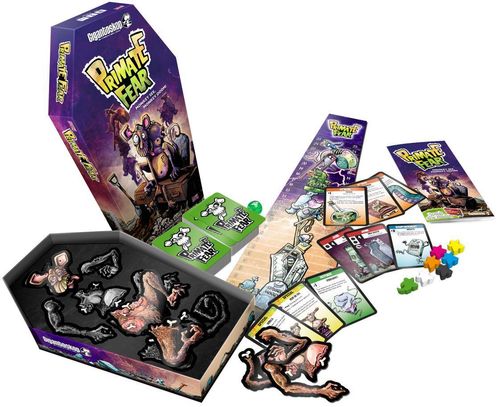
Components
- 120 cards: all the interesting things you can find at the dump at night.
- 6 coloured player tokens, one for you and each of your friends.
- The Primate token: it is already looking for you.
- The height track board: it shows which player is where.
- 7 Primate body parts: when they gather together, you had better be far away!
- The Primate assembly board.
- A die for tricky situations.
- These rules (what you are holding in your hands).
Object of the Game
Players build towers of garbage to keep away from the Primate. At the same time they try to make their towers taller than the other players' towers, so that the Primate reaches the opponents first and removes them from the game. The last player remaining in the game, while all the others have been eaten, wins.
If the deck runs out of cards, or the Primate eats all the remaining players at the same time, the Primate wins.
Setup
- Place the height track board in the centre of the table. Each player chooses a token and places it on height 0.
- Place all the Primate body parts on one side of the height track board. Place the Primate assembly board and the Primate token on the other side of it.
- Shuffle all the cards together to form one deck and deal five cards to each player.
- Place the deck where everyone can reach it. Leave space next to the deck for a discard pile.
- Decide who goes first by rolling the die.
The Primate
When a card with the Primate body-part symbol is played, take a new Primate body part and place it on the Primate assembly board. When all seven body parts have been moved to the assembly board, the Primate comes to life. After this, place the Primate token on height 1 of the height track board.
If a body part is played at a moment when the Primate is already on the height track board, move the Primate token one step up. It climbs after you.
As soon as the Primate has been assembled, it begins to eat players, moving at the end of each player's turn. If a body part is removed from the assembly board, the Primate stops. It will not eat players and will not move at the end of each player's turn until all of its body parts are again together on the assembly board.
The Primate cannot climb above height 25 or below height 0. Any player on a height greater than 25 is safe from the Primate.
Turn Order
On your turn, carry out these steps in order:
- Draw cards. If you have four or fewer cards in hand, draw two cards. If you have five or more cards in hand, draw only one card.
- Construction. Make your tower taller with one garbage card. You may also reinforce it with one reinforcement card in the same turn.
- Attack. Attack your opponents with attack cards. Your opponents may defend themselves with defence cards.
- Primate's turn. The Primate moves up one step. All players who are on the same height as the Primate, or lower, are eliminated from the game.
- Discard cards. You may discard up to two cards to the discard pile without using them.
Drawing Cards
Take cards from the deck. If you have four or fewer cards in hand, take two cards. If you already have five or more cards in hand, take only one card. There is no limit on the number of cards you may hold in hand.
Construction
You can make your tower taller by placing a garbage card on its top. You can also strengthen your tower by placing a reinforcement card on your top garbage card.
In one turn you cannot play more than one garbage card and one reinforcement card, but you can play them in any order you like. This means you can play a reinforcement card onto your top garbage card first, and then make the tower taller with a new garbage card. More than one reinforcement card may lie on a single garbage card.
Height
Your height depends on the total height of the garbage cards in your tower. Each garbage card has a height scale with a different number of dots on it (●). This number shows the height of that card. You are always at the very top of your tower. When the height of your tower changes, do not forget to move the corresponding tokens on the height track.
Example: If your first garbage card is the "Guillotine" with two height points on it, you are on height 2 (see Figure 1). If your next garbage card is the "Mysterious Van" with three points, you rise to height 5 (see Figure 2).
Phantom Height
If a height point is shown inside a white circle (○) instead of a fully black dot (●), it is called a phantom height and has a condition that must be fulfilled. While that condition is not met, this point does not add to the height of the tower. As soon as the condition is met, the point starts to add to the height of the tower.
Strength
The stability of your towers depends on the strength of your garbage cards. Each garbage card has a strength value (shown by the number in the icon) that shows how stable it is. If you play a reinforcement card on a garbage card, the strength of that garbage card increases.
Example: The garbage card "Mysterious Van" has a strength value of 3. If you play the reinforcement card "Giant Web", which adds +2 to strength, you raise the strength of the "Mysterious Van" to 5 (see Figure 3).
Effects
Some garbage cards and reinforcement cards have additional effects. These effects are usually not repeated; they arise when you play the card. If an effect can be repeated, this is stated separately on the card.
Categories
Each garbage card belongs to one of several categories: furniture, contraband, or organic. Some cards can affect these categories, which means they act on many garbage cards at once.
Moving Garbage Cards
If a garbage card is moved to another place within the same tower, into another tower, or anywhere else, its reinforcement cards always move together with it.
Attack
To stop your opponents from defending themselves against the Primate, you may attack them with attack cards. Such cards act mainly on your opponents' garbage cards, but not always. Your opponents may find defence cards that stop or hinder your attacks.
You may play as many attack cards during your attack phase as you like, but play them one at a time. For each attack card, choose the opponent it will attack.
There are three different kinds of attack: close, distant and hidden.
- Close attack: You may attack only those cards that are at the same height as you. A close attack is always made from the very top point of your tower. Count the points on your garbage cards to find out what height you are at. Then count the points on your opponent's tower; this tells you which of its garbage cards you can attack. If you are higher than your opponent, you cannot attack any of his garbage cards. If your tower contains no garbage cards, you can attack only the bottom garbage card of your opponent's tower.
- Distant attack: You may attack any garbage card in your opponent's tower, regardless of your height.
- Hidden attack: Using a hidden attack, you can attack your opponents in different ways. Each hidden attack card has text explaining how that attack works. If a hidden attack card has no attack bonus, defence cards that lower the attack value cannot be used against that attack.
To succeed in an attack against a garbage card, you must roll on the die a number greater than or equal to the strength of that garbage card (including its reinforcement cards). Attack and defence cards may change the results of such rolls.
Resolving an Attack
- Play an attack card and declare which garbage card you are attacking.
- Calculate the total strength of your target. To do this, add the strength of all reinforcement cards attached to the garbage card to the strength value of the garbage card.
- Your opponent may play one or several defence cards that affect your roll, usually reducing its result. Unless the card says otherwise, defence cards must be played before you roll the die.
- Roll the die. Add the attack bonus from the attack card to the roll result and subtract the bonuses from defence cards.
If the result is equal to or greater than the strength of the target, the garbage card and the reinforcement cards attached to it are destroyed. Such cards are removed from the tower and discarded. If the result is less than the strength of the target, nothing happens. If the die shows 1, the attack always fails, no matter how large your attack bonus is. Used attack and defence cards are always discarded, whether the attack succeeded or failed.
- If the height of any player on the height track has changed, move that player's token to the corresponding height.
Some attack cards have a special condition which, when met, gives an even bigger bonus. Either way, an attack card has only one bonus: either a weaker one or a stronger one.
Example: You use the "Burning Pumpkins" (they add +4 to the attack) to attack your opponent's "Lighthouse" (strength 5), to which a "Tapestries" reinforcement card is attached (adding +1 to strength). Your opponent uses the "Spirit Board" (-2 to defence) as a defence. For the attack to succeed you must roll 6 on the die (5+1), but since your roll gets a bonus of +2 (+4-2), it is enough to roll 4.
Self-Attack
The only way to remove cards from your own tower is to attack your own tower. Such attacks proceed as normal, and you may play defence cards against your own attack cards if you suddenly want to.
Collisions (When Your Tower Falls)
When a garbage card is destroyed, a hole may appear in your tower. In this case, the garbage cards and reinforcement cards above the hole fall onto the garbage card located directly beneath them, or onto the ground. This is a collision. You must roll the die for the two colliding garbage cards (or for only one garbage card, if the collision is with the ground). In any case, you roll the die only once, even if two garbage cards collide.
Roll the die. If the result is equal to or greater than the strength of the garbage card (together with its reinforcement cards), the garbage card and its reinforcement cards are destroyed and discarded. In this way new holes may appear, and even more cards fall down, so you must roll the die for a collision again. This continues while there is something left to fall, and it stops when there is nothing to fall, or when the garbage cards involved in the collision were not damaged as a result.
Whatever the height of your tower becomes, do not forget to move your token to the corresponding height on the height track.
The Primate's Turn
At the end of each player's turn, the Primate rises one step up, if it is fully assembled. All players who are on the same height as the Primate, or lower, are eaten and no longer take part in the game. Discard the cards in their towers without applying any effects from those cards, and remove all long-term special cards of the eaten players.
If the Primate is not fully assembled, it will neither move nor eat players.
Discarding Cards
If you wish, you may discard up to two cards from your hand to the discard pile without using them.
Special Cards
The game contains many special cards. Each special card states at what moment you may use it and what effect it has. When you have played a special card, it is discarded to the discard pile, unless it is a long-term special card (marked with the ∞ symbol). A long-term special card stays in play until the conditions for its discard are met.
Conflicting Cards
Sometimes the effects of cards will contradict each other. Such conflicts are resolved as follows:
- Follow the game rules.
- If a card's text contradicts the game rules, the card's text takes precedence.
- If two cards contradict each other, the card that was played last takes precedence.
Card Overview
Garbage card (red header):
- Card type.
- Height: the number of height points on the card.
- Phantom height: height points shown inside white circles (see Phantom Height above).
- Primate body part symbol.
- Name and category.
- Effect.
- Strength.
Reinforcement card (blue header):
- Card type.
- Strength bonus.
- Primate body part symbol.
- Special strength bonus.
- Name and effect.
Special card (multicoloured header):
- Card type.
- Long-term marker (∞), if the card is long-term.
- Name and when it is played.
- Effect.
Attack card (orange header):
- Card type.
- Attack bonus.
- Special attack bonus.
- Name and attack type (close, distant or hidden).
- Effect.
Defence card (green header):
- Card type.
- Defence bonus (a negative number lowers the attack roll).
- Special defence bonus.
- Name and effect.