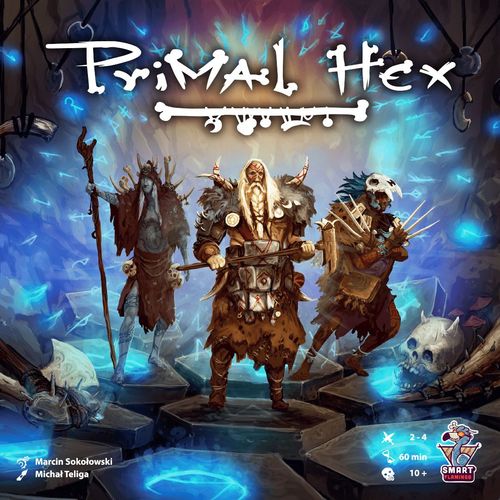
Primal Hex
Primal Hex Rulebook
Table of Contents
Table of Contents
Game Components
- 80 faction hexes (40 double-sided red and blue and 40 double-sided green and yellow)
- 10 terrain hexes (mountains)
- 4 player screens
- 12 Warchief cards
- 12 Advisor cards
- 13 Strength tokens
- 8 Season cards
- 54 Tactic cards
- 40 dice: 10 blue, 10 yellow, 10 green, 10 red
- 24 Order tokens (6 blue, 6 red, 6 green, 6 yellow)
- 4 Victory Point markers (red, yellow, blue, green)
- First player marker
- Turn token
- Board (rubber playmat)
- Rulebook
Game Setup
Start by Preparing the Common Parts
- Put the board in the centre.
- Draw or select a scenario for this game (for the first game, we suggest the scenario marked (S) on the card).
- Set up the terrain hexes as shown on the scenario card.
- Shuffle the Seasons deck, draw three cards and place them in order on the season track.
- Shuffle the Tactic deck and place it next to the board.
- Choose or select by random a tribe for each player.
- Prepare the hexes in the colours of the tribes participating in the game.
- Randomly select the First Player.
Then Each Player Prepares Their Tribe
- Take the player screen, 10 dice and 6 order tokens in the colour of your tribe.
- Place a Victory Point marker in your colour on "0" of the victory track.
- Shuffle your Warchief deck and your Advisor deck separately, draw 3 cards from each of them, and select one Warchief and one Advisor at the same time. Place both cards in front of you — the Warchief face up and the Advisor face down. Return the remaining cards to the box.
- Take Strength tokens in number equal to your Warchief's Strength.
- Draw cards from Tactics deck in number equal to your Warchief's Cunning. Select 6 of them to keep and shuffle the rest back into the deck.
- Starting with the First Player, take hexes in number equal to your Warchief's Influence and place them on the board. All of them must be placed within the Starting Territory — defined for each tribe in the scenario (see section at the end of this rulebook).
A Strength Token can be used at any time to add / subtract 1 from the value of one chosen die. Strength Tokens are single-use and do not replenish.
Goal and Spirit of the Game
The aim of the game is to score the most Victory Points. At the end of the sixth turn, the player with the most Victory Points is the winner.
Note on the draft: the introduction on page 3 says the game ends at the end of the third season, while this page says the end of the sixth turn. Both are transcribed as printed.
Players Earn Victory Points in Several Ways
- "Harvest" order — by "collecting" points from adjacent friendly hexes;
- Seasons — a variable scoring condition during the game;
- Advisors — providing bonus points at the end of the game;
- Other effects — some cards and characters can be a source of additional points.
Key Concepts and Features in the Game
Orders
Orders are the most important mechanic of Primal Hex. Each order has a cost (expressed in successes) and an effect. You can pay a multiplication of an order's cost to multiply its effect.
Order Mechanics
You can pay 2 successes for an order — in this case, it has no effect. This allows you to tacticly execute a "void" order and skip your turn to see what your opponents will do.
The order activation sequence is as follows:
- Select an order.
- Reveal it if it was face down.
- Declare how many successes you are spending on it.
- Remove the declared successes (they are "used up" in this turn).
- Set the order's targets (if required), i.e. the hexes you are attacking.
- Execute the effect of the order.
- Remove the order token from the board (exception: Fortify).
Attack
- Cost: 1 success.
- Effect: Take over one hex adjacent to this order.
Charge
- Cost: 2 successes.
- Effect: Take over two hexes in a straight line.
You cannot Charge through terrain hexes or your own hexes. Both hexes targeted by the order must meet these conditions for the charge to be declared.
A charge is always counted from the hex with the order, so paying 4 successes will result in capturing two hexes in a straight line from the order and two other hexes in a straight line, also counting from the hex with the order.
Shoot
- Cost: 3 successes.
- Effect: Take over one hex that is 2 hexes away from this order (there has to be one hex between the order and the target of the attack).
You can Shoot over terrain hexes and your own hexes.
Pray
- Cost: 2 successes.
- Effect: Destroy one enemy hex without an order OR move a terrain hex to an adjacent free space.
Both Pray effects can be combined freely, remembering that 2 successes must be paid each time. The range of this order is unlimited, so its target can be any hex on the board.
Important! "Destroy" vs "Take over" — if the effect requires destroying a hex (as in the case of the Pray order), it is simply removed from the board. Taking over a hex replaces it with a hex of your colour.
Fortify
- Cost: 0 successes.
- Effect: This hex cannot be destroyed or taken over.
Fortify is a passive order, which means that it works regardless of whether it is face up or face down. When an attempt is made to destroy or take it over, the owner of the order reveals it (if it was not already revealed), the attack fails, and the opponent loses their declared successes.
The Fortify Order is not removed from the board when activated, but only during the Cleanup Phase.
Harvest
- Cost: 4 successes.
- Effect: Gain 1 Victory Point for each friendly hex adjacent to this order (max once per turn).
The effect of the Harvest order can't be multiplied, which means that you cannot spend 8 successes to harvest twice.
Hexes
Hexes symbolise parts of the mythical land of Viray, which is being fought over by tribes. Through the effects of orders or cards, players will take over these regions by marking them on the board with a hex of their colour. There are three types of hexes in the game:
- Neutral — not occupied by any player, i.e. empty.
- Occupied — taken over by a given player.
- Terrain — a natural obstacle. Players cannot capture terrain hexes, but they can move them using Pray order.
Warchiefs and Advisors
Warchiefs
- Name (and usually a nickname).
- Unique ability — the strategy that a given Warchief follows. A Warchief's ability is active throughout the game and usually significantly modifies one of the game rules.
- Strength — determines how many Strength tokens the Warchief will have at the beginning of the game. Strength tokens are single-use and do not refresh (unless through a card effect).
- Cunning — which shows the Warchief's wit and combat skills. This translates into the number of Tactic cards from which the player will choose their hand for a given game.
- Influence — determines how much respect the Warchief inspires among their tribe. In the game, the Influence value indicates with how many hexes on the board the player will start the game.
Advisors
- Name (and often a nickname).
- Secret objective — At the end of the game, each player receives additional Victory Points for fulfilling this objective.
- Reveal effect — The Advisor card remains face down at the start of the game, but by using the Reveal Effect at any time, the player may turn it over to gain a one-time effect. Revealing the Advisor causes the other players to know what Secret Objective the player has which can allow them to counter it.
Dice and Successes
The dice are a key element of the game — each turn, players roll ten dice in their colour and use successes to "pay" for the cost of orders — a success is a roll of 4, 5 or 6 (often referred to as 4+). Players will be able to influence the results of the dice rolls, by rerolling or modifying the results of some of them to help them carry out their plans more effectively.
Dice pool: the number of dice available to the player. This will almost always be 10, but there may be situations where the dice pool is reduced. In this case, dice outside the pool do not participate in the game and cannot be used, changed or re-rolled. The dice pool can never exceed 10.
Bad luck protection: during the Preparation Phase, if the dice roll is particularly unlucky, the player may discard one die from their pool and roll all nine remaining dice again. If the result of the roll is still not satisfactory, they may discard one die from their pool and roll again (now with eight dice) — and so on until the result is satisfactory. Important: discarded dice are removed from the pool (see above) — they are no longer used in the game. However, they will return to the player at the end of that turn.
Stretch Goal
Printed in the rulebook as a note on future content:
As one of the first stretch goals we plan to add 4 player boards with upgraded dice mechanics!
Manage the fate! No more bad luck in dice! Use all the results on dice to plan, conquer and destroy the enemies!
This will be a mini expansion coming along with 4 player boards that help you organise the dice. New mechanics for dice management will bring the gameplay to the next level! You will be able to use all the dice to fuel up the orders or to hide them and to perform rituals.
Now it's only up to you to win the battle!
Game Flow
Each of the six rounds of the game consists of six phases, some of which will take place simultaneously for all players, and some in order starting with the first player and continuing clockwise.
1. Preparation Phase
Simultaneously, each player rolls 10 dice. The results 4, 5 and 6 are successes – it is a good idea to separate them from the other dice, as they will be used by players to "pay" for carrying out orders.
2. Tactics Phase
At the same time, each player chooses a Tactic card and places it face down in front of them.
3. Order Phase
Players place three orders on their hexes – two of them must be face down, one face up. Orders are placed one at a time, starting with the first player.
4. Reveal Phase
All players simultaneously reveal their previously selected Tactic cards. Their effects are applied immediately in turn order.
5. Action Phase
Players activate their orders by paying for them with successes on the dice (4,5,6). Orders are activated one at a time, in turns order. The active player selects an order to activate. After resolving it, remove it from the board and return it to that player's pool.
6. Cleanup Phase
- players discard used Tactic cards,
- unused orders return to their owners,
- the turn token moves forward one space on the turn track,
- the First Player marker is passed to the next player in order.
Additional and Detailed Rules
Order Costs
Effects that affect order costs accumulate simultaneously — both those that reduce and those that increase the cost. Note that if the base cost of an order is modified, it also modifies it's multiplication (meaning that you're paying the multiplication of modified cost). The cost of a command can never be less than 0.
Distance
Distance X indicates how many "steps" or "jumps" must be made from a given hex.
Protection from Elimination
In the game, it is not possible to eliminate a tribe completely. The last hex of a player on the board is treated as if it had a Fortify order. When the player gains new hexes, this effect disappears.
Board Edge
The line of edge horizontal and vertical hexes forming the "border" of the board.
Board Centre
The hex in the centre of the board marked with a special symbol.
Strength Token Limit
The STRENGTH characteristic of the Warchief is only used to determine the initial number of tokens and does not represent a limit on Strength during the game. Players MAY have more Strength tokens than their Warchief's Strength.
Starting Scenarios
The draft presents the starting scenarios as board diagrams only, one per player count. The starting hex layouts are shown in the diagrams and are not reproduced here as text.
For 2 Players
Board diagram (see page image).
For 3 Players
Board diagram (see page image).
For 4 Players
Board diagram (see page image).