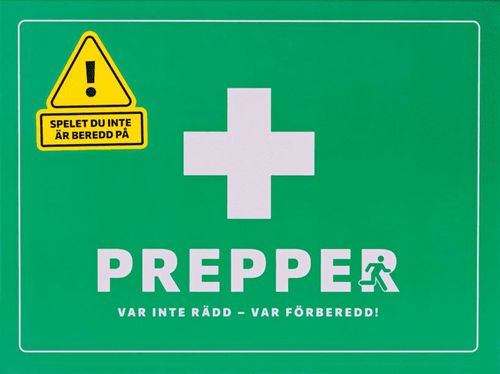
Prepper
Prepper Rulebook
Table of Contents
Table of Contents
Game Contents
- 1 game board
- 4 prepping stash / Bug Out Bag player boards
- 8 game pieces
- 4 plastic feet
- 4 reminder cards
- 1 rulebook
- 1 shelf
- 100 tiles with items and abilities
- 5 joker tiles
- 4 MacGyver coins
- 200 prepping cards
- 4 crisis folders
- 1 poster
- 240 crisis cards, divided across 4 scenarios:
- 60 × Lost in the Forest
- 60 × Storm
- 60 × Pandemic
- 60 × Infrastructure Collapse
The booklet's "Find in the booklet" index refers to: the Prepping phase (page 3), the Crisis phase (page 7), MacGyver coins (page 9), Help! (page 9), Bug Out (page 10) and Frequently Asked Questions (page 11).
Overview
Spara regelhäftet! ("Keep the rulebook!")
You were born ready. Now it's time to prove it.
Prepper consists of two parts: the Prepping phase and the Crisis phase. You need to build the game board before each phase.
How to Win Prepper
The game is over when you have got through the whole crisis and all cards on the game board have been used up. Then unfold the leaflet, read how the crisis ends and hand out any bonus points.
The winner, and the table's true survivor, is the player who has come furthest on the game board when the game is over.
Prepping Phase
Setup
-
Lay the game board on the table.
-
Each player places a player board in front of them with the stash face up, and one reminder card.
-
Shuffle the prepping cards and place as many cards as there are players on each of the nine green prepping spaces before the crisis line, i.e. 2–4 cards per space. These are your prepping cards.
Number of players – number of prepping cards:
- 2 players – 18 cards
- 3 players – 27 cards
- 4 players – 36 cards
-
Each player chooses a game piece and places it on the start space of the game board. Place the joker tiles so that you have them within easy reach.
-
Each player randomly draws five tiles from the bag and places them in their prepping stash, picture side up. Everyone may see everyone else's stash.
-
Place the shelf (the wooden tile holder) next to the game board. Draw ten tiles and place them on the shelf. The shelf must always hold ten tiles: when a tile is taken, it is replaced with a new one from the bag.
NOW YOU ARE READY FOR THE PREPPING PHASE!
Figure captions (printed in the rulebook): A) One player board and reminder card each. B) One prepping card per player on the 9 spaces. C) Game pieces on the start space. D) Five randomly drawn tiles on each player board. E) Ten randomly drawn tiles on the shelf.
Prepping Phase Sequence
-
The player who most recently held a roll of duct tape (silvertejp) starts. Play then passes clockwise.
-
A turn consists of three steps:
Step 1: Answer a question / perform a mission. The player to the left of the active player takes the top card from the current space and reads it aloud. The active player tries to answer the question or perform the mission, and on success receives points or tiles. Each time you receive points, move your game piece forward that many steps. Each time you receive a penalty (negative points), move your game piece backward that many steps. Read prepping cards are used up and set aside. Each time a tile is taken from the shelf, the shelf is refilled with a new tile from the bag.
Note: Some missions invite you to be creative. Feel free to think outside the box and stretch your imagination, but respect your surroundings and remember that honesty lasts longest. Don't be afraid to challenge your fellow players, but don't go too hard, as you may need their help later in the game.
Once you have received an item, you may assume that you also know how to use it correctly: you know how to connect your generator, keep the axe sharp, get a camp stove going and so on.
Step 2: The card reader receives a tile from the shelf. The card reader chooses any tile from the shelf for their stash, reads to themselves what is written on it, and refills the shelf with a new tile from the bag.
Step 3: Trade? You may offer one item to the other players for trade. All items can be traded for each other, but you may only offer one (1) item and receive one (1) item in exchange.
-
The turn passes on. Play continues clockwise until all nine rounds are complete, the spaces on the board are empty of cards, and you have reached the dreaded crisis line.
Tiles
Tiles are items and abilities that you collect into your prepping stash. At the start the bag contains 100 tiles, of which 95 are items and 5 are abilities.
The tile examples printed in the rulebook are: EXTRA FUEL (item), FIRST AID (ability) and JOKER (joker tile).
Items go into your prepping stash and can be used directly. Items come in different sizes for different uses. Items are tiles with information on the back. Each item has a weight (shown by a symbol on the tile): 0kg, S, M or L.
Your prepping stash has no maximum number of items, but your Bug Out Bag does (see Bug Out below).
Abilities differ from items: they take time to learn to use, and they cannot be traded or lost. The five abilities you can learn are: Hunting and Fishing (Jakt och fiske), Peak Condition (Toppform), Electricity and Water (El och vatten), Communication (Kommunikation) and First Aid (Första hjälpen).
Abilities are blue on the front. Instead of putting an ability into your stash as soon as you receive it, you must place it on the game board three prepping spaces further ahead. For example, if you are on space three, you place the ability on space six (see the figure below). When you reach space six you have learned the ability and place it in your prepping stash.
This means that at the latest you can choose a tile with an ability on space six; after that you do not have time to learn it before the crisis strikes. If there are abilities on the shelf, or if abilities are drawn to the shelf after space six, they are replaced.
Figure caption (printed in the rulebook): HOW YOU LEARN AN ABILITY. "You are here" is the current space. The ability is placed on the space three prepping spaces further on. When you get there, you receive the ability.
Joker tiles – In some cases a prepping or crisis card may reward you with a certain item when you have succeeded with an event. For example, you may be rewarded with EXTRA FOOD for helping a neighbour. If no other player has that item, look for it in the bag or on the shelf. If another player already has the item, take a joker tile instead. This tile now represents EXTRA FOOD for the rest of the game. Joker tiles become the item for the rest of the game, and a joker tile cannot be used for any other purpose.
Booklet box (printed in the rulebook): Rules film. It can be a lot of information to take in, so it is easy to forget useful tips and advice. Check the game's rules film (scan the QR code with your mobile phone) to make sure you have understood everything.
Crisis Phase
Now it strikes: the crisis. The prepping phase is over and you will receive no more tiles unless a crisis card explicitly says so. Instead you will now need to rely on your prepping stash and your ingenuity to get through the crisis unharmed.
Crisis Phase Setup
-
Empty the tiles from the shelf back into the bag. The crisis phase is played without the shelf.
-
Choose which scenario you will play; each scenario is a possible crisis that may strike you. Place the folders you want to choose from face down on the table, shuffle them and choose one.
-
Shuffle the crisis cards. Place one crisis card per player in each of the eight scenario spaces along the crisis line, i.e. 2–4 cards per space. These are your crisis cards.
Number of players – number of crisis cards:
- 2 players – 16 cards
- 3 players – 24 cards
- 4 players – 32 cards
-
Each player takes one MacGyver coin.
Crisis Phase Sequence
-
One player reads the crisis introduction aloud. Be careful not to accidentally read the scenario's ending now! Then make any changes the scenario tells you to make, e.g. discarding items or turning over your Bug Out Bag.
-
The player to the left of you takes the top crisis card from the first crisis space and reads it aloud. You now try to solve the card's event. This can be done in the following ways, in this order:
a) Follow one of the solution proposals on the card. If you have the item or ability that a solution requires, you have dealt with the event and receive the solution's reward. You also keep the item you used, unless it says otherwise.
b) Trade items with other players to get what you need to succeed with a solution.
c) Test your own solution to the problem by "MacGyvering" (see MacGyver Coins below).
d) Ask your fellow players for help to get you out of the problem (see Help! below).
e) If you do not succeed in solving the event, you receive the card's penalty, which means you lose points (steps) or items. Lost items are returned to the bag.
-
The crisis card is used up regardless of the outcome.
-
The game continues: the next player on turn reads the next card from the first crisis space, and so on.
-
Play continues clockwise until all eight crisis spaces are empty of cards and the crisis is over. Now you read the crisis ending in the leaflet, hand out any bonus points, and see how far everyone has come on the game board.
The winner is the player who has come furthest on the game board when the scenario is over!
Do You Get Points or a Penalty?
The card's solutions are checked in this order (the flowchart in the rulebook):
- Do you have what the card's solutions require? YES leads to the REWARD. NO moves on to the next question.
- Can or will you trade yourself into what a solution requires? YES leads to the REWARD. NO moves on.
- Do you succeed in MacGyvering? YES leads to the REWARD. NO moves on.
- Do you get help if you ask for it? YES leads to the REWARD. NO leads to the PENALTY.
Note on the flowchart: the arrows are reproduced as read from the printed page; each YES leads to the reward box and the final NO leads to the penalty box.
MacGyver Coins
Just as in reality, a big part of Prepper is about finding ways to get through crisis situations based on your own abilities and what you have at hand. To quote MacGyver: "If you don't have the right equipment for the job, you just have to make it yourself."
With the help of the MacGyver coin you can, using your problem-solving ability and what you have at hand, come up with your own solutions. When you play the MacGyver coin you describe your brilliant solution to the other players. But do they believe you could carry it out?
Example (printed in the rulebook): You find yourself in a situation where you have the chance to try your luck fishing. The problem is that you do not have the fishing box. But you have a roll of duct tape and a knife, and you are in a forest full of sticks. You might be able to build a spear to spear-fish with? If you believe you can take your spear apart again and get your knife back, then you do it.
Does your MacGyver solution hold? If all players believe in your idea, it succeeds! If there are sceptics among you and one or more vote it down, you need to test the idea by flipping the MacGyver coin.
- If the coin lands on GREEN, you succeed in carrying out your idea and have successfully "MacGyvered". In both cases you receive 2 points, regardless of what the crisis card says.
- If the coin lands on RED, you fail and receive the card's penalty.
NOTE! If the idea means that you in some way use up or damage one of your items, it is lost from your prepping stash. Be realistic and be fair. Encourage each other's creativity and reward good ideas.
Abilities give an advantage: For each ABILITY you have, you may flip the MacGyver coin once more. No matter how many chances you have, it is enough to win once for your solution to succeed.
Help!
If you cannot solve an event using the card's solutions and you cannot MacGyver your way out of the situation, you may ask the other players for help as a last resort. Another player may give you items you need if they want to.
If you get through an event thanks to another player's kindness, the player who helped you automatically receives the crisis card's highest reward. You get the item and can solve the problem, but you receive no points, and not the card's penalty either.
In some situations you are encouraged to steal items. These unique events are described exhaustively on the card. No card is compulsory, and it is you who decides what you are comfortable doing, depending on how desperate or ruthless you feel.
Bug Out: Evacuate
Some crises will mean you need to leave home and head for the forest or a safe evacuation site. You then empty your prepping stash and turn over your player board so that your Bug Out Bag, or escape bag, lies face up instead.
Unlike your prepping stash, your Bug Out Bag has limited capacity. On the back of every item is a weight: 0kg, S, M or L.
Your Bug Out Bag holds up to:
- 9 small items (S)
- 3 medium items (M)
- Unlimited items weighing 0kg (as they take no space in the bag)
You cannot take large items (L) with you; you lose any you have. Learned abilities cannot be lost. You spend the rest of the game with only the items you have in your bag. Unless the scenario's introduction explicitly says otherwise, you may assume that you have secured your basic need for food and water.
Figure caption (printed in the rulebook): FROM SHELF TO BAG. Turn the player board so that the Bug Out Bag is face up. Move items with weight M, S and 0kg into the bag. All large items (L) are removed from the game; these you lose!
VIOLENCE DOES NOT PAY. Whatever happens, you may not use your items to exert violence against another player or other people in the game, real or imagined (hunting and fishing may, however, be necessary). If you insist on using violence, you will automatically lose all your points, items and your dignity, and you must play the rest of the game without this trinity.
NOTE! You also may not destroy other people's items, real or imagined. However, you may destroy your own items to create a new one. Read more about this under MacGyver Coins.
Frequently Asked Questions
Is there a difference between points and steps? No. The outer track of the game board is the game's scoring. 1 point = 1 step on the game board.
What do I do on my turn, and in what order? Each player receives a double-sided reminder card to keep in front of them, which goes through what happens during a turn in the prepping and crisis phases.
Why would I help someone instead of trading? You receive the crisis card's points.
What do I get out of asking for help? I give away points. You avoid the card's penalty.
How do I get tiles? In the prepping phase the card reader always receives at least one tile, and the player whose turn it is receives one when the card says so. In the crisis phase you receive tiles if the card says so.
How many items may a player have in their stash? Your stash has no maximum, but your Bug Out Bag does.
Can crisis cards be saved until I have what is required to solve the event? No. Crisis cards are used up after they have been read.
Important Phone Numbers and Websites
- 112 – In an emergency that requires immediate help from an ambulance, fire brigade or police.
- 113 13 – To report or get information in case of serious accidents or crisis situations.
- 114 14 – All police matters that do not concern an ongoing crime or incident.
- 1177 – Healthcare advice (Sweden).
- www.dinsäkerhet.se – More detailed information about crisis preparedness.
- www.krisinformation.se – Consolidated information from Swedish authorities during crises.