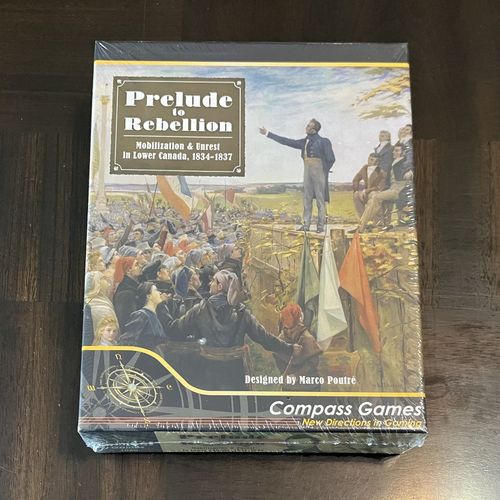
Prelude to Rebellion: Mobilization & Unrest in Lower Canada 1834-1837
Prelude to Rebellion: Mobilization & Unrest in Lower Canada 1834-1837 Rulebook
Table of Contents
Table of Contents
- 1.0 Components
- 2.0 Game Sequence
- 3.0 Cards
- 4.0 Scoring Die
- 5.0 Scoring Tracks
- 6.0 Rebellious Spirit
- 7.0 Opportunity Pool
- 8.0 Mobilization Check
- 9.0 Activity Points
- 10.0 Parliamentary Sessions
- 11.0 Random Counties
- 12.0 Card Clarifications
- 13.0 Extended Example of Play
- Patriote Strategy Primer
- Loyal Strategy Primer
- Player Aid — Action Round Summary
1.0 Components
A complete game of Prelude to Rebellion includes:
- 1 22" x 34" mounted game board;
- 3 green Patriote dice and 3 red Loyal dice;
- 4 custom Scoring dice;
- 150 green Patriote Mobilization cubes;
- 125 red Loyal Mobilization cubes;
- 147 cards divided as such:
- 8 Key Event cards;
- 24 cards forming the 1834 Deck;
- 24 cards forming the 1835-36 Deck;
- 39 cards forming the 1837 Deck;
- 52 cards forming the Generic Deck;
- 1 sheet of counters;
- 1 dice and cube bag.
1.1 Game Map
The map of western Lower Canada on the board is divided into 26 Counties that were actual electoral districts at the time. There are 2 Urban Counties (Montréal and Québec) and 24 Rural Counties (all others).
Each County may contain a number of Patriote (green) and Loyal (red) Mobilization cubes (hereafter called Cubes) in Mobilization Boxes. The number of Cubes for a player in a County is called its Mobilization Value (MV). Some Counties start the game with a number of Patriote or Loyal Cubes (as indicated by the Mobilization Boxes whose background color is dark green or red).
A Rural County may have a Patriote Bias or a Loyal Bias. A flag will be present in the relevant Rural Organization placeholder to denote the Bias.
A County is controlled by the player with the highest Mobilization Value in it. If both players have an equal Mobilization Value in the County (including when the County contains no Cubes at all), the County is considered uncontrolled.
2.0 Game Sequence
A game of Prelude to Rebellion can last up to 7 Turns. Every Turn consists of 8 Action Rounds during which each player, starting with the First Player, alternate playing a card (3.1). Therefore, an Action Round will always consist of a Patriote and a Loyal Action Round, in an order determined by whoever is the First Player for the Turn. During his Action Round, a player is sometimes referred to as the Active Player.
Each Turn is also associated with a deck (called the Active Deck) from which most of the players' cards will come. The 1834, 1835-36 and 1837 Decks contain Events specific to these years. There is also a fourth deck, called the Generic Deck, which contains Events that did or could have occurred at any time during the period covered by the game.
Example: In the image below, the Early 1834 and Late 1834 rows each represents a Turn and each of the numbered squares represents an Action Round. For both of these turns, the Active Deck is the 1834 Deck.
2.1 Setting up the Game
- Determine by any method desired who will be the Patriote player and who will be the Loyal player. It is recommended that players sit side by side: the Patriote player to the left while facing the game board and the Loyal player to the right.
- Place Cubes on all Mobilization Boxes whose background color is dark green or red (1.1).
- Place markers on their respective starting boxes (denoted by thick black outlines) on the Victory Points, Rural Counties, Organizations, External Influence, Urban Counties and Rebellious Spirit tracks.
- Place the Scoring Markers on the Start box of each Scoring Track.
- Place the Patriote player's marker on the '6' box and the Loyal player's marker on the '8' box on the Opportunity Points track.
- Set the 8 Key Event cards aside and sort them by their Turn of entry on the upper right. These cards are not part of any Deck and thus are never shuffled.
- Shuffle the four Decks separately.
- Place markers next to each of the six Special Actions on the Governor's Privileges and the La Tête à Papineau player board (9.5).
- Add a Loyal 4 VP marker to the War Readiness box (6.1).
- Add 5 Loyal 1 VP markers in the Volunteer Corps boxes.
2.2 Start of Turn
-
Place cards in the Opportunity Pool (7.0):
- Early 1834: Top 2 cards of the 1834 and Generic Deck.
- Late 1834: Top card of the 1834 and Generic Deck + General Elections Key Event.
- 1835: Top 2 cards of the 1835-36 and Generic Deck + The Loyal Answer to the Elections Key Event.
- 1836: Top card of the 1835-36 and Generic Deck + The Select General Committee Key Event.
- Early 1837: Top 2 cards of the 1837 and Generic Deck + The Russell Resolutions and The St-Ours Declaration Key Events.
- Fall 1837: Top card of the 1837 and Generic Deck + The Assembly of the Six Counties, The Sons of Liberty Society and Arrest Warrants against Patriote Leaders Key Events.
- Winter 1837: Top card of the 1837 and Generic Deck.
-
Each player draws cards from the Active Deck until he has 4 cards from the Active Deck in hand and draws cards from the Generic Deck until he has 3 cards from the Generic Deck in hand (for a total of 7 cards in hand).
Example: At the end of the Early 1834 Turn, the Patriote player held a card from the 1834 Deck. This held card carries over to the start of the Late 1834 Turn and the Patriote player would draw 3 cards from the 1834 Deck and 3 cards from the Generic Deck, giving him the required 7 cards in hand.
-
The Patriote player decides who will be the First Player for the turn.
2.3 End of Turn
- Card effects lasting until the end of the Turn either end or are resolved.
- The Key Events of the current Turn, if any remain, are discarded from the Opportunity Pool.
- The Patriote player gains 6 Opportunity Points (maximum of 12) and the Loyal player gains 8 Opportunity Points (maximum of 16).
- If the Rebellious Spirit marker is on its 'No +1 EoT', flip it. Otherwise, the Rebellious Spirit marker moves up 1 space. If this brings the marker to 15, the game ends (2.4).
- If this is the last Turn for a Deck (Late 1834 or 1836):
- All cards in the players' hands and in the Opportunity Pool are discarded.
- Otherwise, each player keeps the card(s) he's still holding.
- If this is the end of the Winter 1837 Turn, the game ends (2.4).
2.4 End of Game
The Victory Points (VP) track measures how close each player is to achieving its ultimate goal.
Each time the Patriote player scores a VP, move the VP marker one box to the left.
Each time the Loyal player scores a VP, move the VP marker one box to the right.
The game can end in one of the following ways:
- If, at the end of a player's Action Round or the end of a Turn, the Rebellious Spirit marker has reached 15:
- Go through the Scoring Sequence for each Scoring Track (5.0);
- Award the War Readiness VP (6.1);
- The player ahead on the VP track wins. If the VP marker is at 0, the Loyal player wins.
- If, at the end of a player's Action Round or at the end of a Turn, a player reached 20 VP, he automatically wins.
- When the Winter 1837 Turn ends:
- Go through the Scoring Sequence for each Scoring Track (5.0);
- The player ahead on the VP track wins. If the VP marker is at 0, the Loyal player wins.
In the rare case where more than one victory condition would trigger at the same time, precedence is determined by the order listed above.
Example 1: At the end of an Action Round, a player has 20 VP and the Rebellious Spirit marker reached 15. Go through the Scoring Sequence for each Scoring Track and award the War Readiness VP before determining a winner.
Example 2: During the Winter 1837 end of Turn sequence, the Rebellious Spirit marker reaches 15. In addition to going through the Scoring Sequence for each Scoring Track, award the War Readiness VP.
3.0 Cards
3.1 Playing a Card
In each of his Action Rounds, a player plays one card from his hand or the Opportunity Pool (7.0). A player can only forfeit his Action Round if he has no cards in hand.
When a player plays a card associated with his faction from his hand, he can either:
- Play the card's Event (if the prerequisite is met). The card is then discarded unless the Event states otherwise.
- Play the card for its Activity Points (9.0). The card is then discarded.
When a player plays a neutral card from his hand, he can either:
- Play the card's Event (if the prerequisite is met). The card is then discarded.
- Play the card for its Activity Points. The card is then placed in the Opportunity Pool.
When a player plays a card associated with the opposing faction, he must play it for its Activity Points. Then:
- If the Event's prerequisite is met, his opponent has to play it, making all indicated decisions. The card is then discarded unless the Event states otherwise.
- If the Event's prerequisite is not met, the card is placed in the Opportunity Pool and his opponent gains Opportunity Points equal to half the Activity Point value of the played card.
IMPORTANT: After playing a card in his Action Round, a player rolls the Scoring Die associated with it (4.0).
3.1 Playing a Card Example: The Patriote player plays the Loyalty Oaths Loyal card from his hand. Since this is a card of the opposing faction, he has to use the 4 Activity Points provided by the card. Then, given that the Event of the card has the prerequisite "The Rebellious Spirit marker is at 10+", one of two things will happen:
- If the Rebellious Spirit marker is at 10+, the Loyal player follows the Event's instructions.
- If the Rebellious Spirit marker is at 9 or less, the card is placed in the Opportunity Pool and the Loyal player gains 2 Opportunity Points (half the card's Activity Point value).
Loyalty Oaths (card 92, Loyal, 1837 Deck, 4 AP) — Prerequisite: The Rebellious Spirit marker is at 10+. Event: For each point over 5 on the Rebellious Spirit track, add 1 Cube to a distinct Rural County. Historical background: As the troubles came to a head, a lot of petitions in which people renewed their loyalty towards the Queen started flying around. Most signatories hoped to avoid retaliation.
3.2 Card Terminology
+x [...] on the External Influence track: Move the External Influence Advantage Marker x boxes towards the specified faction.
Add x Cubes in
Spend: A player must have something to be able to spend it. For instance, if a card asks a player to spend 2 Opportunity Points, that player must have at least that many Opportunity Points and must lower his Opportunity Points by 2 if he decides to go forward.
Parliamentary: See 10.0.
Choose a random County: See 11.0.
By default, a card's prerequisite and Event refer to the faction associated with it. For example, on a Patriote card, terms such as 'You' refer to the Patriote player and if the card's Event states to add 2 Cubes, add Patriote Cubes.
Anatomy of a Card
- Scoring Die: The Scoring Die (4.0) a player rolls immediately after playing this card.
- Faction: The Faction associated with the card — Patriote, Loyal, or Neutral (both flags).
- Deck: The deck to which the card belongs.
- Activity Points: The amount of Activity Points (9.0) the card is worth should a player use it to perform activities. Also represents the Opportunity Point cost to play the card if it's in the Opportunity Pool (7.0).
- Title: The card's title.
- Prerequisite: Necessary condition to play the card's Event.
- Event: The instructions to follow should a player decide to play the card's Event.
- Historical Background: Additional information of interest to learn more about the conflict but irrelevant for gameplay.
- Card Number: A sequential card number to help identify the cards.
Example card: "Patriotic Unions and Associations of Reform" (card 147, Neutral, Generic Deck, 4 AP). Prerequisite: At least 2 Patriote Rural Organizations have been created. Event: Perform a +4 Mobilization Check in 2 Rural Counties containing a Patriote Organization. For each successful check, score 2 VP. Historical background: The goal of these organizations similar to the committees of correspondence was to raise money, set up commemorative events, etc.
4.0 Scoring Die
Each card has one of four Scoring Dice printed on it: Rural Counties (RC), Organizations (O), External Influence (EI) or Urban Counties (UC). Immediately after playing a card, the Active Player rolls the specified die and advances the Scoring Marker of the track rolled by one box. If that brings the Scoring Marker to the end of the track (the Score box), players should go through the Scoring Sequence detailed under the relevant Scoring Tracks section (5.0).
- The Scoring Die is rolled after the card play is complete. It's the very last thing that happens before the card is discarded or put in the Opportunity Pool.
- A Scoring Die is rolled even if a card is played from the Opportunity Pool.
- Patriote Activities and Loyal Activities cards specify that the Scoring Die to be rolled is chosen by the Patriote or Loyal player, respectively.
Note: A Scoring Die is a custom 6-sided die. Three faces of the die bear the die's associated Scoring Track while the other three faces bear the abbreviations corresponding to the three other tracks. For example, the Rural Counties Scoring Die has three Rural Counties faces, one Organizations face, one External Influence face and one Urban Counties face.
5.0 Scoring Tracks
Four tracks are used to measure the posture of each player in relation to key issues of the conflict. Each track has an Advantage Marker showing which player is currently favored as well as a Scoring Marker that has a chance to move one box to the right every time a card is played (4.0). When the Scoring Marker reaches a Score box, it will trigger a specific sequence of activities described below. Most importantly, the player favored on the track will be awarded the corresponding number of VP.
5.1 Rural Counties
This track measures the player that controls (1.1) the most Rural Counties (note that Montréal and Québec are Urban Counties and thus do not affect the Rural Counties track). The Advantage Marker starts on the leftmost '4' box, favoring the Patriote player.
- Move the marker to the Patriote side when the Patriote player takes control of an uncontrolled Rural County or when a Rural County controlled by the Loyal player becomes uncontrolled.
- Move the marker to the Loyal side when the Loyal player takes control of an uncontrolled Rural County or when a Rural County controlled by the Patriote player becomes uncontrolled.
Example: If the Loyal player, starting the game, decides to add a Cube in the Counties of Rouville and Richelieu, the Advantage Marker should immediately be moved 2 boxes to the right, to the leftmost '3' box, still favoring the Patriote player.
If you ever need to confirm the position of the Rural Counties Advantage Marker, subtract the number of Rural Counties controlled by the player which controls the least from the number of Rural Counties controlled by the player which controls the most. Starting from the '0' space, move the Advantage Marker a number of boxes equal to the difference in favor of the dominant player.
Example: At the start of the game, the Patriote player controls ten Rural Counties and the Loyal player controls two. 10-2 = 8 boxes towards the Patriote player from the '0' space.
5.1.1 Scoring Sequence
Perform the following activities in order when the Rural Counties track scores:
- The Loyal player rolls a die, applies the relevant die roll modifier listed beside the Rebellious Spirit track (6.0) and references the final number on the Fear of Reprisal table (6.2) on the board. He then removes Patriote Cubes from Rural Counties based on the indicated result.
DESIGN NOTE: This represents the more moderate or peaceful inhabitants withdrawing their support for the Patriote cause.
- The player favored on the track is awarded a corresponding number of VP.
- Put the Scoring Marker back on the Start box.
5.2 Organizations
This track measures the player with the most Organizations (9.2). The Patriote player can create one Urban Organization, which must be in Montréal. The Loyal player can create two Urban Organizations, one in Québec and one in Montréal. The creation of an Urban Organization allows a player to move the Advantage Marker 2 boxes in his favor.
DESIGN NOTE: These urban organizations decided the key strategies for each faction.
Once a player has created an Urban Organization, he can create Rural Organizations in Rural Counties. The creation of a Rural Organization allows a player to move the Advantage Marker 1 box in his favor.
DESIGN NOTE: These committees or associations tried to follow the roadmap given by urban organizations.
5.2.1 Scoring Sequence
Perform the following activities in order when the Organizations track scores:
- The player favored on the track is awarded a corresponding number of VP.
- Put the Scoring Marker back on the Start box.
5.3 External Influence
This track measures the support each player receives from external powers such as Britain, France, the United States and Upper Canada. The Advantage Marker starts on the '2' box favoring the Loyal player, representing Britain's natural support for its colonial administration. This track can only be influenced by Events which will specify to move the Advantage Marker a number of boxes towards a faction.
5.3.1 Scoring Sequence
Perform the following activities in order when the External Influence track scores:
- The player favored on the track is awarded a corresponding number of VP.
- Put the Scoring Marker back on the Start box.
5.4 Urban Counties
This track represents the intense partisan activity of the two Urban Counties, Montréal and Québec.
- Move the marker to the Patriote side when the Patriote player takes control of an uncontrolled Urban County or when an Urban County controlled by the Loyal player becomes uncontrolled.
- Move the marker to the Loyal side when the Loyal player takes control of an uncontrolled Urban County or when an Urban County controlled by the Patriote player becomes uncontrolled.
Example: At the beginning of the game, the Patriote player controls Montréal and the Loyal player controls Québec. The Advantage Marker is on the '0' box. If the Loyal player adds 1 Cube in Montréal, it becomes uncontrolled and the Advantage Marker is moved to the '2' box, favoring the Loyal player. If the Loyal player adds another Cube in Montréal, he now controls it and the Advantage Marker is moved to the '4' box, favoring the Loyal player.
5.4.1 Scoring Sequence
Perform the following activities in order when the Urban Counties track scores:
-
The player favored on the track is awarded a corresponding number of VP.
-
If the Mobilization Value of a player in Montréal/Québec is:
- 1-5: Remove 1 Cube of the player.
- 6-10: Remove 2 Cubes of the player.
- 11+: Remove 3 Cubes of the player.
Example: If a player has 7 cubes in Montréal and 4 cubes in Québec, he loses 2 in Montréal and 1 in Québec.
-
Following this attrition, each player scores 2 VP for each Urban County in which his opponent has a Mobilization Value of 0.
-
Put the Scoring Marker back on the Start box.
6.0 Rebellious Spirit
This track measures the Patriotes' animosity and how close they are to an uprising. Several Events increase the Rebellious Spirit and very few lower it. Many Events also have a prerequisite that the Rebellious Spirit marker has reached a certain number. When it reaches 8, the Loyal player can actively try to increase it by recruiting Volunteer Corps (9.4). When it reaches 15, the game ends (2.4) with an armed revolt by the Patriotes and the VP in the War Readiness box are awarded (6.1).
At the end of a turn, unless the Patriote player performed the Call for Composure action (9.3) during the turn, the marker moves up 1 space.
The track carries the following end-of-turn die roll modifiers for the Fear of Reprisal table (6.2), keyed to the Rebellious Spirit marker's position: 0-1 no modifier (-2 shown at position 2); 5-6 +0; 8 +1 (Volunteer Corps recruitment becomes available); 10 +2; 13 +3; 15 +4 (Game End).
6.1 War Readiness
VP markers will be put in this box throughout the game but won't be awarded to their respective players unless the game ends because the Rebellious Spirit reaches 15 (2.4). Markers can be put in this box in the following ways:
-
At the start of the game, add a Loyal 4 VP marker to the box (2.1).
DESIGN NOTE: This represents the readily available British soldiers stationed in the colony.
-
Some Events will instruct players to add Patriote or Loyal VP markers to the box.
-
Every time the Loyal player successfully creates a Volunteer Corps (9.4), he adds a Loyal 1 VP marker to the box.
6.2 Fear of Reprisal Table
The Loyal player will roll on this table every time the Rural Counties track scores (5.1.1), applying a die roll modifier as indicated beside the Rebellious Spirit track.
Fear of Reprisal table (1d6 ± Modifier on the left):
| Result | Effect |
|---|---|
| < 3 | No effect |
| 3-4 | -2 Cubes, max. 1/County |
| 5-6 | -5 Cubes, max. 2/County |
| 7-8 | -7 Cubes, max. 3/County |
| 9+ | -10 Cubes |
7.0 Opportunity Pool
The Opportunity Pool is an area from which cards may be played (3.1) by both players. Whenever cards are placed in the Opportunity Pool, players should group them by faction on the table below the board. Over the Opportunity Pool are two tracks where players keep track of their available Opportunity Points. Opportunity Points are used to play cards from the Opportunity Pool as well as to improve the result of a Mobilization Check (8.0). At the end of each Turn (2.3), the Patriote player gains 6 Opportunity Points and the Loyal player gains 8.
Cards are placed in the Opportunity Pool in the following situations:
- At the start of each Turn (2.2), one/two cards from the Active Deck, one/two cards from the Generic Deck as well as the Key Events of the current Turn are placed in it.
- Whenever a player plays a neutral card (3.1) from his hand for the Activity Points.
- Whenever a player plays a card from the opposing faction (3.1) and the prerequisite of this card's Event is not met when the Event would occur (reminder: the Active Player's opponent then receives half the card's Activity Points value in Opportunity Points).
Key Events are discarded from the Opportunity Pool at the end of the Turn. Other cards in the Opportunity Pool are discarded at the end of the last Turn of a deck (2.3).
During his Action Round, instead of playing a card from his hand, a player may spend x Opportunity Points to play the Event of a card (associated with his faction or neutral) worth x Activity Points from the Opportunity Pool (the prerequisite of the card's Event has to be met at the time it is played).
Note: Whenever a card is played from the Opportunity Pool, it is discarded.
8.0 Mobilization Check
A Mobilization Check is a way of testing if the people in a County are sufficiently organized and/or enthused to perform a certain action. It involves luck, but players have some control over the outcome. There are two types of Mobilization Checks.
Event-triggered
Some Events require the player to make one or more Mobilization Checks. The Event's effect will depend on the result(s) of the check(s). When an Event requires a Mobilization Check, the check's bonus will always be specified on the card. For example, the Patriote Event Patriotic Unions and Associations of Reform states "Perform a +4 Mobilization Check in 2 Rural Counties containing a Patriote Organization..."
Action-triggered
Some actions available to players require a Mobilization Check. In such a case, the number of Activity Points (9.0) dedicated to the action (minimum 2) will be the check's bonus. For example, if a player decides to use 3 Activity Points out of the 6 Activity Points provided by a card to create a Rural Organization, the check's bonus will be +3.
Success/Failure
To perform a Mobilization Check, a player adds the check's bonus to his Mobilization Value in the targeted County. That becomes the target number. He then rolls 3 dice and compares the sum to the target number. If the result is:
- Less than or equal to the target number, the check is a success.
- Greater than the target number, the player has two options:
- Confirm the check is a failure OR
- Spend Opportunity Points to increase the target number until it is equal to his result, turning the would-be failure into a success.
Examples
The Patriote Mobilization Value in Chambly is 7. The Patriote player must perform a +4 Mobilization Check there. The target number is thus 11. He rolls three dice and gets a sum of 10. Since this is less than or equal to the target number, the check is a success.
Later in the turn, the Loyal player must perform a +2 Mobilization Check in Drummond. The Loyal Mobilization Value in Drummond is 8. The target number is thus 10. The Loyal player rolls 3 dice and gets a sum of 12. He now has the option to confirm the check is a failure or spend 2 Opportunity Points (if he still has enough) to increase the target number from 10 to 12 and turn the check into a success.
9.0 Activity Points
When a player plays a card for its Activity Points (AP), he receives the card's Activity Points value and may spend it to perform one or more of the following actions (it's possible to perform more than one type of action in the same Action Round).
9.1 Mobilization
Mobilization is the most common action and is used to increase Mobilization Value in Counties. Players must always place their Cubes from bottom to top in a County. The Activity Point cost for placing a Cube in a County will depend on whether it's a Rural or Urban County and the next free Mobilization Box in it.
9.1.1 Mobilization in Rural Counties
The base cost for Mobilizing a Rural County's box is 1 AP. A white number beside a Mobilization Box is an additional cost necessary to Mobilize that box. It costs a player -1 AP (to a minimum of 1) to Mobilize a box if his Mobilization Value in the County is lower than his opponent's at the time the Cube is added.
DESIGN NOTE: Even in counties strongly favoring one faction or the other, not much happened historically until the other side started mobilizing. It's easier to rally people when you feel a sense of urgency and watch your opponents attend meetings, sign petitions, etc.
Example: Assuming there are 2 Patriote Cubes in Laprairie, it would cost the Loyal player 1 AP to Mobilize the first box (base 1, +1 for the white number, -1 for catching up). It would then cost him 2 AP to Mobilize the second box (base 1, +2 for the white number, -1 for catching up). Then, if he wants to pull ahead, it would cost him 2 AP to Mobilize the third box (base 1, +1 for the white number) and it would cost him 3 AP to Mobilize the fourth box (base 1, +2 for the white number).
Rural Mobilization: base/minimum cost 1 AP; additional AP cost per the white number shown beside a box; -1 AP if MV is lower than opponent's.
9.1.2 Mobilization in Urban Counties
The base cost for Mobilizing an Urban County's box is 2 AP. A white number beside a Mobilization Box is an additional cost necessary to Mobilize that box. There is no cost reduction for catching up with your opponent in Urban Counties.
Example: Assuming there are 3 Patriote Cubes in Montréal, it would cost the Patriote player 2 AP to Mobilize the fourth box, 2 AP to Mobilize the fifth box and 3 AP to Mobilize the sixth box.
Urban Mobilization: base cost 2 AP; additional AP cost per the white number shown beside a box.
9.2 Creating Organizations
To create an Organization, a player must spend a minimum of 2 Activity Points. The number of Activity Points dedicated to the action will become the Mobilization Check's bonus to create the Organization. If a player fails a check to create an Organization, he can't attempt to create Organizations for the rest of his Action Round.
Each player can only have one Organization in a County (place the relevant counter on the player's Organization placeholder as a reminder).
9.2.1 Urban Organization
Each player must have an Urban Organization before creating Rural Organizations. The Patriote player can only create an Urban Organization in Montréal while the Loyal player can create one in Montréal and/or Québec.
To create an Urban Organization, a player targets a legal Urban County and performs a Mobilization Check (8.0) using a bonus equal to the number of Activity Points dedicated to the action (minimum 2). A success allows him to move the Organizations Advantage Marker two boxes in his favor and now allows him (for the rest of the game) to create Rural Organizations in Rural Counties.
9.2.2 Rural Organization
To create a Rural Organization:
- The player chooses how many Activity Points he will dedicate to this action (minimum 2).
- The player targets a Rural County that does not already contain a Rural Organization for his faction.
- The player selects an Urban Organization with which to affiliate the Rural Organization. If this is the Loyal player and both his Urban Organizations have been created, he still has to select a single Urban Organization with which to affiliate the Rural Organization.
- The player then performs a Mobilization Check (8.0) in the targeted Rural County using a bonus equal to:
- The number of Activity Points dedicated to the action.
- An additional +1 if his Mobilization Value in the affiliated Urban County is 6-10 OR +2 if his Mobilization Value in the affiliated Urban County is 11+ (there is no additional bonus if his Mobilization Value in the affiliated Urban County is lower than 6).
- A success allows the player to move the Organizations Advantage Marker one box in his favor.
Example: The Loyal player wants to create a Rural Organization in Sherbrooke. The Urban Organizations of Québec and Montréal have been created. The Loyal Mobilization Values are 7 in Sherbrooke, 8 in Québec and 5 in Montréal. He thus decides to affiliate the new Organization with Québec's.
The Loyal player decides to use 4 Activity Points for this action. The target number for the check is 12 (Sherbrooke's Mobilization Value of 7 + the 4 Activity Points spent on the check + 1 because Québec's Mobilization Value is between 6 and 10). He rolls 3 dice and gets a sum of 13. The Loyal player decides to spend 1 Opportunity Point to add 1 to the target number and turn the check into a success. The Loyal player then moves the Organizations Advantage Marker one box in his favor and places a Loyal Organization counter on Sherbrooke's Rural Organization placeholder.
9.3 Call for Composure
This action may only be performed by the Patriote player, once per turn.
For a cost of 2 Activity Points in 1834, 4 Activity Points in 1835-36 and 6 Activity Points in 1837, the Patriote player can prevent the Rebellious Spirit marker (6.0) from increasing by 1 at the end of the current turn (2.3). As a reminder, flip the Rebellious Spirit marker.
9.4 Volunteer Corps Recruitment
This action may only be performed by the Loyal player.
If the Rebellious Spirit marker (6.0) is at 8+, the Loyal player can recruit Volunteer Corps in Rural Counties in which there is a Loyal Rural Organization (9.2.2) and in which no Volunteer Corps has already been recruited.
To do so, the Loyal player targets a legal Rural County and performs a Mobilization Check (8.0) in the target County using a bonus equal to the number of Activity Points dedicated to the action (minimum 2). If the check is a success:
- The Loyal player flips the county's Organization counter on its Volunteer Corps side as a reminder that he can no longer recruit Volunteer Corps there.
- The Loyal player rolls a die: on a 4+, the Rebellious Spirit marker increases by 1.
- The Loyal player moves one Loyal 1 VP marker from the Volunteer Corps boxes to the War Readiness box (6.1).
The Loyal player can create up to 5 Volunteer Corps.
DESIGN NOTE: Historically, the volunteers made quite an impact on the military aspect of the conflict.
9.5 Special Actions
Once per Turn, each player can use one of the Special Actions available on the relevant player board associated with their faction, La Tête à Papineau for the Patriote player and Governor's Privileges for the Loyal player. Each Special Action may only be used once per game. Move the counter beside a used Special Action to the current Action Round on the Turn track as a reminder that this Special Action is no longer available for the remainder of the game and that the player used his Special Action for the Turn.
To play a Special Action, a player must spend the required number of associated AP.
9.5.1 Governor's Privileges
- x AP – Pulling the Strings: Roll x Scoring Dice (4.0) of your choice. The player first decides the number of dice he will roll and then spends the required amount of AP. Each die is then rolled and resolved one at a time. If a track scores (5.0), scoring occurs before the remaining dice are rolled.
- 2 AP – Strategic Realignment: After your Action Round, exchange your cards in hand with those of the Patriote player.
- 4 AP – Non-Issue: Reset a Scoring Track (5.0). Put the track's Scoring Marker back on the Start box, without actually scoring the track.
- 4/6 AP – Looking for Trouble: +1/+2 to the Rebellious Spirit (6.0).
- 2 AP – Le Canadien: The next time you play a card of the opposing faction from your hand (3.1), ignore the Event (you play the AP, roll the Scoring Die and then discard the card). Even if the Event's prerequisite is not met, the opposing player does not get Opportunity Points and the card is not put in the Opportunity Pool. Flip the marker to its Spent side after the player plays a card from the opposing faction from his hand.
- 2 AP – Partisan Media: The next time you play a card of your faction from your hand, you play the AP and then the Event. If the Event's prerequisite is not met, the Special Action is wasted. Flip the marker to its Spent side after the player plays a card from his faction from his hand.
9.5.2 La Tête à Papineau
- 4 AP – Our Moment: Gain 6 Opportunity Points.
- 4 AP – Overwhelming Support: Score 1 VP for each of your fully Mobilized Patriote-Biased Counties (1.1). That would be 1 VP for each Rural County with a Patriote Mobilization Value of 9.
- 4 AP – No Matter the Cost: The next time the Rural Counties track scores, the Loyal player doesn't roll on the Fear of Reprisal table (6.2). Flip the marker to its Spent side after the Rural Counties track scores.
- 2/4/6 AP – Various Angles: Exchange 1/2/3 cards from your hand with 1/2/3 non-Key Event cards from the Opportunity Pool. You must have at least the chosen amount of cards in hand and there must be at least the chosen amount of eligible cards in the Opportunity Pool.
- 2 AP – Le Canadien: See the Governor's Privileges Special Action of the same name.
- 2 AP – Partisan Media: See the Governor's Privileges Special Action of the same name.
10.0 Parliamentary Sessions
Some Action Rounds are Parliamentary Sessions.
DESIGN NOTE: Just like today, these are times when deputies are busy debating in Québec.
An Event can have the prerequisite 'Parliamentary', which means it has to be played during a Parliamentary Session. If played outside of a Parliamentary Session, the prerequisite is not considered to be met.
After the last Action Round of a Parliamentary Session (contiguous or individual Action Rounds with the Parliamentary Session icon), the Patriote player:
- Adds 1 Cube in Québec.
- Scores 2 VP.
DESIGN NOTE: This represents the proselytizing work done by Patriote politicians while attending Parliament in Québec and the fact that some of the little leverage Patriote deputies had was to consistently vote against subsidies, depriving officials of their pay and paralyzing colonial projects.
Example: The first and second Action Round of the 'Early 1834' Turn are considered to be a single Parliamentary Session. During these two Action Rounds, Events with the 'Parliamentary' prerequisite can be played. At the end of the second Action Round, the Patriote player adds 1 Cube in Québec and scores 2 VP.
11.0 Random Counties
Some Events involve picking a random County. To do so, the player activating the Event rolls one green die and one red die and cross-references the result in the following table.
| Green \ Red | 1 | 2 | 3 | 4 | 5 | 6 |
|---|---|---|---|---|---|---|
| 1 | D-Montagnes | Terrebonne | Lachenaie | L'Assomption | Berthier | St-Maurice |
| 2 | Vaudreuil | Beauharnois | Laprairie | L'Acadie | Chambly | Rouville |
| 3 | Verchères | St-Hyacinthe | Richelieu | Yamaska | Nicolet | Missisquoi |
12.0 Card Clarifications
Card #3 – The Select General Committee: The Loyal player decides if he wants to perform a Mobilization Check in Québec or Montréal first. If the check is a success, he would then perform a check in the other Urban County.
Card #4 – The Russell Resolutions: For example, if the External Influence track's Advantage marker is on the '3' box favoring the Loyal player, the Patriote player adds a Patriote Cube in 3 Rural Counties with a Patriote Organization and gains 3 Opportunity Points. The Loyal player scores 3 VP.
Card #5 – The St-Ours Declaration: Going through a Scoring Sequence includes resetting the Scoring Marker by putting it back in the Start box.
Card #7 – The Assembly of the Six Counties: The Patriote player decides the order in which he wants to perform the Mobilization Checks. Theme-wise, the number chosen is the number of influential leaders presiding the assembly.
Card #8 – Arrest Warrants against Patriote Leaders: If the roll is successful and the Loyal player decides to trigger the end of the game, the RC Scoring Die associated with this card would not be rolled.
Cards #9-10-11-12-13-33-34-57-58 – Loyal Activities: If playing the card from his hand, remember the Loyal player can choose to use the card's AP value to perform actions, as usual.
Cards #14-15-16-17-18-35-36-59-60 – Patriote Activities: If playing the card from his hand, remember the Patriote player can choose to use the card's AP value to perform actions, as usual.
Card #23 – The 'St-Jean-Baptiste' Society: When in play, that Event triggers right before the Patriote player plays a card in a 'St-Jean-Baptiste' Action Round (see Turn track).
Card #28 – The 92 Resolutions in London: The Opportunity Points are spent for the sole purpose of the Event and can't be used to purchase cards in the Opportunity Pool.
Card #37 – Caron Resigns: If the end of Turn VP brings a player to 20 VP or more, finish going through the end of Turn sequence before determining a winner.
Card #40 – De Bleury Hanged in Effigy: Even though this is a Loyal card, the Patriote player is the one who gets to decide whether or not he wants to spend Opportunity Points when he performs his Mobilization Check.
Cards #42-43 – By-Election: If the end of Turn VP brings a player to 20 VP or more, finish going through the end of Turn sequence before determining a winner.
Card #48 – Gosford's Charm Offensive: The 'Partisan Media' and 'Le Canadien' Special Actions would work just like the ones from 'La Tête à Papineau'. Their effect would not be cumulative.
Card #49 – 'La Banque du Peuple': These Opportunity Points are over and above the Opportunity Points the Patriote player gains if the Event's prerequisite is not met.
Card #56 – Papineau Shipped Overseas: The Patriote player can still add Cubes to Rural Counties over the Mobilization Value limit of 5 through an Event. He just can't do it through a Mobilization action using AP.
Card #68 – Beyond Regional Leadership: This basically means that the Patriote player will never spend more than 1 AP to mobilize a box in a Patriote-biased County until the end of the game.
Card #70 – Tumult against Colborne: The Opportunity Points are spent for the sole purpose of the Event and can't be used to purchase cards in the Opportunity Pool.
Card #75 – A Permanent Committee in Québec at last!: Some players like to keep this card in play as a reminder in case they need to confirm the position of the Organizations Advantage Marker.
Card #76 – Skirmish with the Doric Club: Even though this is a Loyal card, the Patriote player is the one who gets to decide whether or not he wants to spend Opportunity Points when he performs his Mobilization Check.
Card #77 – Gosford Forbids Dissident Meetings: For example, the Loyal player gains 1 VP if the Patriote player spends 4 AP in a single Action Round to perform the Mobilization action.
Card #84 – Bishop Lartigue's Command: Even though this is a Loyal card, the Patriote player is the one who gets to decide whether or not he wants to spend Opportunity Points when he performs his Mobilization Checks.
Card #85 – Lafontaine's Plan: For example, if this Event is played in the 4th Action Round of the Early 1837 Turn, treat the 5th Action Round of the Early 1837 Turn as if it was a Parliamentary Action Round for all purposes. Events with the 'Parliamentary' prerequisite can thus be played in the 5th Action Round and at the end of the 5th Action Round, the Patriote player scores 2 VP and places 1 Cube in Québec.
Card #88 – The Septembrokers: Even though this is a Loyal card, the Patriote player is the one who gets to decide whether or not he wants to spend Opportunity Points when he performs his Mobilization Checks.
Cards #92-93 – Loyalty Oaths: For example, if the Rebellious Spirit is at 11, the Loyal player adds 1 Cube in 6 Rural Counties.
Card #94 – Victoria: For example, if the External Influence Advantage Marker is on the '2' box favoring the Loyal player, the Loyal player gets a +2 bonus on his die roll.
Card #107 – Family in the Countryside: For example, in his next Action Round after playing this Event, the Patriote player could use the 4 AP provided by a card to add 8 Cubes in Rural Counties, regardless of the boxes the Cubes go into. This can possibly carry over into the next Turn if the Event was played on the 8th Action Round.
Card #108 – Overseas Business: This can possibly carry over into the next Turn if the Event was played on the 8th Action Round.
Card #129 – A Ragtag Coalition: For example, if the Rural County of Richelieu had a Patriote Mobilization Value of 3 and a Loyal Mobilization Value of 2 when the Event is played, it would be legal for the Loyal player to add 2 Cubes in Richelieu.
Card #130 – The Mentor and his Apprentices: Spending 2 AP to Mobilize is the same as using a card's AP to perform the Mobilization action.
Card #131 – Spontaneous Mobilization: The Patriote player rolls for Counties one at a time so that he can reroll if he rolls the same County twice. Even if he rolls 'Player's pick' more than once, he can't pick the same county a second time.
Card #134 – You go, we go: In a legal Rural County where the Patriote player has a Mobilization Value of 8 or 9, the Loyal player's Mobilization Value would top at 7.
Card #138 – Prorogued Session: The Patriote player immediately gains the usual benefits for the end of a Parliamentary Session (he scores 2 VP and adds 1 Cube in Québec). If the Parliamentary Session was more than 1 Action Round long, treat the contiguous Action Rounds normally identified as Parliamentary Session Action Rounds on the Turn track as non-Parliamentary Session Action Rounds instead.
13.0 Extended Example of Play
This section will provide a detailed play-by-play of a whole Turn (Early 1834). It is recommended that players go through this example with the physical components of the game for a better understanding of the rules.
Make sure to go through the steps outlined in section 2.1. Then select the following cards to form both players' hands:
Patriote player
From the 1834 Deck: Card #13 – Loyal Activities, Card #16 – Patriote Activities, Card #22 – The Aylmer-Glenelg Letters, Card #27 – 'L'Écho du Pays'. From the Generic Deck: Card #123 – 'La Minerve', Card #134 – You go, we go, Card #146 – A Nationalist Seminar.
A decent hand for the Patriote player, good amount of AP and only You go, we go is truly troublesome.
Loyal player
From the 1834 Deck: Card #15 – Patriote Activities, Card #23 – The 'Saint-Jean-Baptiste' Society, Card #24 – Concerned Reformists at Étienne Parent's, Card #28 – The 92 Resolutions in London. From the Generic Deck: Card #108 – Overseas Business, Card #141 – The Montreal Herald, Card #147 – Patriotic Unions and Associations of Reform.
AP-wise, this is also a good hand, even though it's a bit trickier to play. Overseas Business is always nasty and ideally, the Loyal player will want to hold The 'Saint-Jean-Baptiste' Society to deny the Patriote player the potential 4 uses of the card's ongoing effect.
Put the following cards in the Opportunity Pool:
Card #142 – The Morning Courier, Card #9 – Loyal Activities, Card #21 – BALC: British American Land Company, Card #120 – 'La Petite Famille'.
The Patriote player decides to be the First Player for the Turn.
Round 1
Patriote Action
Spending 2 Opportunity Points to play Card #142 – The Morning Courier from the Opportunity Pool. 1 Patriote Cube is added to Montréal. The UC Scoring Die is rolled and the result is UC, advancing the UC Scoring Marker one space on the UC Scoring Track.
If the Patriote player didn't go first, there was a pretty good chance the Loyal player would've played that card, since the Event is even stronger for him. And the fact that there are no Patriote cards in the Opportunity Pool made that decision even easier.
Loyal Action
Spending 4 Opportunity Points to play Card #120 – 'La Petite Famille' from the Opportunity Pool. Since the Event is played during a Parliamentary Session, 2 Loyal Cubes are added to Québec and 1 Patriote Cube is removed. The UC Scoring Die is rolled and the result is UC, advancing the UC Scoring Marker one space on the UC Scoring Track.
The Loyal player is already planning the creation of his Urban Organization in Québec. With a Mobilization Value of 6 there and 4 Opportunity Points left, it seems like it would be worth a shot to try it with 4 AP during his next Action Round.
Round 2
Patriote Action
Playing Card #123 – 'La Minerve' from his hand for the Event. 2 Patriote Cubes are added to Montréal and 1 Cube is added to Lachenaie and Berthier. The RC Advantage Marker is adjusted 2 boxes towards the Patriote player, to the leftmost '5' box on the Patriote side. The RC Scoring Die is rolled and the result is RC, advancing the RC Scoring Marker one space on the RC Scoring Track.
Seems like the Patriote player is preparing his counterpunch, the nice thing with this Event is that he is keeping the pressure on the Rural Counties front as well, helped by his advantageous starting position and the Scoring Die. The fact the UC track is still 2 boxes away from scoring guarantees him he will get a shot at creating his Urban Organization in Montréal before Cubes are removed to attrition (part of this track's Scoring Sequence).
Loyal Action
Playing Card #24 – Concerned Reformists at Étienne Parent's from his hand for AP. Spending all 4 AP to create the Urban Organization in Québec. Mobilization Value of 6 + 4 AP = target number of 10. Rolling 3 dice for a sum of 9. The Organization's creation is a success, the Organizations Advantage Marker is moved 2 boxes towards the Loyal player. The O Scoring Die is rolled and the result is EI, advancing the EI Scoring Marker one space on the EI Scoring Track.
Gaining 3 VP is nice but improving your board position is usually better. The Loyal player expected to roll higher than 10 and have to spend Opportunity Points so he caught a nice break there.
The Parliamentary Session ends. The Patriote player scores 2 VP and adds 1 Patriote Cube in Québec.
Round 3
Patriote Action
Playing Card #16 – Patriote Activities from his hand for the AP. Spending all 4 AP to create the Urban Organization in Montréal. Mobilization Value of 6 + 4 AP = target number of 10. Rolling 3 dice for a sum of 12. Spending 2 Opportunity Points to raise the target number to 12. The Organization's creation is a success, the Organizations Advantage Marker is moved 2 boxes towards the Patriote player. The Patriote player chooses to roll the RC Scoring Die and the result is O, advancing the O Scoring Marker one space on the O Scoring Track.
The Patriote player is not so lucky. With the same odds, he has to spend 2 Opportunity Points to create his Organization in Montréal. The RC Scoring Die also didn't cooperate and moved the Organizations Scoring Marker forward.
Loyal Action
Playing Card #108 – Overseas Business from his hand for AP. Adding 1 Cube in Deux-Montagnes (base cost 1 AP, +1 cost, -1 for catching up) and 1 Cube in Sherbrooke (base cost 1 AP). The RC Advantage Marker is adjusted 2 boxes towards the Loyal player, to the leftmost '4' box on the Patriote side. The Patriote player plays the Event: The Loyal player has to skip his next Action Round. The EI die is rolled and the result is EI, advancing the EI Scoring Marker one space on the EI Scoring Track.
Here the Loyal player sees an opportunity to get rid of Overseas Business. He regains some ground on the Rural Counties track just before granting the Patriote player 2 Action Rounds in a row. The timing is good as no track is less than 2 boxes away from scoring. Thanks to the Event, he will only play 7 Action Rounds during the Turn. As he already played a card from the Opportunity Pool, he will thus be able to hold a troublesome Patriote card in his hand for next Turn (he has 4 Action Rounds remaining and 5 cards left in hand). Additionally, the Scoring Die is on his side, rolling the only track currently favoring him.
Round 4
Patriote Action
Playing Card #27 – 'L'Écho du Pays' from his hand for the Event. Adding 3 Patriote Cubes in Richelieu and 1 Patriote Cube in St-Hyacinthe and Yamaska. The RC Advantage Marker is adjusted 1 box towards the Patriote player, to the rightmost '5' box on the Patriote side. The RC die is rolled and the result is RC, advancing the RC Scoring Marker one space on the RC Scoring Track.
The Cube in St-Hyacinthe allows the Patriote player to bypass a Mobilization Box with an extra cost. With 4 cubes in Richelieu, he can slowly start thinking about creating an Organization there.
Loyal Action
Skipped because of the Overseas Business event.
Round 5
Patriote Action
Playing Card #13 – Loyal Activities from his hand for the AP. Adding 2 Cubes to St-Hyacinthe (base cost 1 AP for both) and 2 Cubes in Montréal (base cost 2 AP for both). The Loyal player plays the Event: He decides to gain 3 Opportunity Points and put the Loyal Activities card in the Opportunity Pool. The Loyal player asks the Patriote player to roll the EI Scoring Die and the result is EI, advancing the EI Scoring Marker one space on the EI Scoring Track.
No immediate benefit for the Patriote here but he's in a nice position now. Even if the Urban Counties track scores, he will still have over 5 cubes in Montréal following the attrition, to keep his bonus to create Rural Organizations. And he won't have to pay the extra cost again to get in the 6-10 Mobilization Value bracket. The Loyal player chose to gain 3 Opportunity Points instead of spending 3 AP because he has a plan in mind.
Loyal Action Round 5
Spending 4 Opportunity Points to play Card #21 – BALC: British American Land Company from the Opportunity Pool. 1 Loyal Cube is added in Stanstead, Sherbrooke and Shefford. The Rebellious Spirit is increased by 1. The RC Advantage Marker is adjusted 2 boxes towards the Loyal player, to the rightmost '4' box on the Patriote side. The EI die is rolled and the result is UC, advancing the UC Scoring Marker one space on the UC Scoring Track.
The 3 Opportunity Points the Loyal player received during the previous Patriote Action Round allow him to play another card from the Opportunity Pool which will in turn allow him to hold 2 cards. The Event itself is pretty good too, grabbing 2 Rural Counties and moving the Rebellious Spirit closer to the '5' box, where the Fear of Reprisal table starts to get interesting.
Round 6
Patriote Action
Playing Card #22 – The Aylmer-Glenelg Letters from his hand for the Event. The EI Advantage Marker is adjusted 1 box towards the Patriote player. The EI die is rolled and the result is EI, advancing the EI Scoring Marker one space on the EI Scoring Track. The track scores, 1 VP is awarded to the Loyal player and the EI Scoring Track resets.
Good timing here, it's always nice to improve your position on a Scoring Track right before it scores.
Loyal Action
Playing Card #147 – Patriotic Unions and Associations of Reform from his hand for the AP. Adding 1 Cube in Vaudreuil, Lachenaie, Berthier and Yamaska. Despite the fact these boxes are all '+1' Mobilization Boxes, the Loyal player is catching up in these Counties, allowing him to add the Cubes for a 1-AP cost apiece. The RC Advantage Marker is adjusted 4 boxes towards the Loyal player, to the rightmost '2' box on the Patriote side. The Patriote player now tries to play the Event but the prerequisite isn't met. He thus gains half the card's value in AP (2) as Opportunity Points and the card is placed in the Opportunity Pool. The O die is rolled and the result is O, advancing the O Scoring Marker one space on the O Scoring Track.
The Loyal player has an easy time keeping up with the Patriote player in Rural Counties until the latter distances himself. The Patriote player will probably be able to play the card that was just placed in the Opportunity Pool at some point next Turn if he can manage to follow through with his plan to create Rural Organizations in Richelieu and St-Hyacinthe.
Round 7
Patriote Action
Playing Card #146 – A Nationalist Seminar from his hand for the Event. 3 Patriotes Cubes are added to St-Hyacinthe. The RC die is rolled and the result is UC, advancing the UC Scoring Marker one space on the UC Scoring Track. The track scores, no VP are awarded because each player controls a County. The Patriote player loses 2 Cubes in Montréal and 1 Cube in Québec to attrition. The Loyal player loses 1 Cube in Montréal and 2 Cubes in Québec to attrition. Then, since the Patriote Mobilization Value in Québec is 0, the Loyal player scores 2 VP. The UC Scoring Track resets.
Québec is a tough nut to crack for the Patriote player, especially in the early going. The 3 Parliamentary Sessions in 1835-36 and some 1837 Events will help him gain some ground. In the meantime, he's usually happy with the Urban Counties track scoring 0.
Loyal Action
Playing Card #141 – The Montreal Herald from his hand for the Event. The Rebellious Spirit is increased by 2. The UC die is rolled and the result is RC, advancing the RC Scoring Marker one space on the RC Scoring Track.
The Loyal player continues to push the Rebellious Spirit, hoping he can dodge a scoring of the Rural Counties track until he can get the marker to the next bracket.
The track scores. The Loyal player rolls a 4 on his Fear of Reprisal roll, modified by -2 for the Rebellious Spirit value. The end result is 2, which amounts to no effect. The Patriote player scores 1 VP. The RC Scoring Track resets.
Quite a busy Action Round! Sensing the Rebellious Spirit awakening, the Patriote player wisely spends 2 AP to prevent it from increasing at the end of the Turn. Always a good idea to try and spare these AP in 1834 as the Call for Composure action is cheap. The odds were good for the Organization creation in St-Hyacinthe, especially with 6 Opportunity Points remaining. Unfortunately for the Patriote player, the event is quite powerful and the Loyal player is able to break the Patriote player's control of L'Acadie and Terrebonne, right before the RC track scores. While the Rebellious Spirit is at 0-4, the Loyal player needs a 5 or a 6 on his Fear of Reprisal roll to be able to remove the Patriote Cubes. He missed by a pip.
Loyal Action
Playing Card #23 – The 'Saint-Jean-Baptiste' Society from his hand for the AP. He spends 6 AP to play the Special Action 'Looking for Trouble', raising the Rebellious Spirit by 2. The Patriote player plays the Event: the card is set aside for the rest of the game and its effect will trigger at the start of each of the future 'St-Jean-Baptiste' Patriote Action Rounds (see Turn track). The O die is rolled and the result is O, advancing the O Scoring Marker one space on the O Scoring Track.
At least the Loyal player dodged the first 'St-Jean-Baptiste' but he just gave the Patriote player a delayed 3 VP and 6 Cubes if the game lasts until Fall 1837. He could have tried to keep that card until the end of the Late 1834 Turn but he really wanted 6 AP to play the stronger effect of 'Looking for Trouble'. He is now threatening to remove quite a bunch of Patriote Cubes in the future when the Rural Counties track scores.
Round 8
Patriote Action
Playing Card #134 – You go, we go from his hand for the AP. He spends 2 AP to perform the Call for Composure action, flipping the Rebellious Spirit marker to its 'No +1 EoT' side. He spends the remaining 2 AP to try to create his Rural Organization in St-Hyacinthe. Mobilization Value of 8 + 2 AP +1 (bonus from Montréal) = target number of 11. Rolling 3 dice for a sum of 10. The Organization's creation is a success, the Organizations Advantage Marker is moved 1 box towards the Patriote player. The Loyal player plays the Event: 3 Loyal Cubes are added in L'Acadie and 2 Loyal Cubes are added in Terrebonne. The RC Advantage Marker is adjusted 2 boxes towards the Loyal player, to the rightmost '1' box on the Patriote side. The RC die is rolled and the result is RC, advancing the RC Scoring Marker one space on the RC Scoring Track. The track scores, the Loyal player rolls a 4 on his Fear of Reprisal roll, modified by -2 for the Rebellious Spirit value. The end result is 2, which amounts to no effect. The Patriote player scores 1 VP. The RC Scoring Track resets.
End of Turn
The Patriote player gains 6 Opportunity Points and the Loyal player gains 8. The Rebellious Spirit marker is flipped but does not move up. The Loyal player keeps the two 1834 cards he still has in hand: he will draw only 2 cards from the 1834 Deck and 3 cards from the Generic Deck next turn to bring his hand back to 7 cards. Everything is in place for a nail-biting duel!
Patriote Strategy Primer
1834
Creating the Urban Organization in Montréal should be a top priority. You also want to make sure you retain control of Montréal since Québec is pretty much a lost cause until 1837 and the best you can probably hope is for the Urban Counties Scoring Marker to remain at 0. Consider using the 'Our Moment' Special Action early on to fight the Loyal player on more equal terms on the Opportunity Points front. Make sure you can spend the points though, you regain 6 at the end of a Turn and you can't have more than 12!
Go 'wide' on the Rural Counties: when the Rebellious Spirit is at 0-4, being ahead by 1 or 2 Cubes in a County is more then enough. Focus on the Patriote-Biased Counties: at some point, the +2 cost will be very prohibitive for the Loyal player trying to keep up with you. Push that RC track forward the best you can because it will get ugly once the colony's inhabitants grow restless. Don't fight too much for the General Elections: You should be happy to score ~4 VP off of it. You should definitely pay 2 AP/Turn to play the Call for Composure action on the first 2 Turns of the game: the tricky part is to squeeze it when there's no fire to put out somewhere.
1835-36
Just like in real life, this is a rough patch for you. Both Key Events for these turns belong to the Loyal player. At some point, you might be behind on 3 Scoring Tracks out of 4. Minimize the damage. The one bright spot is that there are 3 Parliamentary Sessions during these 2 Turns: That's 6 VP and 3 Cubes in Québec. Keep an eye on the Rebellious Spirit and consider gradually shifting your strategy from 'wide' to 'high' for the Rural Counties. When the Loyal player starts removing 5 Cubes or more thanks to the Fear of Reprisal table, you're better off focusing on adding more Cubes to less Counties, allowing you to create Rural Organizations in these Counties to gradually take control of the Organizations track. The By-Election cards, though neutral, favor you thanks to the 17-7 ratio of Patriote vs Loyal-Biased Counties.
1837
Usually, the Early 1837 Turn starts with the Rebellious Spirit around 8, the RC track still favoring you but by a lesser margin than at the beginning of the game and the Organizations track about to shift on your side. If you can bring the Organizations track to '4' or '6' in the green, the St-Ours Declaration Key Event can be very powerful, allowing you to score that track twice in successive Action Rounds.
Fall 1837 gives you 2 of the most powerful Key Events of the game so do everything you can to make it there. The Sons of Liberty Society is potentially worth 7 VP while The Assembly of the Six Counties can net you 6 if the Richelieu valley is as packed with Cubes as it was historically. This can give you the padding you need to offset the 'usually brimming with red VP markers' War Readiness box.
The 'No Matter the Cost' Special Action is also very important, allowing you to temporarily relive the 1834 joy of not having to worry about the Fear of Reprisal table for a while. You can even try to time it so that it triggers during the final scoring, when the Loyal player usually has a big modifier on that table. Most nasty Loyal Events have a prerequisite that the Rebellious Spirit is at 8, 10 or 12 so if you're holding one of the rare Events that lower the marker, use them to try to stay below these levels if possible. Your worst nightmare is probably for the Rebellious Spirit to remain between 12 and 14 for an extended period of time: your support will erode quickly. Always remember you still have a shot even if the marker reaches 15: actually, during playtesting, many Loyal players were caught off-guard trying to end the game too quickly. If you have the lead in VP and a favorable position on the Scoring Tracks, you can pull that always satisfying 'We rebelled and still won' scenario!
Loyal Strategy Primer
1834
If you can create your 2 Urban Organizations, you will have a jumpstart on the Organizations track even if the Patriote player manages to create his Organization in Montréal. Keep an eye on the Rural Counties track: there are quite a few you can tie pretty easily (for 1 AP) to bring that track closer to 0. Also consider using the 'Non-Issue' Special Action to reset that track and give the Rebellious Spirit a chance to go up and allow you to remove Cubes. It's nice to keep Montréal within striking distance (2 or 3 Cubes) so you can threaten to tie it or even take control of it right before the Urban Counties track scores.
Try to get rid of the '78,000 Names' cards (there are 2) by all means possible if you draw them as they will give the Patriote player a serious foothold in the Rural Counties. Take advantage of the 8 Opportunity Points you get every turn to play 2 cards from the Opportunity Pool and hold the nastiest Patriote card you have in hand. Whenever you're ahead on 3 Scoring Tracks, consider using the 'Pulling the Strings' Special Action. And whenever you draw a troublesome hand (pay attention not so much to the flags as to the AP values), go for a 'Strategic Realignment'.
1835-36
You might think you do not have enough Cubes in Rural Counties to take advantage of the Key Event 'The Loyal Answer to the Elections' but you'd be surprised how a reroll and 10-12 Opportunity Points can go a long way. You could try in a County with as few as 4 Cubes with a 4-AP card. At least one of the cities should have over 5 Cubes so that makes for a decent target number of 9. Even if you manage to create only 2-3 Rural Organizations, it should allow you to remain ahead on that track and keep the Patriote player in defensive mode. 'The Select General Committee' can have a nice payout if you kept investing in Montréal and Québec (it is indeed a reason to do so). Adding Cubes to Counties where you already have a Rural Organization might seem like a waste but remember that you will probably want to recruit Volunteer Corps in those Counties soon.
1837
This is where you need to keep a close eye on the VP and the Rebellious Spirit tracks. Try to hold the cards you have that can increase the Rebellious Spirit until you have a clear idea whether or not you will win the game if it reaches 15. The 'Looking for Trouble' Special action might help to get that marker up just enough to enable other events but watch out because, like what happened historically, things can spiral out of control real fast! The 'Arrest Warrants against Patriote Leaders' Key Event is another option you have at ending the game. It's completely risk-free to play since even if you succeed at the roll, you can always decide whether or not you want to trigger the card's effect.
If you managed to hang on to 'Non-Issue', you will probably want to use it to reset the Organizations track now as it usually favors the Patriote player at this point. The Volunteer Corps can help you make sure you win the game if there's an uprising but they don't have an immediate effect on the Scoring Tracks so make sure you recruit them while nothing pressing is going on. They are also sometimes your only way to reach the other echelons of the Rebellious Spirit (10 and 12), where the truly violent or war-related Events can trigger. More than ever in 1837, you dictate the pace of the game and get to decide whether this conflict will end peacefully or painfully!
Player Aid — Action Round Summary
Action Round — Choose Between:
- Play a card from your hand:
- If a card from your faction, choose between:
- Play the card's Event (if prerequisite is met). The card is then discarded unless the Event states otherwise.
- Play the card for its AP (see 'Spending AP', below). The card is then discarded.
- If a neutral card, choose between:
- Play the card's Event (if prerequisite is met). The card is then discarded.
- Play the card for its AP (see 'Spending AP', below) and place it in the Opportunity Pool.
- If a card from the opposing faction:
- Play the card for its AP (see 'Spending AP', below) and, a) If the Event's prerequisite is met, the Event happens (opponent makes all relevant decisions). The card is then discarded unless the Event states otherwise. b) If the Event's prerequisite is not met, place the card in the Opportunity Pool and your opponent receives half the card's AP value in Opportunity Points.
- If a card from your faction, choose between:
- Play a card from the Opportunity Pool: Spend x Opportunity Points to play the Event from a card of your faction or a neutral card worth x AP from the Opportunity Pool. The Event's prerequisite has to be met. The card is then discarded.
- Pass — (only if you have no cards in hand).
Spending AP — You Can Split Your AP Between Different Actions:
Mobilization
Urban Mobilization: Base cost 2 AP; additional AP cost per the white number shown beside a box. Rural Mobilization: Base/Minimum cost 1 AP; additional AP cost per the white number shown beside a box; -1 AP if MV lower than opponent's.
Creating Organizations
Perform a Mobilization Check. Target number = Targeted County's MV + x AP spent (minimum 2) + Rural Organization bonus (1/2 if associated Urban County's MV is 6-10/11+).
Call for Composure
Prevent the Rebellious Spirit from increasing at the end of the Turn. Costs 2 AP in 1834, 4 AP in 1835-36 and 6 AP in 1837.
Volunteer Corps Recruitment (Rebellious Spirit at 8+)
Perform a Mobilization Check: Target number = Targeted County's Mobilization Value + x AP spent (minimum 2).
La Tête à Papineau/Governor's Privileges
Maximum once/Turn, each Special Action once/game — Spend the Special Action cost in AP to perform it.
Start of Turn
- Place cards in the Opportunity Pool:
- Early 1834: Top 2 cards of the 1834 and Generic Deck.
- Late 1834: Top card of the 1834 and Generic Deck + General Elections Key Event.
- 1835: Top 2 cards of the 1835-36 and Generic Deck + The Loyal Answer to the Elections Key Event.
- 1836: Top card of the 1835-36 and Generic Deck + The Select General Committee Key Event.
- Early 1837: Top 2 cards of the 1837 and Generic Deck + The Russell Resolutions and The St-Ours Declaration Key Events.
- Fall 1837: Top card of the 1837 and Generic Deck + The Assembly of the Six Counties, The Sons of Liberty Society and Arrest Warrants against Patriote Leaders Key Events.
- Winter 1837: Top card of the 1837 and Generic Deck.
- Draw Cards: Each player draws cards from the Active Deck until he has 4 cards from the Active Deck in hand and draws cards from the Generic Deck until he has 3 cards from the Generic Deck in hand (for a total of 7 cards in hand).
- Choose First Player: The Patriote player decides who will be the First Player for the turn.
End of Turn
- Card effects lasting until the end of the Turn either end or are resolved.
- The Key Events of the current Turn, if any remain, are discarded from the Opportunity Pool.
- The Patriote player gains 6 Opportunity Points (maximum of 12) and the Loyal player gains 8 Opportunity Points (maximum of 16).
- If the Rebellious Spirit marker is on its 'No +1 EoT', flip it. Otherwise, the Rebellious Spirit marker moves up 1 space. If this brings the marker to 15, the game ends.
- Late 1834 or 1836: All cards in the players' hands and in the Opportunity Pool are discarded.
- Otherwise, each player keeps the card(s) he's still holding.
- If this is the end of the Winter 1837 Turn, the game ends.
Easily Overlooked Rules
- At the end of a Parliamentary Session, the Patriote player scores 2 VP and adds 1 Cube in Québec.
- If a player fails a check to create an Organization, he cannot attempt to create Organizations for the rest of his Action Round.
- Rural Organization creation: A player receives an additional bonus if the Urban County containing the Organization with which the Rural Organization is affiliated with has 6-10 Cubes (+1) or 11+ Cubes (+2).
- When a player plays a neutral card from his hand for the AP, the card is then placed in the Opportunity Pool.
- When a player plays a card of the opposing faction for which the Event's prerequisite is not met, the card is then placed in the Opportunity Pool and that player's opponent receives half the card's AP value in Opportunity Points.
- Players can't play more than 1 Special Action/Turn.
- Key Events are discarded from the Opportunity Pool at the end of the Turn during which they were placed.