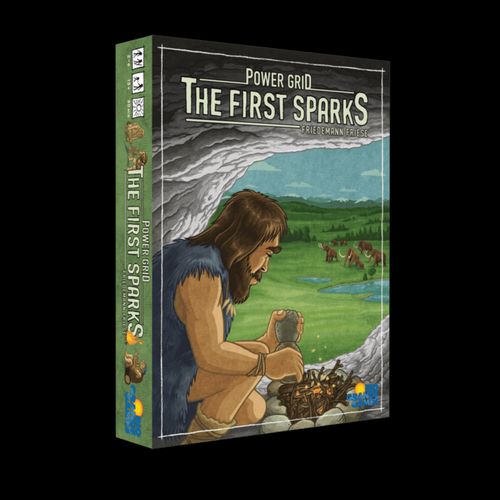
Power Grid: The First Sparks
Power Grid: The First Sparks Rulebook
Table of Contents
Table of Contents
- Game Components
- Author's Foreword
- Preparation
- The Landscape Tiles
- The Food Tokens
- The Technology Cards
- Playing the Game
- The Placement Round
- All Following Game Rounds
- 1. Buying New Technology/Discarding Rotten Food
- 2. Going Hunting/Feeding the Clan
- 3. Spreading the Clan
- 4. Bureaucracy
- Game End
- 2 Players
- 6 Players
- Details of the Knowledge Cards
Game Components
- 6 board tiles (4 for 2-6 players, 1 for 4-6 players (marked), 1 for 5-6 players (marked))
- 1 storage board with tracks for clan size (1-15) and player order (1-6), harvest spaces for food (field, berry bush, lake, woods, valley)
- 102 clan members: 17 each in green, red, blue, black, white and yellow
- 98 food tokens:
- 18 field crops (value 1)
- 12 field crops (value 3)
- 18 berries (value 2)
- 20 fish (value 3)
- 18 bears (value 3)
- 12 mammoths (value 4)
- 42 technology cards: 6 starting "herbs" cards, 28 "tools" cards, 7 "knowledge" cards, 1 "shuffle" card
- 6 overview cards "food/spreading the clan"
- 6 overview cards "phases of the game turn"
- 12 tiles "food supply" (4 berries, 3 fish, 3 bears, and 2 mammoths)
- rules sheet
- achievement sheet
Author's Foreword
To celebrate the 10th anniversary of the original Power Grid (called Funkenschlag), I wanted to do something special. While thinking about the different possibilities, an interesting idea arose. Let's play with the name of the game (literal translation: "Flying Sparks") and do something with sparks. And this was the birth of this game: Stone Age, fire, food.
"The First Sparks", shifts the Power Grid principle into the Stone Age. The order of phases during a game round, the player order, the technology cards: all these parts you already know from Power Grid. But what is new? What is different?
"The First Sparks" is much faster and far more direct: you are immediately part of the action and each turn, each decision is important.
One piece of advice for the first game: if you decide to choose to buy a certain knowledge card, adjust your strategy completely to this card. Do not try to get everything at once, either. The most important hint: do not spend too much food on spreading your clan. If you do, you may not have enough left for buying the next technology card. This is the biggest possible mistake you can make in "The First Sparks"!
Enough for now: Have a lot of fun during the Stone Age!
Preparation
The following are the game rules for 3-5 players. The changes for 2 and 6 players are covered later, in their own sections.
-
Each player takes 17 clan members in (his) color and takes 7 food (1 field crop of value 1 and 2 field crops of value 3). The players always place all food tokens visibly in front of themselves (in their play areas). Additionally, each player takes a "food/spreading the clan" overview card and a "phases of a game turn" overview card.
-
Take a number of starting "herbs" cards with the lowest numbers matching the number of players (e.g., with 4 players use the cards with numbers "1-4") and shuffle them. Place the remaining starting cards back into the game box. Each player takes 1 starting card randomly and places it face up in his play area. Afterwards, the player with the highest numbered starting card (with 4 players this is the "4") places a clan member on space 1 of the player order track. The other players follow in descending order based on the number on their starting cards, placing their clan members on spaces 2, 3, and so on.
-
Each player places 1 additional clan member on space 1 of the clan size track.
-
Place all food tokens as a general supply next to the storage board. Place the following food tokens on the harvest spaces of the storage board: place all field crops on the field, place 4 berries on the berry bush, place 2 fish on the lake, place 3 bears in the woods, and place 2 mammoths in the valley. These spaces represent the "harvest" and should not be confused with the general supply! The harvest pile of the field crops is the only unlimited supply.
-
Depending on the number of players, choose the correct number of landscape tiles and shuffle them face down. In player order beginning with the first player (clan member on space 1 of the player order track), the players create the game board. The first player draws a landscape tile and places it in the middle of the table. The remaining players follow in player order and draw landscape tiles and place them as a game board. The second tile must be adjacent to at least one edge of the first tile. Each following landscape tile must be adjacent to at least two other landscape tiles.
Note: only during the very first game you should use the recommended starting game boards.
-
To show the food supply, place the correct tiles on the "harvest spaces". The food supply is dependent on the number of players and the number of different hunting areas on the game board. Each game round a number of food tokens is placed on the harvest spaces based on the refill table in the Bureaucracy phase below, plus 1 additional food token for each matching hunting area of the game board.
Example: the base food supply for 3 players is 3 berries, 2 fish, 1 bear, and 1 mammoth. With the landscape tiles shown, the complete food supply is as follows: 5 berries, 3 fish, 2 bears, and 3 mammoths.
-
Place technology cards numbered 07-14 in two rows to represent the technology market. Place cards 07-10 in increasing number order (left-right) in the top row (the current market) and cards 11-14 in increasing number order (left-right) in the bottom row of the market (the future market).
The Landscape Tiles
Each landscape tile consists of two hunting areas surrounded by 3 spaces. The clans can only hunt a certain type of food when they have at least one clan member standing next to a matching hunting area and own 1 or more matching tools - see below. If there are several identical hunting areas, both the food supply increases (see the "bureaucracy" phase below) and the effectiveness of the tools increases, if the clan stands next to two or three of these hunting grounds (see the "hunting" phase below).
Note: we know that players cannot hunt berries and that fish, bears, and mammoths rarely lie on harvest spaces. But to simplify the game terms, we use consistent terms for "hunting", "hunting areas" and "harvest" or "harvest spaces".
The Food Tokens
The different food tokens (both plants and animals) have different values - see also the overview cards. The food equals money. Players can always exchange their food tokens during the game with the general supply when players need change (do not exchange food tokens with the harvest spaces!). As the demand for field crops is higher, the green tokens count as "1s" and the yellow as "3s".
The Technology Cards
There exist two different types of technology cards: tools and knowledge.
a) Tools
With help of the tools, the clan harvests food when hunting. The clan can own a maximum of 3 tool cards. If the clan gets a fourth tool, the clan discards any one of its tools and removes it from the game. The starting "herbs" card and the tool "field" cards are considered as tools, too. Clans can own any combination of tools, even several copies of the same type (e.g. 2 bows).
Example: (Berry-)Basket - the clan needs to stand next to at least 1 hunting area with berries to be able to use this basket.
Example: Field - secure harvest, independent of the clan's positions on the game board.
b) Knowledge
With help of knowledge, the clan gets permanent advantages. Besides its tools, a clan can own any number of knowledge cards. Knowledge does not occupy any space and can be hoarded in addition to tools. But a single clan can only own one copy each type of knowledge.
Example: Fire - does not count against the maximum of 3 tools cards.
Reading a technology card
A. The number shows the rank of the card.
B. The name and the graphics illustrate the tools or knowledge and have no relevance for playing the game.
C. The price shows the value of food which the buyer of the card needs to pay and place back into the general storage. (e.g. 3 field crops)
D. The color of the box and the symbols determine the type and number of food tokens which the player will harvest during hunting. Green is for field crops, red is for berries, blue is for fish, light brown is for bears and dark brown is for mammoths. The fields (and herbs) always give the clan a secure amount of food. The other tools give the clan a changing amount of food, depending on the number of food tokens on the harvest spaces. The clan must also stand next to the correct hunting area to be able to use the matching tools.
(Example: with the basket shown above, the clan takes 1 berry, if there are up to 3 berries on the harvest space. If there are 4 to 6 berries, the clan takes 2 berries and if there are finally 7 or more berries on the harvest space, the clan takes 3 berries).
E. The text explains the advantage of the knowledge, if the clan owns this card.
Playing the Game
The game starts with a short placement round representing the clans' initial settlement on the game board. Afterwards, several game rounds follow, during which the clans buy technology cards, go hunting, and spread on the game board. The biggest clan at game end will win the game.
The Placement Round
Settling the clan
Each clan starts with one or two clan members on the game board.
a) In reverse player order starting with the last player, each clan must place one clan member on any one empty space of the game board. Next to each hunting area only 1 clan can settle with its first clan member. This first placement is free. Depending on the adjacent hunting area, the clan can harvest the matching goods when it is hunting.
For the very first game, we suggest players use suggested starting positions. Beginning with the second game, the clans can choose their starting spaces on their own.
Suggested starting places for the first game: in reverse player order the last player places 1 clan member on space 1, the second to last player on space 2 etc.
b) Afterwards, in player order starting with the first player, each clan may voluntarily place a second clan member. The clan places its second clan member on a space adjacent to the first clan member. Other clans can already be occupying the chosen space. A space can be occupied by one member of each clan, up to the number of players in the game! The costs for placing the second clan member are the same costs as explained in the "Spreading the clan" phase below.
c) After each clan has placed a total of 1 or 2 clan members on the game board, the correct number is marked off on the clan size track.
Determining the player order
Because the player order is chosen randomly at the start of the game, players now re-determine the player order. The player with the biggest clan is the new first player, followed by the other players in order of descending clan size. In case of a tie for clan size, the tied player with the higher numbered starting "herbs" card is ahead of the other.
Example: at the start of a 3-player game, Christian was first player (starting card "3"), Angelika was second (starting card "2") and Steffi third (starting card "1"). Only Angelika places 2 clan members and is the new first player. Both Christian and Steffi want to start with only 1 clan member, so Christian is the second player because of his higher starting card and Steffi remains in third position.
All Following Game Rounds
Players will play several game rounds, each consisting of 4 phases. Each phase is finished by all players before players continue with the next phase.
- Buying new technology/discarding rotten food
- Going hunting/feeding the clan
- Spreading the clan
- Bureaucracy
1. Buying New Technology/Discarding Rotten Food
During this phase, the clans can each buy one technology card. At the end of the phase it is possible that part of the food rots and must be discarded by the clans.
Buying new technology
At the start of this phase, place a field crop of value 1 as a bonus on the lowest-numbered card of the current technology market.
In player order starting with the first player, each player chooses a technology card and offers it for purchase. On a player's turn, he chooses between the following two options:
a) Pass
If he does not want to choose a technology card and offer it for purchase, he can pass. He will not get a new technology card in this game round. Even if other players later choose technology cards and offer them for purchase in the same game round, he is not allowed to buy a card.
b) Choose a technology card for purchase
The player chooses a technology card for purchase from the current market and offers it for purchase (one of the four technology cards from the top row). In player order, the other players have one chance to buy this card for themselves. The player furthest down in the player order who wants to buy the offered card, pays the printed costs with his food and places the technology card face up in his play area. If no other player wants to buy the card, the offering player must buy this card. When a player takes the lowest-numbered card from the current market, he also takes the field crop which lies on this card. He can immediately use this free field crop to pay part of the costs of the technology card.
Immediately draw a new technology card to replace the sold card and place the new card in the market. Rearrange the technology cards in the market in ascending order: the four lowest-numbered cards in the current market, the four highest-numbered in the future market. If players draw a lower card than the one that received the free field crop at the start of the phase, remove the field crop without replacement and place it back to the general storage.
If players draw the "shuffle" card during this phase, place it temporarily as the highest card in the market. Shuffle the remaining technology cards in the draw pile thoroughly and place them as a new draw pile. Continue this phase and offer new technology cards until all players have either bought one or passed on this opportunity. Draw new cards from the draw pile if necessary to refill the market.
Each clan can only buy 1 single technology card in each game round. To keep track, players can flip the clan members of the players on the turn order track when they buy a card in the game round.
If the first player takes his chosen card, the next player in player order takes his turn at offering a technology card for purchase, if he has not already purchased a technology card in this game round. If he has, the next player in turn order may offer a card, and so on. When another player buys the technology card, the current offering player may again choose a new technology card for purchase from the current market or pass.
During the game, each clan can only own 3 tools at any time. When a player buys a fourth tool, he must discard one of his tools and place it back into the game box. The knowledge cards do not need any spaces. A clan can own any number of (different!) knowledge cards besides its tools!
After all players have bought a new technology card or passed and the lowest technology card (with the free field crop) still lies in the market, remove the field crop, and place it back to the general storage. Discard this technology card and place it back into the game box. Draw a replacement card and rearrange all technology cards in the market in ascending order.
Discarding rotten food
All clans without a knowledge "fire" card must discard 1/3 of their food (rounded down) and place it back into the general storage. A clan with fire keeps all its food.
Example: at the end of the phase, Christian owns 1 mammoth, 1 berry, and 2 field crops for a total value of 8. He must discard food of value 2 and discards the berry.
2. Going Hunting/Feeding the Clan
During this phase, the clans go hunting and need to feed their clan members. The clans collect food from the harvest spaces if they have both the appropriate tools and stand next to the matching hunting areas. At the end of the phase, players must feed their clan members on the game board.
Going hunting
In reverse player order beginning with the last player, the players go hunting. On a player's turn, he checks to see which hunting areas his clan members are standing next to and which matching tools his clan owns for this type of food. Only when the clan fulfills both criteria can it successfully go hunting. The clan can use one or more tools of the same type as long as at least a single clan member stands next to the matching hunting areas. For the starting "herbs" card and the tool "field" card, the clan always harvests a secure amount of food, without needing to stand next to a certain hunting ground.
Example: Christian's clan has 1 clan member next to the lake and owns a fishing rod, allowing the clan to harvest fish. Another clan member stands next to a berry bush, but the clan has no basket and for this reason cannot harvest berries. As the clan still has its "herbs" card, it harvests 1 field crop.
The clan checks each tool card for the amount of food it is allowed to harvest. It takes the matching number as "harvest" from the harvest spaces of the storage board. If a clan owns more than one tool card of the same food type, it can use all of them during hunting and can choose the order of the tool cards to get the maximum harvest. The player takes all food tokens for the first tool before checking the amount of food on the harvest space for the next tool of the same type.
If a clan has clan members next to 2 (or even 3) hunting areas of the same type, it can use its matching tools more effectively and harvest more food. When a clan takes food from the harvest spaces, just add 1 (or 2) additional virtual tokens to the number of food tokens when counting for the matching type. There is no advantage for having several clan members standing next to the same hunting ground.
Example: Christian's clan owns the mammoth spear and can harvest 2 mammoths, if he has at least 1 clan member next to a valley and if there are a minimum of 4 mammoths on the harvest space. If Christian's clan members are standing at two different valleys, he already harvests 2 mammoths, if there are a minimum of 3 mammoths on the harvest space, as he is allowed to add 1 additional virtual mammoth to the count.
Feeding the clan
After a player's clan receives its harvest, he must feed 1 food to each clan member on the game board and place that food back into the general storage. In very rare cases, if a player does not have enough food, he must choose and remove the starving clan members. The player adjusts his clan member on the clan size track to show the number of surviving clan members on the game board. He can choose which clan members to remove as long as the remaining clan members all stand on adjacent spaces as one group.
3. Spreading the Clan
During this phase, the clans spread out on the game board to reach new hunting areas. On each space, each clan can only have a single clan member, but all clans can share a single space. A player can place new clan members on any adjacent spaces; the new members do not need to stand in a row nor even next to each other. A player can directly use newly placed clan members as "neighbors".
In reverse player order beginning with the last player, each clan adds new clan members on the game board. On a player's turn, he pays the following base costs for new clan members:
| New clan members | 1 | 2 | 3 | 4 | 5 |
|---|---|---|---|---|---|
| Food | 1 | 3 | 6 | 10 | 15 |
A player may need to pay additional costs:
- If the player's clan moves across a mountain, he pays +1 food.
- If the player places the new clan member in a space already including one or more opposing clan member(s), he pays +X food, where X is the total number of clan members including his own (e.g. +2 food for being second, +3 food for being third…).
Example: Costs for spreading 2 clan members. Green spreads into 2 empty spaces and pays 3 food (base costs). Black first spreads to an occupied space and then across a mountain, he pays 3 (base costs) +2 for the occupied space +1 across the mountain: a total cost of 3+2+1 = 6 food.
When a player places new clan members, it is best to place them on their sides and only stand them upright after calculating and paying all the costs. A player is only allowed to place a maximum of 5 clan members on the game board during this phase. Afterwards, he adjusts his clan member on the clan size track to show his new number of clan members.
Very important: at the start of the next game round, a player needs some food to be able to buy a new technology card. If a player spends all (or too much) food for spreading his clan, he will need at least one complete game round to be able to buy a new technology card from the market!
4. Bureaucracy
During this phase, the players determine the player order for the next game round, refill the food supply on the harvest spaces, and remove the highest-numbered technology card from the technology market.
Determine the player order
The player with the biggest clan is the new first player (according to the clan size track). The other players follow in decreasing clan size. In case of a tie, the player among them with the highest-numbered technology card is first.
Example: Angelika has 6 clan members and Steffi and Christian both 7. Because Steffi has the technology card #18 and Christian only the #15, Steffi is the new first player, Christian is second and Angelika third in the player order.
Refill food supply
Depending on the number of players, players refill the following base number of food on the harvest spaces.
| Berry | Fish | Bear | Mammoth | |
|---|---|---|---|---|
| 2 players | 2 | 1 | 0 | 0 |
| 3 players | 3 | 2 | 1 | 1 |
| 4 players | 4 | 2 | 1 | 1 |
| 5 players | 5 | 3 | 2 | 1 |
| 6 players | 6 | 4 | 3 | 1 |
Additionally, players refill 1 additional food token for each hunting area of the game board. For an easy overview, place the matching food supply markers on the harvest spaces at the start of the game.
Example: in a game with 4 players, there are 3 berry bushes, 2 lakes, 2 woods, and 1 valley. The food supply for this game is: 7 berries, 4 fish, 3 bears, and 2 mammoths.
Adjust technology market
Remove the highest-numbered technology card from the future market and put it face-down on the bottom of the draw pile. Draw a replacement card and place it in the market. Rearrange the technology cards in ascending order: the four lowest in the current market and the four highest in the future market.
When players draw the "shuffle" card in this phase, place it as the highest card in the technology market, shuffle the remaining cards of the draw pile, and place them back as a new face down draw pile.
When the "shuffle" card is the highest card in the technology market, the game changes as follows: remove the "shuffle" card together with the lowest card of the market and place them back in the game box. Thus, the whole technology market is reduced to a total of 6 technology cards. From now on, the players can choose from all 6 cards during phase 1 and players do not place the highest card back below the draw pile for the remaining game rounds.
Now players start a new game round with phase 1 "Buying new technology/discarding rotten food".
Game End
As soon as one clan places its 13th clan member on the game board, players finish the current phase 3 ("Spreading the clan") so that all players can finish their turns. Of course, a player is allowed to place more than 13 clan members, as long as he can pay for them (up to a maximum of 15 clan members). The game ends now, so players skip phase 4 ("bureaucracy") in the last game round.
The player with the most clan members wins the game. In case of a tie, the player among them with most remaining food is the winner.
2 Players
For 2 players, all rules from above are valid, with the following additions. The main change is a third neutral clan spreading on the game board. Additionally, it is possible to remove technology cards from the market together with an amount of food from the harvest spaces.
Preparation
Randomly determine the player order between the two real players with the starting cards "1" and "2". The neutral clan is ignored in the player order. Afterwards, players create the game board with 3 landscape tiles. The first player places the first 2 landscape tiles and the second player the third.
Remove the following technology cards from the game and place them back in the game box: 10, 11, 15, 20, 24, 26, 33, 39. Place only 6 cards in the technology market (the 3 smallest cards in the current market, the 3 following higher cards in the future market). After placing the starting market, shuffle the remaining cards, and remove 2 random cards face down from the stack before placing the "shuffle" card on the bottom of the draw pile.
Place all clan members of a third color next to the game board. Place 1 of these clan members on space 1 of the clan size track.
Playing the game
The placement round
The second player places 1 clan member of the neutral clan on any one empty space of the game board. Afterwards, both players place 1 or 2 clan members according the normal placement rules. Adjust both the clan size track (for all 3 clans) and the player order to finish the placement round.
For the very first game, we suggest players use the starting game board for 3 players. Before both players have the chance to place their second clan members, the second player chooses one of the 3 starting spaces for the neutral clan before he takes one of the remaining spaces for himself.
All following game rounds
1. Buying new technology
The first player does not need to buy his first chosen technology card. If the second player declines his option to buy that card, the first player can decide to discard this card and place it back into the game box. If it is a tool card, he also removes the highest amount of matching food tokens from the harvest space (he follows the normal hunting rules and checks the number of food tokens vs. the harvest). The first player must buy the second card he chooses, if the second player again declines the option to buy!
Example: Christian is the first player and chooses the basket #22. As Hedwig does not want to buy this card, Christian decides to discard it. There are 5 berries on the harvest space, so Christian takes 2 berries from that space and places them back in the general storage.
3. Spreading the clan
The second player begins the phase by placing clan members of the neutral clan before he places his own clan members on the game board. He must place as many new neutral clan members until the neutral clan size equals the first player's clan size. The neutral clan members must follow all normal placement rules (only one clan member of the same clan in each space and sharing the space with members of opposing clans), but it does not need to pay any placement costs. Afterwards, both players follow as explained in the rules above.
4. Bureaucracy
Adjust technology market
When players remove the "shuffle" card together with the smallest technology card, the whole market is reduced to 4 cards.
6 Players
For 6 players there is only one small rules change to the existing rules.
Preparation
After preparing the technology market, place the "shuffle" card and the technology card #15 to the side and shuffle the remaining cards. Afterwards, place the technology card #15 face down on top of the draw pile and the "shuffle" card face down below the pile.
Playing the game
The placement round
We suggest to play only with 6 experienced players, so we do not include suggested starting positions for the very first game.
Details of the Knowledge Cards
Fire: when a clan discovers fire, the player can hide all of his food tokens and does not need to show them to the other players for the rest of the game. In Phase 1, this player does not lose any rotten food and simply keeps all his remaining food (technology cards #9 and #15).
Plow: the player gets bonus field crops for tool "field" cards. The starting "herbs" cards do not count for this bonus (technology card #18).
Transport sled: the clan can have up to 4 tools. The player places the fourth tool card on the transport sled as a reminder. When the player buys a fifth tool card, he must discard one of his tools and place it back in the game box (technology card #21).
Speech: the clan can talk to opposing clans. During phase 3, the player always pays one less food when he places a clan member in a space with opposing clans (e.g. +1 food for being second, +2 food for being third…) (technology cards #24 and #26).
Intelligence: as soon as a clan gets intelligent, the player order must be immediately adjusted for the first time. During phase 4 ("Bureaucracy") the player is always moved back one space in the player order - he knows that being "worse" in player order is clever (technology card #28)!