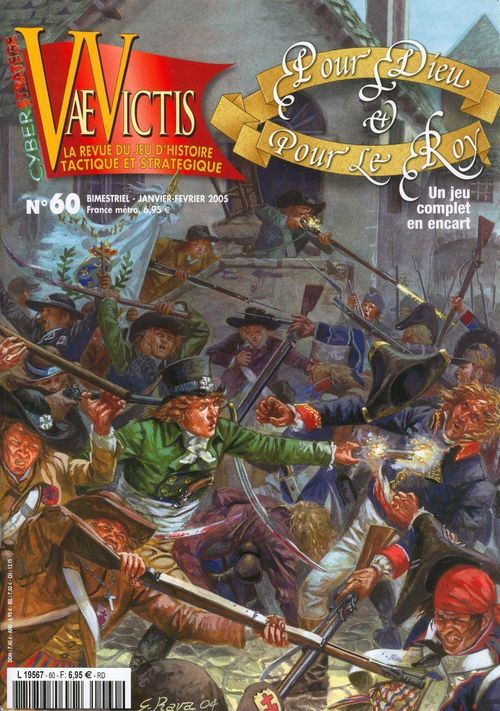
Pour Dieu et pour le Roy
Pour Dieu et pour le Roy Rulebook
Table of Contents
Table of Contents
0 – Overview
0.1 Game Scales
A game turn equals a month. One centimeter on the map represents around 3 km (the map areas, irregular in size, are about 10 to 15 km from center to center). Each combat strength point represents from 500 to 1500 men.
0.2 The Map
The map is divided into land areas which serve to regulate movement. There are four types of zones:
- bocage zones, with very dense vegetation;
- marsh zones;
- plains zones, very open;
- 'mixed' zones, with normal vegetation, neither too dense nor too sparse.
Zones are defined by white borders, the ocean, the Loire river and minor rivers. Rivers in 'light blue' are considered as included in a zone, they do not mark its borders.
Zones can also include a stronghold (represented by a chateau), a city or village, forests or hills. They may also be crossed by minor rivers, royal roads or major routes. Other than the special case of strongholds, the other terrain elements do not have a direct influence on combat (a bocage zone with woods for example will have the same effect as a bocage zone without woods).
The influence zones of the Vendée armies are represented directly on the map by borders colored as follows:
- in red: "Anjou", zone of the catholic and royal Grande Armee of Anjou and Haut-Poitou [Upper Poitou]. This zone includes a sub-zone, in the south, composed of la Gâtine (with Bressuire as "capital");
- in green: the "Center", zone of the catholic and royal army of the Center;
- in blue: "Bas-Poitou", zone of the catholic and royal army of the region Retz and Bas-Poitou [Lower Poitou];
- in red and blue: the "Loroux", zone of troops from the Loroux.
Colored pennants indicate the supply bases of the different Republican armies:
- in yellow: supply bases of the army which operates in the northwest, from Nantes and Paimboeuf;
- in red: supply bases of the army which operates in the northeast, from Angers, Saumur and Thouars;
- in orange: supply bases of the army which operates in the south, from Sables d'Olonne, Luçon and Fontenay-le-Comte.
White Churches - in Mortagne, Châtillon and Cholet - indicate the primary objectives of the Republicans.
Crosses (two in Anjou, two in the Center, two in the Loroux and three in Bas-Poitou) mark secondary objectives.
0.3 Dice
The game requires the use of two six-sided dice per player, the first die being white and the second some other color. When the rules refer to 1d6, roll a single six-sided die, for a result from 1 to 6; when they refer to 2d6, roll both dice and sum the totals, for a result from 2 to 12.
1 – Game Counters
1.1 The Generals
[see counter examples ('Exemple de Pions') in box on p. 31 - general counters have a portrait and the person's name in a strip along the left side].
"General" counters represent the chief historical leaders. They have a strategic competence rating [number on the left, e.g the Republican Boulard is a '2'], used to obtain Action Points (AP) or to attempt marches 'to the sound of the guns', and a tactical competence rating [number on the right, e.g. the Vendéen Bonchamps is a '3'], used in battles. In addition, the counter of a Republican general has a fleur-de-lys if he was of noble birth [Canclaux, Menou, Biron, d'Ayat, Boulard, Aubert du Bayet], or a Phrygian cap if he was part of the sans-culottes movement [Rossignol, Ronsin, Santerre, Léchelle] (and nothing if he was neither). This supplementary characteristic influences his chances of acquitting himself before the Committee for Public Safety, if he has the misfortune of being accused (see §2.6).
1.2 Combat Units
[again, refer to the 'Exemple de Pions' box on p. 31 of the rules - combat units have an armed person on the counter, facing to the right if Republican, to the left if Vendéen]
"Combat unit" counters represent the masses of fighters on each side. Each counter has a value, from 1 to 10, corresponding to its combat strength points. At any time during the game, you may replace a single counter with several counters, or vice versa, provided that:
- the total number of combat strength points does not increase;
- the replaced and replacing counters have the same affiliation.
Thus, an "Anjou" counter of strength 10 can be replaced, for example, with four other "Anjou" counters: one of strength 5, two of strength 2 and one of strength 1.
1.3 Distinctive Colors
The counters are organised into four Vendée armies (Anjou, Centre, Loroux, and Bas-Poitou), and four Republican armies (Nantes, Saumur, La Rochelle, and Mayençais). The distinctive color of each army - present in the counters of this army - allows for easy determination on the map of its influence zone (for the Vendéens) or its supply bases (for the Republicans). The Mayençais use the supply bases of the Republican army that they reinforce. Certain counters - émigrés or deserters - do not have distinctive colors.
1.4 The "Events"
[single-sided counters with various images, labelled E1 through E15]
At the start of the game, the Vendée player receives the ten "Event" markers numbered E1 to E6, and the Republican player receives the ten numbered E7 to E15. These counters may be used by the players during the game (see §6). [Actually, I count only nine numbered E1 to E6, and nine numbered E7 to E15?]
1.5 The "Tactical Incidents"
[single-sided counters labelled T1 through T12]
At the start of the game the 18 'tactical incident' counters numbered T1 to T12 are placed in a sack or opaque container so that they can be drawn at random during combats (see §4.3). Use ONLY THREE Tactical Incident T1 markers, not all four! [Change per errata in VV61 to improve the life expectancies of Vendée generals]
1.6 The Markers
Markers are used by placing them on the appropriate track on the map.
The Turn marker [has an image of a pocket watch] is used to indicate - on the Turn Record Track - the current game turn.
The 'Republican Morale' and 'Vendée Morale' markers [they show the factional flag and an arrow] are used to indicate - on the Morale Level Track - each side's morale, which fluctuates between -2 (morale "very low") and +2 (morale "excellent").
'Arms and Powder' markers [show muskets leaning on barrels of gunpowder] are used to indicate - on the 'Arms and Powder' track - the armament status, which varies between -2 (few firearms and/or gunpowder) and +2 (numerous firearms and no shortage of powder). There are three such counters, one for each of the main Vendée armies. The men of Loroux use the counter of the army they are with or, by default, the Army of Anjou marker.
2 – Sequence of Play
For God and For the King lasts eight game turns, each turn having the following phases:
- Check wounded generals
- Arrival and placement of reinforcements
- Initiative
- Operations
- Desertion
- "The Committee for Public Safety is Watching ..."
- End of Turn
2.1 Check Wounded Generals
[T# marker shows a portrait with a bandage across]
For each of his wounded generals, each player rolls 1d6 if the wound is serious, or 2d6 if it is light. If the result is at least 6, the general returns to the game during the reinforcements phase of this turn. If the result is less than 6, the general is placed into the next turn's space on the Turn Record Track (and an identical check will be made for him next turn).
2.2 Arrival and Placement of Reinforcements
The Republican player plays, if he can or wishes, an event which releases the arrival of reinforcements, calculates his reinforcements according to the 'Reinforcements Table' ["Table des renforts"] and places them, as well as any of his generals who have returned to the game this turn, on the game map. All reinforcements must be placed on one or more supply bases of their army, or in an adjacent zone if a base is occupied by the enemy.
Next, the Vendée player plays, if he can or wishes, one of his "Alarm" events [marker shows a bell being rung] and proceeds in the same manner as the Republican player, except that Vendée reinforcements, and generals returning to the game this turn, are placed in the influence zone of their army, in one or more open areas not controlled by the enemy, or if that is not possible, in one or more areas (still open and not controlled by the enemy) adjacent to their influence zone.
A zone is said to be free of the enemy when it contains no enemy combat points (thus, a zone containing only enemy generals is indeed open).
Reinforcements are calculated differently for the two sides:
- for the Republican, the Reinforcements Table gives the total combat points to be added to those already on the map for the army in question. For example, if the result for the Nantes army is 8, and this army already has 14 combat points on the map, it now has 22 combat points. This number is only limited by the total number of counters: if there are not enough counters available for the army in question, the 'excess' combat points are lost;
- for the Vendéen, the Reinforcements Table gives the total combat points for the army in question; this total INCLUDES the combat points already on the map. For example, if the result for the army of Anjou is 20, and the army already has 8 combat points on the game map, it only receives 12 more. If the number rolled is less than the number of combat points already on the map, the 'excess' are NOT removed.
2.3 Initiative
Each player rolls 1d6 and adds to the result the Strategic Competence rating of his best general, and his side's morale level. In case of a tie, reroll. The player who has the higher total wins the initiative and may choose to:
- seize the opportunity and begin the Operations Phase;
- yield the opportunity to his opponent, who then begins the Operations Phase.
2.4 Operations
The player who begins the Operations Phase:
- chooses all or part of a stack of counters;
- calculates the Action Points (AP) of this stack of 'active' counters;
- spends this stack's APs to move and have combat.
When the player has spent all the APs of this stack or when this stack loses a combat:
- either the player chooses another stack of counters and proceeds as above;
- or the player yields the opportunity to his opponent, who may in turn choose a stack, calculate the APs, spend them, etc.
The Operations Phase continues so long as there are counters that have not been activated and so long as the players do not pass in succession, one and then the other. In the latter case, the Operations Phase ends immediately, even if there are counters who have yet to move: too bad, shouldn't have passed the activation!
Exception: the player who won the initiative may attempt to 'preempt' his opponent once (and only once) per Operations Phase. On 1d6, you must roll equal to or less than the Strategic Competence rating of the best general in the stack which wishes to pre-empt:
- success means that the activation opportunity changes and the player begins by activating the stack that he used to pre-empt. Then, he continues to activate other stacks or pass the opportunity. When the preempted player regains the opportunity, he is not required to activate the stack that he was activating when pre-empted;
- in case of failure, the Operations Phase continues normally.
2.5 Desertion
[literally Turncoat, men who are deserting the army to return to civilian life]
During the Desertion phase, the Vendée player rolls 2d6 for each of his four armies, to determine the percentage of combat points that desert from the army. This number is rounded to the nearest whole number (1.2 rounds to 1; 1.5 or 1.8 round to 2). For example, if 40% of the 19 combat points of the army of Anjou 'desert', the player must remove 8 combat points.
Combat points are removed from the game immediately with the following decreasing order of priorities:
- first in Clear areas;
- then outside of Vendée army influence zones;
- then outside the influence zone of their army;
- last within the influence zone of their army.
If a Vendée general finds himself without combat points, remove him from the map to return to the game in the next turn's Reinforcements phase.
Counters of deserters, emigrés, and Chouans do not take part in the Desertion phase (they can only be lost through combat). The last turn does NOT include the Desertions Phase.
2.6 "The Committee of Public Safety is Watching ..."
The behavior of each Republican army is scrutinized by special representatives, to verify that the generals indeed attempted the impossible. Thus, for each Republican army, all of the generals except one:
- must have fought with Vendée combat points during the preceding Operations Phase;
- or be currently accompanying Republican combat points within the influence zone of a Vendée army.
One and only one general per Republican army has the right to violate the above objectives without penalty. Any other generals must immediately explain themselves before a revolutionary tribunal: for each 'delinquent' general, roll 2d6 with a -2 modifier if the general is a ci-devant [noble] and +2 if he is a sans-culotte. If the modified result is at least 7, the explanations are convincing and he is saved. If the result is less than or equal to 6, he is accused of a counter-revolutionary plot and led to the guillotine ...: immediately remove the general from the game.
2.7 End of Turn
If this was the eighth turn, the game is over (determine the victor, see §7.2), otherwise advance the Turn marker one space and begin the next turn.
3 – Action Points and Movement
3.1 Calculation of APs
The number of APs is determined by using the 'Action Points Calculation Table' ["Calcul des points d'action"]. If several generals are present, for AP calculation consider the one with the best Strategic Competence.
3.2 Spending APs
APs are spent to move counters from one area to an adjacent area, by paying the number of APs indicated on the 'Action Costs Table' ["Coût des actions"]. The higher the number of APs, the more the counters will be able to move (combat actions are 'free').
Movement Example: Let's suppose that General Menou rolls an 8 on 2d6 which gives him 5 APs. He decides to advance along the royal road towards Vihiers (0.5 AP per area moved into), then to move off to the northwest into the bocage for 3 additional APs, while leaving two combat points free of charge in Vihiers. The total cost is 4.5 APs. As for the Anjou troops [Angevins] in Chalonnes, they cannot 'benefit' from Sapinaud because he is not from the same army: they will therefore have only 2 APs available, which they spend to move to south of Chemillé. As for Sapinaud, he decides to accompany the Anjou troops, but he could have made a move by himself. Note that the Angevins cannot move directly from Chalonnes to Chemillé because that would be moving from one enemy-controlled area directly into another enemy-controlled area, which is forbidden [see §3.4 infra].
It is not necessary for one or more combat points to be accompanied by a general in order to perform actions. However, the presence of at least one general of the same army has several advantages:
- the number of APs initially allotted is substantially greater;
- with a general you may choose only part of a stack to activate for actions;
- with a general you may 'drop off' some of the counters of the stack during movement, or 'pick up' counters which have not yet been activated and are in the area the stack is moving through.
In fact, a stack composed only of combat points - or with generals who are not from the same army as the combat points - will not move far and may never divide or collect counters from areas moved through.
It is not required to spend all of the APs allocated to a stack of counters. However, any APs not spent are lost: the APs may not be set aside to be spent later, not even in the same Operations phase or the next turn.
A counter may only be activated once per Operations phase.
3.3 Special Movements
Minor rivers, cities, villages, strongholds, hills and forests have no effect on movement.
To benefit from the movement cost along a major or royal road, the road must exist between the area departed from and the area entered.
The Loire (major river) is impassable, except for Republican counters which leave from an area which is not in the influence zone of a Vendée army and arrive in an area free of all Vendéens.
The Ile de Noirmoutier is accessible (in fact at low tide) by the passage from Gois.
3.4 Zones of Control and Movement
By default, a combat point in an area creates a Zone of Control which extends into all the areas adjacent to the one that it occupies.
Exceptions:
- A combat point in the Ile de Noirmoutier does not create a zone of control and cannot be controlled;
- a combat point on one bank of the Loire cannot control areas on the other bank of the Loire, except that a combat point in Nantes, Angers or Saumur does indeed control the area on the other end of the bridge.
An area is said to be controlled by a player when it is part of the zone of control of a combat unit of that player. An area is not controlled by the enemy when it is not in the zone of control of an enemy combat unit. An area may be controlled by both sides simultaneously.
A combat point which is in an enemy zone of control may ONLY enter:
- either an area containing enemy units;
- or an area free of enemy control.
Thus, it is not possible for combat points to move directly from one enemy zone of control into another enemy zone of control.
Exception: a combat point which enters and immediately leaves an enemy zone of control along a royal road or major road ignores the restrictions imposed by the enemy zone of control. [Note that this Exception was added in the errata from VV61, to force players to block roads with troops, not just ZoC]
3.5 Stacking and Restrictions
Stacking of counters in an area is unlimited, but the counters must still abide by the following rules.
Counters belonging to the three Republican armies of Nantes, Saumur and La Rochelle can never be in the same area, except as the result of a retreat or rout (in which case they must separate as soon as possible). Mayençais may only 'mix' with the army that they are reinforcing. When event E13 'Army of the West' is played, these restrictions are removed. [per the clarifications in VV61, prior to play of Event E13, an army may move THROUGH an area occupied by a different army, it may not STOP in such an area.]
Loroux counters may stack without restriction with Bas-Poitou counters (except La Cathelinière) or with Anjou counters, and vice-versa. When Loroux counters are with Anjou counters, they may stack with Center counters, and vice-versa. Anjou and Center counters can mix without restrictions.
For Bas-Poitou counters:
- La Cathelinière may not stack with other generals (he always operates independently);
- when reinforcements are being divided, La Cathelinière must, as far as possible, receive at least 20% of the combat points of the army of Bas-Poitou;
- Anjou and Center counters cannot enter an area containing Bas-Poitou counters;
- a stack of Bas-Poitou counters led by Charette or Joly must roll a 5 or 6 on 1d6 to be able to enter an area containing Anjou and/or Center counters. In case of failure, the APs are not spent and the player may continue to move the Bas-Poitou counters as he wishes. Only one attempt may be made per general and per Operations phase.
3.6 Hidden Movement
Each counter has a front with its statistics and a back identical among all of the counters of the same side.
In zones of influence of the Vendée armies:
- Vendée counters are placed with their fronts down (and their backs showing);
- Republican counters are placed with their fronts showing.
Outside of these influence zones, it is the reverse.
As soon as enemy counters are in the SAME area, all the counters are placed with their fronts visible. As soon as a counter is in an area without enemy units, it may immediately be placed face down, provided that it meets the above criteria.
Note: when a player enters an area adjacent to an area occupied by enemy units with their fronts hidden, the opponent must indicate whether the player's counters are in a controlled area or not. In the second case, that indicates that the face-down counter(s) are exclusively generals who cannot 'produce' by themselves a zone of control.
3.7 Isolated Generals
One or several isolated generals (i.e., alone, without accompanying combat points) cannot enter an area with an enemy combat point, but they may move through, without using roads or paths, an area containing only enemy generals or enemy zones of control.
When enemy combat points and isolated generals are in the same area, the generals are immediately displaced by the owning player towards an area empty of enemy counters (following the same priorities as for a retreat or rout, see § 4.5); if, to do this, the generals must move through one or more areas containing enemy combat points, the player rolls 1d6 per isolated general per enemy area moved through. On a result of 1, the general is captured: remove it from the game and, only if it was a Vendée general, raise the Republican morale one space.
4 – Combat
4.1 Combat Procedure
When combat points do a movement action and find themselves in an area with enemy combat points, a combat occurs. Independently of the strategic situation, the player who was moving the active units (i.e. those which just moved into the area) is termed the attacker, and the owner of the counters which were already in the area is termed the defender.
To resolve the combat:
- check for any reinforcements 'marching to the sound of the guns';
- randomly draw the appropriate number of 'tactical incident' markers;
- calculate the force ratio in calculating the ratio between the total combat points of the attacker and the total combat points of the defender. This ratio is first rounded in favor of the defender, to the nearest column on the Combat Results Table, then modified by any column modifiers to determine the final column;
- roll 2d6 and apply any modifiers to the die roll;
- determine and apply the result from the Combat Results Table, on the line corresponding to the modified 2d6 result and the final modified column.
Important: An odds ratio greater than 4:1 counts as 4:1. It is forbidden to KNOWINGLY attack at odds of less than 1:3 (otherwise resolve the combat with a -2 dice roll penalty).
The Combat Results Table gives the result for the loser:
- ARn-x = the attacker retreats n areas and suffers x percent losses;
- ADn-x = the attacker routs [D for "déroute"] n areas and suffers x percent losses;
- DRn-x = the defender retreats n areas and suffers x percent losses;
- DDn-x = the defender routs n areas and suffers x percent losses.
The loser's losses are calculated as a percentage of his own combat points total.
The winner's losses are calculated based on the attacker's original 2d6 roll (the dice are not rerolled):
- if the colored die is greater than the white die, the attacker suffers 10% losses;
- if the colored die is less than the white die, the attacker suffers 20% losses;
- if the dice are equal ('doubles'), the attacker suffers 30% losses.
The attacker's losses are calculated as a percent of the SMALLER of the winner's and loser's total combat points.
The percentage of losses (in combat points) is calculated in rounding to the nearest whole number. It is the owning player's choice how to divide these losses among his involved combat units. Combat units are immediately removed from the game.
For example, the attacker has 18 combat points and the defender has 12; a result of DR2-40 rolled with doubles-five means:
- the defender retreats two areas and suffers 5 losses: 40% of 12 is the loser's total = 4.8 = 5 losses. The loser is reduced to 7 combat points;
- the attacker receives four losses: 'doubles' = 30% losses, calculated from 12, which is less than 18 = 3.6 = 4 losses. The winner is reduced to 14 combat points.
Reminder: when apportioning losses, you are allowed to replace counters with other counters from the same army. Returning to the previous example, if the defender's 12 combat points are composed of a '10' counter and a '2' counter, he could immediately, when apportioning his losses, replace them with a '5' counter and a '2' counter.
Note on modifiers:
- depending on whether the player is attacker or defender, a bonus is either added to or subtracted from the 2d6 roll. For example, if the side with the better morale is the attacker, that makes +1 on the 2d6; if it is the defender, it is -1 on the 2d6. Similarly, a column shift to the left is an advantage to the defender and such a shift to the right is an advantage for the attacker. For example, an unsupplied Republican attacks in bocage with an initial force ratio of 1:1, which shifts left two columns (in the Vendée defender's favor) by two columns (one for combat in the bocage and the other for lack of supply), for a final odds ratio of 1:2;
- when several generals from the same side take part in the combat, only the best Tactical Competence rating is used. However this general must be accompanied by at least one combat point from the same army;
- when there are combat points present from different armies, the 'arms and powder' marker considered is that of the most numerous army present in terms of combat points;
- 'total defense' of a bridge is the case where ALL of the attacker's counters are crossing the bridge to attack; 'partial defense' is when only some of the attacker's counters are crossing the bridge to attack.
4.2 "March to the Sound of the Guns"
A stack of counters, accompanied by one or more generals, may attempt to 'march to the sound of the guns' to rejoin friendly counters attacked or attacking an adjacent area. They must abide by stacking restrictions. For example, a stack of Bas-Poitou led by Charette which wishes to reinforce a stack of Angevins must roll 5 or 6 on 2d6 to attempt to march to the sound of the guns [see § 3.5]. You cannot "march to the sound of the guns" across the Loire or the Gois.
[Note that the first sentence is changed, per errata from VV61, to allow both attacker and defender to 'march to the sound of the guns'.]
The player rolls 1d6. If the result is less than twice the Strategic Competence of the best general in the stack, the march is successful and the stack of counters moves into the adjacent area. Otherwise, the attempt fails and the stack does not move.
A counter which has already been activated this phase may still attempt to march to the sound of the guns. A counter may make as many marches to the sound of the guns as it wishes. A march to the sound of the guns does not prevent a future activation, except in the case of a rout (see §4.5).
4.3 Tactical Incidents
If the sum of all the combat points in the area is:
- less than 10 points: the attacker draws a single tactical incident;
- between 10 and 19 points inclusive: the attacker draws two tactical incidents;
- between 20 and 29 points inclusive: the attacker draws three tactical incidents;
- at least 30 points: the attacker draws four tactical incidents.
The consequence(s) of these tactical incidents applies - depending on the incident - before, during or after the combat, then, unless the contrary is specified, the incidents are put back into the pool (for future combats). Tactical incidents can be in favor of the defender or the attacker, they may also not be applicable to this particular combat (because the required conditions are not met): too bad, no supplementary tactical incidents are drawn.
[Note: according to the Clarifications in VV61: "Only Tactical Incidents T1 are cumulable, the others are not. If several identical Tactical Incidents other than T1 are drawn for the same combat, only one of these incidents is considered, the others are ignored (and none are redrawn)".]
T1 "If I die, avenge me!" After the combat, randomly choose one Vendée general who took part in the combat, and roll 2d6 modified by -1 if the Vendée side routed. If the modified result is:
- 9 or greater, the general is lightly wounded;
- 7 or 8, the general is seriously wounded;
- less than or equal to 6, the general is killed (Vendée morale lowers one level if the general had a tactical competence rating of 3).
Immediately remove the general from the game. If he is wounded, place him on the next turn space on the Turn Record Track.
T2 Deserters. If the combat result is a Republican rout and, after this combat, the Republican morale is zero or negative, then if the Republicans initially had:
- between 5 and 9 combat points, a single combat point of 'deserters' joins the Vendéens;
- at least 10 combat points, at most two combat points of deserters join the Vendéens.
Immediately place the one or two points of deserters in the area where the combat took place. At most two points of deserters may join the insurgents: when the second point has done so, remove this incident from the pool.
T3 "Cherry Sellers" [marker has a picture of a horseman, but I do not understand the reference?] The Vendée cavalry is effective: bonus of +/-1 for the Vendéen.
T4 Run for Your Lives! [literally "Save who can!", i.e. every man for himself] Panic in the Vendée ranks: two column shifts in favor of the Republicans.
T5 The Marie-Jeanne. If the Republicans are routed, the Vendéens capture a cannon which they make their palladium [reference is to a statue of Pallas that the Trojans considered their savior - essentially a symbol or mascot]: Vendée morale rises one level. Remove this counter from the pool.
T6 Out of Powder! The supply train didn't follow: retreat (without losses) before combat OR fight with a penalty of +/-2. The problem is temporary, this incident does not affect the 'arms and powder' markers.
T7 Hazards of the Job. After combat, randomly choose a Republican general who took part in the combat, and roll 2d6 modified by -1 if the Republican side routed. If the modified result is:
- 9 or greater, the general is lightly wounded;
- 7 or 8, the general is seriously wounded;
- less than or equal to 6, the general is killed (Vendée morale lowers one level if the general had a tactical competence rating of 3).
Immediately remove the general from the game. If he is wounded, place him on the next turn space on the Turn Record Track.
T8 One for the Scaffold. After the combat, if the Republican side retreated or routed, randomly choose one Republican general who took part in the combat and temporarily remove him from the game: he will go before a revolutionary tribunal during "The Committee for Public Safety is Watching ..." phase. If he isn't sent to the guillotine, he will return to the game in the Reinforcements phase of the following turn.
T9 "Draw Sabers!" The Republican cavalry is effective: bonus of +/- 2 for the Republicans in this combat in clear terrain, +/- 1 otherwise.
T10 Thunder of Guns. The Republican artillery is effective: bonus of +/- 1 in this combat for the Republicans.
T11 Howitzers from Hell. If there are Mayençais participating in the combat, their howitzers sow confusion in the Vendée ranks: bonus of +/- 1 in this combat for the Republicans.
T12 Treachery. Panic in the Republican ranks, unless Mayençais make up at least half of the Republican combat points: two column shifts in favor of the Vendéens.
4.4 Supply
A Republican combat point is supplied if it is:
- on the Ile de Noirmoutier;
- if it controls - or is in - an area with a road and it is possible to trace, using major or royal roads and without going through areas with Vendée combat points, a line of supply to one of the bases for its army.
4.5 Retreat and Rout
As indicated on the Combat Results Table, a retreat is one or two areas, a rout is three or four areas. If the last area is enemy-occupied, the counters retreat or rout as many areas as necessary to reach a free area.
For the attacker's counters or for the defender's counters which marched to the sound of the guns, the first retreat or rout area must be that from which the stack came. The defender may never retreat into the area from which the attacker came.
In all other cases, the choice of each retreat or rout area is determined as a function of the following priorities, in decreasing order:
- an area out of enemy control;
- an enemy-controlled area;
- an enemy-occupied area.
If several areas meet the first criterion, the player must choose as his second selection criteria (still in decreasing order):
- for the Republican, an area closer to a supply base for his army;
- for the Republican, an area closer to any supply base;
- for the Vendéen, an area closer to his army's zone of influence;
- for the Vendéen, an area closer to any Vendéen zone of influence.
If there is still a choice between several areas, the player chooses whichever he wishes. During a retreat or rout, you may not cross the Loire, except at a bridge. During a combat on the Ile de Noirmoutier, the defender is eliminated if he is forced to retreat or rout.
The winner may pursue a routed enemy by one or two areas. If the winner thus enters an enemy-occupied area, the pursuit ends and a combat immediately occurs.
An active counter which suffers a retreat or rout has its activation end. A counter which suffers a rout cannot be activated during this Operations phase. If generals find themselves isolated because all of the combat counters which accompanied them have been eliminated (by any means), each such general must check to see if he is captured, see §3.7.
4.6 Retreat or Rout into an Enemy-Occupied Area
[In the French rules this is numbered 4.5, should be 4.6]
If the Vendée player must retreat or rout in an area occupied by the Republicans:
- if it is a clear terrain area, Vendée combat points are eliminated in the amount of triple the number of Republican combat points;
- if it is a mixed area, Vendée combat points are eliminated in the amount of double the number of Republican combat points;
- if it is a bocage area, Vendée combat points are eliminated in the amount of the number of Republican combat points.
If the Republican player must retreat or rout in an area occupied by the Vendéens:
- if it is a clear terrain area, Republican combat points are eliminated in the amount of the number of Vendée combat points;
- if it is a mixed area, Republican combat points are eliminated in the amount of double the number of Vendée combat points;
- if it is a bocage area, Republican combat points are eliminated in the amount of triple the number of Vendée combat points.
5 – Markers
The morale values of the Vendéens and Republicans and those of 'arms and powder' are given by the position of appropriate markers in the spaces on the tracks located on the game map. The position of these markers fluctuates during the game between -2 and +2 as a function of factors the exhaustive list of which is given in the tables "Morale Marker Modifiers" and "Arms and Powder Marker Modifiers".
5.1 "Morale" Marker
As soon as a player wins a combat, the morale marker is adjusted as a function of the size of the battle (calculated by the sum of all the combat points of both sides). On the other hand, a defeat does not adjust the morale marker unless it is a rout.
The '-2' for "the first time that one of the primary objectives is occupied" only applies once. For example, Châtillon is occupied, the Vendée morale drops by -2; Cholet is then occupied, the morale does not suffer another -2, even if this is the first time that the Cholet objective is taken.
5.2 "Arms and Powder" Marker
The allocation of the bonus or penalty is done by giving each army if possible a +1/-1, starting with the most numerous (in combat points) army to the least numerous, that took part in this combat. If the bonus or penalty is for a single army, you must choose the one with the most combat points engaged in this combat.
6 – Events
Events are played by the players as a function of the criteria particular to each event. Unlike the tactical incidents, an event which is played is always and immediately removed from the game (if an event may be played several times, the player will have several copies of the identical event marker).
E1 Alarm. This event may be played during a reinforcement phase, except that of the first turn. Effect: for each of his armies, the Vendée player rolls 2d6, modifies the result, and checks the 'Reinforcements Table'. Except on the first turn, if the 2d6 for the Anjou army are doubles six - or any doubles if Event E8 'Loire Flotilla' has not yet been played by the Republican player - the Vendée player may make an additional roll on the "Chouans" column. These latter become part of the Anjou army (hence their distinctive red color).
E2 La Gâtine. This event may be played during the reinforcements phase, except during the first turn, provided that the Vendée morale is +1 or +2. Effect: the region of La Gâtine also rises in revolt. You receive as a reinforcement La Rochejaquelein and, if no event E1 Alarm is played this phase, four Anjou combat points. The region of La Gâtine (the five areas around Bressuire) are now part of the influence zone of the Anjou army.
E3 Liberation! This event may be played the first time that Bressuire is occupied by Vendée combat points. Effect: You free from prison the Marquis of Lescure who immediately joins your ranks. Place him in the Bressuire area.
E4 Bishop of Agra. This event may be played the first time that Thouars is occupied by Vendée combat points. Effect: A Republican prisoner claims to be the bishop of Agra, special envoy from the Pope. Vendée morale rises one space. However, at the start of each subsequent turn, roll 2d6 during the 'check wounded generals' phase: on doubles one, the fraud is discovered and word spreads through the Vendée ranks. Roll 1d6: on a 1 or 2, Vendée morale drops two spaces; one space on a 3 through 5, and no effect on a 6.
E5 English Assistance. This event may be played at any time, except on the first turn. Effect: Vendée messengers leave to try to obtain aid from the English and the Emigrés [Frenchmen who had fled revolutionary France and were living abroad]. At the start of each turn, during the 'check wounded generals' phase, roll 2d6:
- on doubles one, or any doubles (except doubles six) if 'Event E7 Isolating the Coast' has been played by the Republicans, some Vendée emissaries are captured: Republican morale rises one space (however, the Vendée player may continue to check each turn for the arrival of English assistance).
- on doubles six, a favorable response from the English and the émigrés who offer to land reinforcements, weapons and gunpowder. Vendée morale rises one space. The Vendée player secretly notes on a piece of scrap paper the landing area chosen and the anticipated turn of arrival (this turn cannot be the one in which the doubles six was rolled). During the reinforcements phase of the turn of arrival, the Vendée player receives 'émigrés' troops, arms and gunpowder as a function of the landing area selected:
- if the landing area is Les Sables or Paimboeuf, the Vendée player receives 6 combat points of émigrés and all the 'arms and powder' markers are placed on the +2 space;
- if the landing area is Saint-Gilles-sur-Vie, Noirmoutier or Pornic, the Vendée player receives 4 combat points of émigrés and the 'arms and powder' markers of the Bas-Poitou army and one other army of his choice are placed on the +2 space;
- if the landing area is a marsh area, the Vendée player receives two émigrés combat points and only the Bas-Poitou army's 'arms and powder' marker is placed on the +2 space.
The landing can only occur if Vendée combat points occupy the planned area. In this case, Vendée morale rises two spaces. If the area is not occupied by the Vendéen, the landing is delayed one turn. If, after this one turn delay, it is still not possible to land in the planned area, the landing does not occur, the English squadron returns to England and Vendée morale drops two spaces.
E6 Fortifications. This event may be played in a bocage area just before Republican combat points enter the area. Effect: the Vendée defenders receive a bonus of +1/-1 for this combat only.
E7 Isolating the Coast. This event may be played during a reinforcement phase. Effect: The Republican player immediately removes a combat point from his choice of either the Nantes army or the La Rochelle army, to conduct patrols along the coast and at Noirmoutier. Thanks to this event, the likelihood of the Republicans capturing the Vendée emissaries heading to or from London or Jersey increases (if the Vendée player has played event 'E5 English Assistance').
E8 Loire Flotilla. This event may be played during a reinforcements phase. Effect: the Republican player immediately removes a combat point from the Nantes army, to make a flotilla and conduct patrols on the Loire river and hinder the Chouans from reinforcing the Anjou army much.
E9 Reserve Army. This event may be played during a reinforcements phase, beginning in the month of April (inclusive). Effect: The Republican player receives the following reinforcements:
- Nantes army: Vergnes and a roll on the Major Reinforcements Table;
- Saumur army: Berruyer, Leigonyer and a roll on the Major Reinforcements Table;
- La Rochelle army: d'Ayat and a roll on the Minor Reinforcements Table.
E10 The Homeland Endangered. This event may be played during a reinforcements phase beginning in the month of May (inclusive). Effect: The Republican player receives the following reinforcements:
- Nantes army: a roll on the Minor Reinforcements Table;
- Saumur army: Menou and a roll on the Minor Reinforcements Table, Berruyer is removed from the game;
- La Rochelle army: Westermann and a roll on the Major Reinforcements Table. Roll 1d6: on a 5 or 6, Biron also arrives this turn, otherwise he arrives next turn.
E11 Mass Uprising. This event may be played during a reinforcements phase beginning in the month of July (inclusive). Effect: the Republican player receives the following reinforcements:
- Nantes army: a roll on the Minor Reinforcements Table;
- Saumur army: Rossignol, Ronsin, Santerre and a roll on the Major Reinforcements Table. All the other generals of the Saumur army are removed from the game, except for one general of the player's choice;
- La Rochelle army: a roll on the Minor Reinforcements Table. Biron is removed from the game.
E12 The Mayençais. This event may be played during a reinforcements phase, beginning in the month of September (inclusive). Effect: the Republican player receives as reinforcements Marceau (La Rochelle army), all the generals of the Mayence army and a roll on the Major Reinforcements Table for the Mayençais combat points. The player must choose which army - Nantes, Saumur or La Rochelle - will be reinforced by the Mayençais. If the chosen army is NOT Saumur, roll 1d6: on a 1 or 2, the sans-culotte generals of Saumur have nonetheless managed to have the Mayençais army attached to theirs. Republican morale rises one space and Vendée morale drops one space. [I assume that the morale change is regardless of which army the Mayençais join?]
E13 Army of the West. This event may be played during the reinforcements phase in October. Effect: The Republican player need no longer abide by the stacking restrictions and receives as a reinforcement Léchelle. Canclaux and Aubert du Bayet are removed from the game.
E14 Virée de Galerne. This event may be played at the end of a turn when all of the primary objectives are occupied by the Republicans and the Vendée morale is at -2. Effect: Panic in the Vendée ranks, the insurgent army crosses the Loire and takes La Virée de Galerne. The game ends immediately in a Republican victory.
E15 Maritime Move. This event may be played during a reinforcements phase. Effect: The Republican player may use sea movement for one combat point from the reinforcements of the Nantes or La Rochelle armies, or a combat point in the areas of Sables or Paimboeuf. Roll 1d6:
- 1: an English squadron or a tempest at sea destroys the combat point;
- 2: disorganisation or bad weather delays the embarkation. The combat point is temporarily removed from the game, a new 1d6 roll will occur during next turn's reinforcements phase.
- 3-6: the combat point is landed at your choice of Sables, Saint-Gilles-sur-Vie, Noirmoutier, Pornic or Paimboeuf.
7 – The Campaign
7.1 Initial Placement
The game begins with:
- The Turn marker in the March ["mars"] space;
- Both the Republican and Vendéen morale markers in the 0 space;
- All three 'arms and powder' markers in the -2 space.
During the Reinforcements phase, the Republican player receives:
- Nantes army: Canclaux, Beysser and a roll on the National Guards Table;
- Saumur army: Quétineau, Gauvilliers and a roll on the National Guards Table;
- La Rochelle army: Boulard, Chalbos and a roll on the National Guards Table.
These counters are placed in areas outside the influence zones of the Vendée armies (note that La Gâtine is not yet part of the Anjou army influence zone).
[This also, from the Clarifications in VV61: "Republican counters are placed in areas outside of the influence zones of Vendée armies and the nearest supply base must be one of the bases for their army. So for example, you could not place a counter from the Nantes army as garrison in Sables d'Olonne".]
During the Reinforcements phase, the Vendée player receives:
- Anjou army: Cathelineau, Stofflet, d'Elbée, Bonchamps and a roll on the Reinforcements Table;
- Center army: Royrand, Sapinaud and a roll on the Reinforcements Table;
- Bas Poitou army: Charette, Joly, La Cathelinière and a roll on the Reinforcements Table;
- Loroux army: Lyrot and a roll on the Reinforcements Table.
These counters are placed in the 'objective' area of their army's influence zone. On the first game turn, the revolt is not yet well organised: the Vendée counters cannot leave the influence zone of their army during the Operations phase of the first turn.
7.2 Victory Conditions
Victory Points for the Republican player:
- 3 points per primary objective occupied;
- 1 point per secondary objective occupied;
- 1 point per every 10 Republican combat points on the map.
Victory Points for the Vendée player:
- 10 points if he holds at least one access to the sea (Les Sables, Saint-Gilles-sur-Vie, Noirmoutier, Pornic or Paimboeuf);
- 5 points if he holds at least one bridge over the Loire (Nantes, Angers, or Saumur);
- 5 points if he holds at least one access point to the south (Luçon or Fontenay-le-Comte);
- 2 points per every 10 Vendée combat points on the map.
To score the points for an area, you must have at least one combat point in the area. To score the points for a bridge, you must have at least one combat point on one side of the bridge and the area on the other side cannot be occupied by the enemy.
If the difference is:
- at least 15 points: Strategic Victory for the side with the most points;
- 5 to 14 points: Tactical Victory for the side with the most points;
- less than 5 points: no victor from a military point of view, but a political defeat for the Republic ("Long live the King!").
Errata & Clarifications (Vae Victis 61)
Here are a series of questions & answers, clarifications and errata for the game in the previous issue of Vae Victis. In addition, on page 40 of the current issue [that'd be VV 61], are furnished six Vendée markers and six Republican markers: they are to mark stacks of counters which have been activated during a turn (to prevent activating them again by mistake). If necessary, you may duplicate these counters to get more markers.
Questions: Sequence of Play, Reinforcements, Initial Placement
Q: For the Vendée player, the Reinforcements Table indicates the total combat points for the army in question. When the Royal and Catholic Army of Anjou acquires Chouans or Deserters (which do not 'turncoat'), do these count in the total? A: No.
Q: When two of three bases for a Republican army are taken, must reinforcements enter via the third base (remaining) or may they be placed in an area adjacent to their base? A: The second case.
Q: Can this adjacent area be in the zone of control of Vendée combat points? A: Yes.
Q: The initial placement of Republican troops is free outside the influence zone of the Vendée armies, but isn't there a requirement to at least occupy all of the supply bases with at least one combat point? A: No, but if the Republican player is "rash" enough to leave his bases undefended, do not hesitate to attack them (+5 to the 'arms and powder' markers each time ...)
Q: Vendée reinforcements: if there is no area within their influence zone that is free and outside of Republican ZoC, how are they placed? According to the rule, in an adjacent area (free and outside of Republican ZoC), but if possible in the influence zone of (another) Vendée army. If such a case is not possible (i.e. all areas in the influence zone or adjacent are occupied or in Republican ZoC), what happens? A: The reinforcements are lost: it's tough, but it forces the Vendée player to defend his areas at all costs. Which, incidentally, they did.
Q: The 'Turncoat' phase (§2.5), does it also apply on the first game turn? A: Yes.
Questions: Action Points and Movement
Q: When rule 2.4 says "When the preempted player goes again ...", who is that? A: Player A wishes to act, but is preempted by Player B. "When the preempted player goes again ...", it is Player A.
Q: A stack of counters with a general has not exhausted its APs; it can continue to move and attack in succession. This could for example yield three straight combats? A: Yes.
Q: If a general is wounded or killed during a battle, what becomes of the APs not yet used, are they lost or may the stack of counters continue with the remainder? A: Second case: the number of APs is initially calculated, thus the eventual loss of the general will not affect this number. However, if a stack is left without a general, it can no longer drop off or pick up combat points during its move (see §3.2).
Q: When you activate a stack with two or more generals, can you choose only one general in the stack, and later return for the rest of the stack? A: Yes.
Q: Do Zones of Control extend into enemy-occupied areas? A: Yes.
Q: Is there a limit to the number of combat points in an area? A: No.
Questions: Combat and Tactical Incidents
Q: In the 'Arms and Powder' modifiers, Republican (or Vendée) Rout: must the Rout of 5-9, 10-19, 20-29 combat points be in a single combat to obtain the +1, +2, +3 respectively, or is the number of combat points the cumulative of routs in several successive combats? A: First case: it is combat by combat.
Q: For the morale modifiers after combat: the total is really the attacker's + defender's? A: Yes.
Q: Is that to meet the historical criteria of the conflict? A: Indeed. In reading accounts of the Vendée war, it appeared that the "renown" of a battle depended on the size of the larger [army] ... When the entire Catholic and Royal Grande Armée swamped a few thousand Republicans, it was nonetheless transformed into a great victory. Similarly, when the Saumur army managed to chase some bands of 'bandits', it was amplified and trumpeted even into the pews of the National Assembly.
Q: Does the +1 bonus to morale apply each time a stronghold is taken (even if you take and lose the same one several times)? A: Yes.
Q: Likewise for the +5 for supply? A: Yes.
Q: Rounding for losses: 40% losses for 1 combat point or 20% losses for 2 combat points gives 0 losses and 60% gives 1 loss, correct? A: Yes.
Q: What then for 50% losses for an odd number of combat points? A: 50% of 7 points = 4 points.
Q: Rout or Retreat: What happens to a Republican counter that reaches the edge of the map before it has retreated the required number of areas? A: It follows the edge of the map (that happens very rarely).
Q: What do you do if a Rout of four areas occurs to the Vendée side in the first turn? May it leave the influence zone of its army? A: Yes, if it cannot do otherwise.
Q: After a combat, you may pursue an enemy one or two areas. Must you follow the defeated force? A: Yes.
Q: Do zones of control block the pursuer's advance? A: No.
Q: Vendée generals can only die from Tactical Incident T1? A: Yes.
Q: The 'check wounded generals' phase can only either return them to the game or leave them wounded, correct? A: Yes (except that it is "return them to the game and/or leave them wounded").
Q: Tactical Incident T6 "Out of Powder!" allows retreat without combat: even on defense? A: Yes.
Q: If yes, are Tactical Incidents T1 and T7 still played? A: No (there is no combat).
Q: Tactical Incident T6 "Out of Powder!": If the Vendée player is the attacker, he can retreat: is his activation still ended? A: No, the stack may still attack in this turn. Historically, this happened just before the battle of Cholet: the 'capital' of Mauges was abandoned without a fight, because the Vendéens had no gunpowder. The army retreated to Beaupréau where the stores were. Having resupplied, the army left again the next day, to attack Cholet (with the results we know ...)
Questions: Events
Q: Can you play several events in a turn (as long as all of the conditions are met)? A: Yes, but several Events E1 Alarm cannot be played during the same turn. Likewise, events E9 to E12 (Republican reinforcements) cannot be played during the same turn.
Q: If yes, can you play several (different) events during the same reinforcements phase, for example E1, E2, E5 at the same time? A: Yes.
Clarifications
- the terms 'supply base' and 'base of operations' are synonymous;
- the terms 'primary objective' and 'principal objective' are synonymous;
- on the Reinforcements Table, the '-2 if La Gâtine has not yet been played' applies, of course, only to rolls for the Army of Anjou;
- §3.5 Stacking and Restrictions: before the event "Army of the West", a Republican army still has the right to move through without stopping in an area occupied by another Republican army.
- §4.3 Tactical Incidents: Only Tactical Incidents T1 are cumulable, the others are not. If several identical Tactical Incidents other than T1 are drawn for the same combat, only one of these incidents is considered, the others are ignored (and none are redrawn);
- §7.1 Initial Placement: Republican counters are placed in areas outside of the influence zones of Vendée armies and the nearest supply base must be one of the bases for their army. So for example, you could not place a counter from the Nantes army as garrison in Sables d'Olonne;
- §7.2 Victory Conditions: for 'at least one bridge over the Loire', you must either occupy the areas at both ends of the bridge, or occupy one and the other be free of any enemies.
Errata
- §1.5 Use only three Tactical Incident T1 (instead of four) in the pool (which improves the survival chances of the Vendée generals);
- at the end of §3.4, add: "Exception: a combat point which enters and immediately leaves an enemy zone of control along a royal road or major road ignores the restrictions imposed by the enemy zone of control." This forces you to be ON the road to stop the enemy.
- replace the first sentence of §4.2 with: "A stack of counters, accompanied by one or more generals, may attempt to 'march to the sound of the guns' to rejoin friendly counters attacked or attacking an adjacent area." Now, marching to the sound of the guns can be done by the attacker as well, and not just by the defender.