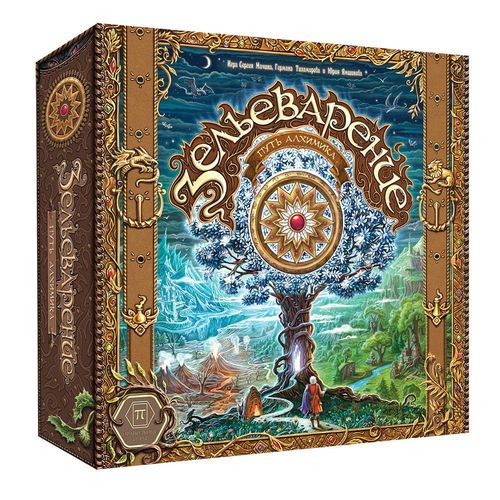
Зельеварение: Путь алхимика (Potion-making: Path of Alchemist)
Зельеварение: Путь алхимика (Potion-making: Path of Alchemist) Rulebook
Table of Contents
Table of Contents
Components
- 128 recipe cards:
- 16 starting recipe cards (green backs with gold corners)
- 32 green recipe cards
- 48 silver recipe cards
- 32 gold recipe cards
- 20 spell cards
- 13 talisman cards
- 20 solo mode cards
- 3 double-sided assembly travel board parts, which together make up the six travel boards: Library of Five Worlds, Great Forest, Snowy Kingdom, Valley of Creation, Underwater World and Floating Islands
- 2 deck boards
- 99 power tokens of various values: 12 tokens of value 1, 27 of value 2, 24 of value 4, 18 of value 6, 12 of value 8, 6 of value 10
- 24 magemas
- 12 talisman markers
- 12 player pawns (3 pawns in each of 4 colours: blue, yellow, green, red)
- 1 organizer
- 4 player aids
- 1 recipe assembly scheme
Setup
You will need a surface of at least 70 x 130 cm.
A. Choose the travel board you will play on. For your first game, the simplest is the "Library of Five Worlds". Assemble the board from three parts.
Along the long sides of the board there are 16 compartments marked with Element symbols. These compartments are called the "cabinet" (Elements cabinet).
B. Place 16 starting recipe cards (green backs with gold corners) face up around the board, so that the Elements on the cards cover the corresponding compartments of the cabinet.
C. On the travel board (except the "Library of Five Worlds" and "Underwater World" boards), find the spaces with the golden dragon symbol and place a talisman marker on each of them. The number of such spaces is shown next to the name of the board.
D. Place the power tokens and magemas into the corresponding compartments of the organizer and put the organizer somewhere everyone can reach. This is the supply (reserve).
E. Place the deck boards on either side of the board. Shuffle the green, silver and gold recipe decks, the spell deck and the talisman deck, and place each face down on its matching board.
When playing on the "Library of Five Worlds" or "Underwater World" board, the talisman cards are not needed.
When playing with two players, remove the talisman cards marked "3+" from the game and return them to the box.
F. Each player takes 2 cards from the green deck, 2 cards from the silver deck and 1 card from the gold deck into hand.
If you happen to get 2 identical green cards, put one of them at the bottom of the deck and draw 1 card from the top instead.
G. Each player takes 1 magema from the supply.
H. Each player chooses a colour, takes the pawns of that colour and places one of them on the "Start" space. Determine the first player by lot. The first player begins the game.
Goal of the Game
In "Potion-making: Path of Alchemist" you create alchemical mixtures that let you travel through the magical world, with the main goal of visiting three different places of power and dispelling the curse of desolation. The first player to pass this test becomes the winner.
Game Turn
Players take turns in clockwise order. Each player's turn consists of several consecutive phases:
- SPELLCASTING – optional. Play spell cards from your hand.
- CREATION – mandatory. Perform one action of the two possible:
- Place a card from your hand into the cabinet as an Element.
- Assemble a recipe from your hand.
- TRAVEL – mandatory if you have more than 3 power tokens; optional if you have 3 or fewer. Move your pawns along the travel board (see page 11).
- REPLENISHMENT – mandatory. Draw recipe cards into your hand until you have 5 (see page 14).
1. Spellcasting
You may play spell cards from your hand, in any order and quantity, but no more than 1 spell of each type. After you resolve a spell card, place it on the spell discard pile. More about spells is on page 23.
2. Creation
You must perform one action of the two possible.
Place a card from your hand into the cabinet as an Element
Place a card from your hand into the corresponding Element compartment of the cabinet and take 1 magema from the supply as your reward. If there was no such Element in the cabinet, additionally take a power token of value 1.
A card with the Primal Element can be placed in any compartment of the cabinet. While a Primal Element is in a compartment of the cabinet, it counts as the corresponding Element. More about Elements is on page 22.
Assemble a recipe from your hand
Choose a recipe from the cards in your hand that you want to assemble and can assemble (all of its ingredients must be available). For example, to assemble the Elixir of Lethargy you need Spring Water (an Element) and an Oblivion Potion (a finished recipe). Check whether Spring Water is in the corresponding compartment of the cabinet. Check whether a finished Oblivion Potion is on the table in front of you or in front of an opponent.
If the required ingredients are missing, or you do not want to use them, you may replace them by discarding magemas to the supply:
- 1 discarded magema replaces 1 any Element;
- 2 discarded magemas replace 1 any Potion;
- 3 discarded magemas replace 1 any Elixir.
Then:
- Place the recipe card face up on the table in front of you. Then take the required ingredients from the cabinet and from the table, turn them face down and cover the left side of the recipe card with them.
- Required Elements may be taken only from the corresponding compartment of the cabinet.
- When a player must take a card from a compartment of the cabinet, he always takes the top card.
- Required finished recipes may be taken only from the table, either your own or your opponent's. You take only the finished recipe card; the ingredient cards it was made from, if there are any, are placed into the corresponding compartments of the cabinet (see page 8, "Filling the cabinet").
- When you take a finished recipe of an opponent, that opponent receives 1 magema from the supply.
- Take the reward shown in the upper right corner of the recipe card. Usually this is a power token of a certain value, taken from the supply. For recipes with the scroll symbol, also take the top card of the spell deck. If the spell deck has run out, shuffle the spell discard pile to form a new deck.
Example 1. Assembling the Elixir of Lethargy: Spring Water is taken from the cabinet as an Element, the Oblivion Potion is taken from the table as a finished recipe, and the Elixir is assembled on the table.
Magemas
Magema is a universal ingredient, a gift to this world from the excess energy of the Primordial Tree. Condensing out of the air during alchemical processes, a magema can replace any required element or compound.
Magemas may be spent:
- when assembling a recipe, to replace ingredients;
- when casting the spell Acceleration (see page 23).
Magemas may be gained:
- when an opponent uses your recipe;
- when you place a card into the cabinet as an Element (see page 6);
- when you dispel your creature (see page 8);
- when you sacrifice a talisman (see page 15).
Recipe Cards
A recipe card is divided into 2 independent parts:
- The upper part shows the recipe itself (3) and the ingredients (5) needed to assemble it.
- The lower part shows the Element (6).
Labels on the card: 1 – name; 2 – reward for assembling the recipe; 3 – recipe image; 4 – element symbol of an ingredient; 5 – ingredients for assembling the recipe; 6 – Element.
- From your hand, a card can be played either as a recipe (assembled on the table in front of you), or as an Element (placed into the cabinet).
- A card in the cabinet counts as an Element.
- A card lying face up on the table in front of a player is a finished recipe.
- Some ingredients are marked with an element symbol (4). This means that, instead of that ingredient, you may use a Powder of the corresponding element (see page 8).
Types of Recipes
Potions
A Potion is assembled from two Elements located next to each other in the Circle of the Great Work (see page 22). It brings you a power token of value 2 and, especially valuable, a spell card.
Elixirs
An Elixir is an important step towards assembling more expensive recipes. It brings you a power token of value 4.
Eternal Potions and Eternal Elixirs
Eternal Potions and Eternal Elixirs (marked with the ∞ symbol) can be used to assemble other recipes in the same way as the corresponding ordinary Potions and Elixirs. But they have a remarkable property: they do not run out.
- When you use a finished Eternal recipe, it remains on the table in front of its owner.
- If the Eternal recipe has ingredient cards on it, place them into the corresponding compartments of the cabinet.
- If you use an opponent's Eternal recipe, the opponent receives 1 magema as usual.
Essences
Essences are triple Elixirs. When assembling another recipe, you may use a finished Essence as any one of the three Elixirs depicted on its card, but only one.
Powders
Powders are concentrates of the elements. When assembling another recipe, you may use a finished Powder as any Potion with the element symbol depicted on its card.
Creatures
Creatures are the highest creations of alchemy. Only one creature may be on the table at a time.
When a new creature appears (assembled as a recipe, or created by the spells Acquisition and Genesis), the owner of the old creature dispels it: they place its card and all its ingredients into the cabinet, and then receive either 1 spell card or 1 magema, of their choice.
Filling the Cabinet
Having Elements in the cabinet is very important for success. Each time after you assemble a recipe, place the ingredients of your used recipes and the cards of dispelled creatures into the corresponding compartments of the cabinet. Then the other players do the same, in clockwise order.
The Primal Element card may be placed into any compartment of the cabinet, as the player chooses.
- Filling the cabinet does not give players any reward, unlike the action "Place a card from your hand into the cabinet" (see page 6).
- Players may not look at cards lying in a compartment of the cabinet under other cards.
Example 2
Player A wants to assemble the creature Alchemicotè.
- Instead of the Elixir of Disappearance, he could use his own Essence of Panacea, but he prefers to use the opponent's Eternal Elixir of Disappearance.
- Instead of the missing Sleep Potion, he could discard 2 magemas, but that is not profitable. So, as the Sleep Potion, he takes the opponent's Powder Spiritus, which has the same element symbol as the Sleep Potion.
- Player A covers the Alchemicotè recipe with the Powder Spiritus card (the Eternal Elixir stays on the table with its owner) and takes the reward, a power token of value 8.
- The opponent receives 2 magemas for the two recipes that were used. The opponent must also dispel their creature, the Unicorn. For this they choose to receive 1 magema, although they could have chosen a spell card instead. So in total the opponent receives 3 magemas and loses 2 finished recipes.
- The cabinet is filled with the ingredient cards of the used recipes and of the dispelled creature.
- Player A has assembled the creature Alchemicotè and received a power token of value 8 as the reward.
Travel Boards
A travel board consists of spaces connected by routes. Players' pawns may move only along routes, in either direction, and may stop only on spaces.
- Only one pawn may be on each space (the exception is the "Start" space).
- Occupied space: a space on which a player's pawn stands. An occupied space "disappears": it is considered to be absent from the route until it is freed.
- The Start space is never considered occupied. Any number of pawns may be on it.
- Talisman spaces: during setup, talisman markers are placed on these spaces. The player whose pawn first reaches such a space returns the talisman marker to the supply and chooses a talisman card for themselves (see page 15).
Final Locations and Sigils
In the world of the Primordial Tree there are places of power. These are nodal points linked to the streams of life. In each of them there is a sigil. A true master can move to it even from a great distance. Now the sigils do not burn, and the power of the Primordial Tree cannot reach them, but the blazing spirit of a true alchemist is able to light them when it is nearby.
A final location is a group of several spaces at the end of a route, joined by a shining ring called a sigil.
- A pawn on a space of a final location may no longer move.
- If unoccupied spaces remain in a final location, other pawns may enter them.
- A player may not enter one final location with two pawns.
As soon as all three pawns of a player are in different final locations, the game ends immediately and that player wins.
3. Travel
You must make a travel if you have 4 or more power tokens. If you have 3 or fewer, travel is optional. You may use tokens in any order and in any quantity to move your pawns along the travel board. You may spend all the tokens or keep some of them, but after the travel no more than 3 tokens may remain.
- Tokens are used one at a time, strictly by their value; they may not be added together.
- At any moment during a travel you may place your second and third pawns on the Start space, and move them as well.
Using Tokens
Tokens of values 2, 4, 6, 8 and 10 are used as follows. Discard one such token to the supply and move any one of your pawns along a route, in the direction you choose, to the nearest free space bearing the symbol of this token. All intermediate spaces bearing the symbols of other tokens are skipped. All occupied spaces are also skipped, regardless of the symbol on them.
Example 3: The red player uses a token of value 4. He may move his first pawn to the nearest "4" space in one of three available directions (arrows 1, 2 and 3 on the picture). In direction 1 the nearest "4" space is occupied by a green pawn, so he skips it. Direction 4 is unavailable, because there are no "4" spaces on it. Alternatively, the player may place his second pawn on the Start space and move it to the nearest "4" space (direction 5).
Using the Token of Value 1
Discard the token of value 1 to the supply and move one of your pawns to any adjacent space. However, you may not enter a final location this way, unless there is a space with the "1" symbol in it.
An adjacent space is the nearest space on the route, in either direction.
Example 4: The yellow player has a token of value 1. He may use it to move his pawn to one of the adjacent spaces: "2", "4" or "8". The space occupied by the red pawn is skipped.
Example 5: The green player has tokens of values 1, 8 and 10. The optimal solution is to spend them in the order 8, 1, 10 (green path). If the player spent the 10 first and then the 8, he would not be able to enter the final location using the 1.
Special Spaces
Special spaces (thickets, ice and bubbles) are found on travel boards of increased difficulty. A special space occupied by a pawn "disappears", and its properties have no effect.
Thickets
In the twilight of tall trees it is easy to get lost, and worse still, the approaches to the houses of alchemists and to places of power are guarded by impassable thickets. Because of them, travel through the Great Forest has been a severe trial for many. Only a truly calm and prudent person can carefully crawl through the barely visible gaps in the tangle of vines and reach the goal.
- Thickets cannot be passed through when moving a pawn. This means the player must stop on the thicket space, using the token of power shown on that space.
- A thicket cannot be entered from an adjacent space using a token of value 1.
- If a pawn is on a space adjacent to thickets, it may be moved onto the thickets by spending a token one level lower than the required one, and additionally discarding a token of value 1. Several tokens of value 1 may be discarded to reduce the requirement by several levels.
Example 6: The red player has tokens of values 1, 4 and 8. He could use the 4 and the 8 to enter the lower final location (grey path). But he decided to discard the 1 to reach the adjacent thicket "6" using the 4, and then enter the space "8" of the upper location to take a talisman (red path).
Ice
On the mountain peaks and in the Snowy Kingdom it is dangerous to travel quickly. Do not underestimate the treachery of ice hidden under snow. Remember, traveller, that if you slip, you may stay here forever. If you need to climb an icy mountain, use a small deposit of power and do not hurry.
- Ice cannot be passed through when moving a pawn using the token shown on it. It can be passed through when using another token.
- A pawn cannot move onto ice using the token shown on it.
- A pawn may move onto ice only from an adjacent space, using a token of value 1.
Example 7: The red player has tokens of values 1, 2 and 6. He has two equally good options: spend the tokens in the order 1, 2, 6 (red path), or in the order 2, 1, 6 (green path).
Bubbles
In the Underwater World and in the rivers of the Valley of Creation one has to proceed by cunning to pass through the places of power. Alchemists who lived here laid a convenient road of air bubbles, but only a double alchemical deposit allows one to overcome their walls.
- A bubble shows a pair of power tokens. A pawn may enter a bubble only by using two such tokens at the same time.
- Using a pair of tokens, a pawn may move in any direction to the nearest bubble with the symbols of that pair.
- When moving onto an adjacent bubble, you may replace 1 or 2 of the required tokens with a token of value 1. However, in this way you cannot enter a final location.
Example 8: The red player has tokens of values 1, 2, 2, 10 and 10. To enter a final location, he may spend 10 + 10 (yellow path); or first move to an adjacent space using 1 + 2, and then to the next space using 2 + 10 (red path), saving the expensive 10 token.
The Valley of Creation
Between high mountains capped with ice and volcanoes spewing lava, rising above the surrounding forest in the centre of a black lake whose bottom shows the bottomless void of cosmos, grows the Primordial Tree. It has been here since time immemorial, and it appeared even before the world itself, for it is the Beginning. The Valley of Creation is the cradle of creation, the alpha and omega, embodying the stage of rubedo. Here the heroes await the last and most difficult trial, passing which one can return the lost harmony of the world.
The Valley of Creation is the most difficult travel board. All kinds of special spaces are found on it: thickets, ice and bubbles.
- If you use a pair of tokens to move onto the nearest bubble, you cannot pass over ice bearing the symbol of one of these tokens, nor any thickets.
Example 9: The red player has tokens of values 2, 2, 4 and 8. He uses the pair 2 + 8 to move onto the corresponding bubble (red arrow). Note that the short route to the left cannot be passed: it is blocked by the ice spaces "2", which cannot be passed using a token of value 2. The player then enters the final location using the pair 2 + 4.
Also, the player cannot use the pair 4 + 8 to enter the lower location, since it is blocked by thickets "2" (purple arrow).
The player has one more option for a productive turn: 8, 2, 4, 2 (orange arrow).
4. Replenishment
Take recipe cards into your hand from any decks until you have 5 in hand. Spell cards are not counted in this, and they do not affect taking recipe cards. Spell cards may be held in any quantity.
- If you need to take several cards, take them one at a time. After taking a card, look at it to decide which deck to take the next card from.
End of the Game and Determining the Winner
As soon as a player moves all three of their pawns onto different final locations, the game ends immediately and that player wins. The winner is hailed a True Adept.
Golden Rule
If the text on a card contradicts the rules, follow the text on the card.
Talismans
When your pawn lands on a space holding a talisman marker, remove the marker, then take the top 2 cards of the talisman deck, choose one of them and place it in front of you. Now it is your talisman, granting you additional abilities. Put the other talisman card under the bottom of the deck.
- You may have no more than 3 talismans. If you take a fourth talisman, return one of your old talismans to the bottom of the talisman deck, and then take 1 magema.
- Once per turn you may sacrifice one of your talismans, placing it under the bottom of the deck, and take 1 magema for it.
- Talismans marked "3+" are put into the deck only in games with 3 or 4 players.
Talismans Permanently Active on Your Turn
- Talisman of Growth: during the Replenishment phase, take recipe cards into your hand until you have 6.
- Talisman of Wealth: after the Travel phase, you may have up to 5 power tokens. This means that you must make a travel only if you have 6 or more tokens.
- Talisman of Dexterity: you may take the required Elements from your hand, in any quantity, as if they were in the cabinet. You may use the Primal Element card in your hand as any Element.
Talismans Applied on Your Turn (Not More Than Once Per Turn)
The following talismans are applied only on your turn, no more than once per turn:
- Talisman of Palantirium: when you take a spell card, choose it from the top 3 cards of the spell deck, and place the 2 remaining cards into the discard pile.
- If the spell deck has fewer than 3 cards, shuffle the spell discard pile and place it under the bottom of the deck before applying this talisman.
- Talisman of Income: when you take the action "Place a card from your hand into the cabinet", take 2 magemas instead of 1.
- Talisman of Memory: you may discard 1 magema to take 1 spell card.
- Talisman of Amnesia: you may discard 1 spell card to take 1 magema.
- Talisman of Transmutation: you may exchange any token except the token of value 1 for two tokens of value 1.
- Talisman of Mutuality (3+): when you assemble a recipe using an opponent's finished recipe, take a power token of value 1.
- Talisman of Modesty (3+): at the start of your turn, if you have the fewest finished recipes, take a power token of value 1.
- If the fewest finished recipes is not only yours (that is, other players share it), the talisman still works.
- Talisman of Greed (3+): you may place the Talisman of Greed on your finished recipe. Opponents may not use this recipe.
- Talisman Speculum (3+): until the end of your turn, make it a copy of any talisman of the neighbour on your right or left.
Talismans Applied on Other Players' Turns
The following talisman applies only on another player's turn, no more than once per turn of each opponent:
- Talisman of Profit (3+): when an opponent takes your recipe, take a power token of value 1.
- This talisman does not work when an opponent uses your Eternal recipe, since it remains with you on the table.
Solo Mode
The flavour text of the solo-mode introduction is not reproduced here.
Your opponent is the great and terrible alchemist Fulcanelli. He is able to brew potions from the void, and he is unstoppable on the way to victory.
Solo Setup
- Assemble the travel board "Floating Islands". On it Fulcanelli's superiority will be less noticeable. For a greater challenge, try the more complex variants: "Great Forest", "Snowy Kingdom" or "Valley of Creation".
- Remove the talisman cards marked "3+" from the talisman deck.
- Prepare enough room for Fulcanelli's recipes. Shuffle his solo-mode deck and place it face down. Give him 1 magema and three pawns.
- You take the first move.
Solo Cards
The solo-mode cards are read as follows:
- A. Check the number of magemas. The card shows the condition, for example "Fulcanelli has at least:" followed by 2 magemas.
- B. If condition A is true, carry out the "YES" block. Otherwise, carry out the "NO" block.
- C. Gain (+) or discard (-) magemas.
- D. Assemble the top recipe from the corresponding deck.
- E. Place an Element into the cabinet.
- F. A Sun or Moon symbol indicates the direction of movement at forks.
Fulcanelli's Turn
Manipulating his fingers, Fulcanelli acts as follows:
- He reveals the top card of his deck.
- He checks the number of his magemas (A). If there are as many or more as the card requires, he carries out the "YES" block of actions (B). If there are fewer, he carries out the "NO" block.
Possible actions:
- Gains or discards magemas (C).
- Places an Element into the cabinet (E):
- a. he takes the top card of the green deck and places it in the cabinet compartment corresponding to its Element;
- b. he does not gain a magema; instead he moves his pawn as if he were using a token of value 1. In this way he may also enter a final location.
- Collects recipe(s) (D):
- a. he places face up in front of himself the top card of the corresponding deck;
- b. he takes the ingredients required for this card: the Elements from the cabinet and the finished recipes from the table. If the required finished recipe is on the table in several variants, you choose which one Fulcanelli takes. If he takes a finished recipe that is yours, you receive 1 magema.
Fulcanelli's Rules
- Fulcanelli always assembles a recipe, regardless of whether the required ingredients are available. But if they are available, he uses them. He never spends his magemas to assemble recipes.
- If the block shows 2 recipes, Fulcanelli assembles the left one first, then the right one.
- If the cabinet is filled with a card with the Primal Element, you choose the compartment in which to place it.
- Fulcanelli never receives power tokens or spells. Instead, he immediately moves his pawn as if he had spent the token shown on the recipe he assembled.
- At a fork he chooses the direction indicated on his card, the Sun or Moon symbol (F). Directions without such symbols are of no interest to Fulcanelli, and he ignores them.
- Fulcanelli never moves his pawn back, towards the "Start" space.
- If his pawn lands on a space with a talisman marker, Fulcanelli discards the marker, but does not receive the talisman. The Dragons of the Primordial Tree refuse to help him.
- Each final location shows a shining ring, a sigil, which is accessible only to Fulcanelli. In the sigil there are spaces with all the token symbols. Fulcanelli's pawn first tries to occupy the shared spaces of a final location, and if it cannot, it enters the sigil.
- Fulcanelli places and begins to move his second pawn only after the first one has entered a final location.
- Fulcanelli may enter one final location with several of his pawns.
- When you use a finished Fulcanelli recipe, he receives 1 magema.
- When a Fulcanelli creature is dispelled (see page 8), he receives 1 magema.
Solo Mode on Particular Boards
- Great Forest: if thickets prevent the movement of Fulcanelli's pawn, it stops on the nearest of them, regardless of the token symbol on those thickets.
- Snowy Kingdom: Fulcanelli ignores the properties of ice and treats it as an ordinary space.
- Valley of Creation: thickets and ice act as described above. Directions with bubbles are unavailable to Fulcanelli.
- The "Library of Five Worlds" and "Underwater World" boards are not used in solo mode.
Adjusting Solo Difficulty
If it is too hard to beat Fulcanelli, take an additional magema at the start of the game. If you win too easily, add 1 magema to Fulcanelli.
Example of a Solo Game
The example is given in the source as a sequence of illustrated turns. The card layouts and the board diagram are not reproduced here; the moves are transcribed in text.
Our starting hand: Potion of Prophecy, Potion of Youth, Elixir of Omens, Essence of Greatness, Powder Spiritus. Fulcanelli's solo deck is shuffled and placed face down.
Our turn 1: We assemble the Potion of Prophecy with a view to the Elixir of Omens, receive a power token of value 2 and the spell Genesis. This is good: under this spell it is worth drawing a card from the gold deck, the Eternal Elixir of Revival. We do not travel; we let Fulcanelli go first.
Fulcanelli's turn 1: He does not have 3 magemas, so he carries out the "NO" block. He takes 1 magema, and reveals the top card of the silver deck: the Essence of Truth. It needs no ingredients, so it is assembled simply. The red pawn moves to the nearest space "6".
Our turn 2: We must seize the chance to get a 6. We assemble the Eternal Elixir of Revival. We take the Essence of Truth from Fulcanelli (he receives his third magema), the Phoenix Feather from the cabinet, and discard a magema instead of Mushrooms, since there are none left in the cabinet. We receive a 6 and, with the red pawn, move to space "6". Then we spend a token so that the opponent cannot repeat this trick against us. We take a card from the gold deck: the Stone Golem.
Fulcanelli's turn 2: He has 3 magemas, so he carries out the "YES" block. He discards 1 magema and reveals the top card of the gold deck: Powder Mare. It has no ingredients for him, so he collects it simply. The red pawn moves to the nearest space "10", choosing the Sun direction at forks.
Our turn 3: This is luck, since we need the token 10. We cast the spell Genesis and place the Essence of Greatness from our hand as a finished recipe. Then we assemble the Powder Spiritus from our recipes. The Eternal Elixir stays on the table, and only its ingredients go into the cabinet. We receive the token 10. In the travel phase we place our second pawn on the "Start" space and move it, through Fulcanelli, onto space "10" of the final location. We remove the talisman marker and choose a talisman from the top two: the Talisman of Transmutation. We refill our hand from the silver deck: an Eternal Amulet Potion and an Elixir of Might.
Fulcanelli's turn 3: He does not have 5 magemas, so he carries out the "NO" block. He reveals the top card of the silver deck: the Elixir of Obsession. He collects it, using his Powder Mare and the Blood Stone from the cabinet. The red pawn goes to space "6". He then reveals another silver card, the Eternal Potion of Prophecy. For its assembly he must take either a Potion of Prophecy or a Powder Spiritus. The choice is ours, and we give him the Potion of Prophecy, which earns him 1 magema. Ahead of his red pawn there is no "4" space, but Fulcanelli sees one in the sigil of a final location and enters it. He then places his second pawn on the "Start" space.
Our turn 4: It is tempting to sacrifice a talisman for 1 magema, assemble the Stone Golem from the Elixir of Obsession and two magemas, put out the third pawn and boldly enter it on space "8". But we act calmly. We carefully assemble the Potion of Youth, receive a token and the spell Acceleration. We move our first pawn to space "2" right next to the final location, and wait to see where Fulcanelli goes. We take a card from the green deck: the Sleep Potion.
Fulcanelli's turn 4: He does not have 5 magemas, so he carries out the "NO" block. He reveals the top card of the gold deck: the Griffin. He assembles it using the Eternal Elixir of Revival (we receive a magema) and either the Eternal Potion of Prophecy or the Powder Spiritus. Since we want another magema, we choose the Powder. Fulcanelli moves in the Sun direction to the nearest "8" space and discards the talisman marker from it. It is fortunate that our pawn was not there.
Our turn 5: We pay a magema and apply Acceleration. We assemble the Sleep Potion from the Elements in the cabinet, and receive a token and a spell card: Study. We assemble the Stone Golem from two magemas and the Elixir of Obsession; Fulcanelli receives 1 magema. The opponent dispels the Griffin and receives one more magema. We enter our second pawn into the final location on space "2", then place the third pawn and move it to space "8". We take cards from the green and silver decks: the Potion of Strength and the Elixir of Lethargy. Only one turn remains to victory, or two turns. How will Fulcanelli answer?
Fulcanelli's turn 5: Fulcanelli smiled: "A worthy pupil... and now I will show you true mastery..."
School of Magic Rules
The introductory flavour text of this variant is not reproduced.
This is a simpler variant with the same board, cabinet and cards.
Goal of the Game
The player who has the most points on their power tokens at the end of the game wins.
Setup
- Assemble any travel board. Use the cabinet as usual, and in the central part of the board place the recipe and spell decks, the magemas and the power tokens.
- Return to the box the player pawns, the tokens of value 1, the talisman deck and the talisman markers.
- For maximum simplification, before shuffling the recipe decks, remove the Eternal Potions and Eternal Elixirs from them.
Playing the Game
Play by the rules of "Path of Alchemist" with the following changes:
- Your turn consists of three phases: spellcasting, creation and replenishment. The travel phase is skipped.
- You may have any number of power tokens. Lay them out in front of you on the table, so that all players can see how many you have.
- When you place into the cabinet an Element that is not there yet, you receive 2 magemas instead of 1 magema and a token of value 1.
- When you dispel your creature, you receive 1 magema instead of choosing between a spell card and a magema.
- Any finished Powder may be used as any Potion, regardless of its element symbol.
End of the Game and Determining the Winner
The game approaches its end when any player collects a certain number of power tokens:
- 10 tokens with 2-3 players;
- 7 tokens with 4 players.
Players complete the round, taking their turns until the turn passes to the first player.
Then each participant counts the sum of the points on their power tokens and adds to it:
- 1 point for each spell card in hand;
- 1 point for each pair of magemas.
The player with the highest total becomes the winner. In case of a tie, all contenders are winners.
Reference
Elements
Alchemical practice uses 16 traditional Elements from the Circle of the Great Work (Круг Делания), and 1 universal Element: the Primal Element.
The available Elements lie in the corresponding compartments of the cabinet. Each player may take from the cabinet the Elements required for assembling recipes, or place Elements from their hand into the cabinet, receiving a reward (see page 6).
The Primal Element may be placed into any compartment of the cabinet, and it counts as the corresponding Element while it lies in that compartment.
The 16 Elements of the Circle are:
- Quintessence of Will
- Dragon Tooth
- Mandrake Root
- Blood Stone
- Astral Energy
- Snake Eye
- Fern Blossom
- Fire Light
- Ether Waves
- Phoenix Feather
- Mushrooms
- Air Crystal
- Emanation of Thought
- Bat Wing
- Belladonna
- Spring Water
The Primal Element is in the centre of the Circle.
Recipe Decks
Recipe cards are divided into three decks by difficulty, with different card backs.
Green deck (including the starting cards) contains 16 Potions, 3 copies of each (48 cards). Each Potion can be assembled from two Elements next to each other in the Circle of the Great Work. For the Potion assembled, the player receives a power token of value 2 and a spell card (see pages 7 and 23).
Silver deck contains:
- 16 Elixirs. Reward: a power token of value 4.
- 16 Essences. Reward: a power token of value 6.
- 16 Eternal Potions. Reward: a power token of value 4.
Gold deck contains:
- 16 Creatures. Reward: a power token of value 8.
- 8 Eternal Elixirs. Reward: a power token of value 6.
- 8 Powders. Reward: a power token of value 10.
Spell Deck
The spell deck contains 4 spells, 5 copies of each (20 cards). When the spell deck runs out, shuffle the spell discard pile and form a new deck.
You may cast spells in the Spellcasting phase, no more than 1 spell of each type per turn.
- The spells Genesis and Acquisition help you create the ingredients you will need in the Creation phase.
- The spell Acceleration lets you perform two actions in a turn instead of one. (The printed overview of the spells reads "receive two power tokens per turn"; the spell card text, given below, makes clear that the effect is two actions.)
- The spell Study lets you obtain the recipe you need, and also get rid of an unneeded card.
Spell of Genesis (Созидания): place 1 recipe from your hand on the table as a finished recipe, without receiving the reward for it.
Spell of Acquisition (Обретения): place the top recipe from any compartment of the cabinet on the table as a finished recipe, without receiving the reward for it.
Spell of Acceleration (Ускорения): discard 1 magema or any power token to perform 2 actions instead of 1 this turn (see page 6).
- You may assemble 2 recipes; or place 2 cards into the cabinet; or perform 2 different actions, in any order.
Spell of Study (Изучения): take the top recipe from any compartment of the cabinet into your hand. Then you may, if you wish, place another recipe from your hand into the cabinet, without receiving a reward for it.
Frequently Asked Questions
What do I do if I cannot assemble any recipe? You must take the action "Place a card from your hand into the cabinet as an Element".
Do I receive a magema when I use my own finished recipe to assemble a recipe? No.
Is the "Start" space an obstacle when moving players' pawns? You may pass through the "Start" space without restriction.
What do I do if one of the recipe decks runs out? In this case you may draw cards into your hand only from the other decks. If all the recipe decks have run out, and at the end of the current turn there is no winner, the game ends in a draw.