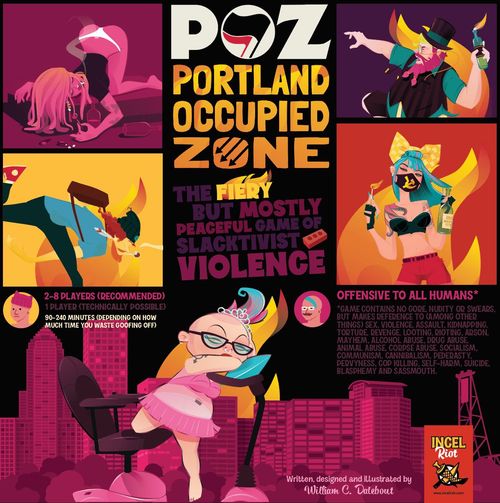
Portland Occupied Zone
Portland Occupied Zone Rulebook
Table of Contents
Table of Contents
- Introduction
- How to Score
- Warriors, Come Out To Play...
- The Character Board
- Game Setup
- Round Phase
- Turn Phase
- Bricks
- Your Mental Health
- Loot and Looting
- Disease
- Waste Disposal
- Achieving Your Goals
- Arson
- Building the POZ
- Pozzed Governance
- The Dictatorship of the POZ
- The Battle of Hawthorne
- PVP Combat
- Cops
- Sgt. Jackson
- Riot Cops
- The Medic
- More Notes on the Destruction of Property
- Alternative Setups
- The Big Red Book of the POZ
Introduction
Winning the Game
- When all Narrative cards have been played.
- The dictator of the POZ is the winner.
In order to survive until the end of the game it will be necessary early on to increase the power of your characters and grow the POZ. This can be accomplished in a variety of ways, including:
- Looting businesses for useful items
- Building POZ structures
- Increasing your personal crapulence and unlocking more powerful character abilities.
Crapulence is used in this game to mean "being a crappy person" (the dictionary definition is "drunkenness").
General Flow of Play
POZ is played over a set number of rounds, measured by the number of cards in the Narrative deck. One narrative is drawn every turn.
Editor's note: the manual says one Narrative is drawn "every turn" here. The Round Phase below draws one Narrative per round, at the top of the round; that is the drawing step followed in this transcription.
The last 16 cards in the deck are Battle of Hawthorne narratives. During the Battle of Hawthorne, the game changes from being mostly about consequence-free looting and burning into a full-scale war agains the police. This gives players plenty of time to grow the POZ, acquire better equipment, put up defenses, and increase the power of their characters before the war begins.
How to Score
There are two numbers to keep track of: your Crapulence, and the Population of the POZ.
Crapulence is a measure of what a disaster of a human being your character is. It is increased by fulfilling 5 Year Plans and committing acts of violence and degeneracy. Crapulence is ranked from 1 to 30 and is tracked on the edge of the board. At 7, 14, 21 and 28 crapulence new character abilities are unlocked (see your character's board for details.)
Each of these actions earns crapulence:
- Defeating a police officer
- Defeating the medic
- Knocking out a player
- Scoring 3 or more natural (unmodified) hits in a single throw when looting.
Population is the number of NPC residents in the POZ. It is increased by building POZ structures such as tents.
There are several ways of increasing POZ population:
- Performing revolutionary theater (these are items that can be looted, mostly from bookstores and theaters.)
- Aktion cards
- Arson (burning a building down completely earns 8 population.)
Each character scores just a little bit differently. Consult your player board for details.
Warriors, Come Out To Play...
There are 8 different playable characters, each with their own abilities and styles of play. Each character begins the game at their place of business (Works at) with their personal effect equipped.
- Magic Pink (xe/xyr) - Works at: Merda d'Artista. Personal effect: the Mobility Scooter.
- Allison (she/her) - Works at: Filthy Rags. Personal effect: Protest Sign.
- Jorge - Works at: People's Food Co-Op. Personal effect: Crisis Crayons.
- Lilith (she/her) - Works at: Hexenhäuschen. Personal effect: the Feminomicon.
- Jack (they/them) - Works at: Captain Asshole's. Personal effect: the Overclocked Vape.
- Kim - Works at: the Grand Herpetic. Personal effect: the Cybergoth Respirator.
- Steve (he/him) - Works at: Pizza. Personal effect: Pizza-Related Handkerchief.
- Jeff (he/him) - Works at: the Pot Dispensary. Personal effect: the Skateboard.
Editor's note: the manual's character descriptions are omitted. The printed page also introduces Andy, a narrator and guide character, who is not a playable character and is not part of the rules.
The Character Board
The Character Board is a reference for your character's stats and abilities, and the place to keep track of your mental stability, injuries and equipment.
- The Header. This area displays the character's name, their stats, where they work, and what their personal effect is.
- The two "stats" are Bricks (this character's base, unmodified number of bricks) and Movement (this character's base movement rate).
- Works at: this is where the character begins the game.
- Personal Effect: every character begins the game with one personal effect. This item is very important to the character and it would be bad if they were to lose it.
- The Mental Stability Tracker. This area displays the character's current mental stability. This is explained in detail in the section titled Your Mental Health.
- Ideology and Theory. Ideology is a bonus power that becomes available when this character is dictator of the POZ. Place the talking pillow/tin pot token here when this character is the leader of the POZ.
- Character Powers. These are your character powers. The first one, indicated by the star, is free. The others are unlocked by accumulating the indicated amount of crapulence: 7, 14, 21 and 28. At 14 and 28 characters' maximum bricks are increased by 1.
- Injuries. These are your injuries. After the last injury is taken, the next hit renders the character knocked out, arrested, or dead (see p25.)
- Equipment. This area keeps track of your equipment. Each character may equip one weapon, one item of apparel, and two accessories. Place these items along the bottom edge of the character board to indicate they are equipped.
For example, Magic Pink has the slowest base movement rate in the game (4). The Mobility Scooter personal effect brings the movement rate up to 6.
Game Setup
- Board Setup
- 1.1 Lay the nine game board tiles flat on the table, face up (see figure on facing page.)
- 1.2 Place the eight business tiles and the courthouse tile on top of their footings.
- 1.3 Place the four dumpsters burning-side-down in their starting locations.
- 1.4 Place four security cameras.
- Card Setup
- 2.1 Shuffle the eight business loot item decks and place them face-down in their respective businesses.
- 2.2 Shuffle the Aktion deck and place it face-down near the board.
- 2.3 Shuffle the Narrative decks. For a full game* draw 24 Standard narratives and 16 Battle of Hawthorne narratives. Place the standard cards on top of the battle cards in the same stack.
- 2.4 Shuffle the 5 Year Plans deck and place it face-down near the board. Draw 5 plans and place them face-up.
- Police and Medic Setup
- 3.1 Place Sgt. Jackson (the officer without a helmet) on his circle in the courthouse.
- 3.2 Place the Medic on his circle in the courthouse next to Sgt. Jackson.
- Player Setup
- 4.1 Each player selects the character(s) they will be playing and places the corresponding character board(s) in front of them on the table.
- 4.2 Equip each character's personal effect (every character has one) in its appropriate slot.
*Alternatives to the full game: POZ is designed to accommodate many different setups and scenarios, but these are beyond the scope of this document. See Alternative Setups below. A complete example setup is shown on p33.
Round Phase
The game of POZ is round-based. During each round every player character may take one turn. The leader of the POZ (either Speaker or Dictator) is responsible for providing vision and moving the revolution along.
At the top of each new round the Leader player will do all of the stuff listed on this page.
- Hold a Teach-In. The teach-in is when everyone gets together to do group stuff and handle party business.
- 1.1 Advance the Revolution. The speaker/dictator turns over the top card on the aktion deck, reads it, and does what it says. Most aktion cards require a decision or a vote. For more on voting see Pozzed Governance.
- 1.2 Advance the Narrative. The speaker/dictator turns over the top card on the narrative deck, reads it, and does what it says. Some narrative cards are plots, meaning they will remain in effect longer than a single round (until another plot is drawn.) Move active plots to one side of the aktion deck rather than discarding them.
- 1.3 Harvest Time. If there are POZ structutes that generate resources, such as farms, the leader draws these cards now.
- 1.4 Manage the POZ. If the Speaker or Dictator wishes to reassign NPCs, exchange POZ structures for other structures, or distribute resources to players, they may do so now.
- Police Business
- 2.1 Clear Gas. If any areas were gassed the previous round, clear the gas canisters at this time.
- 2.2 Deploy Gas. See section Riot Cops for details. Only riot cops may deploy gas.
- 2.3 Move Police and the Medic, and Resolve Combats. If Sgt. Jackson or the Medic are finished recovering from a defeat, return them to play (if the courthouse is gone, roll 1d4 to determine which direction they return from). Sgt. Jackson, Riot Cops, and the Medic take their turns now. Their AI is described in detail in the sections The Police, the Medic, and The Battle of Hawthorne.
Aktions are events related to internal Antifa politics, and there is usually a decision to be made. Narratives are goings-on in the outside world that the players have little control over.
Turn Phase
The player closest to the top of the rainbow (pink, red, orange, yellow, green, teal, blue, and purple) moves first, after which play proceeds to the left. When it is your character's turn, do this stuff in this order:
- Replenish Your Brick Stash. Each character has a different number of base starting bricks. These are indicated at the top of the player card and can be adjusted up or down by in-game modifiers. Bring your bricks up to this total at this time.
- Equip and Unequip Loot Items. This must be done at the beginning of the turn before taking any other action. Place your equipped items next to your player board (or tuck them under the edge) in the indicated spots to indicate that they are equipped.
- Move. Each character has a different base movement. This is indicated at the top of the player card and can be adjusted up or down by in-game modifiers. Players may not move diagonally.
- Do Stuff. Finally, you can also do any and all of this stuff:
- Fight the police
- Fight other players
- Loot
- Rummage through the dumpsters (once per turn)
- Commit arson
- Use a POZ structure (once per turn)
- Use a character power (once per turn)
- Use a special, drug or food item card (as many times as you have cards)
- Trade loot with other players
- Throw loot items in the trash (no limit)
- Claim 5-Year Plans
Spaces. Not all spaces are the same size! Structures and Businesses are treated as a single space regardless of how large they are. Once completely burned down, a large business becomes nine spaces (3x3), and a small business becomes six spaces (3x2). Likewise placing a barricade or other large POZ structure will change multi-square areas into a single square.
Bricks
As an activist, your bricks are your primary instrument of positive change.
Throwing the Bricks
Bricks are used in calculating the success or failure of most player actions, including looting, arson and combat. Players decide how many bricks they want to throw, and how they land determines the number of hits.
Regardless of outcome, thrown bricks are gone forever. Create a brick pile near the game board and return bricks to the pile after you have thrown them. (You will get new bricks from the pile at the beginning of your turn.)
Bricks have six faces and can land in three different configurations: the flat side, the thin side, and the end. Every brick that lands on the flat side is a miss and every brick that lands on the skinny side is a hit. Bricks that land on the end hit twice.
Total hits may be modified by items and other bonuses.
Defending against attack also uses bricks, so it may not be a good idea to use all your bricks on your turn. For example, Kim has 8 bricks. In one round she may move one square, loot a store (using 3 bricks), move two more squares and initiate combat with another character (using 3 bricks). She may keep the remaining two bricks in reserve for defense. Alternatively she may opt to use all 8 of her bricks in a single combat and leave herself completely defenseless until her next turn.
THROWING ADDITIONAL BRICKS TO IMPROVE THE RESULT OF A THROW IS NOT ALLOWED. If it fails, it fails, and the bricks are gone. If you have additional bricks you may try again. You made a poor decision, live with it.
What Will You Do When the Bricks Run Dry?
Like the number of hotels in Monopoly®, the supply of bricks is not meant to be infinite. If you are playing a large game with many players you may experience supply-chain shortages. This is By Design. If it comes your turn and there are not enough bricks for you to reach your total, then take what you can and curse your rotten luck (and your backstabbing comrades).
Your Mental Health
Every character has a track on their player board indicating their current mental stability.
Mental stability is influenced (moved up and down) by player actions, items, events, the weather, and drugs. Especially drugs.
All players begin the game with flat stability (except Kim, who begins the game sad). Mental Stability has five states (unless you are Kim, who has four) with the following effects:
- Depressed: Depressed characters get a -1 debuff to all stats (movement, bricks) (Kim gets a -2 debuff).
- Sad: No modifiers. (Kim gets a -1 debuff to all stats.)
- Flat: No modifiers.
- Happy: No modifiers.
- Manic: Manic characters get a +1 to all stats (movement, bricks.)
- Hyper-Manic (Kim only): Hyper-Manic characters get a +2 to all stats (movement, bricks.)
Editor's note: the manual does not say which of the states Kim does not use; the printed text gives Kim four states without naming the omitted one.
Events that affect a character's stability will adjust its state either up or down. For example, if a happy character is exposed to Direct Sunlight, it will be reduced to flat. If already flat, they will become sad.
Cards that affect mental stability are indicated by the white pill icon (stability+) or the black pill icon (stability-).
Trigger warning: characters who are depressed may also be at greater risk of being maltreated by other players.
Loot and Looting
Looting
Players may loot any business they physically occupy (are inside of, not next to).
Looting uses bricks. When looting a business decide how many bricks you want to use and throw them. Every hit loots one item from that store's loot item deck. If you hit three times, loot three items.
Player characters may not have more than 7 loot items in their hands, unless they have some kind of storage accessory. Equipped items do not count toward this total. If you have a great day looting and you go over this limit, the overages must either be redistributed to other players or thrown in the garbage before your turn ends.
Your Loot and You
There are seven types of loot items: Weapons, Apparel, Accessories, Food, Drugs, Diseases and Specials. The type is indicated in the upper-right hand corner of the card.
Weapons, Apparel, Diseases and Accessories have persistent modifiers that take effect only when equipped. Each player may equip one weapon, one apparel and two accessories at a time. When discarded these are moved to the Garbage. Diseases are a special case, and are covered in the next section.
Food, Drugs and Specials can be used on a player's turn. When used, they are removed from the game completely (do not move to the garbage.)
There may be one or more modifiers at the bottom of each loot card, granting bonuses to combat, defense, etc. One icon is one point. Two icons two points, etc. Refer to the following table. (The icon for each modifier is printed beside its effect on the manual page; the icon artwork itself is not reproduced here.)
- +1 hits vs players
- +1 hits vs police
- +1 defense
- +1 hits to property destruction (arson)
- +1 movement
- +1 maximum bricks
- special critical
- -1 injury
- +1 injury
- +1 mental stability
- -1 mental stability
- +1 range
- +1 crapulence (score)
Disease
Diseases are a unique kind of "equipment" that can be contracted by certain events, certain POZ structures, from other players, and from spending time in jail.
Disease cards are cursed. Cursed items must be equipped in one of your four equipment slots immediately upon receiving them and may not be removed until they are cured.
If your equipment slots are already full, you must unequip one item to make room for your brand new disease.
Most diseases can be cured by brushing with Horse Paste. Horse paste cures one disease. Diseases that have been cured are returned to the disease pile to be re-contracted by others.
Some diseases have unique effects, others do not. All of them take up an equipment slot. Thus, a player character may be afflicted by at most four diseases at once.
Diseases can be transmitted to another player. When this happens, take the disease card and give it to the target player to equip (not terribly realistic, but it works reasonably well as a game mechanic.)
Diseases may be transmitted:
- In a successful combat (see p24.)
- To any character who is knocked out
- To any player occupying the Unmade Bed
- To any player occupying the Ball Pit
Allison begins the game with scabies. Scabies cannot be cured with horse paste.¹ Once cured, return the disease to the disease deck and shuffle it so others can share in the joy.
¹ Ivermectin is a real-world treatment for scabies, just not in this game.
Editor's note: the manual refers to a Homebrew deck (for example for the Meth recipe and for returning cooked or farmed items), but Game Setup does not list one. It is not set up in the printed steps.
Example: Meth
Consider for example the Meth card, a powerful item with many modifiers. Meth is not lootable, it must be cooked at the Meth Lab structure in the POZ. It costs 4 loot cards to cook.
Meth is a drug, meaning it can be used once and is effective for one turn. While in effect it grants: +2 mental stability, +4 bricks, and +2 movement.
At the end of the player's turn, the meth user takes 2 injuries and returns the Meth card to the homebrew deck.
Waste Disposal
Sorting Your Garbage
Items must be discarded in the proper way.
Things You Put in the Garbage. Anything that has been discarded without being used and anything lost in a fire goes face-down into the garbage to be rummaged through later. The garbage can be a neat stack, or, if you have the stomach for it, a disorderly heap. The latter is more realistic. It will be a terrific mess in any case.
Things You Do Not Put in the Garbage. Food, Drugs and Specials that have been used, injected, snorted, free-based, consumed, absorbed rectally, performed, posted or read such as food, drugs, poems and gig posters are removed from the game permanently. Where you put them isn't important. Returning them to the box isn't a bad idea.
Not Garbage. Diseases and items from the homebrew deck that have been cooked or farmed at POZ structures do not go into the garbage after they are cured or consumed. Instead, return these items back to their decks so they are available to be farmed, cooked, and contracted again.
Dumpster Diving and Garbage Day
Any player may, if they are next to a dumpster, go for a dumpster dive. They may do this once per turn. Smear the garbage pile around with your grubby hands and pick yourself a winner. Whether from the top or from the middle, it doesn't matter. (Items from different locations will have different backs, so dumpster diving will never be completely blind.)
Allison knows her way around the municipal trash system and has bonuses to dumpster diving.
Garbage Day is one of the more common plots that can be drawn from the narrative deck. On Garbage Day every player may take two items from the garbage whether they are near a dumpster or not.
Excrement and Gas
Some character powers, items and events can cause a square, POZ structure or building to become befouled (polluted, toxic, stinky, etc.). Place a coily poo token in the affected area to indicate that it is befouled.
A befoulment has the following effects:
- Players who enter or end their turn in a befouled square are knocked out.
- Players who are knocked out by a befoulment have a 1 in 4 chance of contracting a disease.
- When a befoulment knocks a character out it is removed from the board. Assume the character just inhaled the whole thing, chunks and all.
- Some equipment grants immunity to befoulments.
- When all befoulment tokens are used no more can be placed.
Gas works the same way as a befoulment, but is deployed by Riot Cops. See p27.
Achieving Your Goals
5 Year Plans are a good way for players to increase their crapulence quickly.
During setup, five plans are drawn from the deck and placed face-up. These plans are public and available for anyone to claim when they meet the listed requirements.
Players may only claim plans on their turn, and only if they meet the requirements on that turn. If you forgot or you didn't notice, tough beans.
When you claim a 5 Year Plan, discard it in its own pile and deal out another plan from the top of the deck so there are always five showing. When there are no more remaining, shuffle and redraw.
These Plans are Impossible Though
Some of the plans are extremely difficult to fulfill. If the players feel that the difficulty of the plans is holding up the game, the speaker (by consensus) or the dictator (by fiat) may, during the Teach-In round phase, elect to discard all the current plans and replace them with five new ones. Taking this action costs 5 POZ population.
Arson
Every building in Hawthorne is yours for the stealing and the burning. It is no less than your right. Nay, it is your duty. To set something on fire, players must throw their bricks, add in their modifiers, and score three or more hits.
Buildings, checkpoints and dumpsters can be set on fire. Let us consider each of these in turn.
Buildings and Checkpoints
In order to set a building on fire, the player character:
- must be next to or inside the building to set it on fire (no diagonals).
- must hit at least three times with a combination of bricks and modifiers.
If successful, add one arson token for every three hits (rounded down) to the building to show that this building is now on fire.
Subsequently, every time a building is successfully attacked (every three hits) add an additional arson token to advance the fire's progress.
After the last token is placed, the next successful attack burns the building down completely. When a building has been completely burned, it is removed from the board and all unlooted items inside the building are thrown in the garbage. The speaker/dictator adds 8 population to the POZ.
All characters inside the building at the time of the fire, and those who enter a burning building, sustain injuries equal to the strength of the fire. If there is one flame token take one injury, two if two, etc. Injuries from fire are incurred once per round per building. Cops and medics do not take fire damage.
When the People's Food Co-Op, Pizza, Captain Asshole's, and Merda d'Artista are burned down completely, the trafficking tunnels underneath them are exposed and freely useable to all.
The tunnels allow players may move directly from one exposed tunnel entrance to another. Using the tunnel ends the player's turn. Police and the Medic may not use the tunnels.
Burning Dumpsters
Dumpsters are set alight with three modified hits just like a building. When successful, a dumpster catches fire immediately and burns until extinguished or used.
Turn the dumpster card over to show that it is now on fire. The dumpster may be pushed around and used to set another building on fire, as a weapon in PVP combat, and vs. the Police.
If a dumpster is pushed into a square containing a Police or the Medic, combat automatically ensues.
Being a Wet Blanket
The Slow Drizzing Rain plot will extinguish all fires instantly.
The Medic will attempt to put out fires. See The Medic.
Players may also attempt to put out fires. Passing your entire turn next to a burning business will remove one arson token. Passing your entire turn next to a dumpster will extinguish it completely. Players may not move or take any other action while extinguishing fires.
There are only 12 arson tokens in the game. This is by design. So it might be a good idea to finish what you start for a change.
States of a Burning Business
Before. This business is unburnt and perfectly safe to loot or hide in. The walls are intact and it can be entered and exited via the front door. The whole building is treated as one space. Police and the Medic will not enter this building.
During. This business is on fire. The tokens at the top right indicate that this is a stage two fire, meaning anyone inside this business will take two injuries. It can be looted, but there is an obvious risk: a risk of fire. The walls are intact and it can be entered and exited only via the front door. It is treated as one space. Police and the Medic will not also enter this building.
After. This business has burned down. This area is now empty space. There are no walls or door. It is treated as 9 squares. We can build POZ structures on this space.
Building the POZ
The POZ is the collective term for the sprawling sea pile of garbage that makes up your revolutionary homeless camp. It is made up of structures, and its size is measured in population.
The population of each individual structure is indicated by the number in the corner of the tile. The population of all the structures added together is the POZ's total size.
How to Grow the POZ
Players attract population to the POZ in various ways, such as performing revolutionary theater, committing arson and with aktion cards. (See the directions on the card for details.)
The first structure in the POZ is the Struggle Pulpit. This is placed by the Speaker on the first round of the game. The Struggle Pulpit may be placed anywhere on the board not already occupied by a business, a dumpster, a checkpoint, or courthouse square (basically, anywhere on the street.)
Other structures may be built anywhere in the city, and need not be contiguous with any other structure. Though it's never too early to start planning your defenses.
Structures may sometimes be exchanged for other structures. See: Pozzed Governance.
Unique POZ Structures
The POZ is mostly squalid tents, but there are special structures that have unique effects. Some effects are global and affect all players equally, some benefit certain characters, and others affect only players standing on them.
The effect, if any, is detailed on the back of the structure.
Barricades
Barricades are special structures that may only be placed in 8 predesignated locations: at the ends of César E. Chavez Blvd, 37th St., SE Madison St., and Hawthorne Blvd., respectively. (The exact locations are indicated by light gray dashed lines.)
Editor's note: the printed text names four streets for the eight locations and does not map them one to one. The exact locations are those shown on the board.
NPC Volunteers
Put those homeless to work! Some structures have spaces on which to place NPC tokens. NPCs can be created out of spare loot (one card per NPC) and also out of 1-population structures. Once converted, NPCs cannot be turned back into tents or anything else.
Players may create NPCs on their turn. Exchanging tents for NPCs and reallocating NPCs that have already been placed is the job of the Speaker or Dictator.
NPCs act as meat shields when the structure is attacked by riot police. Structures that produce resources, such as farms and meth labs, must be fully staffed in order to work.
There are only 21 NPC tokens in the game, not nearly enough to fill all available structures, so budget wisely.
Pozzed Governance
All players are members of the POZ. Like all progressive utopias, the POZ begins in anarchy and eventually degenerates into dictatorship.
The Anarcho-Syndicalist Collective of the POZ
At the beginning of the game place the Talking Pillow counter on the player card of the character who moves first (see Game Setup). This character is the first Speaker.
The Speaker must, on their first turn, place the Struggle Pulpit structure in any square on the board that is not occupied by another structure, building, dumpster or checkpoint and which is not in the courthouse square (at the beginning of the game this means somewhere on the street.)
Henceforth, any character who walks across the Struggle Pulpit may take the Talking Pillow for themselves, making this character the new Speaker.
Only one player may occupy the Pulpit at a time.
The Speaker of the POZ has the following rights and responsibilities:
- Drawing Aktion and Narrative cards at the beginning of each round. Some Aktion cards have multiple options that must be voted on by the players. The Speaker will read the card and the options, and tally the votes.
- Placing and removing POZ structures (when they are added or removed by an event.) Once placed they may be exchanged for other things, but may not be moved.
- Organizing the Zone. During the Party Business phase of each new round, trade in lower-level structures (structures with lower numbers) to purchase higher-level POZ structures (structures with higher numbers.) For example, you may trade in six tents and build a Potato Patch, but may not trade in a potato patch for six tents.
- Recruit NPCs. Any structure with a population of 1 (tents, etc.) may be converted to NPCs. 1 pop = 1 NPC.
Editor's note: the manual calls this step the "Party Business" phase; the Round Phase section calls the same point of the round the Teach-In.
Notes on Voting
- The Anarcho-Syndicalist Collective of the POZ operates by consensus. This means all votes, unless otherwise indicated, must be unanimous.
- If consensus is not achieved (players choose different options and cannot be persuaded to change their minds) the vote fails.
- If a vote fails, all players immediately lose 2 mental stability and no action is taken. Discard the aktion card.
- It is acceptable (and expected) during a vote to engage in threats and bribery. Players may freely trade bricks, insults and items at this time.
- Players knocked out or in jail at the time the vote is held do not get to vote and their consensus is not required.
The Dictatorship of the POZ
When all the standard cards in the Narrative deck have been drawn, the POZ becomes a dictatorship and the Battle of Hawthorne will begin automatically. In the standard game this gives you 24 turns.
Occupying the Courthouse and Declaring Martial Law
Like businesses, the Courthouse has arson counters and may be burned down. Unlike other structures, the Courthouse may only be burned if there are no cops active anywhere on the board.
This means you must attempt your arson against the courthouse during the brief window while Sgt. Jackson is recovering from a recent defeat.
When the courthouse has been completely destroyed, the POZ takes on its final form: the Dictatorship of the POZ.
When the Dictatorship is established, do the following:
- Remove the courthouse, turn it over, and place the Portland Commune somewhere on the board.
- No population is gained from burning down the courthouse. The 8 population you would have earned is exactly how much the Commune costs, and placing the Commune is mandatory.
- The character holding the Talking Pillow is now the Dictator of the POZ. Turn the talking pillow over and place the Tin Pot on the character board. This character is now dictator. Meaning the Tin Pot must be looted from the current dictator's unconscious body.
- Remove the Struggle Pulpit from the board, it has served its purpose.
- Remove the rest of the normal Narrative cards from play (if any remain) and begin drawing from the Battle of Hawthorne narrative deck.
Life Under Martial Law
The Dictator of the POZ has all the powers of the Speaker of the POZ with the following caveats:
- Henceforth, the council is suspended and there is no more voting. When an aktion card requires a decision to be made, the dictator will decide on a course of action by fiat.
- Leadership can change hands only through violence.
- Players who lose a combat to the dictator may be arrested and placed in Jail. See So You've Been Arrested.
Ideology and Theory
Ideology is a bonus power that takes effect when the character is dictator of the POZ. (Consult the character board.) Ideologies are quite strong, and there are some characters who should never ever be given power.
Preparing for Battle
When the Dictatorship of the POZ is established, the Battle of Hawthorne begins. This begins the final phase of the game. Discard the remaining standard narrative cards and begin drawing from the Battle of Hawthorne cards.
The Battle of Hawthorne
So you gone and burned down the courthouse. That, or you ran out of Narrative cards. Whatever it was, the party is now over and life is about to get serious.
The Portland Commune is a high-priority target for the Riot Cops. The game continues until either the cops reoccupy the courthouse or the Battle of Hawthorne cards are exhausted.
If they reoccupy it (kill the last defender and assault the building) order is reestablished in Portland and the players are sent to Guantanamo Bay to live out the rest of their lives in a shipping container and be waterboarded on a daily basis. That is, the players lose.
If the Commune survives until the end, the People's Republic of the POZ is established and is recognized diplomatically by Cuba and probably Angola or something. Whoever reigns as dictator after the last round is played is the winner.
NPCs
During the Battle of Hawthorne, the POZ will come under attack. You will notice that many POZ structures may be staffed by NPCs. The NPCs function essentially as the structure's hit points. Whenever a building is attacked, remove one NPC. If there are no more NPCs, the next attack destroys the structure.
Strengthening Your Defenses
When first placed, these structures will have zero NPCs. NPCs may be added subsequently in one of two ways:
- Any player character may, on their turn, discard a food, drug or medicine item from their hand and place one NPC for each item discarded. (The strength of the drug or medicine is not taken into account, all are worth exactly one NPC.)
- The Speaker or the Dictator may, during the Teach-In round phase, exchange tents for NPCs. One NPC per tent.
Barricades
Barricades are high-value structures, and may only be built toward the edge of the board. (Over crosswalks, look for the light gray dashed line.)
When barricades come under attack by the police, NPCs are attacked first, player defenders are attacked second, and lastly the undefended barricade itself is destroyed. Thus barricades will hold off the police so long as there are NPCs, or resources to create more NPCs.
If there are multiple players defending a single structure, they will attack the most crapulent one first. If there is a crapulence tie, the leader (probably the dictator at this point) may decide which player the police attack.
Barricades grant an additional 1 defense to player defenders.
PVP Combat
POZ combat is very simple. Attacking hits inflict injuries, defending hits block attacking hits. Imagine a brick hitting a brick in midair.
Both combatants declare the number of bricks they will be using prior to combat, and then throw simultaneously.
Attacker counts their number of hits and adds weapon modifiers. Defender counts their number of hits and adds defensive modifiers. Attack hits minus defense hits is the number of injuries dealt to the defender.
For example: Steve, armed with 5 bricks and surgical tools, attacks Allison, who is wearing the Unisex Dashiki and has 4 bricks to use for defense. Steve hits with three bricks and adds the +1 attack hit bonus of the surgical tools for a total of 4. Allison hits with two and adds the +1 defense from the dashiki for a total of 3. Subtracting Allison's defense from Steve's attack means Allison sustains one injury.
The defender may never harm the attacker, even if they score more hits.
When a character has sustained their last injury (as indicated on their character board) in PVP combat they are knocked out.
I Just Took My Last Injury, What Does That Mean?
- If a cop dealt it and the Courthouse exists, you are arrested. Go to jail.
- If a cop dealt it and the Courthouse does not exist, you are dead.
- If the medic dealt it, you are dead.
- If it had any other cause (fire, drug abuse, trying to make snow angels in the used needle pile, other players, or in-game event) you are knocked out.
Alternatives to Violence
If the attack results in any injuries to the defender, the attacker may, instead of inflicting injuries, opt to do any of the following:
- Spread disease to the defender (if the attacker has a disease)
- Inject drugs into the defender (if a hypodermic needle is equipped)
- Steal one non-equipped item from the defender's inventory (blind draw)
- Force the defender to move 1 square in a direction of the attacker's choosing
- Throw the defender in jail (if attacker is the dictator)
If an Alternative to Violence is chosen the defender sustains no combat injuries.
So, You've Been Knocked Out. What Now?
Being knocked out has the following effects:
- Lay the knocked out character's miniature on its side to indicate they are unconscious.
- Knocked out character becomes depressed.
- Knocked out characters lose their entire next turn, may take no action, and may not vote. They are revived on their following turn at full health (zero injuries).
- Anyone occupying the same or an adjacent square may steal items with complete impunity, including equipped items. (As many as they want. If they steal more than they can carry they may throw the overages in the garbage, or give them to other players.)
- Some characters may take advantage of unconscious players in criminally degenerate ways.
Cops
Cop Combat
Cop combat is a little different from PVP combat in that cops do not throw bricks and do not have injury points. Instead of bricks, cops throw cop dice (1d4). Every point inflicts one injury on the player target. Players may defend themselves with armor and bricks just as in PVP combat.
Sgt. Jackson and the Medic have automatic bonuses to all damage, making them very strong opponents.
Instead of having hit points, players defeat cops only if they score the requisite number of hits in a single attack. e.g. Sgt. Jackson must be hit five times in a single combat.
Line of Sight
On a clear day, the police can see forever. Police can see anything in a straight line measured from the center of the square they occupy to the center of the target square.
Line of Sight is blocked by all buildings, including all POZ structures. Police can see into adjacent structures, but not through them. (For example, they can see players defending a structure they are next to.) They can not see through walls.
Police LoS is extended by checkpoints and security cameras. The courthouse has invisible indestructible cameras at each corner.
Police share LoS. If one of them can see something, or if a camera or checkpoint can see it, they can all see it. The Medic is technically a cop when considering LoS.
So You've Been Arrested
Being arrested out has the following effects:
- Arrested player loses one full turn while they are processed and deloused.
- Arrested player loses 5 crapulence.
- Move the arrested player to jail (inside the courthouse.)
- Character is now at full health.
- Police will confiscate any weapon the player has equipped. Move this weapon to the garbage.
- Arrested player contracts one disease.
- After the character has spent their turn in jail, they are re-released into society in front of the courthouse so they may re-offend.
Sgt. Jackson
Sergeant Jackson is the police officer who does not wear a helmet. He begins the game in the courthouse next to the Medic.
| Stat | Value |
|---|---|
| Hits to defeat | 5 |
| Movement | 5 |
| Damage | 2-5 (1d4+1) |
| Primary target | Most crapulent player in LoS |
| Other | Arrests player characters |
Sgt. Jackson has a movement rate of 5, and is defeated by 5 or more hits in a single attack. He deals 2-5 damage (1d4+1).
If Sgt. Jackson is defeated, remove him from the board until the dispatch phase of the next round. Place him on his circle in the courthouse. If there is no courthouse, he is dispatched together with the riot cops.
Jackson's AI
Sgt. Jackson has the following objectives:
- He will pursue players he can see, prioritizing players with the highest crapulence. The courthouse and security cameras extend his LoS.
- Distance does not matter. Jackson always pursues the crappiest player in his LoS.
- If, when in pursuit of a suspect, his path crosses another player, a dangerous structure (Needle Pile or Tire Fire) or a befouled square, his move immediately ends. Jackson will either engage the player in combat, or clean the befoulment up, respectively. If he runs into something dangerous he is "defeated" as above.
Riot Cops
| Stat | Value |
|---|---|
| Hits to defeat | 4 |
| Movement | 4 |
| Damage | 1-4 (1d4) |
| Primary target | POZ structures in LoS (barricades first) |
| Other | Uses gas |
Riot Cops will begin joining the game every round during the Battle of Hawthorne, after the Dictatorship of the POZ has been established. They are not here to investigate, they are here to bust heads.
Dispatching
After the Battle of Hawthorne begins, riot cops will begin to be dispatched during the dispatch phase of every round.
Roll 1d4 to determine which edge of the board the cops are coming from. If there is an even number of new cops, spread them out evenly between the blue and white arrows. If the number is odd, throw a second 1d4 to determine the exact street on which to place the odd cop. If a 1 or 2 is thrown place the police on blue, if 3 or 4 place the police on blue. Also use this method for placing checkpoints.
Editor's note: as printed, both outcomes (1 or 2, and 3 or 4) say "blue". The second is probably meant to be "white", matching the blue and white arrows described above. This is not confirmed by the printed text.
The cop movement phase comes before the deployment phase. Newly deployed cops will not move until the next turn.
- Dispatch one riot cop to every Checkpoint on the board.
- Identify the character with the highest crapulence and dispatch one riot cop for every seven crapulence they have until Cop Cap is reached. Cop Cap can never be lower than 1.
Consult the Cop Cap table on the back of your player board.
Cop Cap
Cop Cap is the maximum number of riot police that can be on the board at a single time. Cap is determined by the number of player characters in play, or a maximum of 8. When dispatching new police, dispatch until Cop Cap is reached and ignore the overages.
Riot Cop AI
- Riot cops will move in the direction of the highest value (in population) POZ structure in their LoS.
- Barricades are always considered highest value. If the riot cops can see a barricade, they will attack it.
- Riot cops attack the structure with the highest value (the population number in the corner) that they are adjacent to.
- Riot cops will first attack and kill any NPC defenders in the structure. One NPC is killed per turn per riot cop within range.
- If there are no more NPC meat shields, cops will second attack any players in the barricade. Barricades grant an additional +1 defense to players. (If there are multiple defenders, cops will attack the most crapulent one first. If there is a tie, the dictator decides.)
- If there are no NPC or player defenders, the next attack destroys the barricade.
Riot Cops will move around dumpsters, buildings and other cops when calculating their route. Anything else they will walk into, even if it is dangerous to them.
Gas
If there are two or more player characters grouped together (in the same space or adjoining spaces, including structures such as barricades) within 8 squares of a riot cop, the cops will deploy gas before taking their move, provided one of the characters is in their LoS. Place gas tokens in each affected square.
Gas has the same effect as a befoulment. Players who do not immediately move from the affected area, do not successfully clear the gas, or who are not immune are knocked out. Players entering gassed squares are knocked out.
Cops and NPCs are unaffected by gas.
Checkpoints
After the Battle of Hawthorne begins, narrative cards that establish checkpoints may begin to appear. Follow the instruction on the card for exact placement.
Checkpoints are similar to barricades except they belong to the police. Players may not enter or cross checkpoints.
Shooting Guns (Ranged Attack)
During the Battle of Hawthorne, certain plot cards will allow the police and medic to shoot at characters with their firearms. Police and the medic may shoot as far as they can see (LOS bonuses from security cameras do not count) including diagonally, potentially all the way across the board.
Characters who get shot take injuries and subtract their defensive bonuses, but may not throw bricks to defend.
The Medic
| Stat | Value |
|---|---|
| Hits to defeat | 6 |
| Movement | 6 |
| Damage | 3-6 (1d4+2) |
| Primary target | Nearest fire |
| Other | Kills player characters (defense only) |
The Medic moves immediately after the police have moved. He has a movement rate of 6, and is defeated by 6 or more hits in a single attack. He begins the game in the Courthouse next to Sgt. Jackson.
Medic AI
- He will seek out the nearest burning building.
- He will seek out the nearest burning dumpster.
- He will seek out the nearest injured character.
When the medic reaches a burning building he will attempt to put it out. Every full round he spends adjacent to a burning building he may remove 1 arson token.
When the Medic reaches a burning dumpster he will attempt to put it out, also. If he is able to spend an entire round next to the dumpster the fire is extinguished. (If the dumpster moves, the Medic can follow it and still extinguish the fire that round.)
Any character who spends an entire round next to the Medic will be healed of 1 injury.
F'ing Around and Finding Out
The Medic will never initiate combat. He can, however, defend himself very effectively. The Medic is the only character that can inflict damage on an attacker.
When attacked, the Medic will defend himself with the cop die and add two hits to his roll, i.e., rather than hitting 1-4 times, he hits 3-6. Potentially enough to one-shot any character.
If the Medic is attacked, regardless of outcome, he will be unable to render aid or put out fires that round.
If the Medic is defeated, remove him from the board. He will be out of play for one entire round while he recovers. When he feels better, return him to play in front of the Courthouse. If there is no courthouse, dispatch him wherever the riot cops are dispatched that round.
So You've Been Killed. What Now?
Being killed out has the following effects:
- You are dead.
- Probably you also lost an arm.
- The square your character occupied becomes befouled.
- Lay your character miniature on its side to indicate it is dead.
- Anyone occupying the same or an adjacent square may steal items with complete impunity, including equipped items. (As many as they want. If they steal more than they can carry they may throw the overages in the garbage, or give them to other players.)
- Some characters may take advantage of dead players in criminally degenerate ways.
More Notes on the Destruction of Property
Dumpsters
The POZ map has four dumpsters located on the edges of the map at game start.
- On Garbage Day any player next to a dumpster can rummage through it for loot. (Follow the card text for exact details.)
- Dumpsters obstruct the movement and sight of both players and NPCs. Player characters and police may not occupy the same square as a dumpster.
- Dumpsters may be pushed at half of the pushing character's movement rate (rounded down). As they may not occupy the same square as the dumpster, they must push it from an adjacent square. Multiple characters may take turns pushing the dumpster in a single round. Dumpsters may not be pushed into player characters or police (unless they are on fire).
- Dumpsters may not be pushed through structures or buildings.
- Players may light dumpsters on fire. Treat as any other arson: 3 modified hits to start a fire. If successful, turn the dumpster tile over to reveal its "burning" side.
- Burning dumpsters cannot be rummaged for loot.
- When a burning dumpster is pushed into a square or intersection containing characters, police officers or checkpoints, combat ensues. The burning dumpster grants +4 hits vs police, +4 hits vs characters, and +3 hits toward arson. Additionally, every cop adjacent to the initial combat (same or adjoining square) also takes 4 hits.
Surveillance Cameras
Surveillance cameras extend the Line of Sight of the police.
Surveillance cameras can be destroyed the same as an arson attack: 3 hits in a single throw. If the camera is destroyed, remove it.
Alternative Setups
Incel Mode
Since the police and medic operate by AI, it is theoretically possible for a single player to play some or all of the characters by himself. In such a scenario, of course, the PVP elements of the game would still function, but be mostly trivial.
Attention Deficit Mode
If the board is too big for your tiny attic apartment or too complex for your tiny brain, it is possible to play a full game on a smaller board. The game works tolerably well with map tiles removed, so long as there are at least four contiguous blocks (one of which is the center block, the courthouse) in play. If a card or event makes reference to a business or street not on your map, discard it and draw another.
The Big Red Book of the POZ
Notes on specific POZ structures.
The Struggle Pulpit
The home base of the POZ, and the seat of its government, until we take over the courthouse.
Players who walk across the pulpit become the Speaker of the POZ, i.e. it's ad-hoc leader.
The Pulpit may also be used to perform revolutionary theater and slam poetry. The Pulpit cannot be destroyed. It will be removed when the Commune is placed.
Tents
The most basic unit of POZ housing. Does nothing except sit there and smell bad.
Tents be exchanged for other, more useful structures, and for NPCs.
A Used Needle Pile
A convenient place for disposing of your diseased needles. Characters who enter this square take 1 injury and will contract a disease.
Cops will be automatically "killed" by the needle pile when they attempt to enter or assault it. This destroys the needle pile.
Pile of Laundry
This is a pile of laundry. Other than giving the POZ that homey "lived-in" feel, it does nothing special except slow down the police.
May be exchanged for NPCs and other structures the same as a tent. Riot Cops cannot destroy laundry.
Tire Fire
Characters who enter this square take 1 injury.
Cops will be automatically "killed" by the tire fire when they attempt to enter or assault it. This destroys the tire fire.
Mysterious Pile of Bricks
The Mysterious Pile of Bricks grants a permanent +1 brick bonus to all players.
The People's Potato Patch
The POZ's community farming project. Automatically generates one People's Potato per round if fully staffed (by one NPC).
People's Potatoes return to the Homebrew deck when used.
The Skunk Weed Farm
The POZ's other community farming project. Automatically generates one Skunk Weed per round if fully staffed (by one NPC).
Skunk Weed are returned to the Homebrew deck when used.
The Meth Lab
Many useful things can be cooked in the Meth Lab: medicine, bombs, weapons, and of course, meth.
Check the cards in the Homebrew deck for exact recipes.
Two pink men (NPCs) are required to be on hand for the lab to function.
The Altar
The Altar is sometimes necessary to cast some spells, and for performing human sacrifices. See Lilith's board and Witchcraft cards for exact details.
If Lilith is not playing it's still a pretty good defensive location.
Requires an NPC familiar in order to function.
The Unmade Bed
The lair of Magic Pink. Snuggled players will be sent here. Characters (other than Magic Pink) will contract a disease when entering this tile (see Used Needle Pile).
Requires an NPC attendant in order to function.
The Drum Circle
When fully staffed by (two) NPC drummers, all player characters gain +1 to their movement.
Allison has special drumming abilities.
The Ball Pit
Spending an entire turn in the ball pit (character does not move) heals player characters completely.
Players in the ball pit have no resistance to disease (characters may spread their diseases to characters resting in the ball pit without combat) or to being snuggled.
The Commune
The advanced-level base of the POZ. If there is a Commune, there is also a dictator.
The Commune functions as an advanced Struggle Pulpit and may also be used to perform revolutionary theater and slam poetry.
The Commune has a jail, and the dictator can throw you in it.
The Commune may have up to 3 NPC defenders. If the police assault the Commune and it is undefended, the game is over and the players lose.