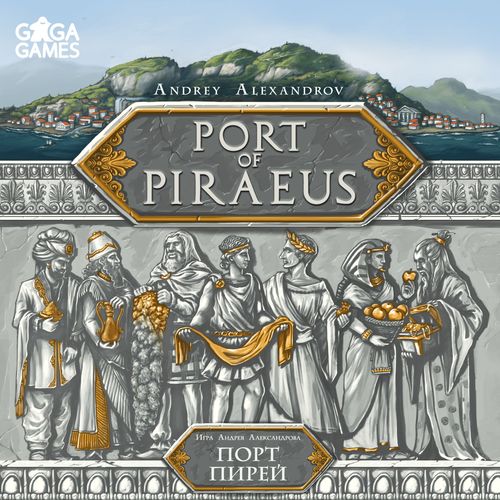
Port of Piraeus
Port of Piraeus Rulebook
Table of Contents
Table of Contents
About the Game
Players become merchants from different countries who strive to grow rich by selling and buying various goods. The game is played over 8 trading days, and each day the participants face a choice of what to do: buy the goods they need or sell their own. Prices for the various goods change constantly depending on the situations that arise. For all goods acquired, or for certain sets of them, each merchant is paid a good price back home! The player who becomes richer than everyone else is declared the winner.
Components
Game board with time and price tracks:
- 1 day marker
- 6 price markers
- 40 coins with a value of 1 drachma
- 40 coins with a value of 5 drachmas
- 6 double-sided tokens: seller / buyer
- Goods cards:
- Romans, 8 cards
- Barbarians, 8 cards
- Egyptians, 8 cards
- Indians, 8 cards
- Chinese, 8 cards
- Persians, 8 cards
- Greeks, 18 cards
Setup
Place the game board in the centre of the table. Leave space below it for the Greek goods, and above it for the foreign goods.
Place the day marker on number 1 of the time track, and the price markers on the corresponding price tracks so that all goods have a starting price of 5 drachmas. Six goods are in play:
- Furs
- Tableware
- Food
- Jewelry
- Spices
- Fabrics
Divide all goods cards into 7 decks by the merchants' country of origin (by colour). Each player chooses a merchant of the country they will represent in the game, and takes all the goods cards of that country, the buyer / seller token of the matching colour, and 10 drachmas. The remaining money forms the reserve, located to the left of the game board.
Important! Greeks cannot be chosen; they are the local inhabitants and the owners of the market. Shuffle the deck of Greek goods and place it next to the game board. Return the other cards to the box; they are not needed in the game.
The printed starting-layout diagram shows four players. The rulebook does not state which country decks are used with fewer or more players, so the setup is transcribed as printed.
Game Flow
The game lasts eight trading days. Each trading day consists of the following phases:
- Start of the day
- Day planning
- Putting goods up for sale
- Conducting deals
- End of the day
1. Start of the Day
The top three cards of the Greek deck are placed in the Greek trade row (below the game board). If the Greek deck has run out of cards, no more are placed.
2. Day Planning
All players choose secretly what they will do this day: buy goods or sell them. To do this, each participant takes their double-sided token and, hiding it with a palm, places it face up on the table on the required side. As soon as everyone has done this, the tokens are revealed and the number of buyers and sellers is counted, after which the first price changes take place:
- If there are fewer sellers than buyers, the price of each Greek-represented good rises by 1 drachma for each card of that good. Move the price marker on the track of the corresponding good one division to the right.
- If there are more sellers than buyers, the price of each Greek-represented good falls by 1 drachma for each card of that good. Move the price marker on the track of the corresponding good one division to the left.
- If the number of sellers and buyers is equal, the price of each Greek-represented good rises by 1 drachma for each card of that good, while goods not put up for sale fall by 1 drachma. Reflect these changes on the price track.
Example: Two players decided to sell goods and two to buy. The Greeks put up for sale the goods "Fabrics", "Furs" and "Furs". Therefore the price of "Fabrics" rises by 1 drachma, and the price of "Furs" rises by 2 drachmas. The prices of "Spices", "Food", "Tableware" and "Jewelry" fall by 1 drachma.
3. Putting Goods Up for Sale
All seller players choose no more than two goods they want to sell today, and place them face down in the foreign trade row (above the game board). Sellers may choose not to put any goods up for sale. When all sellers have made their choice, the cards are turned face up simultaneously, and the price changes take place:
- The price of each good put up for sale falls by 1 drachma for each card of that good. Move the price marker on the track of that good to the left.
- The price of each good not put up for sale rises by 1 drachma for each seller this day. Move the price marker on the track of that good to the right.
Example: Three sellers put up for sale the goods "Furs", "Tableware", "Spices", "Tableware" and "Spices". Accordingly, "Fabrics" and "Jewelry", not being represented, rise by 3 drachmas each (because there are three sellers). "Food" and "Furs" fall by 1 drachma each (one card each). "Tableware" and "Spices" fall by 2 drachmas each (two cards each).
Important! The price of goods cannot rise above 9 drachmas or fall below 1 drachma.
4. Conducting Deals
Each buyer player is allowed to take part in trade deals three times, provided goods are available on the market.
All buyer players, in any order, choose one goods card in either of the two trade rows and place their double-sided token on that card.
Important! A buyer may not place a token on goods they cannot pay for. If a player cannot or does not want to buy anything, they keep the token for themselves. A token may be placed on goods cards that already have other buyers' tokens on them; in that case the player who placed their token first on that card may change their decision and choose new goods (move the token). In all other cases a token may not be moved.
When the buyers' tokens have been placed, the trade deals take place.
Resolving the deals:
- If there is only one buyer's token on a goods card, that buyer pays the owner of the goods the price marked on the game board, and takes the card together with the token. Money paid for Greek goods goes to the reserve.
- If there are several tokens on a goods card, a bidding round is held among the buyers competing for that good: each of them holds in hand any sum of drachmas (not less than the cost of the goods). Then all bidders simultaneously open their palms, and the buyer offering the highest price acquires the goods. The winner pays the money to the owner of the goods, or to the reserve if buying Greek goods. The bidders who lost keep the money they put up. If the bids are equal, the goods are not sold to anyone; the money and the buyers' tokens are returned to their owners.
Important! Note that the deal phase takes place in 3 rounds. Thus each player may buy from 0 to 3 cards in one trading day.
5. End of the Day
- All foreign goods that the participants did not buy are sold to local residents: the owners of these cards receive money from the reserve according to the price of these goods, and the goods cards leave the game.
- Greek goods return to the warehouse (to the bottom of the Greek deck).
- The day marker moves forward one division.
- A new trading day begins (see "Game Flow").
End of the Game
The game ends at the end of the 8th trading day, and all participants travel to their homelands to sell the goods from other countries; that is, the money earned by the players is counted.
Goods are sold individually or in sets. A set is 3 or more cards in which one of two characteristics (type or country of origin) matches and the other differs.
Important! Your own goods cannot be part of a set!
Examples of sets from the rulebook: the "Spices (Persians)", "Spices (Egyptians)" and "Spices (Greeks)" cards form a set. The "Food (Barbarians)", "Tableware (Barbarians)" and "Fabrics (Barbarians)" cards also form a set.
For each set of 3 or more cards, the player receives drachmas according to the table:
| Number of cards in the set | Drachmas per set |
|---|---|
| 3 | 27 |
| 4 | 40 |
| 5 | 55 |
| 6 | 70 |
For each foreign good not taking part in a set, the player receives 6 drachmas.
Important! For each of their own goods remaining unsold, the player receives 1 drachma.
All participants count how much money they earned from selling goods in their homelands, and add the money left over. The richest merchant wins. If two or more players have an equal amount of money, the winner is the one who has fewer of their own goods left. If it is still a tie, the youngest of them wins. If the leader cannot be determined, these players celebrate the victory together.
Have a nice game!