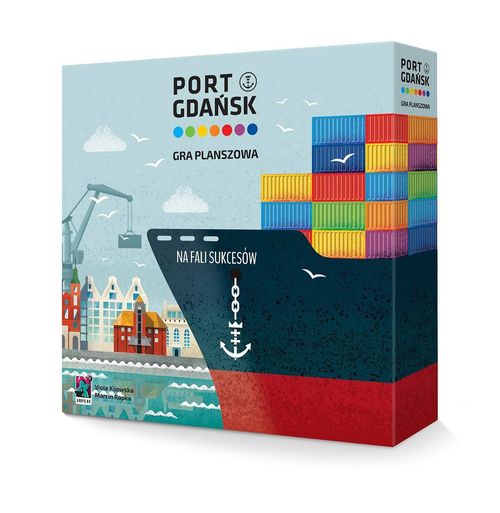
Port Gdańsk
Port Gdańsk Rulebook
Table of Contents
Table of Contents
Components
- 1 Port Gdańsk game board
- 4 Player boards
- 4 Player meeples
- 36 Player markers (9 in each of 4 colours)
- 20 Order tokens
- 20 Port cards
- 21 Cruise Ship cards
- 1 Central Port card
- 40 Worker tokens
- 64 Goods cubes:
- 12 x grain (yellow)
- 12 x liquid fuels (blue)
- 12 x coal (black)
- 10 x containers (red)
- 10 x cargo* (green)
- 8 x Ro-Ro** (white)
- 3 Action dice
- 14 Promo cards (one of them is used as a first player marker)
- 1 Rule book
* Cargo, among other things, includes heavy weight and oversized cargo, and also metallurgical products and other goods packed in pallets, big bags or sacks.
** Ro-Ro is rolling loads (roll-on roll-off) and vehicles (cars, trucks and wagons) that can get on board on their own.
Setup
-
Place the Port Gdańsk game board in the middle of the table.
-
Separate the Goods cubes according to their colours and place them on the respective areas in the unloading zone on the board. They form a common pile.
-
Place Worker tokens next to the board. They form a common pile.
-
Next to them, place the Order tokens in a single stack. Make sure that all Order tokens are placed with the Victory points on top. When playing with two players, return 5 Order tokens from the top of the stack back to the box – they won't be used in this game.
-
Prepare the deck of Port cards. When playing with two players, choose one colour of cards (apart from green). The chosen colour will not be used in this game. Put all the cards of that colour back into the box. That way you determine a sector on the Port Gdańsk game board with no orders. Shuffle the rest of the cards, make a face-down stack and put it above the board. Place the Central Port card at the bottom of the stack.
-
Each player takes one Player board, one meeple and 9 markers in a chosen colour. Place the Player board in front of you and your meeple on any location on the game board (there can be more than one meeple on the same location). Place one of your markers on the "0" space on the score track, and the rest of your markers next to your Player board (to be used as Influence markers during the game). If there's less than 4 players, put Player boards, meeples and markers in unused colours back into the box – you won't need them.
-
Draw three cards from the top of the deck of Port cards and place them face up above the Port Gdańsk game board. Port cards are divided into four groups with different colours: blue, purple, green and brown. The colour on the card and the number in its top right corner will help you find its location on the board.
-
Find the three locations on the Port Gdańsk game board with the same numbers as the three Port cards revealed in the previous step. On each location, place an Order token from the top of the draw pile in the order the cards were revealed.
Description of Game Components
Port Gdańsk game board
The board diagram labels: score track; sector (includes all Port locations of the same colour; the blue sector is marked in the diagram); connection between Port locations; place for an Order token, and for a Player's Influence marker once an order is executed; single Port location (with one quay); double Port location (with two quays); place for the Central Port card, once it is revealed; place for three piles of Cruise Ship cards; unloading zone for Goods cubes; symbols showing a good's weight.
Important: For the purpose of this game, the map of the Port of Gdańsk has been slightly simplified, while still maintaining the unique features of the Port. The scale of some buildings is different than in reality in order to draw your attention to some of the places worth a closer look.
Player board
The player board labels: movement action; loading action; recruitment action; HR panel; cargo space for 9 Goods cubes; player's colour; place acquired Cruise Ship cards here; place acquired Port cards here; place executed Order tokens here.
Order tokens
Front: goods required to execute an order (shown as coloured cubes), information on constant bonus from an executed order, and Victory points (VP). Back: constant bonus for an executed order (shown as a red hexagon).
Port cards
Port cards: the diagram labels the name, number and colour of a quay, the required number of Worker tokens, and the description of a quay (front). The back shows the card design only.
Cruise Ship cards
Cruise Ship cards: the diagram labels the required number of Worker tokens (shown as worker icons above the ship) and the Victory points (VP) on the front. The back shows the ship design only.
Central Port card
The Central Port card shows the unloading action summary: one loading symbol for grain, liquid fuels or coal (2 VP each); two loading symbols for containers or cargo (3 VP each); three loading symbols for Ro-Ro (4 VP each).
Sequence of Play
Goal of the game
Players take the role of a company operating in the Port of Gdańsk, and their task is to execute orders by loading goods in different locations around the port. Players also recruit workers to service passenger ships waiting in the Port, and to strengthen their influence in the Port of Gdansk, which can bring valuable Victory points. The winner is the player whose company will be the most effective in supporting the Port and scores the most Victory points.
The game Port Gdańsk consists of a series of player's turns. The first player starts the game and then other players take their turns in a clockwise order. The game continues until one of the end of game conditions is met (see page 11).
A player's turn
At the start of your turn you roll the dice to determine what kinds of actions you can perform. Available actions include: Loading, Movement, Recruitment.
You may choose to set aside one or more of the dice you rolled. Any dice not set aside are rolled again. Then, you may again choose to set aside some dice before rerolling one final time. You may include dice set aside after your first roll in this final reroll if you wish. You may then perform the actions that you have gained. Their detailed description is on page 6.
Example: Caroline got the following result from her first dice roll: Movement, Recruitment, Loading. She set aside the die with the loading action and rolled the remaining two dice again, hoping to get more loading symbols. She got a loading symbol on one of the dice and a recruitment symbol on the other. Caroline is satisfied with the dice roll result on all three dice and chose not to have a third dice roll.
Note:
- You can perform the actions from the dice in any order.
- If you don't want to perform a given action (eg. moving to a different Port location), you do not have to. Additionally, if you did not roll the required symbol for a given action then you may not perform it.
- When you decide to perform a given action, you have to complete it using the dice that rolled that action's symbol before you start another action (however, you do not need to use all action's symbols). You may not perform the same action twice in a turn, even if you are using a different die to do so.
Example: you roll three movement symbols and two loading symbols, you cannot move one location first then load goods and then move the remaining two locations.
Before and/or after performing all of your actions from your dice roll, you may perform up to three additional actions (in any order):
- Execute one order
- Use your HR panel once
- Serve one cruise ship
Their detailed description is on page 7. Then your turn is over and the player on your left starts their turn.
Detailed Description of Actions
Actions on dice
Loading – lets you move Goods cubes from the unloading zone to the cargo space on your Player board. Each die has two faces with this action: one with a single loading symbol and one with a double loading symbol. The total number of loading symbols that you roll, shows the maximum weight of goods that you can move onto your board in one action. Take from the stack any Goods cubes (of the same or different colours), whose total weight stays within the limit indicated by the dice roll, and place them in your cargo space. Each square in your cargo space may only contain one Goods cube.
Note: You may not use the loading action if your meeple is on the Central Port location and the Central Port card has been revealed.
There are six groups of goods that are unloaded in the Port of Gdańsk: grain (yellow), liquid fuels (blue), coal (black), containers (red), cargo (green) and Ro-Ro (white). Some goods are lighter than others, so they require just one loading symbol; others are heavier, so they require two or even three loading symbols.
To load grain, liquid fuels or coal to your cargo space, you need one loading symbol per Goods cube. Containers and cargo are heavier, so each cube of these goods requires two loading symbols. Ro-Ro is the heaviest, so you need three loading symbols to load each Ro-Ro Goods cube.
Diagram: three loading symbols = Ro-Ro (this good weighs 3); two loading symbols = containers or cargo (these goods weigh 2); one loading symbol = grain, liquid fuels or coal (these goods weigh 1).
Example: Caroline rolled 4 loading symbols. She could take any four goods of weight 1 each (e.g. grain, liquid fuels, liquid fuels, coal) OR any two goods of weight 2 (e.g. containers and cargo) OR any two goods of weight 1 and one good of weight 2 (e.g. liquid fuels, liquid fuels and containers) OR any good of weight 1 and one good of weight 3 (e.g. grain and Ro-Ro). Caroline chose grain, coal and cargo, as she needs these goods to execute an order.
Remember that your cargo space has a limited capacity. At no point in the game you can have more than 9 Goods cubes. If your cargo space is full and you want to perform a loading action, you will have to discard Goods cubes from your cargo space to make room for the new Goods cubes that you want to place there. Place the discarded goods back on the Port Gdańsk board in the designated unloading zone.
The Goods cubes are limited. If you can't find certain goods on the Port Gdańsk game board, then you can't load them until somebody returns them to the common pile.
Movement – lets you move around the Port of Gdańsk by moving your meeple from one location to another. Each die has two faces with this action: one with a single movement symbol and one with a double movement symbol. For each arrow you roll, you can move your meeple on the board along a connection to another location. You can always choose to make fewer moves. You can move in any direction, but only along the black, dotted lines connecting Port locations. You may move your meeple to a location where other player's meeples are.
Example: Adam got the following result from his dice roll: one movement symbol, one loading symbol and one double movement symbol. He takes Goods cubes of total weight 3 from the stack and places them in his cargo space. Then he moves his meeple by one location from Krakowskie Quay (20) to Przemysłowe Quay (18). He could make another move (the dice with the double movement symbol allows it), but he decides to end his movement action with his meeple on Przemysłowe Quay.
Note that some Port locations are connected (eg. Górniczy Basin (9) and Rudowe Quay (14)). Such areas are treated as a single Port location for the purposes of movement. If you have your meeple on such a location, you have access to both quays and you don't need to use a movement action to move from one quay to another.
Example: In the example above, Adam can move two locations (he rolled two arrows on one of the die). Since his meeple is currently on Krakowskie Quay (20), he moves it to Górniczy Basin (9). The move between these two locations requires two arrow symbols, so exactly the amount that Adam got from his dice roll.
Recruitment – lets you acquire Worker tokens. Take one Worker token from the pile for each recruitment symbol rolled. The Worker tokens are unlimited. In rare cases, when there are no tokens left in the pile, use some other markers to replace them (e.g. coins).
Example: In her turn, Caroline got a movement symbol, a recruitment symbol and a recruitment symbol on her dice roll. She takes 2 Worker tokens from the pile and places them next to her Player board. Caroline decides not to perform a movement action as her meeple is on the quay where she wants to execute an order.
Workers are a valuable asset. With them you can make use of the HR panel, serve cruise ships, and execute orders. There's no limit to the number of Worker tokens you can possess.
Additional actions
Before and/or after performing all of your actions from your dice roll, you can additionally execute one order, use your HR panel once or serve one cruise ship. You may perform one or more of these additional actions before your dice actions, and one or more afterwards, if you prefer, but never more than one of each type of additional action during your turn. Each of these actions has a set of requirements that need to be met. There is also a special action "Unloading in Central Port" that becomes available towards the end of the game, once the Central Port card is revealed.
1. Executing an order
Executing orders gets you Victory points and gains you influence in the sector the order is executed in. Some orders also give you a constant bonus that will let you execute future orders more easily. Executing an order also scores Victory points for other players who have influence in that sector.
Conditions for executing orders
To execute an order, you have to meet three conditions:
- Your meeple is on the Port location with the Order token and
- In your cargo space, you have all the goods required to execute the order and
- You have at least one Worker token.
If you meet all of the above conditions, return the required Goods cubes to the unloading zone, and one Worker token to the common pile. Then gain the Victory points stated on the Order token by moving your marker on the score track by that number of spaces.
Reminder: You may only execute one order during your turn. If there are two Order tokens on a double Port location (eg. Górniczy Basin (9) and Rudowe Quay (14)), you can execute just one of these two orders.
Example: After Caroline rolled the following on the dice: a movement symbol, a recruitment symbol and a recruitment symbol, and took 2 Worker tokens from the pile, she is ready to execute an order. She has at least one Worker token, her meeple is on WOC I Quay (1), where there's also an Order token, and she has all the required goods in her cargo space (3x grain, 2x liquid fuels, 1x coal, containers, cargo). Thus Caroline meets all the conditions to execute the order. She puts the Goods cubes and the Worker token back into their piles, for which she receives 12 Victory points.
Diagram captions: Caroline draws two Worker tokens. Caroline moves her meeple to the WOC I Quay (1). Caroline puts her Goods cubes and the Worker token back into their piles on the board.
Victory points for other players with influence in the sector
Now check if any other players have Influence markers in the sector where you just executed your order. Reminder: A sector is a set of port locations in a given colour eg. a sector of blue quays, while an influence is a player's marker on a location. When you execute an order, other players who have Influence markers in that sector, receive 2 Victory points for each of their own markers.
Remember: Every time another player executes an order, check if you have Influence markers in the same sector of the Port.
Example: WOC I Quay (1) is located in the blue sector. Caroline checks if other players have Influence markers on other blue Port locations. Adam has one marker on WOC II Quay (3) and one on OPP Quay (5). Adam receives 4 Victory points for his markers (2 Influence markers x 2 points each). Even though Caroline has one of her Influence markers in the blue Port sector on Westerplatte Terminal (2), she doesn't receive extra Victory points.
Influence in a sector and constant bonus
Remove the executed Order token from the board, and place one of your Influence markers in the location where the Order token was. Remember that you have a limited number of Influence markers (at the beginning of the game you have 8) and once you place your last marker on the board, you meet one of the conditions to finish the game.
Turn the acquired Order token face down and place it below your Player board. If there's a goods symbol on the back of the token, you can use it as a discount for future orders as if you had that Goods cube in your cargo space (you don't have to discard it and it is not included in the 9 cubes limit).
Example: Coal is a constant bonus gained from executing this order. Caroline can use it multiple times in the game (as if she has one extra cube of coal in her cargo space).
New cards and orders in the Port of Gdańsk
Take the Port card for which you executed the order and place it face up to the right of your Player board. Collecting Port cards of different colours (from different Port sectors) will score you Victory points at the end of the game (see page 11).
Then reveal two new Port cards from the pile and place them above the board, next to the others. Cards should be grouped according to their colour, placing cards of the same colour on the top of each other, leaving just the name visible. For each Port card drawn, take an Order token from the top of the draw pile and place it on the location shown on the Port card. If there are no more Port cards or Order tokens then skip this step. Once the Central Port card is drawn (in a 3-4 player game) or revealed at the bottom of the deck (in a 2 player game), immediately place it on the Central Port location on the Port Gdańsk game board. The special action "Unloading in Central Port" is now available (see page 10).
Example: Caroline takes the WOC I Quay (1) card. Then she uncovers two new Port cards from the Port card deck and places them above the board. These cards are: Oliwskie Quay (4) and Północne Quay (7). Now Caroline takes two Order tokens from the pile and places them on the board, one on Oliwskie Quay and another one on Północne Quay.
Diagram caption: Caroline takes this card.
Remember:
- All Order tokens give you Victory points.
- Some Order tokens give you constant bonus that you can use multiple times during the game (shown by the goods symbol on the back).
- Every time you get Victory points for executing an order or for having Influence tokens in the same sector as an order executed by another player, move your marker on the score track.
2. Making use of your HR panel
Your HR panel lets you use Worker tokens and send them to perform special tasks.
Reminder: You may only use your HR panel once during your turn.
Two special tasks are available:
- Return two Worker tokens to the common pile, and swap one of your Influence markers on the board with another player's Influence marker on the board.
- Return three Worker tokens to the common pile, and place one of your Influence markers from your stock onto a location on the board on which there is another player's Influence marker (or more than one other player's Influence markers).
You can only have one of your Influence markers on the same location (you can have two Influence markers on double Port locations – one Influence marker on each quay).
Remember: Making use of your HR panel, you can't place your marker on a location with no other player marker(s) on, or on a location with an Order token.
Example: Anna got the following result from her dice roll: three recruitment symbols. She takes three Worker tokens. Then she returns two Worker tokens to swap her Influence marker on Liquid Fuel Terminal (6) with Caroline's Influence marker on WOC I Quay (1). Anna hopes that this will pay off in the future when other players execute orders in the blue sector.
3. Serving cruise ships
You can send your workers to serve cruise ships giving you extra Victory points at the end of the game.
The size of the cruise ship being served determines how many Worker tokens you must return to the common pile:
- Small cruise ships require 3 Worker tokens
- Medium cruise ships require 5 Worker tokens
- Large cruise ships require 8 Worker tokens
Return to the common pile the required amount of Worker tokens and take a Cruise Ship card from the top of a stack. Place the Cruise Ship card face down to the right of your Player board, so that other players can't see the Victory points you'll score for it at the end of the game. Reminder: You may only serve one cruise ship during your turn.
Example: Anna got the following result from her dice roll: three recruitment symbols. She takes three Worker tokens and adds them to the ones she got in the previous turns. She now has 9 of them in total and decides to discard 8 Worker tokens to serve one large cruise ship in the Port. Anna collects one card from the top of the stack of large ships (worth 12 Victory points at the end of the game) and puts it face down next to her Player board.
Special Action
Unloading in Central Port
This special action becomes available once the Central Port card is revealed and placed on the Central Port location. It allows you to use loading symbols that you have rolled in order to unload goods from your cargo space in exchange for Victory points. You may only use this action if your meeple is on the Central Port location.
The amount of loading symbols rolled shows the maximum weight of goods that you can unload with this action. Take Goods cubes from your cargo space, making sure their total weight isn't higher than the number of loading symbols rolled, and return them to the unloading zone on the Port Gdańsk game board. Each discarded cube gives you a certain amount of Victory points (as shown on the Central Port card, and also in the table below). Move your marker on the score track by that number of spaces.
| Required number of symbols on the dice | 1 loading symbol | 2 loading symbols | 3 loading symbols |
|---|---|---|---|
| Type of goods you can unload | grain (yellow), liquid fuels (blue), coal (black) | containers (red), cargo (green) | Ro-Ro (white) |
| Victory points | 2 VP | 3 VP | 4 VP |
Reminder: You cannot use the loading action if your meeple is on the Central Port location with the Central Port card.
Example: In his turn, Adam executed an order on Oliwskie Quay (4). He drew two new cards from the draw stack, including the last card from the pile: the Central Port card. He put it on the Central Port location of the Port Gdańsk game board. Now it's Anna's turn. Anna tries to roll as many loading symbols as possible, so that she can perform the unloading action on the Central Port card. Her dice roll result is the following: two loading symbols, two loading symbols and one movement symbol. Anna moves her meeple to the Central Port location and then she returns goods of total weight 4: Ro-Ro and grain, for which she receives 6 Victory points in total. She puts the Goods cubes back into their common piles and moves her marker 6 spaces on the score track. As long as Anna's meeple is on the location with the Central Port card, she cannot perform the loading action.
Diagram caption: Anna moves her meeple to the Central Port location. Anna performs the unloading action to unload goods and get 6 VP (she moves her marker 6 spaces on the score track).
Game End
The game ends in one of these three instances:
- When any player has scored on the board 60 Victory points or more or
- When any player places their final (eighth) Influence marker on the board or
- When there are no more Order tokens left on the board.
In such case, you continue the game until all players have played the same number of turns (i.e. up to and including the player to the right of the player who started the game).
End of game scoring
At the end of the game each player is awarded Victory points for the following:
- Cruise Ship cards acquired during the game,
- Sets of different coloured Port cards collected during the game, according to the table below:
| Set of Port cards | Victory points |
|---|---|
| 1 Port card in any colour | 1 |
| 2 Port cards in two different colours | 3 |
| 3 Port cards in three different colours | 6 |
| 4 Port cards in four different colours | 10 |
Each card can be a part of just one set but you may score for multiple sets.
Example: Adam has the following Port cards that he acquired by executing orders: WOC II Quay (3) blue card, Oliwskie Quay (4) blue card, OPP Quay (5) blue card, Wiślane Quay (12) green card and Silo 1 (17) brown card. In total he gets 8 Victory points for them. The set of three Port cards in different colours (blue, green and brown) is worth 6 Victory points, and the remaining two blue cards are worth 1 Victory point each (6+1+1=8).
Move your marker on the score track by the amount of additional Victory points you got at the end of the game. The player with the most victory points wins the game. In the case of a tie, the player with more markers on the board wins the game. Still no luck determining the winner? In such a case, all tied players share the victory!
Summary
Actions on the dice
- Loading – Lets you move Goods cubes from the unloading zone to your cargo space.
- Movement – Lets you move your meeple from one location to another on the Port Gdańsk game board.
- Recruitment – Lets you acquire Worker tokens.
Additional actions
You need Worker tokens to perform all of these actions.
- Executing orders – Lets you acquire precious Victory points in exchange for returning the required Goods cubes.
- Making use of the HR panel – Lets you manipulate Influence markers in the different sectors on the board.
- Serving cruise ships – Lets you acquire precious Victory points by sending workers to serve cruise ships.
Counting Victory points and determining the winner
Sum up your Victory points:
- Acquired during the game – You earn Victory points during the game from executing orders and having Influence markers in sectors where other players execute their orders.
- Acquired at the end of the game for your Cruise Ship cards – You earn Victory points at the end of the game for Cruise Ship cards that you collected during the game. Sum up Victory points from these cards and add them to your total.
- Acquired at the end of the game for sets of Port cards – You earn Victory points at the end of the game for sets of Port cards that you collected during the game. The more Port cards of different colours you have collected, the more they are worth (see page 11). Add these Victory points to your total.
If you're the one who earned the most Victory points, then you're the winner!