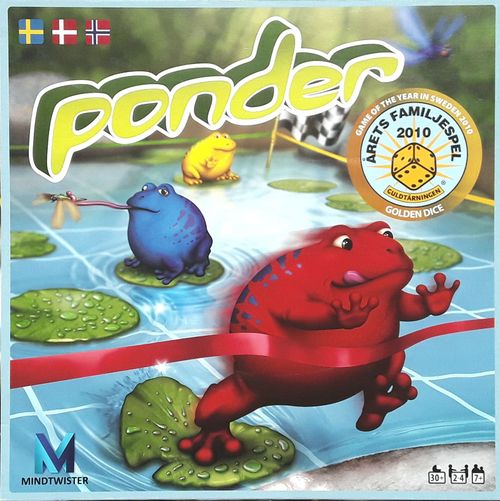
Ponder
Ponder Rulebook
Table of Contents
Table of Contents
Game Flow
A move in the Marsh consists of 3 simple actions:
- Throw a lily pad.
- Move a frog.
- Reveal a new card.
The movement card indicates the direction in which your frog can move.
The first player to get their team's 3 frogs across the Marsh to the opposite bank wins the game!
Setup
- Place the 28 lily pads on the spaces that have a green dot.
- Choose the colour of your team.
- Shuffle your movement cards and place them in a stack, face down, facing you.
- Turn over the first movement card and place it on the space of your colour.
- This bank of the Marsh is your starting zone.
- Frogs sometimes serve as dice. Decide who goes first by rolling your 3 frogs like dice on the table. The player who gets the most frogs "seated" goes first. In case of a tie, roll again until only one player remains.
- Place your frogs wherever you like on your starting bank.
The orange space on the game board shows that it is the starting bank of the orange team. The top card is placed face up on that space so that all players can see it. The game begins with the 3 frogs placed on the starting bank. Each frog can re-enter the Marsh through any space along its bank, if there is a lily pad, of course!
If playing with two players, use colours that sit next to each other on the table (for example Blue and Yellow).
Move a Lily Pad
In the Marsh, a turn begins by recovering a lily pad located 1 space away from one of your team's frogs.
Once the lily pad has been recovered, you can throw it onto any empty space of the Marsh.
Only one lily pad may be moved per turn.
- You may choose to recover a lily pad next to a frog, and place the recovered lily pad where you want, on one of the empty spaces of the board, so as to finally move your frog next to it, or any other frog of your team.
- The starting bank may be treated as a single space. Frogs still on the bank may recover any lily pad located on one of the 5 spaces along it.
- If none of your frogs can recover a lily pad, read the "Paddle" section below.
- If all your frogs are on the starting bank and none of them can recover a nearby lily pad, you pass your turn (however, you must still turn over a movement card).
- You cannot move a lily pad on which a frog is seated.
A frog can jump onto a lily pad if the lily pad is in direct contact with its space, in a straight line or diagonally. In this case, the orange frog may choose between 2 lily pads.
Move a Frog
The movement card revealed on the game board determines how your frog moves (see the list of movements on the last page). Your frogs must jump onto, and only onto, spaces containing a lily pad. They may jump from lily pad to lily pad as far as they can, in the direction shown on your movement card, or stop whenever they wish.
- You must move only ONE frog per turn. If you can move it, you must do so.
- A frog cannot jump over another frog or double it, but that frog may be challenged (see "Combat").
- Frogs on the starting line may enter the Marsh onto any adjacent space, but only in the direction of your movement card.
- A frog cannot be ejected onto a bank unless it has finished its run by passing the finish line, or unless it has been sent back to its starting line after a "Combat".
The movement card shows how the frogs move. In this case, the Orange frog can attack the Blue one, or simply move one space in the direction of the Blue frog. The Orange frog may also choose to go to the lily pad available next to the Yellow frog.
Paddle
If no lily pad is within 1 space of any of your 3 frogs, you are therefore unable to recover a lily pad for movement. In this case only, you may move any one frog that is accompanied by its lily pad by one space, in any direction. After a paddle move, a new movement card must be turned over.
Combat
A frog may challenge another frog. If the movement card allows it, the attacking frog takes the place of the other frog. The defending player then throws their frog like a die. Depending on the position in which the frog lands, there are 3 possible outcomes of the combat:
- If the frog lands on its back or on its side, you lose the combat and your opponent moves your frog back one space in any direction where a lily pad is available.
- If the frog lands sitting up, your frog, unshakeable, takes its place back on its lily pad. In this case you may move your opponent's frog back one space in any direction where a lily pad is available.
- If the frog stops in an acrobatic position on its nose or on its stomach, your frog falls into the Marsh and returns to its starting bank.
Reveal a New Card
At the end of each turn, the player must turn over the next movement card. Once visible to the other players, this card determines the movement the player must make on their next turn.
- When you have no more face-down cards, shuffle your face-up pile, place it face down again, and continue playing.
Winning the Game
The first player to get their 3 frogs across the Marsh to the opposite bank wins the game. A frog that reaches the opposite bank is considered arrived and can no longer re-enter the game.
- Any movement card, used well, lets a frog leave the Marsh (except the "Fly Meal" card, "Repas Mouche").
- Lily pads located next to a frog that has already arrived cannot be recovered to move the other frogs still in the race.
Movement Cards
- Straight line: The frog you choose to move may jump from lily pad to lily pad in a straight line (not diagonally): forwards, backwards or sideways.
- Diagonal: The frog you choose to move may jump from lily pad to lily pad diagonally.
- "Any direction" (Toute direction): The frog you choose to move may go in a straight line or diagonally.
- One step (D'un pas): The frog you choose to move may jump one step, from one lily pad to another, in all directions.
- "Fly Meal" (Repas Mouche): Your frog is distracted by the food passing next to it! And when the appetite comes, it is impossible to resist. In that case, the frog passes its turn. Don't forget, however, to turn over a new movement card for the next turn.
- "Punch" (Coup de Poing): Moves normally according to the movement shown on the card. At the end of the movement, if your frog is 1 space away from another frog, you may perform a "combat".
Tips
- Keep a watchful eye on your opponents' movement cards. They tell you how to move best in response to their next move.
- Make sure you always have lily pads near your starting bank, otherwise some of your frogs may quickly become stuck!