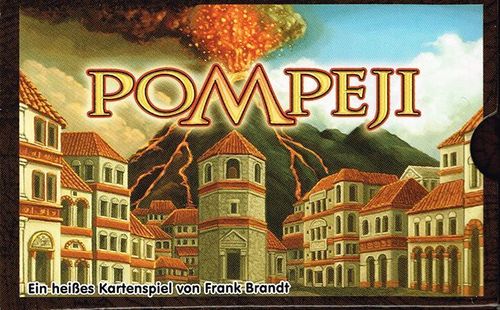
Pompeji
Pompeji Rulebook
Table of Contents
Table of Contents
Contents
- 49 Building cards (7 buildings in 7 colours numbered 1-7)
- 2 Volcano Cards
- 4 Statues
- 4 Special building permits (2x)
- 1 Overview card / drawing
- Rules of the game
Aim of the game
The players are to create the town and build one building next to the other. Points are given to players who construct the same buildings or colours in one street.
Getting ready to play
- Lay pen and paper to one side (each playershould note his own points)
- Each player receives 1 statue and 1 special building permit and places these open in front of him. Remaining statues and special building permits are placed to one side.
- Shuffle all 49 building cards and deal 3 to each player
- From the remaining building cards count two piles of 8 cards and mix 1 volcano card into each pile. Place these two piles face down on top of each other and then place the remaining bulding cards face down on top of them.
- Uncover the top card of this stack and place it face up in the middle of the table. This card is the beginning of Pompeji.
How to play
- The youngest player begins. Play clockwise.
- He chooses one of the cards from his hand and places it next to the building card lying on the table, so that the two cards toch each ohter either alongside or broadside. Placing the card dioganally is not allowed (see drawing 1). The same buildings or colours are not allowed to be either horizontally or vertically adjacent, but this is allowed in diagonal direction. Exception: statues. These may lie next to each other in each direction.
- After playing a building card, the player draws a new card from the pile in the middle of the table.
- If a player cannot place on of his cards next to the buildings on the table he places one of the cards from his hand open next to the stack in the middle of the table and draws a new card.
- Subsequently the player on the left is the next.
Roads
- By laying out the cards, horizontal, vertical and diagonal roads are developed, which chan be interrupted by missing cards. A town of 7 x 7 cards is gradually built, whereby the starting card does not necessarily have to be the centre of the town. It is just important, that no side has more than 7 cards (see drawing 2).
Points (s. Overview card)
1Same buldings in a road: If a player places a building (e.g. fountain) in a road, which already exists at least once in this road, he receives points. The total sum of points of these buildings (here: fountain) are instantly added to his account. 2Same colours in a road: If a player places a building of an already existing colour in one road, he immediately receives the highest amount of points of this colour in this road for his account. 37th building in a road: The player who builds the 7th building in a road receives 7 additional points. Important: Multiple points can be achieved with one card. All roads in horizontal, vertical, and diagonal direction are checked for the same building or colour and whether it is the 7th card. Only those cards are taken into account, which are connected to the card just placed and where the roads are not interrupted by a missing card.
Special building permit(2x)
- Each player can use this card once to achieve points out of turn or to have a second turn directly after his actual turn.
- After playing this card, the player may immediately play a complete round; i.e. the player whose turn it normally was has to wait.
- The player immediately places a building card or statue on the table, counts the points scored and then draws a new card.
- Then the player takes his used special building permit out of the game.
- The interrupted player can now take his turn. Important: If a special bulding permit is played, a further special permit cannot be played, as a round is only allowed to be interrupted once. If more than one player wish to interrup the turn of another player, the player who expressed this wish first may do so.
The statue
- The statue is used as a joker and is itself worth 1 point. The statue card is played as every other card, whereas the player himself decides which building or colour the joker represents. Important: the same buldings or colours are not allowed to be either horizontally or vertically adjacent. Statues are allowed to be placed next to each other. After playing a statue card, a new card may not be drawn. Important: As soon as a player has scored points with his statue, the statue card becomes a neutral card, i.e. the statue immediately loses chosen colour and building. Additional statues in one road do not give extra points.
The volcano / End of the game
- As soon as the first volcano card is uncovered, the town is endangered and the end phase begins. The volcano card is put aside.
- From the 1st volcano on every player decides whether or not to draw new cards, as the cards in the hand are counted as minus points at the end of the game.
- If a player lays his last card onto the table, he has to draw a new card.
- When the 2nd volcano is uncovered Pompeji is demolished. The game ends immediately.
- The points on the building cards in the hands of a player are subtracted from his achieved score.
- The player with the highest score wins.
Variation
To make the game more offensive, each player can use a 2nd special building permit. To do so, the back of the card is used. If a player has used both special building permits, the card is put aside.