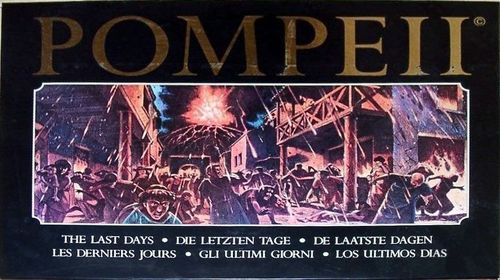
Pompeii: The Last Days
Pompeii: The Last Days Rulebook
Table of Contents
Table of Contents
1. Goal of the Game
Each player must bring himself to safety at the destruction of the city, but at the same time must also save other citizens of Pompeii. This rescue operation is the focus of the 3rd phase of the game.
The first two phases are preparation. The 1st phase allows each player to build up a human capital – the clientes – and a property capital. The second is the phase of the quiet life of the inhabitants of Pompeii up to the eruption of Vesuvius and ... the last day.
2. Components
Game board, rulebook, 8 playing pieces, 2 dice, 1 small plastic bag containing a puzzle, game money.
One deck of cards: Persons/Buildings: 101 cards. One deck of cards: "Vita Romana": 40 cards. One deck of cards: Vesuvius, Eruption of a Volcano: 70 cards.
3. Setup
The various card decks are placed on the board as follows:
- the "Vita Romana" cards, shuffled and with the text face down;
- the "Vesuvius" cards, shuffled and with the numbers face down;
- the other cards (101), which depict persons and buildings, are sorted by number (to simplify their distribution during the first phase of the game) and placed picture side up next to the player who is in charge of distributing them and collecting money for the bank.
Each player chooses a playing piece (without looking). According to the colour of the chosen piece, the player becomes one of the eight inhabitants of Pompeii who take part in this game. He receives a house (see section 4) and capital in sesterces (ST), the amount of which depends on the number of players.
| Number of players | Capital (ST) | Number of players | Capital (ST) |
|---|---|---|---|
| 2 | 25,000 | 5 | 12,000 |
| 3 | 20,000 | 6 | 10,000 |
| 4 | 15,000 | 7 | 8,500 |
| 8 | 7,500 |
4. The Names of the Inhabitants of Pompeii According to the Colours of the Playing Pieces
| Colour | Name | House number |
|---|---|---|
| Green | Julius Polybius | 35 |
| Red | Trebius Valens | 34 |
| White | Marcus Lucretius | 42 |
| Yellow | Obelius Firmus | 36 |
| Black | Fabius Rufus | 53 |
| Blue | Paquius Proculus | 23 |
| Violet | Caecilius Iocundus (printed "Caecilius locundus") | 40 |
| Orange | Lucretius Fronto | 38 |
5. The Game
Important note. To increase his chances of winning, each player must try to acquire a maximum of persons and buildings, without losing sight of his later game strategy and the amount of his capital. The player must then "combine" his persons and buildings according to certain rules; e.g. a priest must (purely locally speaking) be combined with a temple, a slave with a private household, an actor with a theatre, and so on. To make these combinations easier, all cards as well as the individual spaces on the board and the buildings marked on the city map are provided with coloured dots according to a fixed scheme. A person may stay in a building if the colour marking of that building is on the person's card.
Public buildings can accommodate at most 3 persons; private buildings can accommodate only 2 persons.
Phase 1 of the Game: Acquiring Buildings and Persons
In this phase of the game the 107 spaces of the outer part of the board are traversed. An index of all persons and buildings that appear on these spaces is attached to this rulebook in the appendix.
Players roll the dice in turn, using both dice. Starting from INGRESSUS (start), each player must advance as many spaces as the eyes on his two dice show. If, however, he wishes to reach a space that he had to pass over in the current round, he may in the following round move back as many spaces as he can make with only one die; this option exists only in the 1st phase of the game.
If a player comes to a building or person space that has not yet been allocated, he has the option to "buy" it. The player who acquires a space receives the corresponding card (easy to find by its number) against payment of the price stated on the card to the bank.
If the acquisition is a person, the holder of the card becomes that person's Patron from then on. The purchased person thereby becomes his Client. The card holder enjoys the advantages described on the cards for the next phase of the game, the Vita Romana. Above all, however, the Patron has the opportunity to save his Clients during the last phase of the game.
If a player comes to a space whose person or building has already been sold, he may continue on to the next free space.
A player who reaches a FORTUNA (lucky) space may acquire a person or building if it has not yet been sold. It must, however, lie between this FORTUNA and the preceding FORTUNA, or between the FORTUNA and the INGRESSUS if it is the first FORTUNA. The player who makes use of this opportunity places his piece on the newly acquired space and continues the game from that space.
While he is still in the 1st phase, a player may sell his Clients and buildings to other players (or to the bank at 50% of their value, whereby the amount may be rounded up by at most ST 50). During the 2nd phase, however, selling is only permitted if the player no longer has enough money to make the payments required by the "Vita Romana" cards.
If a player wishes to move over into the 2nd phase, then before he finishes the course of the 1st phase he must accommodate the persons in his buildings, observing the prescribed combinations. As already mentioned, it is sufficient to observe the colour markings provided for this purpose. The combinations of buildings and persons must be made clear to all other players by placing the corresponding cards on top of one another.
Those persons for whom no accommodation was found during the 1st phase according to the rules set out below may be sold to other players. The bank may also buy these persons, at 50% of their value, rounded up to at most ST 50.
As soon as a player has completed his combinations (at least one is required), he may move over into the 2nd phase, even if the other players are still in the 1st phase. Each player may remain in the 1st phase for as long as he wishes – that is, he may advance or move back, i.e. play with one die or with two dice; he may acquire buildings and persons even if all the other players are already in the 2nd phase. He must, however, accept the risks that such a strategy could entail.
Phase 2 of the Game: Vita Romana
To begin this phase of the game, the player enters the city walls after passing the last FORTUNA, and places his piece on the house number that was assigned to him at the start of the game. He then takes the top card from the "Vita Romana" pile, reads aloud the instructions on this card, and places it at the bottom of the pile.
This may be an instruction to go to another location; the player must then place his piece on the indicated space. He may, however, also be required to make payments; but payment is due only to those players who are already in Phase 2.
As already mentioned, all payments, both income and expenses, relate to the Patron, i.e. the player who holds the card of the person concerned. If the building to which a player is to go is occupied, the playing piece is placed on the next space with a green dot.
When the card "ULTIMA DIE – Eruption of Vesuvius – 24 August 79" is turned over, the Vita Romana phase is over for ALL fellow players. Only those players who are already in the 2nd phase may take part in the 3rd phase of the game. The other competitors, i.e. those players who are still in the 1st phase, are eliminated.
Phase 3 of the Game: Destruction of the City
In this phase the "Vesuvius" cards are played. They are marked with an erupting volcano. Of the 70 cards in this deck, 57 refer to city quarters, 5 cards contain no instructions (Vesuvius is dormant), and 8 cards bear the note x2 (see below).
Each player who has not yet been eliminated takes a "Vesuvius" card in turn. The number on the back of this card marks the quarter that is now considered destroyed. The player then takes the puzzle piece with the same number and places it, number side up, on the destroyed quarter with the same number. This marks the lava masses and the ash.
Everything covered by puzzle pieces is considered destroyed. The streets and buildings are destroyed, and the players who are located in that quarter at the time of its destruction are eliminated.
As a result of the unpredictable volcanic eruptions, a network of destroyed parts of the city forms on the board, which makes rescue operations ever more difficult.
When the player has turned over the top "Vesuvius" card and placed the corresponding puzzle piece on the city map, he announces the person he wants to save and where that person is located. He then rolls both dice and moves his piece along the green path towards the designated place, by as many green dots as he has rolled eyes. It may of course also happen that a player has to change direction on the way, since the destruction of the streets progresses ever faster.
When a player reaches the building in which his Client is located, he, the Patron, takes the Client into his care. The player now moves his piece by the fastest and safest route to the nearest city gate. As soon as this gate has been passed, the Client counts as saved.
In the next round the player may decide whether he wants to return to the city to save further persons, or whether, for his own safety, he would rather stay outside the city walls. If he wants to return to the city, he may choose any route along the green lines.
Note the following:
-
A pair of equal dice (Pasch, doubles) entitles the player to advance 20 spaces.
-
Cards marked x2 (a particularly calm phase of Vesuvius) entitle the player to advance twice as many green spaces as the two dice show. So a player who rolls a Pasch and at the same time draws an x2 card may advance 40 green points. It may happen that a player is thereby enabled to save one Client and, with the same move, return to the city to save the next Client – whereby the Client to be rescued must always be announced in advance.
If a playing piece is located in the quarter at the moment of a renewed eruption in that quarter, the player is considered dead and is therefore eliminated. It is, moreover, quite possible that the "Vesuvius" card with the number of the quarter to be destroyed is drawn by the player whose own piece stands in that quarter. In such a case every other player may save the Clients of the player who has just been eliminated as if they were his own.
If two players want to save the Client of a third player who has just been eliminated at the same time, the one who reaches the person to be rescued first has priority.
If a player is eliminated after he has already saved one or more persons, these persons keep their value in the final reckoning, except where the player who has just been eliminated is a "late winner" (see section 7).
6. End of the Game
The game ends when one of the following cases occurs:
- all Clients have been saved;
- all city gates and streets are destroyed, so that further rescue operations are no longer possible;
- the last player is eliminated by the destruction of the quarter in which he is currently located.
7. The Winner of the Game
After the end of the game, each player adds up the value of all the persons he has saved.
The winner is the player whose saved persons have the highest total value in ST.
"Late winner": If a player is eliminated by the destruction of the quarter in which he is currently located, he can no longer take part in the game. However, if the persons he has saved have the highest total value at the end of the game, he becomes the "late winner" and thus nevertheless the hero of Pompeii.
In case of a tie, the player who has saved the most persons wins; and if it is still a tie, the player with the most cash wins.
N.B. All names of buildings and persons are given in Latin on the cards and on the game board.
Index of Persons (60)
Column headings as printed: No. – Latin name – ST – Latin office – Function.
1) Magistrates of the city
| No. | Latin name | ST | Latin office | Function |
|---|---|---|---|---|
| 101 | Marcus Holonicus Priscus | 1,000 | Duumvir | First magistrate of the city |
| 102 | Lucius Ceius Secundus | 950 | Duumvir | Magistrate of the city |
| 103 | Quintus Marius Rufus | 700 | Decemvir | Member of the municipal curia |
| 104 | Aulus Vetius Caprassius Felix | 700 | Decemvir | Member of the municipal curia |
| 105 | Publius Vedius Sicicus | 600 | Decemvir |
2) Notables and priests
| No. | Latin name | ST | Latin office | Function |
|---|---|---|---|---|
| 113 | Caius Calventius Sittius | 750 | Legatus Reipublicae | Envoy of the Republic (from Rome) |
| 114 | Aulus Clodius Flaccus | 400 | Tribunus Militum | Military tribune |
| 115 | Vibius Severus | 550 | Curator Reipublicae | Government commissioner |
| 116 | Marcus Aedipus Sabinus | 400 | Orator | Lawyer |
| 117 | Aulus Suettius Verus | 350 | Curator Annonae (printed "Curator Annonal") |
3) Various citizens
| No. | Latin name | ST | Latin office | Function |
|---|---|---|---|---|
| 126 | Medicus | 300 | Medicus | Doctor |
| 127/128 | Miles (2) | 200 | Miles (2) | Soldiers (2) |
| 129/131 | Matrona (3) | 200 | Matrona (3) | Housewives (3) |
| 132 | Lanista | 200 | Lanista | Trainer of gladiators |
| 133 | Lictor | 100 | Lictor | Lictor |
4) Servants and slaves
| No. | Latin name | ST | Latin office | Function |
|---|---|---|---|---|
| 142 | Rhetor | 250 | Rhetor | Professor |
| 143 | Litterator | 200 | Litterator | Teacher |
| 144 | Musicus | 150 | Musicus | Musician |
| 145 | Pistor | 150 | Pistor | Baker |
| 146 | Vascularius | 150 | Vascularius | Potter |
Index of Buildings (57)
Column headings as printed: No. – Latin name – ST – German name (the Latin name is shown first and the English rendering of the printed German name second). Gates are not for sale and have no price ("—").
| No. | Latin name | ST | Name (translated) |
|---|---|---|---|
| 1 | Porta Marina | — | Marina Gate |
| 2 | Templum Veneris | 1,000 | Temple of Venus |
| 3 | Basilica | 1,000 | Court of justice |
| 4 | Curia | 1,000 | Curia, municipal building |
| 5 | Forum | — | Forum, main square |
| 6 | Templum Apollinaris | 1,000 | Temple of Apollo |
| 7 |
The houses marked with * are the ones allocated to the players. They are identified by their reference number on the city map.