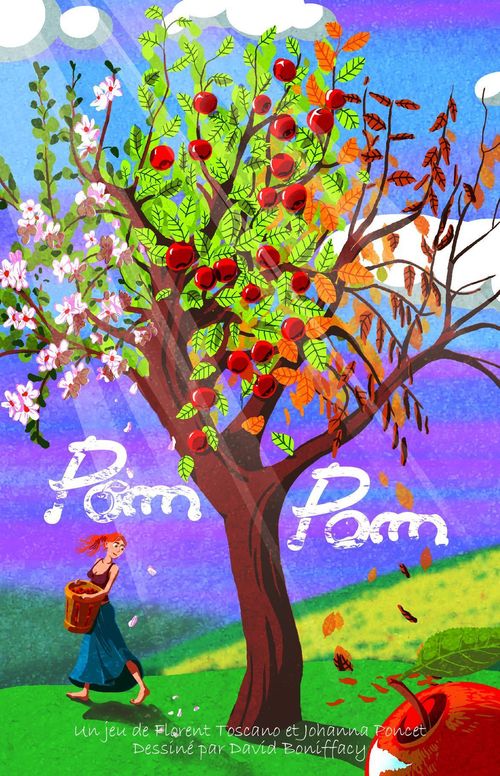
Pom Pom
Pom Pom Rulebook
Table of Contents
Table of Contents
Components
The game consists of this rules booklet and 55 cards:
- 48 fruit and vegetable cards: 12 spring (green), 12 summer (yellow), 12 autumn (orange), 12 winter (blue);
- 4 disaster cards: spring frost (green), summer drought (yellow), autumn hail (orange), winter field mice (blue);
- 3 market cards. These market cards are also the insurance.
Each season has 6 fruit cards and 6 vegetable cards, valued 1 to 6. To tell them apart, the values on fruit cards are white on an apple, and the values on vegetable cards are black on a potato.
Goal of the Game
Players must grow fruit and vegetables to sell at market. To do so, they lay out in front of themselves pairs of cards, a fruit and a vegetable, with the highest values possible for each season.
Setup
Place the three market cards next to each other. Shuffle the remaining cards and divide them into three piles of roughly equal size. Place them face down, one on top of each of the three market cards. Combine all three piles into one: this is the deck, which contains the three market cards, with the third market card at the very bottom of the deck.
Take the top 4 cards from this deck and place them face up in the centre of the table, next to the deck. The game begins!
Playing the Game
The player who most recently ate an apple starts. On his or her turn, a player has 3 actions to choose from:
- take the top card of the deck into hand;
or
- take one of the 4 face-up cards into hand and replace it with the top card of the deck, so that there are always 4 cards in the centre of the table;
or
- discard one card from hand (a fruit, a vegetable, a disaster or an insurance card), face up, onto the discard pile next to the deck: this is the compost heap.
Players take turns in clockwise order until the top card of the deck is a market card, which starts the market phase. A player may hold as many cards in hand as he or she wants, but beware of the final scoring (see "Scoring")!
Market
During the market, each player may sell their fruit and vegetables. Pairs of sold fruit and vegetables of one season are laid out face up in front of the player, and they stay there until the end of the game.
Note: a player cannot sell produce of a season if he or she already has a pair in front of them consisting of fruit and vegetable cards of that season.
Also, the following cannot be sold:
- only one card;
- 2 fruit or 2 vegetable cards of the same season;
- a fruit card and a vegetable card from 2 different seasons.
Furthermore, once a season's produce has been sold, the player may not sell anything else from that season for the rest of the game. However, during the market phase, produce of different seasons may be sold, that is, a player may lay out in front of themselves pairs of fruit and vegetable cards of several seasons.
At the end of the market phase, the insurance broker walks around and offers the growers the chance to buy insurance (shown on the market card). The player who played last and revealed the market card may, if he or she wishes, take this card into hand. Then he or she is insured against a disaster (see "Disasters"). If that player does not wish to do so, the player to his or her left may, if they wish, take the card, and so on, until some player takes this market card into hand. If nobody wants to be insured, the market card is discarded.
The game continues. Now the player to the left of the player who revealed the market card takes a turn, and so on, until the second market card is revealed, and then the third, which marks the end of the game.
It may happen that the game ends at the end of the first or second market phase, if one of the players has already sold all of their produce, that is, a pair of fruit and vegetable cards from each of the 4 seasons, 8 cards in total. Then the scoring begins (see "Scoring").
Disasters
On his or her turn, a player may discard a disaster card that he or she holds. All players, including the one who discarded it, must discard from hand all fruit and vegetable cards of the season corresponding to that disaster. Disasters pose no danger to cards that were already laid out in front of players during a market phase, because that produce has already been sold!
For example, if a player discards a drought card (the summer disaster), all players must discard the fruit and vegetable cards of that season that they hold. The only way not to lose a card during a disaster is to discard an insurance card instead of one fruit or vegetable card, or to hold no cards at all of the corresponding season!
Scoring
Each player adds up the values of the fruit and vegetables he or she has sold (the cards laid out in front of them), and subtracts the total value of the cards still in hand. In addition, each unused insurance card and disaster card remaining in hand costs 3 points each. The player with the most points wins.
Several rounds may be played, until one of the players reaches 100 points, 200 points, or more!
Variants
"Big Harvest"
By mutual agreement of all players, discard the 4 face-up cards and replace them with the 4 top cards of the deck.
"Blow to the Grower"
At the start of the game, after the three piles of cards have been combined into one common deck, shuffle this deck thoroughly. Markets can now open at any time!