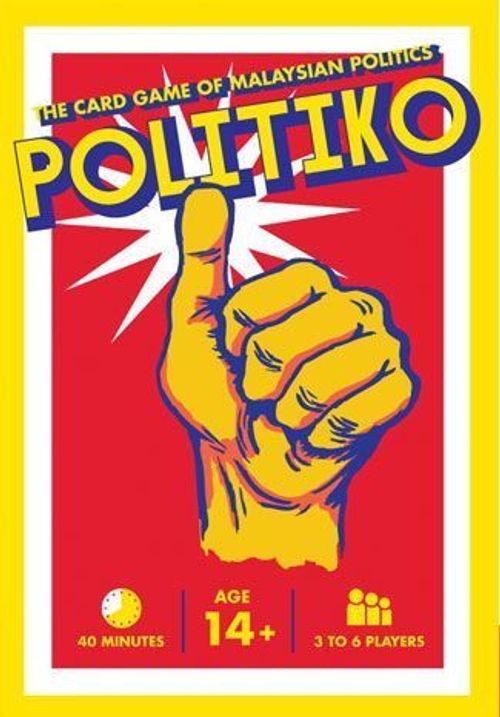
Politiko (2nd Ed)
Politiko (2nd Ed) Rulebook
Table of Contents
Table of Contents
Setup
- Every player chooses one PARTY card. Choose in order, starting with the wealthiest player (in the real world).
- Set the remaining PARTY cards aside, out of the way, so they do not get mixed in.
- Shuffle the deck. Each player takes 7 cards as their starting hand.
POINT!! In POLITIKO, unique rules and disputes that arise during the game can be resolved by a majority vote of all players. Debate, negotiate, bully, and threaten, and behave like real politicians!
Note on dealing: the sheet asks "How should the cards be dealt?" and gives a dealing method only in the F/T original rules box. See the F/T Original Rules section below.
Card Types
(See Appendix 1, 別紙1, which is not included in this sheet.)
-
PARTY card (政党カード): Every party has its own conditions. You may place only those VOTER cards that meet the conditions of your party in your VOTER zone. Discard any VOTER card that does not fit. A party also has conditions on which parties it can form an alliance with. You cannot form an alliance with a party named on your PARTY card.
-
VOTER card (有権者カード): Each VOTER card is made up of a combination of three attributes: ethnicity × place of residence × political stance (民族 × 居住地 × 政治的立場).
-
SCHEME card (スキーム): A "scheme" card gives various instructions to players or to the table. There are four scheme colours plus the gold King's Power card (王権カード):
- Political Corruption cards (red, 政治汚職カード)
- Infrastructure cards (green, インフラ整備カード)
- Civic Movement cards (yellow, 市民運動カード)
- Abuse of Power cards (blue, 職権乱用カード)
A scheme can be activated not only by spending the card, but also by giving the instruction verbally when it concerns an alliance (see Alliances below).
Glossary
- Deck (山札): Draw cards from the deck. When the deck runs out, shuffle the discard pile to form a new deck.
- Discard Pile (捨て山): Where used SCHEME cards and discarded VOTER cards go.
- Hand (手札): Your hand is limited to 7 cards (meaning 1 to 7 cards). Keep it hidden from other players.
- VOTER Zone (有権者ゾーン): Each player has a place in front of them for VOTER cards, called the "VOTER zone." Collect VOTER cards here as you work toward victory.
Playing the Game
POLITIKO is played counterclockwise. Start with the wealthiest player (in the real world).
On your turn:
- Draw 2 cards from the deck.
- Then do one of the following:
- Place VOTER cards in your VOTER zone (any number of cards is allowed), or
- Spend 2 schemes, either by playing SCHEME cards or by spending schemes related to alliances.
- Check your hand:
- If you have 7 or fewer cards in hand, your turn ends.
- If you have 8 or more cards in hand, discard down to 7 cards.
The sheet presents these steps as a flow chart (draw 2 → place VOTER cards or spend 2 schemes → hand limit check). The order above follows that flow chart.
- When you spend schemes, you must always spend 2 at the same time. You may not spend only 1 scheme and end your turn, and you may not spend "1 VOTER card and 1 scheme" together.
- If it is your turn and there is no card you can play, and you cannot activate an alliance-related scheme either, decide with the group what to do (F/T interpretation; see the F/T Original Rules section).
- Some schemes prevent a player from playing cards for one turn, or restrict which cards they may draw from the deck for three turns. The affected player shows the restriction with the scheme card so that others can see which turn of the restriction it is (F/T original rules; see below).
Alliances
One player finds it very difficult to win alone. A player may form an alliance with up to 3 parties. When you are in an alliance, the VOTER card counts of the allied parties are added together.
- Winning with 2 parties: the allied parties win together with 15 VOTER cards in total.
- Winning with 3 parties: the allied parties win together with 21 VOTER cards in total.
You may also pass VOTER cards that do not fit your own party's conditions to a player in an allied party.
Note: this applies only to VOTER cards obtained by using a SCHEME card. For example, even if you draw a VOTER card from the deck that meets your ally's conditions, you cannot simply hand it over. If you want to hand it over, use "Consultation" (協議) instead.
Alliance Actions
- Form an alliance (連立を組む): To form an alliance, the agreement of all players who want to join must be obtained. An attempt to form an alliance counts as 1 scheme.
- Consultation (協議): You may exchange cards from your hand with cards from the hands of your other alliance members. The numbers of cards exchanged do not need to match, and there is no limit on how many cards may be exchanged. This counts as 1 scheme.
- Note: do not look at each other's hands.
- Leave an alliance (離脱): To leave an alliance, you must discard 2 VOTER cards (from your VOTER zone). This counts as 1 scheme.
F/T Original Rules
The rules in this section are the F/T (Festival/Tokyo 2016) event version's own rules, as marked on the sheet ("F/T版オリジナル・ルール", "F/T版では…", "F/T版の解釈"). They are not part of the base rules described above.
Dealing the Starting Cards (F/T version)
The sheet's F/T box shows a row of cards. The first card is a Malay (マレー系) VOTER card, marked with an arrow. The rest are labelled "それ以外のカード" (other cards). A bracket spanning the whole row is labelled "プレイヤー分の枚数" (the number of players). The printed instruction reads:
- Draw face-down cards at the same time, on "go" (「せーの」).
- The player who takes the Malay VOTER card chooses a PARTY card first, and then the choice goes counterclockwise.
Translator's note: the diagram's exact card count and setup are not explained in the text, so only the printed instruction is transcribed here. The sheet gives no separate dealing method for the base rules.
Turn Without a Playable Card (F/T interpretation)
If it is your turn, there is no card you can play, and you cannot activate an alliance-related scheme either, the sheet says the group should decide together how to handle it (F/T版の解釈). No ruling is printed.
Restriction Markers for Scheme Effects
Some scheme effects stop a player from playing cards for one turn, or restrict which cards they may draw from the deck for three turns. To show everyone which turn of the restriction is in effect, the affected player displays the scheme card as follows:
- 1-turn restriction:
- Turn 1 of the restriction: show the scheme card upright, face up (縦(オモテ)表示).
- 2-turn restriction:
- Turn 1 of the restriction: show the scheme card upright, face up (縦(オモテ)表示).
- Turn 2 of the restriction: show the scheme card sideways, face up (横(オモテ)表示).
- 3-turn restriction:
- Turn 1 of the restriction: show the scheme card upright, face up (縦(オモテ)表示).
- Turn 2 of the restriction: show the scheme card sideways, face up (横(オモテ)表示).
- Turn 3 of the restriction: show the scheme card face down (ウラ表示).
Not Covered by This Sheet
This sheet does not include the card list in Appendix 1 (別紙1), which describes the individual PARTY, VOTER, and SCHEME cards and their effects. It also does not list the individual effects of each scheme colour, the King's Power card, or the full alliance and win-condition rules. Consult the printed rulebook included with the game, or the card text, for these.