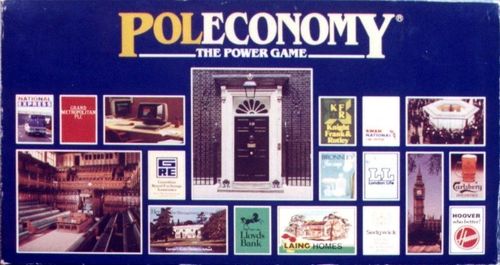
Poleconomy
Poleconomy Rulebook
Table of Contents
Table of Contents
Set up
-
GM rolls 2d6 for each player as his Basic Income (BI).
-
Knowing their income, players negotiate to form Parties, who will vote together in Parliament. Players may also remain Independent.
-
Knowing the parties (if any), GM conducts an Election by rolling 2d6 for each player, with doubles allowing a second roll, to be added to the first. Votes for members of each Party are totalled.
- If an Independent has a majority of votes, he is automatically the Government, and the PM.
- If a Party has the majority of votes, the players in it must decide which of them will be PM. If no decision can be reached, the Party member with most individual votes is declared PM.
- If no Independent or Party has a majority, Parties may try to form Coalitions in order to form Government, and can then choose a PM from amongst themselves as above.
- If no Government can be formed, then the GM conducts a new Election.
Once a Government and PM has been chosen, the GM declares movement order for the first round, with the PM being first. In subsequent rounds the previous first player will move last, and other players move one step up the order:
e.g. in a 4-player game, where PM is player 1. Round 1: 1, 2, 3, 4 Round 2: 2, 3, 4, 1 Round 3: 3, 4, 1, 2 Round 4: 4, 1, 2, 3 etc.
After each fresh election, while the overall order of players remains the same, the new PM will be the first player. e.g. if player 3 is now elected PM at the end of round 4, the order for the round 5 will be 3, 4, 1, 2.
- All players begin the game on the Start square on the Inner track.
- Each player begins with cash of $[4(BI)+10]
- The Inflation Index begins on "1, Election", pointing clockwise.
- The Bank begins with 5 Life Insurance policies, 5 Business Insurance policies, 20 company title deeds, 25 Advertiser title deeds, and $3000 minus the starting incomes paid to players in step 1 above.
- The Treasury begins with $0 and 30 $10 Bonds.
Play
Each round each player's orders consist of:
a) any bids he will make for Companies or Advertisers put up for auction in the last round
b) how he will move:
- directly to a specific one of the four corner squares, and if so, whether he will take the action of the square, or just sit (if he is on a corner square he can move directly to the same square); OR
- via a dice roll (2d6) clockwise around the track he is on AND - if he is on a corner square, he must specify which track (inner or outer) he will move off along, - what he will do for each possible square he could land on that requires a decision. NOTE: If a player elects to move by die roll and the GM rolls double six for him, he suffers a Business disaster: he does not move; if he has no Business Insurance, he loses ALL his assets (cash, Companies and Advertisers) back to the Bank. If he has Business Insurance he only loses the Business Insurance back to the Bank.
c) to which of his Companies he will direct any player who lands on one of his Advertisers.
d) to which Company (his own, someone else's or unowned) he will move if he lands no one of his own Advertisers.
e) whether he will support the PM in:
- changing Government salaries,
- changing the Tax rate,
- paying Treasury Funds.
f) Whether he is willing to sell back any Bonds to Treasury if the PM wishes to buy them back from players (the GM will randomly select Bonds from players if more wish to sell back than the PM wishes to buy back)
In addition, the PM may, on his turn, freely order to:
f) reverse the direction of the Inflation Index marker
g) elevate or demote any members of the Government to Cabinet Ministries.
h) issue Bonds..
The PM may also, on his turn and assuming he has the Consent of Parliament, order to:
i) change Government Salaries
j) change the Tax rate
k) pay Treasury funds.
Each turn the GM conducts auctions from the last round, then moves players in turn order according to their orders (direct moves or via 2d6), and making all purchases, payments etc. for them. The GM issues available Bonds when required by Treasury to meets its obligations.
The GM reports to all players all game data including the end-of-round Inflation Index location and direction, player locations and assets, Companies and Advertisers up for auction, Companies and Advertisers unsold, money in the Bank and the Treasury, number of Bonds issued and unissued, Life and Business Insurance available for sale, Cabinet Ministers and Government Salaries and Tax rates.
Game end
- The game ends in a LOSS for all players if the Treasury is ever unable to pay Government Salaries or other obligations.
- Otherwise the game ends when the Bank runs out of money (it begins with $3000 before starting cash is paid), or after an agreed number of turns, or by mutual agreement. The player with the most valuable assets wins:
- Cash at face value
- Companies and Advertisers at current inflation-rated values
- Life Insurance policies at face value ($100 each)
- Government Bonds at face value
Board squares
a. Corner squares:
There are 4 different squares where players can choose to sit, or perform an action specific to that one square:
- Business Insurance: 5 policies in total are available (even in a 6-player game). May be bought for $10. Returned to the Bank if a player throws double six when moving. Only one policy may be held at a time. Cannot be traded or sold.
- Life Insurance: 5 policies in total are available (even in a 6-player game). May be bought for $10. Worth $100 each at game-end. Only one policy may be bought per turn, but any number may be held. May be sold back to the Bank for $8 on a player's turn (and is then available for repurchase by the same or another player). May not be traded or sold between players.
- Takeover. Player may attempt to takeover a specified Company from another player. Cost: $3. GM rolls 2d6. On doubles, player pays owner half current value (i.e. ½×$10×current Inflation) and receives the Company. On non-doubles, bid fails. [Note: double six is not a Business Disaster during a Takeover!]
- Bonds: Any Bonds that have been issued by the PM from Treasury may be purchased from the Bank. Cost: $10 each. Any number may be purchased on one turn. May be returned to the Bank on a player's turn for $10.
b. Companies:
- if unowned, a player may buy it for $10×current Inflation. If not purchased, it is put up for auction at the end of the round.
- if already owned by him, he receives profits of $10×current Inflation from the Bank.
- if already owned by another player, he must pay $10×current Inflation to the owner. If he does not have enough cash, he only pays what he has and the difference is ignored.
c. Advertisers:
- if unowned, a player may buy it for $1×current Inflation. If not purchased, it is put up for auction at the end of the round.
- if already owned by him, he moves immediately to any Company (his own, someone else's or unowned) he wishes on the board
- if already owned by another player, the owner specifies to which Company he is moved (usually one of the owner's). The owner may equally choose to move the player to another player's Company, and the two then share equally the profits the moving player must pay; or to move the player to an unowned Company.
d. Income (i.e. 2× to 10×): the player receives his BI multiplied by the factor indicated (2×, 4×, 5× or 10×). Three of the outer track's four "10×" income squares are also "Opportunity" squares, allowing a free immediate move to any other non-Opportunity square on the board. A player with the potential to land on one of these should indicate how he wishes to use this Opportunity.
e. Index (i.e. +1 to +5): the Inflation Index is moved around its own track the indicated number of spaces (1, 2, 3, 4 or 5) in the direction the indicator is currently pointing. To simplify purchasing decisions, while each index move occurs on the appropriate player's turn, the new Inflation multiplier only comes into effect at the beginning of the next Round, as the cumulative result of all moves during the round. The PM can change the direction of the inflation index effective at the beginning of his turn, so that at the end of the round, some of the changes may be in one direction, and then the rest in the opposite direction.
Each Inflation Index space also has its own effect:
- Tax. All players are immediately taxed $5 per Company owned. The PM can change the rules on who gets taxed, and how much, but only with Consent of Parliament.
- Bonds. Interest of $10 must be paid from Treasury on each issued Bond. This money is paid to players for each Bond they own, or to the Bank for Bonds issued but unpurchased by players.
- Election. The GM conducts an Election at the end of the round. Any elections required in a round beyond the first are ignored. Play may need to be interrupted for players to form a new Government and for a new PM to be determined. Parties do not change, but new Coalitions may be formed. The new PM takes over the role as it stands (current Tax rates, inflation, Treasury situation, Government Salaries etc.), but all previous Cabinet Ministers lose their jobs. The new PM will move first in the following round.
- Government Salary. The PM and all Cabinet Ministers are paid $10 from Treasury. The PM, with consent of Parliament, may change his own salary above (but never below) $10, and change those of Cabinet Ministers to any figure.
Auctions
When a player lands on an unowned Company or Advertiser and does not buy it (by choice or by lack of cash), the Company or Advertiser is put up for auction at the end of the round. The GM lists all such firms, in the order that they came up for auction. Players then bid on them as part of their next round orders, and the GM will conduct all auctions, in order, before adjudicating the next round of play. Bids can be conditional on any circumstance in earlier auctions. Likewise, movement orders may be made conditional on the results of auctions occurring at the beginning of the round (and indeed on any player turns occurring prior to the turn of the player in question.
PM's powers
The PM has 6 powers he can use on his turn before he moves. 3 can be used freely, and 3 require Consent of Parliament.
Actions NOT requiring Parliamentary Consent:
- Index Marker direction. The PM can order that the direction of the Inflation Index marker be changed form clockwise to anticlockwise or vice versa.
- Cabinet Ministers. The PM can elevate any player who is a member of the Government to a Cabinet Ministry, and/or he can demote any Cabinet Minister. A Cabinet Ministry entitles a player to receive a Government Salary when the Inflation Index lands on a Government Salary space.
- Bonds. Besides automatic issuance of Bonds when the Treasury runs out of cash and needs to pay Government Salaries or Bond interest, the PM can also choose to issue any number of available Bonds to increase cash in Treasury. The PM may also buy back Bonds from the Bank (for $10 each) or from players (for $20 each) if they choose to sell.
Actions requiring Parliamentary Consent
These actions will only occur if players holding a majority of electoral votes agree to them. Players may express their consent generally ("Agree to any PM actions"; "Agree to PM raising his salary"), or with any degree of specificity ("Agree to PM increasing his salary to $19"). The PM will need to negotiate with players between rounds to obtain the consent he needs (unless he has a majority of electoral votes himself), and players must explicitly order to support these actions. The GM will interpret player consent orders when necessary.
- Government Salaries. The PM begins the game on a salary of $10 which is paid each time the Inflation Index lands on a Government Salaries square. The PM can order changes in his own Salary either up or down but never below $10. The PM can also set, raise and lower Salaries for each Cabinet Minister without limit.
- Tax. Tax begins the game at a rate of $5 per Company owned by a player, paid to Treasury whenever the Inflation Index marker lands on a Tax space. The PM may change the tax rate as he sees fit, not only in amount but in who is liable to pay it. E.g. "Only players with more than 2 companies pay tax" or "Players whose Basic Income is less than $6 need not pay Tax". Tax is only paid when a player has cash tpo pay it. Any excess is ignored. Players do not sell or lose their other assets if they become liable for Tax beyond their immediate cash in hand.
- Payment of Treasury Funds. The PM may pay cash from Treasury to any player, including himself, for any purpose. Game etiquette demands the PM issue a Press release explaining his actions (ie.g. as a 'tax rebate' or 'investment stimulation', etc).
PBM issues
Any timing issues not covered in the rules above will be handled by the GM in a way that firstly reflects the spirit of the original face-to-face board game. That is, all actions and effects occur on the activating player's turn (except: Inflationary price changes which are cumulatively adjusted at the end of the Round; Elections, which are delayed until the end of the round; and Auctions, which are adjudicated at the beginning of the next round). Note that the actual movement of the Inflation Index still occurs as activated by each player in turn, as do its non-Inflationary and non-Election effects (Bonds, Government Salaries, Tax).
A player may make their orders conditional on anything occurring earlier in the round or earlier on his turn
Negotiations will be necessary for the PM to secure Parliamentary Consent to use some of his powers.
NMRs
If on a corner square, a player NMRing sits in place without action. If not on a corner square, he will move to the nearest corner square in a clockwise direction, and sit there without action.
A player not specifying how to move an opponent who lands on one of the NMRer's Advertisers will have the opponent move to the nearest Company owned by the NMRer: first in a clockwise direction on the same track, and then on the other track. The player being moved is considered to make a full lap of his current track, then via the next corner square, will begin a lap of the other track If the NMRer does not own any Company at all, the moving player is instead moved in the same manner to the first Company owned by a player other than himself.
If the PM NMRs, the GM will issue Bonds only to meet the Treasury's immediate obligations.
Statistical Distribution
Inflation Index (20 spaces): Election = 3 Govt Salaries = 5 Tax = 6 Bonds = 6
| Play tracks | Inner | Outer | Corner | Total |
|---|---|---|---|---|
| Income | 8 | 4 | -- | 12 (4@×2, 2@×4, 2@×5, 4@×10) |
| Index | 6 | 13 | -- | 19 (5@+1, 5@+2, 4@+3, 4@+4, 1@+5) |
| Company | 6 | 14 | -- | 20 |
| Advertiser | 8 | 17 | -- | 25 |
| Corners | -- | -- | 4 | 4 |