Polarity
Polarity Rulebook
Table of Contents
Table of Contents
Stuff You Need
- A chess board
- Lots of stones, all of the same colour
- Two bishops, two rooks and a queen for each player
Play
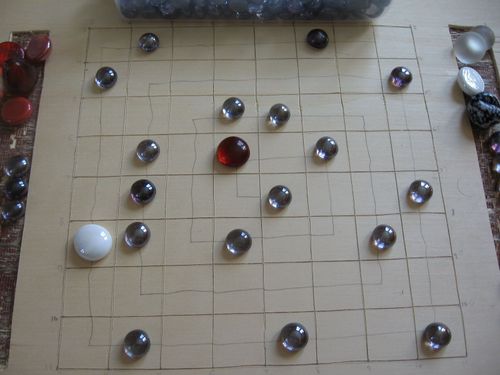
You and your opponent take turns placing stones on a chess board. All players use the same colour stones. Each player also has two rooks, two bishops and a queen.
You cannot place a stone on a space vertically or horizontally adjacent to another stone. When you place a stone, you can spend one of your chess pieces to make it push or pull in a direction dictated by the chess piece's movement. This is the only way you can make stones be adjacent to one another. Once a stone is vertically or horizontally adjacent to another stone, neither stone can be pushed or pulled.
Pushing and Pulling
Rook
Find the nearest stones in a vertical and horizontal line from the stone you just placed. You can choose to pull them one space away from your stone or pull them one space towards your stone. If you have chosen to pull with a rook, the next rook you spend must be used to push. If you push, your next rook must pull.
Bishop
Find the nearest stones in a diagonal line from the stone you just placed. You can choose to pull them one space away from your stone or pull them one space towards your stone. As with the rooks, if you have chosen to pull, the next bishop you spend must be used to push. If you push, your next rook must pull.
Note: the printed source says "your next rook must pull" in the bishop paragraph. This is reproduced as printed; the rule as written in the Rook section (the next bishop must pull) is the apparent intent, and the source's wording is preserved here without correction.
Queen
The queen can combines the effects of bishops and rooks. Find the nearest stones in a horizontal, vertical AND diagonal line from the stone you just placed and either push or pull all of them by one space.
Note: "can combines" is reproduced as printed in the source.
Once you have spent all your chess pieces, you must place a normal stone on your next turn and then gather up your chess pieces again.
Victory
When you cause three or more stones to be in a continuous horizontal or vertical line, remove them from the board and add them to your collection. The first player to collect 10 stones in this manner wins.