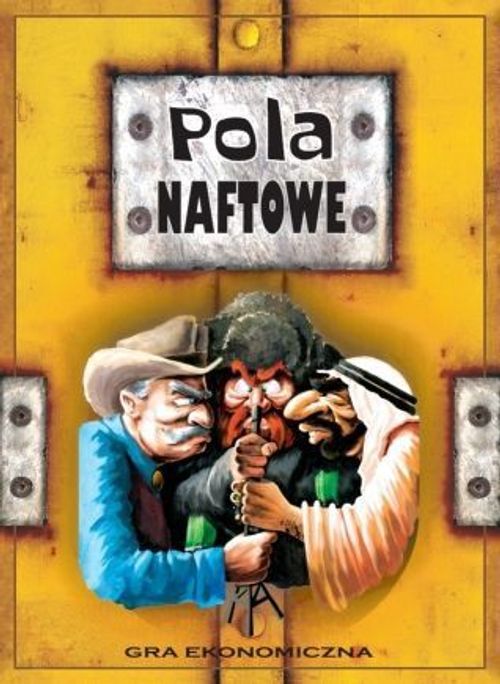
Pola Naftowe
Pola Naftowe Rulebook
Table of Contents
Table of Contents
Components
The box should contain:
- 8 mini-boards showing Oil Fields
- 20 Tanker tokens
- 11 Refinery tokens
- 40 Oil Well tokens (in 5 colours)
- 6 auxiliary tokens (in 5 colours) and the Round of the Game token
- banknotes representing Petrodollars: 30 of denomination 100, 30 of 500 and 30 of 1000
- 80 wooden cubes representing barrels of oil
- 7 six-sided dice
- 2 auxiliary cards (Costs and Rounds), and the Events and Tables card
- the rulebook
Goal of the Game
The game is for 3 to 5 players. It lasts 5 rounds, and the winner is the player who, at the end of the 5th round, has the most Petrodollars (P$), the currency of Pola Naftowe.
If at any moment a player is insolvent (that is, unable to pay even one of their obligations), they immediately end the game, and their holdings (Refineries, Tankers, Oil Wells, Petrodollars) leave the table and return to the supply.
Setup
Depending on the number of players, prepare the supply of available Tankers and Refineries, and draw the available Oil Fields. The number of Oil Fields drawn equals the number of players.
Each player then receives 1 Tanker and 3000 P$ (in any denominations). The remaining banknotes form the bank.
Players choose a colour for their Oil Wells and take the 8 tokens representing them. In addition, each player receives a round auxiliary token in their colour. It is used to mark the current costs on the Cost Table. Each time the maintenance costs of Oil Wells and Tankers increase or decrease, the player moves their token so that it shows the current costs.
Barrels of oil are set aside in a place accessible to everyone.
The Round of the Game token is placed on space 1 of the Round of the Game track.
Rules
The game lasts 5 rounds. To speed up play, each round is divided into 10 phases:
- Lobbying Phase
- Demand Phase
- Random Event Phase
- Infrastructure Phase
- Auction Phase
- Extraction Phase
- Refinery Supply Phase
- Fees Phase
- Stock Exchange Phase
- Refinery Income Phase
Bidding rules: Players must bid in such a way that they can pay the amounts they bid. The minimum bid is 100 P$, and bids are made in multiples of 100.
Lobbying Phase
Each player secretly declares an amount, after which all players simultaneously reveal the declared sums. The player who declared the most wins the Lobbying Phase. Then all players pay their declared sums to the bank.
The winner of the Lobbying Phase has a number of privileges:
- They act first in every phase (except the Stock Exchange Phase, described later). The other players act in clockwise order.
- They may designate a player (themselves or another) who must ignore the Random Event, unless the description of the Random Event says otherwise.
- They resolve all ties in the game.
- Once, they may add to or withdraw from the barrels of oil already declared in the Stock Exchange Phase, by exactly as many barrels as the number of Tankers they own (see the description of the Stock Exchange Phase).
- They decide what will be put up for auction in the Auction Phase.
Note: If, in the first round, there is a tie after the sums are declared in the Lobbying Phase, the winner is decided by a dice roll.
Note: You cannot declare 0.
Demand Phase
Now the Demand for oil in the current round must be determined. Roll as many white six-sided dice as there are players, then add the individual results together.
Leave the dice showing until the end of the round, so that everyone can see the current Demand. It will still be needed in the Stock Exchange Phase.
Random Event Phase
Any player rolls 2 black dice. Adding the results gives a number from 2 to 12. Read off the event assigned to that result in the Events table, and apply its effect to the game.
Remember that the player who won the Lobbying Phase may designate a player (themselves or another) who ignores the event.
Translator's note: the Events table is not included in the PDF this text was taken from, so the individual event effects are not reproduced here.
Infrastructure Phase
In this phase, each player may:
a) buy 2 Oil Wells, or liquidate 1 existing Oil Well that they own;
b) buy 2 Tankers, or liquidate 1 existing Tanker that they own;
c) buy 1 Refinery (Refineries cannot be liquidated).
After buying a Tanker or a Refinery, the player pays the due amount to the bank and takes the token representing the purchased Tanker or Refinery. If they liquidate one, they return the token to the supply (they do not, however, receive any P$ back).
If the supply runs out of Tanker or Refinery tokens, they cannot be bought.
If a player buys an Oil Well, then after paying for it they place a token in their colour on the card of the corresponding Oil Field.
Note: During the game, each player must own at least 1 Tanker, or 1 Oil Well, or 1 Refinery. A player cannot own nothing.
Tankers
A Tanker costs 500 P$. In addition, its owner must pay its operating cost of 200 P$ in the Fees Phase.
A single Tanker can store up to 5 barrels of oil.
Oil Wells and Oil Fields
Mark the Oil Wells that are bought on the card of the Oil Field. The characteristics of an Oil Well depend on the Oil Field on which it is placed.
Each Oil Field is described by 4 elements:
- the cost of placing a well on it;
- the maintenance cost of a well on it, paid each round in the Fees Phase;
- the number of barrels of oil extracted from one well on it per round;
- the maximum number of wells that may stand on that Oil Field.
Translator's note: the values for each Oil Field are printed on the Oil Field boards and cards, which are not in the PDF this text was taken from, so they are not reproduced here.
Refineries
A Refinery costs 700 P$. Each round, in the Refinery Supply Phase, 3 barrels of oil must be delivered to each Refinery owned. In the last phase of the round (the Refinery Income Phase), a Refinery brings in income of 800 P$.
Auction Phase
The player who won the Lobbying Phase must decide what will be put up for an open auction. They choose between 1 Tanker, 1 Oil Well or 1 Refinery (provided the chosen item is available).
They also start the auction by proposing a sum for which they are ready to acquire the chosen item (or they may withdraw from the auction immediately). Then the other players, in clockwise order, declare the amounts they are ready to pay for the item. Of course, a player can always opt out and say "pass" on their turn. If someone has passed, they may no longer bid in this round.
Note: Once an amount has been declared, it cannot be withdrawn; it must be paid. The amount is paid to the bank.
Note: An Oil Well acquired in this way may be placed on any Oil Field with free space. No placement cost is paid for it on that Oil Field.
Extraction Phase
Players, one after another, total the extraction from all the Oil Wells they own and receive that number of barrels of oil from the supply.
A player cannot store more barrels of oil than fit on the Tankers they own. Surplus production (above the total capacity of the Tankers owned) is lost, and in addition the player pays a penalty of 100 P$ for each barrel that exceeded their Tanker capacity.
Refinery Supply Phase
For each Refinery owned, players should deliver 3 barrels of oil. This is not obligatory, but for each barrel not delivered, the player must immediately pay a penalty of 300 P$.
Barrels delivered to Refineries return to the supply of available barrels.
Fees Phase
When buying or liquidating Tankers and Oil Wells, players mark their changing maintenance cost on the Cost Table. In this phase, this cost must be paid.
Translator's note: the Cost Table is not included in the PDF this text was taken from, so the maintenance cost levels it lists are not reproduced here. The per-Oil-Field figures (placement cost, maintenance cost, extraction per well, maximum number of wells) are likewise printed on the Oil Field boards and cards, which are not in the PDF; they are not reproduced here.
Stock Exchange Phase
The task of the players is to sell the barrels of oil they hold on the stock exchange as profitably as possible.
The Stock Exchange Phase is divided into two trading sessions, which differ in the price of 1 barrel of oil. The procedure is identical in both sessions.
Players secretly declare a quantity of the barrels of oil they hold, and then reveal them simultaneously. All declared barrels are added together. The sum is the current Supply.
The player who won the Lobbying Phase may, once during the Stock Exchange Phase, add to or subtract from their declared barrels an amount equal to the number of Tankers they own.
Now compare Supply and Demand, and consult the appropriate table, depending on whether it is session I or session II.
Session I
| Supply / Demand | Price of 1 barrel on the stock exchange |
|---|---|
| Supply <= Demand | 400 P$ |
| Supply > Demand | 300 P$ |
| Supply > 2 x Demand | 100 P$ |
Session II
| Supply / Demand | Price of 1 barrel on the stock exchange |
|---|---|
| Supply <= Demand | 300 P$ |
| Supply > Demand | 200 P$ |
| Supply > 2 x Demand | 100 P$ |
The number of barrels that can be sold at the favourable price is determined by the Demand. If the barrels sold in this way cover the Demand, their price automatically drops to 100 P$ per barrel.
Selling starts with the player who declared the most barrels in this session. Then come those who declared the next most, in order.
When Supply exceeds Demand twice over, the price per barrel is set at 100 P$ for everyone from the start.
Refinery Income Phase
Players receive 800 P$ for each Refinery they own.
Trade Between Players
Players are encouraged to shape their mutual trading relations freely during the game, with two reservations:
- Do not cheat or steal. Obligations arising from transactions between players are treated equally with those arising from the rules of Pola Naftowe.
- Players may trade with each other whenever they want, except in the Fees Phase.
Example of Play
Anna, Piotr, Marcin and Krzysiek sit down to play. Since there are four players, they draw 4 Oil Fields. The draw gives: PERSIAN GULF, TEXAS, NORTH SEA, INDIAN OCEAN.
They then place 16 Tankers and 9 Refineries in the supply of available items. Each player takes the tokens in their colour representing their Oil Wells. Each player now receives 3000 Petrodollars (P$) in any denominations and 1 starting Tanker. The rest of the money is placed in the bank, sorted by denomination. They also mark their maintenance costs and the round on the Costs and Rounds card. At the start, each player has 200 P$ of maintenance costs.
The game can begin.
Round 1. The round opens with the Lobbying Phase. The players prepare their banknotes in secret, then simultaneously reveal the declared sums. Krzysiek declared 200 P$, Marcin 300 P$, Piotr 100 P$, and Anna, like Marcin, 300 P$. All declared money goes to the bank. There is a tie between Anna and Marcin. Since this is the first round, there is no one to break the tie, so they must rely on the dice. They roll, and Marcin's die shows more, so he is the winner of the Lobbying Phase in the first round.
The next phase is the Demand Phase. Although it makes no difference, the players agreed that the dice would be rolled by whoever wins the Lobbying Phase. Marcin rolls 4 white dice: 1, 4, 2 and 6, for a total of 13. This is the Demand for the first round. The dice are set aside so that no one forgets the Demand for this round.
Marcin then makes another roll, this time for the Random Event. He rolls two black dice and gets 5: "Extraction from Oil Wells increases by 1 in this round." After a moment's thought, he designates Krzysiek as the player who must ignore the Random Event.
The Infrastructure Phase begins. Marcin buys 2 Oil Wells in Texas, 1 Tanker and 1 Refinery. He spends 1600 P$ in total, and his maintenance cost rises to 1000 P$.
Krzysiek buys exactly the same as Marcin. He also spends 1600 P$, and his maintenance cost is 1000 P$, which he immediately marks on the auxiliary card.
Anna buys 2 Oil Wells in the Persian Gulf and 1 Refinery. She pays 1100 P$ and marks her maintenance cost at 600 P$.
Piotr buys 1 Oil Well in the Persian Gulf, 1 Oil Well in the North Sea, and also a Tanker. Together this costs 1100 P$, and his maintenance cost rises to 1100 P$.
Marcin, as the winner of the Lobbying Phase, also decides what will be put up for auction in the next phase, the Auction Phase. He decides it will be a Tanker. He himself withdraws from the bidding. The next player to his left, Krzysiek, declares that he is ready to buy the Tanker for 100 P$. Anna says "pass" and, like Marcin, may no longer bid in this round. Piotr declares 200 P$ for the Tanker. Krzysiek passes and breathes a sigh of relief, since he realises that he could not afford to maintain this Tanker and would finish the game early. Piotr buys the Tanker for 200 P$, and his maintenance cost rises to 1300 P$.
For Piotr, this is a good deal: he bought a third Tanker cheaply, and he will not pay the penalty for overproduction of oil in the Extraction Phase.
Extraction Phase. Marcin extracts 10 barrels of oil in this round. He has 2 Tankers, so all the oil fits on his Tankers (5 on each). Anna extracts 8 barrels of oil, and Krzysiek's situation is the same (he had to ignore the Random Event that increases extraction in every Oil Well owned). Anna owns only 1 Tanker. Three barrels are lost, and in addition Anna pays a penalty of 100 P$ for extraction beyond her storage capacity. She is left with only 5 barrels. Piotr extracts 12 barrels, but all of them fit on his 3 Tankers.
Refinery Supply Phase. Everyone who owns a Refinery delivers 3 barrels of oil, that is Marcin, Krzysiek and Anna. These barrels return to the supply of available barrels.
Starting with Marcin, the players check the Cost Table to see how much they must pay for the maintenance of their Oil Wells and Tankers. Marcin pays 1000 P$, Krzysiek also pays 1000 P$, Anna 600 P$, and Piotr 1300 P$.
What Petrodollars does each player have left?
Marcin: 100 P$ Krzysiek: 200 P$ Anna: 700 P$ Piotr: 300 P$
Stock Exchange Phase. Recall that the Demand in this round is 13. Marcin has 7 barrels, Krzysiek 5 barrels, Anna 2 barrels, and Piotr 12 barrels.
In the first session, Marcin declares 5 barrels, Krzysiek 4 barrels, Anna 0 barrels, and Piotr 7. Marcin uses the option of adding to or subtracting from his declared barrels an amount equal to the number of Tankers he owns. He decides to add 2 more barrels to his 5, making 7 in total.
The sum of the declared barrels, that is the Supply, is 18. Piotr and Marcin declared the same number of barrels, but Marcin, as the winner of the Lobbying Phase, resolves this tie in his favour, and he is the first to sell his barrels at 300 P$ each (since the Supply is higher than the Demand). He earns 2100 P$ in total. Second is Piotr, but he can sell only 6 barrels at 300 P$ each (the Demand is 13, and Marcin has already sold 7 barrels). He sells his seventh barrel only for 100 P$.
Krzysiek sells his 4 barrels for a total of 400 P$.
In the second session, Piotr declares 7 barrels, Krzysiek 1 barrel, Anna 3, and Marcin none this time. The Supply is 11, which is below the Demand. This means a price of 300 P$ for everyone. In this session Piotr earns 2100 P$, Krzysiek 300 P$, and Anna 900 P$.
Now, in the Refinery Income Phase, Marcin, Krzysiek and Anna each receive 800 P$ for each Refinery they own.
The end of the round looks as follows:
- Marcin has 3000 P$
- Krzysiek has 1700 P$
- Anna has 2400 P$
- Piotr has 4300 P$
End of the first round of the game.