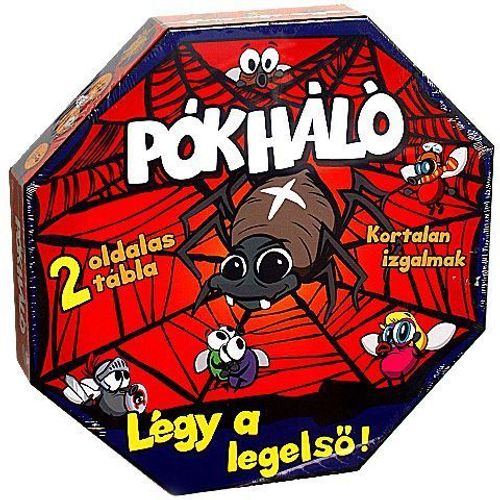
Pókháló
Pókháló Rulebook
Table of Contents
Table of Contents
Setup
Each player chooses a colour. The starting player is determined by lot, and the others take their turns in clockwise order.
Set the spider's pointer to the spider symbol above the Start field.
How to Play
Move your fly forward the number of fields shown on the die. If you land on an action field, carry out its action immediately. The actions of action fields and of the Cselszövő variant cards are described below.
Movement of the Spider
The game includes a special die on which the 1 face is replaced by a spider. When a player rolls the spider, they must move the spider's pointer one eighth of a turn (one zone) in either direction. The spider always moves along the neighbouring black main threads.
The spider also moves in one other case. If a fly moves onto a field on which another fly already stands, the spider senses the vibration of the web and immediately rushes toward this "rendezvous" (légyott). In this case it moves one zone in the direction in which it can reach the flies in fewer steps.
If, while moving, the spider passes over one or more flies, it stings them, and they each fall one level toward the centre of the spiral game board.
For example, from field 36 down to field 20:
[Illustration on the rulebook: a fly falls from field 36 to field 20.]
If a fly cannot fall any lower, it immediately returns to the Start field. If a fly falls back onto an action field, that field's action must be carried out out of turn, and then play continues.
No domino effect: if two flies fall back together by one level, the spider does not jump over them again!
Reaching the Goal
In games for 2–3 players, the Goal (Cél) can only be entered with an exact move. Otherwise the fly bounces back by the number rolled, and the excitement continues. For 4–6 participants this is not recommended, as it can greatly lengthen the game.
The winner is the player who reaches the Goal first.
Meaning of the Fields and Cards
Plus move (blue +5 field): move forward to the field indicated by the value.
Minus move (purple −3 field): move back to the field indicated by the value.
Roll again (orange field with dice): roll once more. The spider may also move in the meantime.
Miss a turn (brown field with a stuck fly): you miss one turn. The card remains face up in front of you until your next turn. Meanwhile you cannot play a spider-defence card, because you are tied up!
Protection from the spider (green field with a ladybird): a fly standing on such a field, or a fly playing such a card, cannot be harmed by the spider. It enjoys protection. Moreover, right at the start, between fields 2 and 5, even if the spider and the fly meet, the spider does not move toward them.
Only in the Legyező variant: field 20/31 (red field with the number 20 and an arrow): move to field 20/31!
Note: the rulebook gives no separate set of rules for the Legyező variant (40 fields). The rules in this document apply to it, together with the Legyező-only field above.
Only in the Cselszövő variant: luck card (red field with a spider-web card): immediately draw a luck card!
Cselszövő Variant
Rules of the Cselszövő Variant
In games for 2–3 players, each participant starts with 3 cards. In games for 4–6 players, each participant starts with 2 cards. You may never hold more than five cards at once!
You do not have to play a card immediately when you draw it. You may play it before or after your roll, but at most two cards on your own turn.
Cards of the Cselszövő Variant
Any move (blue card with dice and a question mark): move 1 to 6 fields, of any number you choose, with this card.
Miss a turn (brown card with a stuck fly and a die): you can only move on with a roll of 6, though you may leave the field immediately. The card can be neutralised with an Any move card. Its effect also ends if the fly falls back one level because of a spider sting, but until then the card must be kept face up in front of the player. If you have failed to roll a 6 five times in a row, you are automatically freed on the sixth attempt!
Move the spider (red cards with a spider, showing +1 and +2): move the spider 1 or 2 zones in any direction!
If the spider would pass directly over you, it can be pushed back to its starting line. But if another fly is also in that sector, it does not protect that fly, unless that fly plays a defence card against the spider sting! With the +2 card you can not only push the spider back to where it came from, but one zone further. Red cards can also be played to pester other flies, to make the spider visit a rival.
Interaction cards (yellow cards): these can also be played on your fellow players, and in that case they must carry out the instruction immediately.
- Draw two cards! Because there is almost a 50% chance that you will draw a bad card.
- Pass: pass another card to any player! This will likely be a miss-a-turn or move-back card.
- Spy: look at one of a player's cards and draw one card from it!
Spider-defence cards (green and red cards): as spider-defence cards, green and red cards have the special property that they may be played outside your own turn. With red cards you can also cause an unpleasant surprise for another fly.
Do not enter the Goal while holding purple or brown cards in your hand. If someone carelessly does so anyway, they must restart from field 30!
Cards may be combined. For example, playing a Miss a turn card and a Roll again card together cancels them out.
You can also use cards tactically. For example, if you want to avoid a field that is unfavourable to you, you may increase the value of your roll or decrease it with a card showing +/− value. In that case the effect of the action field you were originally supposed to land on does not apply.
For example: I rolled a 3 and it happens to be a Miss-a-turn field. By playing a +2 card I can move on from it without stopping, so I do not have to miss a turn.
[Illustration on the rulebook: a +2 card is played and the fly moves past a Miss-a-turn field.]
Note: the Goal rule above refers to purple cards and to a card called "Célba" (Goal). The card key does not show these, so they are transcribed as printed.
Game Variants
The testers of Pókháló came up with several alternative rules during development. The best of them are presented here.
Two Dice
This variant needs one ordinary die in addition to the spider die. Play by the rules of the Cselszövő variant, with the difference that you now roll two dice. The player whose turn it is may choose the value of one die or the other, moving by whichever is more favourable to them. When someone rolls a double, they may draw a luck card!
A double counts when a player rolls the spider and a 1 at the same time. In this case the spider counts as the pair of the 1. The player may move the value of the other die after moving the spider.
Network
We recommend this variant for gamers. The Cselszövő rules change in that the cards, apart from the red, yellow and green ones, may only be given to opponents.
On your own turn you may place a card in front of a fellow player. When their turn comes, they must carry it out, either before or after the roll.
A green spider-defence card may be placed face up in front of you. It stays there until you use it, or until a yellow card (in this variant, a take-card) removes it from in front of you.
Red cards move the spider by the normal rules.
Only one card may be played per turn. However, you may not enter the Goal while holding the Goal card in your hand.
The players may also decide that the game ends when the draw pile runs out. In that case the player in the best position wins.