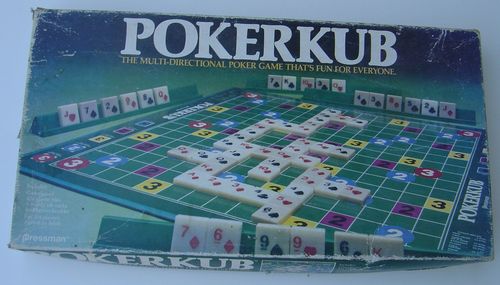
Pokerkub
Pokerkub Rulebook
Table of Contents
Equipment
- Playing Board
- 2 Sets of Tiles
- 4 Tile Racks
Each set of tiles represents a full deck of cards (no jokers). For two players use only one set of tiles.
Melds
There are two kinds of Melds: Poker Melds, and Building Melds. The tiles in a Meld (3 or 4 in the case of a Building Meld, and 2, 3, 4 or 5 in the case of a Poker Meld) are next to each other, and in the same horizontal or vertical row. At each end of a Meld there must be either a blank square or the edge of the board.
A. Definition of a Building Meld: three or four tiles of the same suit, or in sequence, or both.
B. Definitions of Poker Melds, and their point values:
- 5 pts. for a Pair (2 tiles of the same rank but different suits)
- 10 pts. for Two Pairs
- 15 pts. for Three-of-a-kind (3 tiles of the same rank but different suits)
- 20 pts. for a Straight (5 tiles in sequence)
- 25 pts. for a Flush (5 tiles of the same suit)
- 30 pts. for a Full House (Three-of-a-kind, plus a Pair)
- 35 pts. for a Four-of-a-kind (4 tiles of the same rank but different suits)
- 40 pts. for a Straight Flush (5 tiles of the same suit in sequence)
To Begin
Place all tiles face down in the box lid and mix them well. Each player draws one tile. The player holding the tile of the highest value will have the first turn. Return the tiles face down and mix them again. Then each player draws seven tiles and places them in his rack.
The Play
A. The first player combines two or more of his tiles to form a Meld, and places them in a row on the board (horizontally or vertically) with one tile on the center • square.
B. A player completes his turn by counting and announcing his score for the turn. He then draws as many new tiles as he played, thus always keeping seven tiles in his rack.
C. Play passes to the left. The second player, and then each in turn, adds one or more tiles to those already played so as to form new Melds. All tiles played in any one turn must be placed either in one horizontal or one vertical row. They must form one complete Meld (containing all tiles placed) and if, at the same time, they touch other tiles in adjacent rows, they must form complete Melds, crossword fashion, with all such tiles.
D. New Melds may be formed by:
- Adding one or more tiles to a Meld already on the board. (see 3rd and 6th Plays below)
- Placing a Meld at right angles to a Meld already on the board. The new Meld must use one of the tiles of the Meld already on the board or must add a tile to it. (see 2nd, 4th and 5th Plays below)
- Placing a complete Meld parallel to one or more Melds already played so that adjoining tiles also form complete Melds. (see 7th Play below)
E. In any Poker Meld or Building Meld, the tiles may be in any order.
F. A Building Meld is always valid when made, even though it may be impossible to add any tiles to it to form a Poker Meld (Straight, Flush, or Straight Flush).
G. If a player does not have a play, or does not wish to make a play, he may replace any or all of his tiles or simply pass to the player to his left. He scores zero for that turn.
H. Play continues until all tiles have been drawn and one of the players has an empty rack, or until all possible plays have been made.
Notes:
(1) No Meld may contain a tile that doesn't belong—for example: (a) a Building Meld consisting of a Nine-Ten-Jack cannot be expanded by Two Pairs by adding a Nine and a Jack, because the Ten would not belong; and (b) a King could not be added to a Four-of-a-kind of Kings, because there would then be two Kings of the same suit and one of them would not belong.
(2) There may never be more than five tiles in a row (next to each other in the same row)—and thus it is not possible to expand a Straight (by adding a tile in sequence) or a Flush (by adding a tile of the same suit) or a Full House (by adding a tile of the same rank as the Pair or the Three-of-a-kind).
Scoring
A. Scores are recorded at the end of each turn.
B. The score for each turn is the sum of the point values of all tiles placed, plus the values of all Poker Melds formed, plus the bonus values resulting from placing tiles on bonus squares.
Note: Every Meld is scored only once, at the time formed. Thus, when a Pair becomes part of a Three-of-a-kind, only the Three-of-a-kind is scored; and when a Pair or Three-of-a-kind becomes part of a Four-of-a-kind or a Full House, only the Four-of-a-kind or Full House is scored.
C. The Point Values: Aces count 15 [as shown on game board] when forming Pairs, Three-of-a-kinds, Full Houses, or Four-of-a-kinds, but only 1 in all other Poker Melds and all Building Melds; a King, Queen, or Jack counts 10; and all other tiles—2 thru 9—are counted at their face values.
D. Bonus Tile Squares: A square marked "Double Tile Score" doubles the score of a tile placed on it; and a square marked "Triple Tile Score" triples the score of a tile placed on it.
E. Bonus Poker Meld Squares: The score for a Poker Meld is doubled when one of its tiles is placed on a square marked "Double Meld Score"; and tripled when one of the tiles is placed on a square marked "Triple Meld Score". Include bonus points for double or triple tile values, if any, before doubling or tripling the Poker Meld score. (Building Melds have no point value)
F. All bonus squares only count in the turn they are covered.
G. Multiple Melds: When two or more Poker Melds are formed in the same play, each is scored (but don't count any Pair or Three-of-a-kind that was already there). Any tile placed so as to be included in two Melds at the same time is scored twice, once for each Meld (see 4th, 5th and 7th Plays below).
H. Scoring Formulas: (1) The total score for each Building Meld formed is the sum of the point values of all tiles placed in that Meld in that turn. (2) To get the total score for each Poker Meld formed add (a) the sum of the point values of all tiles placed in that Meld in that turn, and (b) the point value of the Meld; and then, if any of those tiles was placed on a square marked "Double Meld Score" or "Triple Meld Score", multiply the sum of (a) and (b) by two or three.
I. At the end of the game, each player's score is reduced by the sum of his unplayed tiles. (Note: count an Ace as 15)
Examples of Meld Formation and Scoring
In the following, the tiles added in 7 successive plays are shown in solid type. The tile 3♦ is on the center • square.
The printed example diagrams show tile positions and bonus squares on a 5-column board. They are not reproduced here as a grid; each play's text below states the tiles placed and the bonus each one earned.
First Play: Building Meld (22 pts.)
3 for placing the 3-tile, plus 9 for placing the 9-tile, plus 10 for placing the Jack-tile, equals 22 points for a Building Meld (3 tiles of the same suit).
Second Play: Pair (23 pts.)
18 (2 times 9) for placing the 9-tile on a Double Tile Score, plus 5 for forming a Pair, equals 23 Poker Meld points.
Third Play: Flush (42 pts.)
1 for placing the Ace-tile, plus 16 (2 times 8) for placing the 8-tile on a Double Tile Score, plus 25 for forming a Flush, equals 42 Poker Meld points.
Fourth Play: Building Meld & Pair (53 pts.)
9 for placing the 9-tile, plus 30 (3 times 10) for placing the 10-tile on a Triple Tile Score, equals 39 points for a Building Meld (3 tiles in sequence). Another 9 for placing the 9-tile, plus 5 for forming a Pair, equals 14 Poker Meld points. 39 plus 14 equals 53 total points.
Fifth Play: Building Meld & Three-of-a-kind (100 pts.)
10 for placing the Queen-of-Spades to form a Building Meld of four tiles in sequence. Plus 30 for placing three Queen-tiles (10 for each Queen), plus 15 for forming a Three-of-a-kind, and the sum (45) multiplied by two because one Queen was placed on a Double Meld Score for a total of 90 Poker Meld points. Total Building and Poker: 100
Sixth Play: Full House (50 pts.)
10 for placing the King-of-Clubs tile, plus 10 for placing the King-of-Spades tile, plus 30 for forming a Full House, equals 50 Poker Meld points.
Seventh Play: Building Meld & Three Poker Melds (98 pts.)
29 for a Building Meld: 18 (2 times 9) for placing the 9-tile on a Double Tile Score, plus 3 for placing the 3-tile and 8 for placing the 8-tile. 8 for a Pair: 3 for placing the 3-tile, plus 5 for forming a Pair. 33 for a Three-of-a-kind: 18 (2 times 9) for placing the 9-tile on a Double Tile Score, plus 15 for forming a Three-of-a-kind. 28 for a Straight: 8 for placing the 8-tile, plus 20 for forming a Straight. Total: 98 points.
Note to Seventh Play: Any one of the three tiles placed (3-tile, 8-tile or 9-tile) could be placed instead of all three, because it would complete a Poker Meld—Pair, Three-of-a-kind, or Straight. But no two of those tiles could be placed, because two tiles separated by an empty square don't form a Meld, and neither do two tiles next to each other unless they are of the same rank and different suits (a Pair). The RULE: Tiles can be placed only when a Meld is formed that contains all of them.