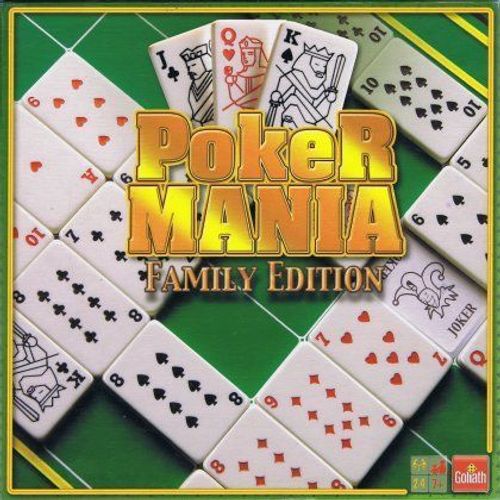
Poker Mania
Poker Mania Rulebook
Table of Contents
Table of Contents
Goal of the Game
Make the best poker combinations to win as many tokens as possible.
For 2 to 4 players, from age 7.
Contents
- 1 game board
- 56 tiles representing cards
- 4 sliders (réglettes), one per player
- 12 blue tokens (10 points)
- 24 red tokens (5 points)
- 36 yellow tokens (1 point)
- 1 rule sheet
Setup
Place the game board in the middle of the table. Shuffle the tiles and place them face down next to the board.
Each player draws 5 tiles and places them on his slider. One of the players draws 2 more tiles and places them in the middle of the board on the "Start" squares. The remaining tiles form the draw pile.
Start of the Game
The youngest player begins. He places 1 to 5 tiles so that they form a horizontal or vertical line (never diagonal) with one of the tiles already on the board.
The line created must show a poker combination. It is impossible to create two combinations end to end on the same line during the same turn.
Tiles must be placed in one single line, but they may form combinations both horizontally and vertically.
At the end of his turn, the player scores points for each combination formed (see the score table). However, if several combinations are created on the same line, only the one that totals the most points is counted. The player receives tokens matching his score (yellow for 1 point, red for 5 points and blue for 10 points), then draws as many tiles as he placed during the turn and places them on his slider.
Continuing the Game
Play continues clockwise. Each player may place 1 to 5 tiles on each turn, following the same rules.
At least one of the five tiles you place must be adjacent, vertically or horizontally, to a tile already placed. The other tiles do not need to form valid combinations with the adjacent tiles already placed, but all the combinations you create score points (figure 2).
During your turn, you place a new combination of at most 5 tiles in one single horizontal or vertical line (see figure 1). No combination may exceed 5 tiles (see figure 3). If you form several combinations on one line or column, only the one that scores the most points is counted.
A placed tile is never removed or moved again.
If a player does not want to play or cannot play, he may exchange one or more tiles with the draw pile. His turn then ends.
When there are no more tiles to draw, the players continue to place the tiles they have on their sliders.
The sheet's figures 1 to 3 are diagrams of these placement rules and are not reproduced here.
Score Table
The table below lists all the possible poker combinations, horizontally or vertically, and the corresponding points.
- One Pair: 1 pair (2 cards of the same value) = 1 point
- Two Pairs: 2 pairs (2 times 2 cards of the same value) = 2 points
- Three of a kind: three of a kind (3 cards of the same value) = 3 points
- Straight: a run of 5 cards = 5 points
- Flush: 5 cards of the same suit = 5 points
- Full House: 2 cards of the same value + 3 cards of the same value = 5 points
- Four of a kind: 4 cards of the same value = 7 points
- Five of a kind: 5 cards of the same value = 10 points
- Straight Flush: a run of 5 cards in the same suit = 10 points
- Royal Flush: a run of the 5 highest cards of the same suit = 15 points
Source note: the printed text above gives 10 points for a Straight Flush and 15 points for a Royal Flush. The illustrated score table on page 3 of the same sheet shows the Straight Flush paid with tokens worth 10 + 5 (15 points) and the Royal Flush with tokens worth 10 + 10 (20 points). The text is transcribed as printed; the two disagree and the official values should be checked against the physical game.
Jokers
The game contains two jokers. They can replace any card in a combination. When a joker has already been placed on the board, a player may assign it a different value to form a new combination.
Joker Squares
The board has two Joker squares. When a player places a tile next to a Joker square, he may use that square to complete his combination by assigning it any value. A Joker square that has already been used for a combination may change value for another combination.
Warning: it is impossible to place a tile on a Joker square.
End of the Game
When all the tiles have been placed on the board, or when it is impossible to place another tile, the players count their tokens and deduct one point for each tile left on their slider. The player with the highest score wins the game.
The sheet's contact address and its multilingual safety and copyright notices are not transcribed.