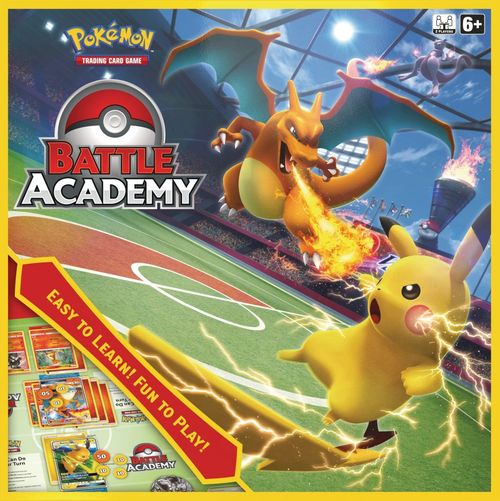
Pokémon Trading Card Game: Battle Academy
Pokémon Trading Card Game: Battle Academy Rulebook
Table of Contents
Table of Contents
Rules Reference
Stop here unless you have already finished the tutorial game!
Welcome to the Rules Reference! These rules will help you understand terms associated with some of the more advanced play in the Pokémon Trading Card Game.
Playing with the Third Deck
Once you are comfortable with the Lightning-type Pikachu Deck and the Fire-type Armarouge Deck, and you are ready for more advanced play, you can try the Darkness-type Darkrai Deck as another option. Each player should shuffle their deck before each game. Try these new advanced rules during play.
Advanced Play Setup
- Shake hands with your opponent.
- Flip a coin. The winner of the coin flip decides which player goes first. (This is important because the player who goes first can't attack or play a Supporter card on their first turn.)
- Shuffle your deck. Then, draw the top 7 cards and keep them in your hand. (Just for the tutorial game, you played with these cards face up on the table—but most of the time, you'll hold the cards you draw, and your opponent doesn't get to see what they are until you play them.)
- Check to see if you have any Basic Pokémon in your hand. (If you don't, see the Mulligan section below.)
- Put 1 of your Basic Pokémon face down in the Active Spot. This will be your Active Pokémon when the game begins. (In the tutorial game, you played it face up.)
- You may put up to 5 more Basic Pokémon face down on your Bench. (In the tutorial game, you skipped this step and played your other Basic Pokémon on later turns.)
- Put the top 6 cards of your deck off to the side face down as your Prize cards. (The tutorial game used 4 Prize cards for a shorter game.)
- Both players flip their Active and Benched Pokémon face up and start the game!
Mulligan
If you don't have any Basic Pokémon in your first hand of 7 cards, show your cards to your opponent and shuffle them back into your deck, then draw 7 new cards. Repeat if you still don't have any Basic Pokémon. After you get a Basic Pokémon, your opponent may draw a card for each time you had to draw a new hand.
First Turn
Some actions (see Parts of a Turn) cannot be taken on a player's first turn of the game. Neither player can evolve any of the Pokémon that they played during setup, even though those Pokémon started their turn in play. Additionally, the first player cannot play a Supporter card (although they can play other Trainer cards) and cannot attack.
Glossary
Active Pokémon
A player's Active Pokémon is the Pokémon in their Active Spot. This Pokémon is used to attack. Each player can only have 1 Active Pokémon at a time. If your Active Pokémon is Knocked Out, move a new Pokémon from your Bench to the Active Spot to replace it. If at any time your opponent has no more Pokémon in play, you win the game.
Active Spot
This space on the playmat is where your Active Pokémon should be placed. It is in the center of the playmat, above the Bench.
Attacking
Attacking is when your Active Pokémon, with enough Energy attached, uses 1 of its attacks on your opponent's Pokémon.
There are 4 steps to attacking:
- Choose the attack you'd like to use, and check to see if you have the correct number and type of Energy attached to your Active Pokémon. For each Energy symbol to the left of the attack name, you must have an Energy card of the matching type. (The Colorless symbol is like a wild card—any type of Energy will work for Colorless.) If you have the correct Energy, announce which attack you are using.
- Check Weakness and Resistance of your opponent's Active Pokémon. This might affect how much damage the attack does. (See Checking Weakness & Resistance.)
- Put the corresponding damage counters on your opponent's Active Pokémon. Remember that effects from Abilities and Trainer cards can change the amount of damage a Pokémon takes. After your attack, check to see if you Knocked Out your opponent's Pokémon. If your opponent's Pokémon has damage counters on it equal to or greater than its HP, then that Pokémon is Knocked Out. If your Pokémon did not do enough damage to Knock Out your opponent's Pokémon, that's OK! The damage counters will remain on that Pokémon.
- Resolve any additional effects of your Pokémon's attack.
After you attack, your turn ends. Make sure you do everything else during your turn that you want to do before you attack.
Attack Example
Your Active Pokémon is Houndour! Houndour's Bite attack does 10 damage to your opponent's Active Pokémon and requires 1 Energy of any type.
- This attack is called Bite. Houndour needs 1 of any type of Energy attached to use this attack. Bite does 10 damage to your opponent's Active Pokémon.
- This attack is called Flare. Houndour needs 2 Energy attached to use Flare: 1 Fire Energy and 1 of any type of Energy. Flare does 30 damage to your opponent's Active Pokémon.
Card Types
The Pokémon Trading Card Game is made up of 3 kinds of cards: Pokémon, Energy cards, and Trainer cards. The card type is shown on the top of the card. A Pokémon has its name across the top of the card. Energy cards say "Energy" at the top of the card and show the Energy type symbol on the right side. Trainer cards say "Trainer" in the top-right corner above the name of the card, and the specific type of Trainer card is listed in the top left.
Energy Cards
Energy cards provide Energy of a specific type that allows the Pokémon to use its attacks when the card is attached. Energy cards are not discarded when using an attack unless the attack says otherwise. (See Attacking.)
Attaching an Energy card means placing it underneath an Active or Benched Pokémon.
Energy comes in these types: Grass, Fire, Water, Lightning, Psychic, Fighting, Darkness, Metal, and Colorless.
Energy cards are discarded from the Pokémon when it retreats. (See Retreating.)
Special Energy Cards
In addition to the Basic Energy cards that are found in these decks, there are also Special Energy cards. While these cards also provide Energy, they often have additional effects or special rules to follow. The text of each Special Energy card tells you how it works.
Trainer Cards
Trainer cards are useful cards that help you to gain advantages in your game. Trainer cards come in four varieties: Item, Stadium, Pokémon Tool, and Supporter. Each has different advantages when you add them to your deck!
Item Cards
Item cards are the most basic type of Trainer card. You play them during your turn, and you may play as many Item cards as you like before you attack. After they are played, they generally go to the discard pile.
Pokémon Tools
A Pokémon Tool card is a Trainer card that you attach to (put it underneath) 1 of your Pokémon, where it provides that Pokémon with a special effect. Each Pokémon can have only 1 Pokémon Tool attached at a time. Pokémon Tools cannot be removed once they're attached to a Pokémon, except with the effect of a card. If the Pokémon is Knocked Out, any Pokémon Tool attached to it also goes to the discard pile.
Supporter Cards
Similar to an Item card, Supporter cards can help you during play. You can play only 1 Supporter card during your turn. The player who goes first can't play a Supporter card on their first turn.
Stadium Cards
Stadium cards are Trainer cards that stay in play after you play them. Each Stadium affects both players. Only 1 Stadium can be in play at a time—if a new one comes into play, discard the old one and end its effects. You can play only 1 Stadium card each turn.
Bench
The bottom row of your in-play section is the Bench. This is where you play new Basic Pokémon. It can hold up to 5 Pokémon, so if you already have 5 Pokémon there, you cannot play a new Basic Pokémon.
Coin Flip
If an attack or Ability requires a coin flip, you can flip a coin or roll a die to determine the outcome. If you roll a standard die, an even number is heads, and an odd number is tails.
Damage
The primary goal of most attacks is to damage the opponent's Active Pokémon. The amount of damage done is the number listed on the right side of the card next to the attack name. If an attack does damage, the player puts damage counters on the opponent's Pokémon. Damage is not removed from a Pokémon unless another card effect heals it. Damage remains on a Pokémon even if it is moved to the Bench. If the damage on a Pokémon is ever equal to or greater than its HP, it is Knocked Out.
Placing Damage Counters
If an effect refers to putting a damage counter on a Pokémon, each damage counter represents 10 damage. Placing damage counters is different from doing damage, and it's not affected by Weakness, Resistance, or other effects that change the damage from attacks.
Defending Pokémon
The Defending Pokémon is the Pokémon in your opponent's Active Spot. It is the target of your Active Pokémon's attacks, unless the attack says otherwise.
Evolution
Some Pokémon evolve into other Pokémon—often larger Pokémon with bigger attacks and more HP. To evolve a Pokémon, you must have a Pokémon in your hand that says "Evolves from X," where X is the name of a Pokémon you have in play.
You cannot evolve a Pokémon during the same turn you put it into play (including any Evolution Pokémon you already played during that turn). You also can't evolve a Pokémon during your first turn.
When a Pokémon evolves, it keeps all cards attached to it (Energy cards, Evolution cards, etc.) and any damage counters on it. Any effects of attacks or Special Conditions affecting the Pokémon—such as Asleep, Confused, or Poisoned—end when it evolves. A Pokémon cannot use the attacks or Abilities of its previous Evolution. Pokémon can be evolved while they're in the Active Spot or on your Bench.
Basic Pokémon
Basic Pokémon are labeled in the top-left corner of the card. Basic Pokémon can be played directly from your hand to your Bench.
Stage 1 Pokémon
A Stage 1 Pokémon is an Evolution Pokémon that can be played on the correct Basic Pokémon to evolve it. Crocalor is a Stage 1 Pokémon that can be played on Fuecoco.
Stage 2 Pokémon
A Stage 2 Pokémon is an Evolution Pokémon that can be played on the correct Stage 1 Pokémon to evolve it. Skeledirge is a Stage 2 Pokémon that can be played on Crocalor.
Special Pokémon
Some Pokémon stand out from the rest, possessing special advantages and sometimes drawbacks. These are listed here.
Pokémon ex
Pokémon ex are special Pokémon with high HP and powerful attacks. A Pokémon ex has the ex logo next to its name. Pokémon ex can be Basic, Stage 1, or Stage 2. (See Evolution.)
When you Knock Out your opponent's Pokémon ex, take 2 Prize cards instead of 1.
Pokémon ex (Tera)
Tera Pokémon ex are even more powerful Pokémon ex. A Tera Pokémon ex has the Tera logo under its HP. In addition to the normal rules for a Pokémon ex, they have an additional rule that prevents them from being damaged by any attacks (yours or your opponent's) when they are on the Bench.
When you Knock Out your opponent's Tera Pokémon ex, take 2 Prize cards instead of 1.
Pokémon V
Pokémon V are powerful Basic Pokémon with big HP and strong attacks. A Pokémon V has the V logo next to the name of the Pokémon.
If you Knock Out your opponent's Pokémon V, take 2 Prize cards instead of 1.
Pokémon VMAX
Pokémon VMAX are strong Evolution Pokémon that evolve from specific Pokémon V. A Pokémon VMAX has the VMAX logo next to its name. Most Pokémon VMAX have at least 300 HP, making them difficult to take down in battle.
If you Knock Out your opponent's Pokémon VMAX, take 3 Prize cards instead of 1.
Pokémon VSTAR
Pokémon VSTAR are strong Evolution Pokémon that evolve from specific Pokémon V. A Pokémon VSTAR has the VSTAR logo next to its name. Pokémon VSTAR have a special VSTAR Power, which can be an attack or an Ability.
If you Knock Out your opponent's Pokémon VSTAR, take 2 Prize cards instead of 1.
VSTAR Power
Every Pokémon VSTAR has a special VSTAR Power, which can be an attack or an Ability, but there is a catch—you can only use 1 VSTAR Power during the entire game, even if you have lots of Pokémon VSTAR in your deck. After you use a VSTAR Power, turn over the special VSTAR marker as a reminder that you can't use another one during this game.
Pokémon V-UNION
Pokémon V-UNION are powerful Pokémon that are made up of four different cards that all have the same name. Once assembled, the four cards are treated as a single Pokémon with all of the text on all four cards. The only way to play one is to get all four of those cards into the discard pile and play them all at once as a single Pokémon onto your Bench. You can only play each Pokémon V-UNION once during a game.
If you Knock Out your opponent's Pokémon V-UNION, take 3 Prize cards instead of 1.
Radiant Pokémon
Radiant Pokémon are powerful cards with a special rule. You can only have one Radiant Pokémon in your deck. The word "Radiant" is part of the Pokémon's name—which limits which Pokémon it can evolve into, since a Pokémon can only evolve from the one that is listed on its card.
Parts of a Turn
Each turn has 3 main parts:
1. Draw a card.
Start your turn by drawing a card. If you cannot draw a card from your deck at the beginning of your turn because you have no cards left, the game is over, and your opponent wins. (See Winning.)
2. Do any of the following actions in any order:
- A. Put Basic Pokémon cards from your hand onto your Bench (as many times as you want). Choose a Basic Pokémon from your hand and put it face up onto your Bench. Your Bench can hold up to 5 Pokémon. (See Basic Pokémon.)
- B. Evolve a Pokémon (as many times as you want). If you have a card in your hand that says, "Evolves from X," and X is the name of a Pokémon you had in play at the beginning of your turn, you may play that card from your hand on top of X. This is called "evolving" a Pokémon. (See Evolution.)
- C. Attach an Energy card from your hand to 1 of your Pokémon (once per turn). Take an Energy card from your hand and put it underneath your Active Pokémon or 1 of your Benched Pokémon. (See Energy Cards.)
- D. Play Trainer cards (as many as you want, but only 1 Supporter card and 1 Stadium card per turn). When you play a Trainer card, read the text out loud, do what the text says, and follow the rule at the bottom of the card. Discard Item and Supporter cards after you play them. Stadium cards stay in play. (See Trainer Cards.)
- E. Retreat your Active Pokémon (only once per turn). To retreat a Pokémon, you must discard 1 Energy from your Active Pokémon for each Energy symbol listed in its Retreat Cost. If no Energy symbols are listed, it retreats for free. Then, you switch that retreating Pokémon with a Pokémon from your Bench. Keep all damage counters and all attached cards with each Pokémon when they switch. If you retreat, you can still attack that turn with your new Active Pokémon. (See Retreating.)
- F. Use Abilities (as many as you want). Some Pokémon have special Abilities that they can use. You can use many of them before your attack. Be sure to announce which Abilities you are using so your opponent knows what you're doing. (See Abilities.)
3. Attack. Then, end your turn.
When you are ready to attack, make sure you've done everything in step 2 that you'd like to do, because attacking is the last thing you can do during your turn. Check the Energy attached to your Active Pokémon to make sure you have the right type and amount of Energy for it to attack. (See Energy Cards.) Also, check the Weakness and Resistance of your opponent's Active Pokémon. (See Checking Weakness & Resistance.) Then, put damage counters on your opponent's Active Pokémon. (See Attacking.)
Regional Variant Pokémon
Some Pokémon have different forms that are specific to the region where they live. These Pokémon often have different appearances and types than their original form. A regional variant Pokémon has a different card name than the original Pokémon (for example: Meowth, Alolan Meowth, and Galarian Meowth all have different names), so when building a deck, you can include 4 copies of each.
Alolan Pokémon
Alolan Pokémon are from the Alola region. The word "Alolan" is part of the Pokémon's name—which limits which Pokémon it can evolve into, since a Pokémon can only evolve from the one that is listed on its card. (See Evolution.)
Galarian Pokémon
Galarian Pokémon are from the Galar region. The word "Galarian" is part of the Pokémon's name—which limits which Pokémon it can evolve into, since a Pokémon can only evolve from the one that is listed on its card. (See Evolution.)
Paldean Pokémon
Paldean Pokémon are from the Paldea region. The word "Paldean" is part of the Pokémon's name—which limits which Pokémon it can evolve into, since a Pokémon can only evolve from the one that is listed on its card. (See Evolution.)
Lost Zone
Any cards that are put in the Lost Zone are removed from play and set aside. Each player should keep track of their own Lost Zone by keeping the cards in a separate pile, similar to their discard pile. Some cards may refer to cards that are put in the Lost Zone, but they are otherwise not used again in the game.
Parts of a Pokémon Card
Abilities
Some Pokémon have Abilities. An Ability is different from an attack. Each Ability is different, so read carefully to see how each one works. Some you have to choose to activate. Some work only if a condition is met or at a certain time in a turn. Others work all the time. Be sure to announce which Abilities you are using so your opponent knows what you're doing. Abilities do not count as attacks, so your Pokémon may still attack after using an Ability. You can use Abilities from both your Benched and Active Pokémon.
HP
HP, which stands for Hit Points, is the amount of damage a Pokémon can take before it is Knocked Out. HP is shown in the top-right corner. If a Pokémon has damage on it equal to or greater than its HP, it is Knocked Out.
The card diagram labels these parts: Pokémon Type, HP, Card Name, Stage, Evolves From, Ability, Pokémon, Expansion Symbol, and Collector Card Number.
Pokémon Checkup
Pokémon Checkup happens after your turn is complete, before your opponent starts their turn. Pokémon Checkup is when you take care of Special Conditions.
During Pokémon Checkup, take the following actions to prepare for the next turn.
- Take care of any Special Conditions on your Active Pokémon in this order: Poisoned, Burned, Asleep, and Paralyzed.
- If your Active Pokémon is Poisoned, now is when it takes damage from the poison. Put a damage counter on your Active Pokémon.
- If your Active Pokémon is Burned, now is when it takes damage from the burn. Put 2 damage counters on your Active Pokémon, then flip a coin. If you flip heads, the Pokémon recovers (remove the Burn marker). The damage counters stay on the Pokémon.
- If your Active Pokémon is Asleep, flip a coin. If you flip heads, the Pokémon wakes up (turn it right-side up). If you flip tails, your Pokémon will remain Asleep until the next Pokémon Checkup.
- When your Active Pokémon becomes Paralyzed, it will recover during Pokémon Checkup after your next turn. Return the card to its original position.
Checking Weakness & Resistance
The bottom-left corner of the card shows whether a Pokémon has Weakness or Resistance.
Weakness
Most Pokémon have Weakness. If your Pokémon has Weakness to a certain type, that means it will take double damage from that type of Pokémon in battle. If the Energy symbol next to a Pokémon's Weakness matches the type of the opponent's Attacking Pokémon, it will take more damage from the attack. Check and apply Weakness before checking and applying Resistance.
Resistance
Some Pokémon have Resistance. If your Pokémon has Resistance to a certain type, that means it will take less damage from that type of Pokémon in battle. If the Energy symbol next to a Pokémon's Resistance matches the type of the opponent's Attacking Pokémon, it will take less damage from the attack.
Prize Cards
Each player starts with 6 Prize cards. When an opponent's Pokémon is Knocked Out, you take a Prize card. The first player to take all of their Prize cards wins.
Some Pokémon, like Pokémon ex or Pokémon V, award more than 1 Prize card for a Knock Out. This rule is shown in the bottom-right corner of the card.
Retreating
Retreating a Pokémon lets you move a Pokémon out of the Active Spot and switch it with a Pokémon on your Bench.
On most turns, you probably will not retreat your Pokémon.
To retreat your Active Pokémon, you must discard 1 Energy from it for each Energy symbol listed in its Retreat Cost at the bottom right of the card. If no Retreat Cost is listed, you may retreat your Pokémon for free!
When a Pokémon retreats, all of its damage counters remain on it, but it recovers from the Special Conditions Burned, Confused, and Poisoned. All effects of attacks are also removed.
(Example: Shinx has a Retreat Cost of 1.)
Special Conditions
Asleep
A Pokémon is Asleep when it is hit with an attack that states "Your opponent's Active Pokémon is now Asleep." To show that your Pokémon is Asleep, turn it counterclockwise 90 degrees. (The top of the card goes to the Left for AsLeep!)
A Pokémon that is Asleep cannot attack or retreat. During Pokémon Checkup, which happens between turns, flip a coin to see if your Pokémon wakes up. If you flip heads, your Pokémon recovers, and you can turn it right-side up. If you flip tails, it remains Asleep.
Burned
A Pokémon is Burned when it is hit with an attack that states "Your opponent's Active Pokémon is now Burned." To show that your Pokémon is Burned, put a Burn marker on it.
During Pokémon Checkup, put 2 damage counters on your Burned Pokémon, then flip a coin. If heads, the Pokémon recovers, and you can remove the Burn marker. The damage counters stay on the Pokémon.
A Pokémon cannot have two Burn markers. If an attack gives it another Burn marker, the new Burned Condition simply replaces the old one.
Confused
A Pokémon is Confused when it is hit with an attack that states "Your opponent's Active Pokémon is now Confused." To show that your Pokémon is Confused, turn the top of the card to point toward you.
A Confused Pokémon could hurt itself when it uses an attack. Before attacking with a Confused Pokémon, flip a coin. If the coin is heads, the attack works normally. If the coin is tails, your Pokémon hurts itself instead of attacking. Put 3 damage counters on your Confused Pokémon. (Your opponent's Pokémon takes no damage, because the attack didn't work.)
Paralyzed
A Pokémon is Paralyzed when it is hit with an attack that states "Your opponent's Active Pokémon is now Paralyzed." To show that your Pokémon is Paralyzed, turn it clockwise 90 degrees. (The top of the card goes to the Right for PaRalyzed!)
A Paralyzed Pokémon cannot attack or retreat. After your next turn, your Pokémon will recover during Pokémon Checkup.
Poisoned
A Pokémon is Poisoned when it is hit with an attack that states "Your opponent's Active Pokémon is now Poisoned." To show that your Pokémon is Poisoned, put a Poison marker on it.
During Pokémon Checkup, put a damage counter on your Poisoned Pokémon.
A Pokémon cannot have 2 Poison markers—if it becomes Poisoned again, the new Poisoned Condition replaces the old one.
How to Recover from Special Conditions
Evolving a Pokémon or moving it to the Bench removes all Special Conditions. The only Special Conditions that prevent Pokémon from retreating are Asleep and Paralyzed. Since Asleep, Confused, and Paralyzed all rotate the Pokémon card, whichever one happened last to the Pokémon is the only one that is still in effect. Since Poisoned and Burned use markers, those don't affect other Special Conditions. An unfortunate Pokémon could be Burned, Paralyzed, and Poisoned all at the same time!
Winning
You can win the game in 3 ways:
- Take all 6 of your Prize cards.
- Knock Out all of your opponent's Pokémon in play.
- If your opponent has no cards in their deck at the beginning of their turn.
Sometimes, there is a rare case where both players win at the same time. In this case, you play a short game called Sudden Death.
Sudden Death
Sudden Death is used to determine a winner in the case of a tie. This is a short game—the first person to take 1 Prize card wins!
What's Next?
This game is just part of the world of the Pokémon Trading Card Game. Thousands of other cards have been made for the game, and there are lots of other Pokémon TCG deck products that you can find to expand your collection and give you more options when playing.
You can find more cards inside booster packs, and if you open cards that you think would be good in your deck, you can remove a card from the deck and put the new card in its place. (A deck always has to have exactly 60 cards!)
In addition to playing at home, you can participate in your local Pokémon League to meet other players and get tips on deck building and battling. You can also visit the Pokémon TCG website to learn more about other cards that are available and to find out how to play online with Pokémon TCG Live.