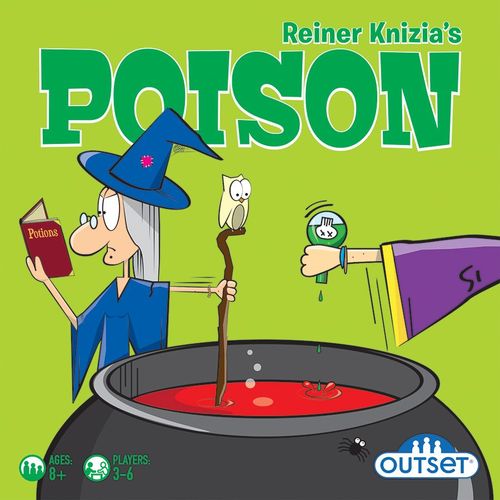
Poison
Poison Rulebook
Table of Contents
Table of Contents
Game Components
- Eight poison cards with the value 4
- 14 potion cards in each of three colors — per color, two cards with the value 4 and three cards each with the values 1, 2, 5 and 7
- Score pad
Setup
A game of Poison is played over several rounds. At the start of each round one player is the dealer. The dealer passes to the next player clockwise for the following rounds.
The dealer shuffles all the cards and deals them out one at a time to the players. Depending on the number of players, some players receive one card more in hand than other players. The score pad and a pencil are not needed until the end of a round.
Note: With three players, the cards are dealt out as if for four players, and the cards for the surplus player are removed from the game for that round.
Playing the Game
The player to the left of the dealer begins, then play continues clockwise. Whoever's turn it is must play one of their cards face up into a cauldron. There are at most three cauldrons. The cauldrons are the area in the middle of the table.
The color of the first potion card played into a cauldron determines the color of all the cards that may be played into that cauldron. Further cards of that color must be placed into the same cauldron. At no time may one color be represented in more than one cauldron.
Attention: This does not apply to the green poison cards; those may be placed into any cauldron. If a cauldron contains only poison cards, its color is not yet determined. When a potion card is played into the cauldron, that card determines the color of the cauldron. The cauldron may not, however, have the color of a cauldron that already exists.
If a player plays a card that makes the sum of all card values (potion cards and any poison cards) in a cauldron exceed the value 13, that player must take all the cards already laid down in that cauldron and place them face down in front of themselves. The card (potion card or poison card) that caused the value 13 to be exceeded remains in the cauldron.
Note: A player may not look at their face-down cards until the end of the game.
Example 1:
- a) Karl plays a "2" and fills the cauldron up to the value 13.
- b) Sarah plays a "4"; this makes the value of the cauldron exceed 13. Sarah must take all three cards already played into the cauldron and place them face down in front of herself.
- c) The "4" played by Sarah remains in the cauldron.
Example 2:
- a) Richard plays a poison card, which always has the value "4", and fills the cauldron up to the value 11.
- b) Johann plays a "5" and this makes the value of the cauldron exceed 13. Johann must take the cards already played into the cauldron, including the poison card, and places them face down in front of himself.
- c) The "5" played by Johann remains in the cauldron.
Scoring
A round ends when all the cards have been played. Cards still lying in the cauldrons at the end of a round are not scored.
The players reveal their face-down cards and determine their result. Each potion card counts one minus point; each poison card counts two minus points.
If a player has the most cards of a color, those cards count zero points. In the event of a tie for the most cards, the players affected must nevertheless score their cards as minus points. Poison cards are always scored, even if a player has the most of them.
The minus points are noted for each player on a sheet of the score pad.
Example of a scoring round:
Sarah has three blue cards, two red cards and one poison card. She has the most cards in no color and must score all her cards. She receives 7 minus points.
1 + 1 + 1 + 1 + 1 + 2 = 7
Richard has six red cards and two violet cards. Since he has the most red cards of all the players, he does not have to score his red cards. He receives only 2 minus points.
0 + 0 + 0 + 0 + 0 + 0 + 1 + 1 = 2
Karl has two blue cards, five red cards, six violet cards and two poison cards. Karl has achieved only a tie with Johann on the violet cards and must score them. He receives 17 minus points.
1 + 1 + 1 + 1 + 1 + 1 + 1 + 1 + 1 + 1 + 1 + 1 + 1 + 2 + 2 = 17
Johann has six blue cards, one red card, six violet cards and four poison cards. He has the most blue cards and accordingly does not have to score them. He has achieved only a tie with Karl on the violet cards and must therefore score them. Although he has the most poison cards, he must score them, because a player must always score their poison cards. Johann receives 15 minus points.
0 + 0 + 0 + 0 + 0 + 0 + 1 + 1 + 1 + 1 + 1 + 1 + 1 + 2 + 2 + 2 + 2 = 15
End of the Game
After each round the dealer must shuffle all the cards again and deal them out to the players. When every player has been the dealer once, a game is over. Now each player's minus points are added up. The player with the fewest minus points wins.
Note: With three players, a game is over when every player has been the dealer twice.
Variant
At the start of each round each player receives only five cards in hand. The remaining cards form a face-down deck. Whoever plays a card then draws a new card from the deck. The game ends when the deck is used up and all the cards have been played.
Publisher
You have purchased a quality product. Should you nevertheless have cause for a complaint, please contact us directly. Do you still have questions? We are glad to help you:
AMIGO Spiel + Freizeit GmbH, Waldstraße 23-D5, D-63128 Dietzenbach — www.amigo-spiele.de, E-Mail: [email protected]
© AMIGO Spiel + Freizeit GmbH, D-63128 Dietzenbach, MMVIII — Version 1.0