Pocket Tactics
Pocket Tactics Rulebook
Table of Contents
Table of Contents
Intro
Welcome to Pocket-Tactics, a fast-paced, modular strategy war game that you can take with you and play just about anywhere!
Factions
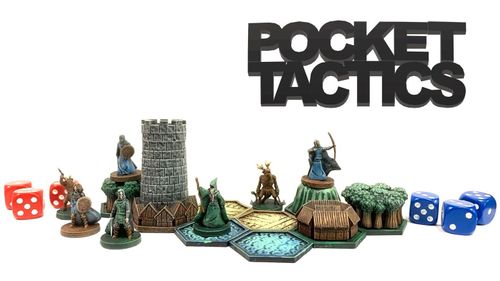
In a game of Pocket-Tactics, each player brings a faction to the table. A faction set will typically include:
- eleven character miniatures (units), each with their own stat cards.
- one base tile (often a special building or terrain piece on a hexagonal tile).
- 10 hexagonal terrain tiles and six 6-sided dice (three red, three blue).
Factions sets are sold separately (some are even free!), and all of them are compatible and can be matched against one another as you see fit.
Glossary
- ACTIVATION: Choosing a unit to perform an action (one activation per player turn).
- ADJACENT: A tile or model that is next to another tile or model.
- ADVANTAGE: A condition (usually from favored terrain or adjacent allies) that allows a unit to re-roll a single die during an assault. Each unit may be listed with a terrain type in which they gain advantage.
- ASSAULT: A combat between two units.
- ATTACK: The action used to initiate an assault.
- BALLISTICS: A skill, used to attack and defend in ranged assaults.
- BASE TILE: A special hex tile used to deploy your units. It typically defends with three dice whenever it is attacked and may not be occupied by a unit.
- CAPTURES: A space off to the side of the map where players collect defeated enemy units.
- COST: An indicator of the unit's value.
- DEFEATED: When a unit is taken out of action via an assault or hazard.
- DEPLOYMENT: The action used to bring a unit from reserves onto the map.
- MELEE: A skill, used to attack and defend in close assaults.
Setting Up
- Choose factions and set base tiles and units to the side of the play space.
- Mix all the terrain tiles in a bag and shake them up.
- Roll off to determine who is the first player.
- The first player places their base tile before them in the play space, draws a terrain tile from the bag, then places the tile against an outward-facing side of their base tile (the three sides facing away from the first player).
- Player 2 draws and places a tile in the same way.
- Alternate placing new tiles in this way. (The map should bloom out toward the second player.)
- Once all the terrain tiles are in play, the second player places their base tile as far as possible from the first base tile while still touching the same number of tile sides. (For example, if the first player's base tile is connected to two tiles, the second player's base tile must be placed in the furthest position where it also connects to two tiles.)
3-D Terrain
Some tiles feature a 3-d piece of terrain. These are set to the side and, when the tiles are drawn, fill them with the terrain piece listed on the tile.
Deploy Units
Each of the character models is referred to as a unit. Starting with the first player, players take turns placing units on the tiles closest to their base. When each player has three units in play, move the rest of the units to the side of the map to act as reserves that can be deployed later.
Ready to Play
Because of the randomized nature of tile draws and the options players take when placing them, the map layout will be different each time you play. Once you've followed these steps, your map should look something like (remotely) the image in the rulebook. Play can begin, starting with the first player.
Gameplay
The first player starts the game. On their turn, a player must activate a single unit to either Move, Assault, or be Deployed.
Move
Each tile may only be occupied by a single unit. A unit activated to move may do so to an adjacent unoccupied tile. Units may "hop" one tile occupied by a friendly unit to reach an unoccupied tile. Some units have special abilities that allow them to move in different ways.
HAZARDS: Hazards are tile effects that may defeat a unit outside of an assault or cause other negative results. For example, a unit moving (or making a close assault) into a Water tile immediately rolls a single die. On a 1-3, the unit is defeated.
Hopping over an ally in a hazard tile does not prompt a hazard check. A unit that has tile advantage in a hazard tile is immune to the hazard effect.
Assault
A unit may attack an enemy unit by declaring an "assault." They must have at least one OFF die (red) to declare an assault with any given skill. There are two kinds of assaults: close assaults and ranged assaults.
CLOSE ASSAULTS: To perform a close assault, the attacking unit moves onto an adjacent enemy's tile and declares that they are attacking with Melee or Special (Magic, Tech, et cetera). You don't have to physically move the model to the tile yet, but remember that they count as occupying the tile they are invading.
RANGED ASSAULTS: To perform a ranged assault, the attacking unit chooses an enemy in an adjacent tile and declares that they are attacking with Ballistics or Special (Magic, Tech, et cetera). Ranged assaults are handled the same way as close assaults, except the attacker stays in their own tile and is not moved when they win.
Some units may have special abilities that let them make ranged assaults from farther away. A defender cannot counter-strike (roll OFF dice) unless a similar special ability extends their own range out to the attacker. Assault range may never be drawn through empty spaces where there is no tile.
RESOLVING ASSAULTS: The attacker declares which skill will be used (Melee, Ballistics, or Special) and each player rolls a number of offense (red) and defense (blue) dice based on the OFF and DEF values in that chosen stat. These rolls represent the attacker striking and the defender simultaneously fighting back.
- Dice results are not added together. More dice simply gives you a better chance at getting higher results.
- Compare the red results against the enemy's blue. If a single red die result is higher than any single blue result, the attacker wins.
- If there is a single blue die result that is higher than any rolled by red, the defender wins.
- If the two highest dice results are a tie, move on to the next highest. If those are also a tie, repeat until one side has the highest single result or the other side doesn't have a die to compare. The side with the highest single uncontested die always wins, a perfect tie going to the defender.
EXAMPLE: The Peacekeeper (left) and Commando (right) are engaged in a Ballistic assault. 1: The Commando's OFF die of 6 is matched with the Peacekeeper's highest DEF, a 6, so we move on. 2: The Commando's next highest results, a 2 and a 1, are unable to beat the Peacekeeper's 3, so the Peacekeeper is safe. 3: The Peacekeeper's OFF result of 3 is higher than the Commando's highest DEF, a 2. The Peacekeeper defeats the Commando.
ADVANTAGE: Advantage allows units to re-roll their dice. When units have re-rolls available, alternate re-rolls starting with the attacker, one at a time unless otherwise specified by a special ability. Re-rolls granted by special abilities must be used first, and are not considered to be advantage re-rolls. Each unit may then use any advantage-based re-rolls (see below). Advantage re-rolls affect one die, OFF or DEF, belonging to the re-rolling unit. The two types of advantage re-rolls are tile advantage and assists.
TILE ADVANTAGE: Each unit's stat sheet lists an advantageous terrain type (Hill, Field, Forest, et cetera). Assaulting into that tile type grants the attacker one re-roll. Assaulting from that tile type (for ranged assaults) grants one re-roll. Defending while occupying that tile type grants one re-roll. Sometimes tiles will have variants that are styled differently, but the name of the tile is all that matters for advantage.
ASSISTS: Units adjacent to a combat can grant advantage re-rolls. If the attacker has allies adjacent to the target, they each grant a re-roll. If the defender has allies in adjacent spaces, they each grant a re-roll. Adjacent allied bases grant two re-rolls.
Deployment
Instead of moving or assaulting, a player can choose a unit in reserves and place them on an empty tile adjacent to their base. Deploying a unit onto a Water tile (or any tile with a hazard effect) does not prompt a hazard check. A player can send a unit back to reserves by moving the unit into their base.
Victory
To win, a player must either capture their opponent's entire force or assault and defeat their opponent's base.
Bases cannot capture units. When assaulted, bases always defend with 3 DEF dice. Adjacent allied units can grant Assists to bases, and bases grant two assists to adjacent allied units. Units may not occupy the base like other tiles.