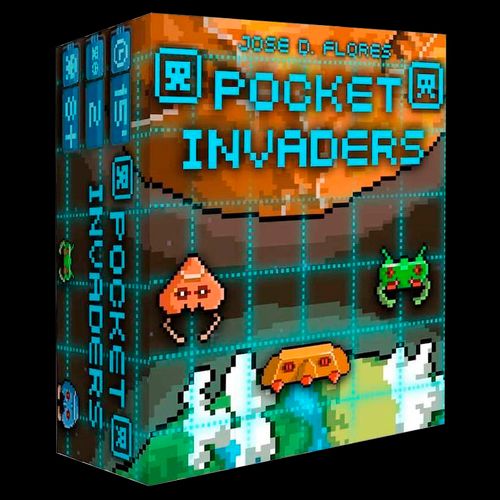
Pocket Invaders
Pocket Invaders Rulebook
Table of Contents
Table of Contents
Characteristics
Game for invaders older than 8 years.
10-20 minutes of duration.
2 to 4 players.
Objective
Conquer the enemy planet with your mothership, or eliminate the enemy's mothership.
Contents
- 1 board with 4 different sizes
- 14 dice with 8 ships
- Rulebook and initial formations
Setup
Even enemies must agree on some things! To begin, you must choose one of the multiple initial configurations and place your ships in formation.
Note that each die must be oriented in the direction of each player, with the green direction pixels facing up.
The green pixel indicates that this is the top of the die.
Once the first player has been chosen, the battle begins!
How to Play
During the turn, each player may do one, and only one, of the following options:
- Move one of your own ships.
- Capture an enemy ship.
- Place a captured ship on the board.
After performing the action, the turn passes to the next player.
The game ends when a player reaches the enemy planet's section with their mothership (Figure 1), or captures the enemy's mothership (Figure 2).
Board zones (Figure 1): the enemy planet, outer space, and your own planet.
1. Move One of Your Own Ships
The player may move any die from their army in one of the possible directions. It only moves one square in that direction.
To move it, the destination square must be free of any other ship, friendly or enemy. The possible directions are marked by dots next to each ship.
Example: the ship in Figure 3 can move orthogonally, that is, up, down, left, or right. The ship in Figure 4 can move diagonally, as indicated by the white or green dots. Figure 5 shows a ship that cannot move up-left because there is already an enemy ship there.
The scout ship, the yellow one (Figure 6), is rerolled again when it manages to reach the enemy planet, upgrading itself for the following rounds. However, it may happen that another yellow comes up again, in which case we keep rolling the die until this doesn't happen, and we place the new ship directly on the same square.
2. Capture an Enemy Ship
Capturing an enemy ship means removing it from the board so that, on other turns, it can be used as your own ship. To be able to capture that ship, it must be in a square adjacent to your own ship and in any of the directions indicated by the dots, the same as for movement.
The ship that captures the enemy one will then move to the square where the captured ship was. Any ship can capture another, but if a ship captures the mothership, the game ends immediately and that player wins the match.
Example: with this ship we can only capture the enemy ship (Figure 7) since it is in our movement path. The enemy ship passes into the player's possession, and the ship used moves to its new position (Figure 8).
Finally, the player keeps the captured ship and, in addition, rolls that ship's die, obtaining a new ship for their personal reserve.
3. Place a Captured Ship on the Board
Instead of making a move or a capture, the player may use a ship from their personal reserve, captured previously, on the game board. That ship can be placed anywhere on the board where there is an empty square, even on the enemy planet. The only exception is the ship in Figure 9, which must be placed outside the enemy planet.
Example: our yellow ship can only be placed in the zones indicated with a green arrow, since the other two are inside the enemy planet (Figure 9). If it were any other ship, it could be placed anywhere on the board.
End of the Game
There are two ways to end the game:
- The game ends immediately if a player manages to reach the enemy planet with their mothership (Figure 2).
- The game also ends if a player manages to capture the enemy's mothership.
In both cases, the player who accomplishes the task is the winner.
Variants
In addition to all the possible combinations of initial formations and board sizes, Pocket Invaders has some variants:
Empty Space
In this variant we begin with the board set up as follows: each player's ships start in their reserve, except for the mothership, which starts placed in a corner square of the play area.
Just as in the traditional mode, these ships can be introduced one at a time on your turn. This variant can also be used with other initial boards.
Chance Is My Ally
In this variant, we use any initial formation and place the ships as it indicates. Each player takes, one at a time, the rest of the ships that appear in the formation and rolls them, placing each one in the starting position where it lands. At that point the battle begins in the traditional way.
Note: because of the randomness, this option can be very unbalanced at the start.
The Art of War
This variant works exactly like the base game, except that captured ships are not rerolled to gain new forces, so the same ship that was captured remains as is.
Reinforcements Under Control
Reinforcements can only be placed on your own planet once they enter play.
Zero Chance
A mix of the two previous variants: captured ships are not rerolled, and they can only be placed on your own planet when they enter the board.
Reinforcement Reserve
The dice left over from the initial configuration are rolled and set aside as a common reserve. Once a player eliminates an opponent's ship, they roll the die as usual and may keep that ship in their reserve or exchange it for any ship in the common reserve, leaving the new ship in its place.
The Supremacy of Chance
Once the board on which we want to start the game is chosen, each player takes the same number of dice, matching the empty squares of their own planet and up to the maximum available in the game. They are rolled simultaneously, and players place their ships one at a time, once per turn per player. Once all the dice have been placed, the game begins.
Note: because of the randomness, this option can be very unbalanced at the start.
Formations
Pocket Invaders can be played with different initial formations, depending on the board zone selected. The board has two faces, and each face in turn has two play zones: the complete face and the unshaded portion. If we choose the unshaded zone, during the battle we cannot leave it with any movement.
The rulebook illustrates several initial ship formations for Board 1 and Board 2, each showing the starting placement of ships (including the mothership and scout) on the player's own planet at the start of the game.