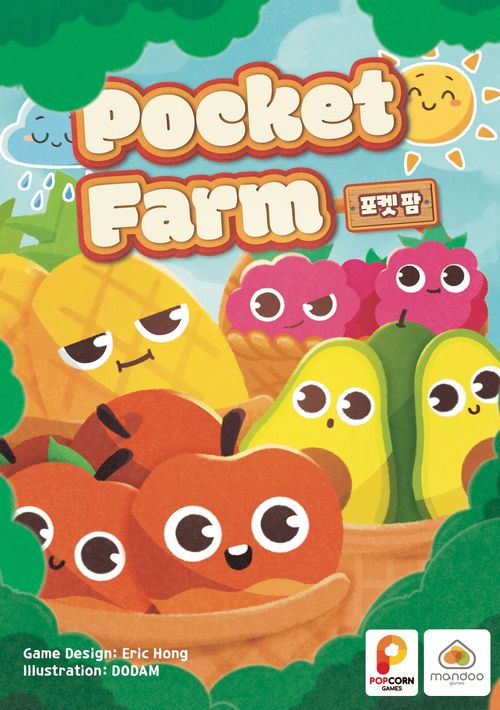
Pocket Farm
Pocket Farm Rulebook
Table of Contents
Table of Contents
Overview
The game consists of 12 rounds, each of which is divided into a Draft Phase and a Placement Phase. During the Draft Phase, each player receives 1 card, and during the Placement Phase, they can place 0 to 2 cards. The first player rotates in a clockwise direction each round. Scoring takes place after the final round.
Components
- First Player Marker
- Scorepad
- 60 Farm Cards (double-sided)
- 4 Starting Farm Cards (there are 4 different Starting Farms, but they all function the same way)
Setup
Each player gets one Starting Farm card and places it face-up in front of them.
Remove any unused Farm cards based on the number of players, then shuffle the remaining cards and place them face-down in a deck at the center of the table.
To determine who goes first, choose a player at random and give them the First Player Marker. This marker will be passed to the next player in clockwise order at the start of each new round.
Each Farm card has a cost and 1-4 dots on the center of the card. The dots indicate the minimum number of players required to use that card.
Use cards with 1 dot in solo games, 1-2 dots in 2-player games, 1-3 dots in 3-player games, and all cards in 4-player games.
Example: In a 3-player game, the cards with 1-3 dots are shuffled into a deck.
Game Play
The game consists of 12 rounds. Each round has a Draft Phase, then a Placement Phase, then the round ends.
1. Draft Phase
The Draft Phase begins by revealing a number of cards from the deck that is one more than the number of players in the game.
- 1 Player: 2 cards
- 2 Players: 3 cards
- 3 Players: 4 cards
- 4 Players: 5 cards
Starting from the first player and in clockwise order, each player chooses one card from the available cards and adds it to their hand.
Once every player has chosen a card, the one remaining card is set aside on the table as an Offering. Players move on to the Placement Phase.
In a 2-player game, reveal 3 cards.
Tip!
- One for each round, there will be a total of 12 Offerings in the game. So, players can keep track of how many rounds have been played.
- The number of each fruit in the Offerings means how many times the fruit will be scored. Keep in mind which fruit is valuable when you choose a card.
2. Placement Phase
In the Placement Phase, each player expands their farm by simultaneously placing cards from their hand. Players can choose to place 0 to 2 Farm cards.
Place 0 cards
You may keep cards in hand if you can't or don't want to place them. There is no limit to the number of cards you can have in your hand. But, cards remaining in hand at the end of the game will not score any points.
Place 1 card
You must cover at least one Sun or Cloud with the card you choose to place. The total values of Sun and Cloud covered must be greater than or equal to the cost of the card.
You may place the card in any direction you desire, but once placed, cards cannot be moved, rotated, or removed. The visible, uncovered portion of the card is your farm, and you should ignore any portion of the card that is covered by other cards.
Tip! You may also cover any fruit or basket, but doing so will not affect the cost.
Suns increase in value when connected horizontally or vertically.
- A single, isolated Sun is worth 1.
- Two connected Suns are each worth 2.
- Three or more connected Suns are each worth 3. Even if there are more than three Suns connected, each of them is still worth 3.
Clouds decrease in value when connected horizontally or vertically.
- A single, isolated Cloud is worth 3.
- Two connected Clouds are each worth 2.
- Three or more connected Clouds are each worth 1. Even if there are more than three Clouds connected, each of them is still worth 1.
Example: Place 1 card. There are 2 Clouds connected in your farm. Those Clouds are each worth 2. You have decided to place a card with a cost of 2 from your hand. Place it by covering one of the Clouds.
Place 2 cards
If you have several cards in hand, you may choose to place 2 cards, one at a time. The first card you place has its normal cost. However, the second card will cost 2 more than its normal cost.
Example: Place 2 cards. You have decided to place a card with a cost of 2 and a card with a cost of 5. There are two connected Clouds worth 2 each, so you place the first card with a cost of 2 by covering one of the Clouds.
The cost of the second card is 7, which is increased by 2. Place it by covering an isolated Sun worth 1 and two isolated Clouds worth 3 each.
3. Round Ends
Once all players have finished the placement phase, the round is over.
The player to the left of the first player becomes the new first player and starts new round.
Game End
Once the 12th round is over (remember to keep track of the rounds using the Offerings cards), every player scores points in their farm. The player with the highest total score wins. In the case of a tie, they share the victory.
Scoring
Score each fruit type separately, in the same manner:
- Add up the value of baskets that are adjacent to that fruit type.
- IMPORTANT: Even if several fruits of that type are adjacent to a basket, add the basket's value only once.
- Multiply the sum by the number of that fruit type in Offerings.
In the same manner, score the Avocado, the Pink Fruit and the Pineapple, respectively.
The sum of the scores of all your fruits is your final score.
Example: Scoring. Here are the Offerings at the end of the game. The Red Fruit appears 4 times in Offerings, and the Avocado 3 times, the Pink Fruit 3 times and the Pineapple 2 times.
- The total value of your baskets adjacent to the Red Fruit is 9. Note that a basket adjacent to 2 or more Red Fruits counts only once. There are 4 Red Fruits in Offerings. The score from the Red Fruit is 36.
- Score the Avocado, the Pink Fruit and the Pineapple in the same way.
| Red Fruit | Avocado | Pink Fruit | Pineapple | Total | |
|---|---|---|---|---|---|
| Basket | 9 | 8 | 10 | 2 | |
| Offerings | x 4 | x 3 | x 3 | x 2 | |
| Score | 36 | 24 | 30 | 4 | 94 |
In the example, a basket adjacent to 2 Red Fruits counts only once.
Strategic Tips
Place big baskets. Cards with big baskets are efficient but expensive, as they require covering several Suns and Clouds at once.
Place different kinds of fruits around the basket. Keep in mind that a basket can harvest the same fruit only once.
- Best! A basket surrounded by four different kinds of fruit.
- Avoid A basket surrounded by the same fruit more than once.
Solo Game Achievement
| Score | Title |
|---|---|
| ~99 | Scarecrow |
| 100~109 | Fruit Picker |
| 110~119 | Novice Farmer |
| 120~129 | Fruit Farmer |
| 130~139 | Orchard Owner |
| 140~149 | Harvest Master |
| 150~ | Demeter |