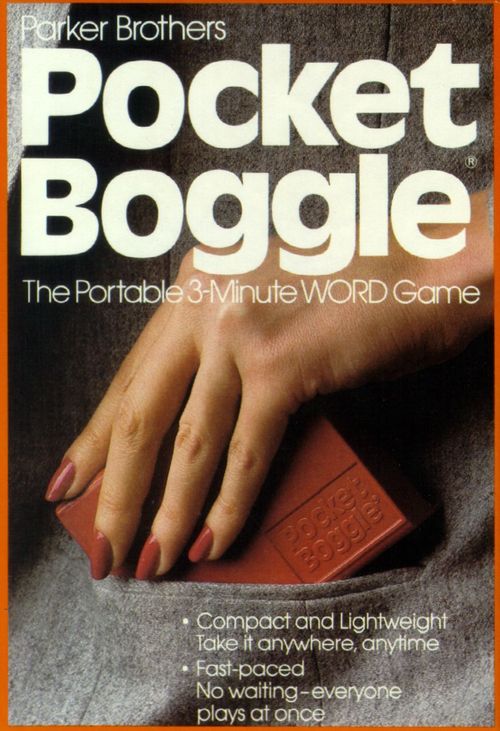
Pocket Boggle
Pocket Boggle Rulebook
Table of Contents
Table of Contents
Equipment
12 letter strips • a grid • a 3-minute timer • Not included, but needed by each player are a pencil and piece of paper.
Object
To list, within 3 minutes, as many words of the highest point value as you can find among the random assortment of letters in the grid.
Preparation
a) Place the timer—empty side up—into the hole on the platform.
b) Choose any four of the letter strips and slide them—one at a time—into the grid. It doesn't matter which end of a strip you slide in first or which side of a strip is facing you.
c) Place the grid onto the platform. Be sure that the grid lies flat and that its open edge lies outside the box.
d) While one player turns over the grid to expose the hidden side, another player starts the timer.
Playing
When the timer starts, each player searches the assortment of letters for words of three letters or more. When you find a word, write it down.
Words are formed from adjoining letters. Letters must join in the proper sequence to spell a word. They may join horizontally, vertically or diagonally, to the left, right or up-and-down. No letter, however, may be used more than once within a single word.
Figures 1 through 3 show how words can be formed from adjoining letters.
CORRECT
Figure 1 — DEAR
Figure 2 — READ
Figure 3 — DARE
INCORRECT
Figures 4 and 5 show two incorrect spelling techniques: in "TART" (Figure 4), the one adjoining "t" is used twice; to form "SIT" (Figure 5), requires skipping over the letter "t." No skipping is allowed; letters must adjoin in sequence.
Try your skill at finding the hidden words in the letter assortment above. There are at least 130 words, including "duets," "taunted" and "predator."
Playing More Games
a) To play another game, simply turn over the grid and search for words on the opposite side of the strips.
b) After determining a winner, remove all four strips and replace them with any four of the remaining strips. Using these new strips, play one game with each side of the grid.
c) Then remove the strips and play two games using the four remaining strips.
d) When you're finished, remove the strips, mix them in with the others and start again by choosing four letter strips at random.
Types of Words Allowed
The only words that are allowed are those that can be found in a standard English dictionary. You may look for any type of word—noun, verb, adjective, adverb, etc. Plural nouns are acceptable, as are all verb tenses. Words within words are also allowed; e.g. beard: bear, ear.
Types of Words Not Allowed
Proper nouns, abbreviations, contractions, hyphenated words and foreign words that are not in an English dictionary.
Scoring and Winning
When the timer runs out, everyone must stop writing. Each player in turn then reads aloud his or her list of words. Any word that appears on more than one player's list must be crossed off all lists, including that of the reader.
After all players have read their lists, each player scores his or her remaining words:
| No. of letters | 3 | 4 | 5 | 6 | 7 | 8 or more |
|---|---|---|---|---|---|---|
| Points | 1 | 1 | 2 | 3 | 5 | 11 |
The winner is: a) the player whose words have earned the most points; or b) the first to reach 50 points, 100 points or whatever score is considered by all to be a reasonable target.
Things to Remember
- No one may touch the grid or the letter strips while the timer is running.
- Multiple meanings of the same word do not earn multiple credit. The word "tear," for example, can mean "to pull apart," "to weep," or "to rush headlong"; yet it may count as only one word.
- The same word found by a player in different areas of the grid may not be counted for multiple credit.
- "Qu" counts as two letters.
- Both the "M" and the "N" have a line under them.
- The letter "Z" also has a line under it and should not be seen as the word "IN."
- Full credit is awarded for both the singular and plural forms of a noun—but only if the player has listed them as separate words.
- Common words tend to be found by more than one player. Therefore, if your words are unique and unusual, they are more likely to earn you points.