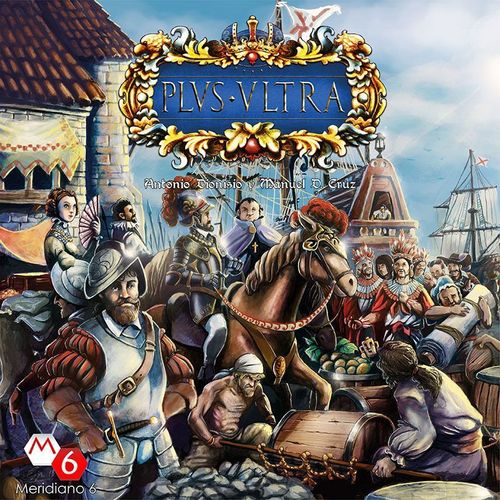
Plus Ultra: The Court of the Emperor Charles V
Plus Ultra: The Court of the Emperor Charles V Rulebook
Table of Contents
Table of Contents
Aim of the Game
At the end of the game, the player with the highest number of Greatness Points (hereafter GP or represented by the symbol GP) will be proclaimed Grandee of Spain and winner of the game. Therefore, all the actions performed by the players must be aimed to increase their amount of GP.
Components
This rulebook's pages have the following color codes: game setup; extended game zones explanation; expansion and advanced rules.
- 39 New World tiles
- 8 estate tiles
- 9 character cards
- 5 bull cards
- 10 rosewindow and 6 Magellan's Voyage cards
- 4 court painter cards
- Wooden tokens (in 4 colors): 4 ships, 20 regiments, 24 houses, 8 big discs, 8 small discs
- 1 wooden black disc, 3 dice and 38 ducats cardboard tokens
- 4 turn order cards
Expansion: The New World — 7 New World cards and 3 aggressive native tiles.
Expansion: The Power of the Court — 4 character cards marked with the advanced symbol.
Expansion: The Ambassador — 1 character card, 1 common action card and 20 ambassador tiles.
Character card
- Name.
- Crown (only for the king).
- Resource icon.
- Character art.
- Passive action.
- Basic action 1.
- Basic action 2.
Board
- Greatness points register (see Definition of Characters section).
- Magellan's Voyage.
- Estates.
- Common actions.
- Crown's wealth.
- Bulls.
- Church.
- Rounds register.
- New World.
- Sea trade.
- Surplus.
- Market.
- European wars.
- Order of peers.
Game Setup
If this is your first game, it is advisable to play basic mode. Take all the cards with the advanced/expansion symbols and the components from the expansions and put them back in the box.
Each player chooses a colour for their tokens and creates their starting personal pool with 1 ship, 1 active rose window, 2 prepared regiments, 2 houses and 3 ducats. Besides, each player receives 2 common action markers, 1 GP marker for the Greatness Points register and 1 order of peers marker. The players must place their GP marker in the square 0 of the Greatness Points register. Stack the rest of the game elements and leave them beside the board, creating the supply.
Unfold the game board in the centre of the table. Next, on the board:
- Place the round marker in the square 1 of the round register.
- A group of tiles with starting resources is placed in the market area. Starting from the square with a golden edge, from left to right: silver, silver, vegetables and gold. An additional silver tile is placed in the surplus area. The Colony tiles of size 3 (with 3 squares) are left besides the board, in sight.
- Shuffle, face down, the rest of the New World tiles and leave them next to the board. Place, face down and randomly, 7 of these tiles in the Exploration of the New World squares. Turn around the one which takes the first position (square with golden edge).
- Place 4 ducats in the Wealth of the Crown area, beginning on the starting square (the one which takes the highest position on the board) from top to bottom.
- Place the bull cards on their area: 5 for games with 4 players, 4 for 3 players and 3 for 2 players. The surplus cards will not be used during the game.
- Place the Magellan's Voyage cards with the blank side looking upwards in the corresponding area: 6 for games with 4 players and 5 for 3 or fewer players. The surplus cards will not be used during the game.
- The estate tiles are randomly placed on the estate area squares, each one taking up a square, with the +1 coin side looking upwards: 8 for games with 4 players, 6 for 3 players and 4 for 2 players. The rest of the estate tiles will not be used during the game.
- The player who rules the largest empire will be the starting player. If none of the players meets this condition, the starting player is randomly chosen. The chosen player places a marker on the square 1 of the order of peers register. The rest of the players must do the same clockwise, from the square 2 onwards. Besides, they must take the turn order cards which correspond to their position in the order of peers register.
Order of peers
The order of peers establishes the priority of the action of the game. The players must choose a character and act according to how this order is marked at the beginning of each round. To remember the position in the order of peers at the beginning of the round, each player takes the order of turn card which corresponds to their position in the order of peers register. These cards are only distributed at the beginning of each round, so the alteration in the order of peers is applied only at the start of the next round.
When an action alters the order of peers, the player's piece is placed in the new position of the register. The pieces of the players who are ahead are moved backwards, taking up the free squares.
Example: The blue player takes the character of the king, whose passive action places him in the first position of the order of peers. When he moves ahead, he pushes back the pieces of the red and yellow players. This new order of turn will be applied at the start of the new round, when the new order of turn cards will be delivered.
The Game
A game of Plus Ultra lasts for 7 game rounds, at the end of which the game finishes and the actions described in the End of the Game section are carried out.
In each round the order of turn determines the order in which the players perform their actions.
Next there are the description of the different phases of a round:
Beginning of the round
-
New World: Fill up the empty spaces of the Exploration Area with new face up exploration tiles, randomly taken, respecting the order of squares (see The New World). In the rounds 2 and 5, place a 3-square colony tile (taken from the tiles reserved in the preparation of the game) in the first free square of the Colonies Area, respecting the square order.
-
The players: Each player takes the order of turn card which corresponds to their current position in the order of peers register. The players taking up the third and fourth position in that register obtain 1 ducat and 2 ducats respectively. In the fifth round the player in the first position of the order of peers register wins 1 GP. In the sixth and seventh rounds, the first and second player in the order of peers register win 2 GP and 1 GP respectively. The players who possess estates receive 1 ducat for each of them. Those players who take up the fifth or further square in the sea trade register also win 1 ducat. Besides, those players situated in the square 8 or further in this same register win 1 GP. Finally, all the players recover their common action markers from the board.
Example: The image shows the register of the order of peers of the board. At the beginning of the round, the blue player wins 1 ducat and the green player wins two. Besides, the red player will take the order of turn card with number 1, the yellow player takes the card with number 2 and so on. During the rest of the round the order of turn will be indicated by these cards.
-
European wars: The players who have all their regiments tired may, in order of peers, pay to get them all ready. Afterwards, the level of belligerency in Europe is determined in this round (see European Wars).
-
Character cards: The characters deck is shuffled with all its cards. One of them is randomly discarded and, without being revealed, it is left on the board facing down. The discarded character will not be taken into account until the End of Round phase (see End of the Round). The player who is taking up the first position in the order of peers takes the rest of the characters, secretly chooses one of them, and keeps it until the end of the round. Next, always respecting the order of peers, the rest of the players repeat the same operation. In a second turn of characters' selection, again in order of peers, the players choose a second card. When all the players have selected their cards, these are revealed simultaneously. The rest of the cards are left besides the board, facing upwards. They will not be used during this round.
Action Phases
Each of the 7 rounds of the game is formed by 2 action phases (3 action phases in a two players game). In each of them, the players use one of the characters previously selected in the beginning phase, and execute any of that characters' two basic actions. The action phases end when all the players have used their two character cards.
To use a card, follow the next rules:
- The players use their cards in order of turn. Once the first phase of action has been played (all the players have used a character card), a second phase is played.
- A card must be played per phase, even if it cannot be solved. The player decides the order of execution of their cards. Each of them can only be used once per round.
- Some cards have a passive action. The passive action is always played, compulsorily, in the moment indicated by the action itself.
- Some basic actions have requisites. If the requisite is not met, the action will have no effect.
Optionally, the players may use a common action in each action phase, as long as it is available and the player can pay for it, before or after using the character card.
There are 8 common actions in the game. When a player performs any of these actions he blocks it, placing a common action marker of his colour on it. During the rest of the round this action cannot be selected again. At the beginning of each round all the players take their markers back, leaving all the common actions available.
Example: In the previous image we can see that the green and the red players have performed one common action each. Both have been blocked with their respective markers.
To perform a common action it is compulsory to pay their activation cost (see Common Actions).
Greatness Points Register
In this register the GP acquired by each player is noted down. In the event that more than 50 GP are acquired, the counting will start from the beginning again, adding 50 GP to their final score.
End of the Round
At the end of each round, the next actions are carried out:
-
European wars: if the necessary level of belligerency is reached, the players score the corresponding GP. Regardless of the success or failure of the mission, the participating regiments are returned to the personal pool of each player in the tired position (see European Wars — Regiments Scoring: End of Turn).
-
New World: The colonies which have adjacent native tiles will suffer sacking (see The New World — End of Round).
-
Market: The resources produced by the colonies of the New World are moved to the market (see The New World — End of Round). Next, the character card that was discarded in the beginning the round phase is discovered, and those market tiles whose kind of resource coincides with that showed by the character card are discarded. For each discarded tile, the Crown increases in 1 ducat its wealth (see The Crown's Wealth).
Example: If the character discarded face down during the beginning of the round was the trader, by the end of the round the silver tiles in the market are removed (the 2 tiles inside the black circle in this example) and are added to the Crown's wealth. The silver of the surplus stack stays in its position.
-
If the last turn played is previous to the seventh one, the round marker is advanced in one position. Otherwise, the game ends.
End of the Game
By the end of the End of round phase of the seventh round, the game ends. In that moment, the players count their GP, taking into account the next instructions:
-
New World: Each player adds 1 GP for each house in their colour built in the New World. Additionally, they obtain GP for each colony that hosts a majority of houses in their colour: 1, 2 or 3 points, depending on the size of the colony. The size of the colonies is determined by the number of houses that can be built on them (2, 3 or 4 houses). In the case of a tie, no player will add the extra GP.
Example: In a same colony of size 4 the green player has two houses and the red player one. At the end of the game, for that colony, the green player obtains 6 GP (2 for two houses and 4 for having the majority of houses in a colony of size 4). The red player will only get 1 GP for his house.
-
Bulls: Each player suffers a penalty of 1 GP for each bull they possess.
-
Rose Windows: Rose windows measure the player's loyalty to the Church. The player or players with a highest number of rose windows add 2 GP. The rest of the players will suffer a penalty of 1 GP for each rose window necessary to have an amount equal to that of the player or players who have most.
-
Sea Trade: The player who has advanced the most in the sea trade register wins 5 GP, the second wins 3 GP and the rest win 1 GP. To obtain points it is necessary to have advanced at least one step in the register. In the event of a tie of more than one player in one square, all the tied players win the points awarded by the final position they are taking (see Sea Trade).
-
Estates: Each player adds 1 GP for each estate that remains in their pool by the end of the game.
-
Magellan's Voyage: If the voyage was not completed, each player adds 1 GP for each card of the Magellan's Voyage that they have obtained during the game. Add 3 GP for each card instead if the voyage has been completed (see Magellan's Voyage).
Once all the points are counted, the player with the highest number of GP wins the game. In the event of a tie, the player who has finished the game in the furthest position of the order of peers register will be proclaimed winner.
Icons Summary
Board zones: Surplus, Church, Sea trade, Market, European wars, Crown's wealth, New World.
Cards' icons: Flip, Consequence separator, Actions or outcome separator, take a component from the referenced type, marker for an action that is triggered or affects another player, marker for an action that is triggered or affects all the other players, remove, move, exchange, win one Greatness point, win one ducat, any one resource tile, a soldier, a silver tile, a house, an estate tile, a native tile, bull card, pirate assault, Magellan's Voyage card, improve the position in the order of peers, rosewindow card, European war victory, the king character, non-lockable common action.
Game Concepts
Below are described the different areas of the board, and the concepts of the game that are useful during the Plus Ultra games are introduced.
Next to each section's title there is a small illustration of the characters whose basic actions directly affect that area. In this way, it is possible to check quickly which characters act on it.
The New World
The New World is represented on the board with two columns of squares: the Colonies Area (left column) and the Exploration Area (right column). The disposition in column determines the order in which the tiles are replaced, discarded and revealed during the Beginning and End of the Round phases and when an exploration action is performed. The order is ascending in both columns, from bottom to top, starting with the square which is furthest down, with a golden border.
In the Exploration Area, an unrevealed tile (facing down) represents an unexplored territory.
The tiles of the New World may contain resources (gold, gems, vegetables and silver), colonies or natives.
Exploration
The Exploration of the New World tiles may contain resources (gold, gems, vegetables and silver), new colonies or natives. The player who performs the action of exploration of the Conqueror reveals the first unexplored tile of the Exploration Area.
If the revealed tile turns out to be a new colony, it is placed in the first empty square of the Colonies Area. If it is a natives or resources tile, it is left face up on the square it occupies in the Exploration Area. (If a new colony is discovered while exploring or refilling, it must be placed in the colony area.)
Colonies and house building
The colony tiles may host between 2 and 4 houses, according to the number of squares featured in it. We call this maximum size of colony.
Whenever any action allows to build a new house in a colony, it must follow the next order inside the tile: from left to right and from top to bottom. (When a new house is built in a colony the square to be occupied must continue with the order: from left to right and from top to bottom.)
Starting a round
All the empty squares of the Exploration Area are filled up in order, from bottom to top, with new randomly chosen tiles. These tiles are placed face up (explored territory). If a new Colony appears, it is relocated in the first empty square of the Colony Area, while the square of the Exploration Area where it appeared remains free until the beginning of the next round.
End of round
During each round the colonies produce and send to the mother country the resources they produce, that is, those which have appeared next to them in the Exploration Area. At the end of the round, following the order of colonies, from bottom to top, those resources are moved to the market, taking up the free squares in order. If the market had no free squares, they would be accumulated in the surplus stack.
The colonies that have adjacent native tiles will suffer sacking: the last house built on them is returned to its owner.
Example: At the end of the round, if the natives tile has not been retired by any player, they will destroy the marked green house, as it is the last one built in the colony.
Example: At the end of the round, these two colonies of the New World will send their resources to the Spanish market, in order, being the vegetables the first to leave, followed by gold.
The Market and the Surplus
The market is the area of the board that collects the goods coming from the New World. The new resources tiles are always placed in the first free square of the market, in order, from left to right. The golden square represents the first free slot in the market.
There cannot be any free spaces between tiles. Every time the tiles leave the market, those situated on their right will immediately take up the spaces they leave free, in order, from left to right.
Example: One silver is removed from the market. The resources on its right, in this case a gold tile, are moved one square to the left to take up the space left by the silver.
The surplus stack
The surplus stack holds the resources which exceed the capacity of the market. These resources are placed on the corresponding square on the board, forming a stack of overlapping piles. The surplus is not considered a part of the market.
Sea Trade
The sea trade register shows the contribution of the players to the exchanges of people, goods and capitals between the New World and the mother country. The register is formed by 10 squares or positions, by way of links of the chain of an anchor arranged in a semicircle. The square with a golden border is the starting square. At the beginning of the game, the players place their respective markers, in the shape of a boat, out of the register, upon the punctuation reminders situated in the centre of the semicircle.
Certain characters' actions allow going up or down in the position of the register. When a player increases their contribution to the sea trade, they move their boat one square further, or place it in the starting one if their boat starts the movement outside of the register. Two or more boats may take up the same square. When a player is forced to go down a position, their boat is moved back one square or retired from the register if it is placed on the starting square.
At the beginning of each round, those players occupying the fifth or further square in the register win 1 GP. Besides, those placed in the eighth or further square win 1 GP.
At the end of the game, the player who has advanced the most positions in the sea trade register wins 5 GP, and the player who has ended in the second place wins 3 GP. In the event of a tie, all the first players win the higher amount, and the second ones win the lower amount. The rest of the players win 1 GP as long as their boats are taking some position in the register.
Example: This image shows the positions of the players in the sea trade at the end of the game. The blue player has advanced the most, followed by the green and yellow players. Blue, green and yellow obtain points respectively. The red player, by not occupying any position in the register, does not obtain any GP. If the green boat had ended up one position further, the green and blue players would have won the same number of points, the yellow one less and the red one would not have won anything.
Magellan's Voyage
The players can help funding the ambitious endeavour of Ferdinand Magellan, who is trying to circumnavigate the globe.
Each time a player supports the endeavour, he will win a Magellan's card, which shall be placed in his pool with the side worth 1 GP facing up. If the Magellan's voyage is completed, the players will be able to flip their Magellan's cards, which will now be worth 3 GP each.
The Magellan's voyage points will be scored at the end of the game.
The Magellan's Voyage cards have two sides. Each card is kept by the side indicating its lower value until the voyage is completed (the deck is finished), in which moment all the cards are turned upside down and each of them is worth its higher value.
The Church
The Church is the area of the board which gathers up the goods donated by the players to fund the true faith.
The Church squares form the donations register, and they follow the same order than the market area squares, in such a way that the first square, with a golden border, of the market, corresponds to the first, with golden border, of the Church, and so on. To make a donation, the player takes any tile from the market and places it in the square that corresponds to the Church as long as there is not a resource tile on it.
The goods from the surplus stack may also be destined to fund the faith. In this case, the player takes the top tile from the stack and places it in any available square of the Church. This action can be very useful when the available goods in the market do not allow to access the empty squares of the Church, because they do not comply with the order of squares rule.
The rose window is a resource bound to the Church. The rose window cards may present two positions: active (lighter colour) and used up (darker colour). The rose windows can be used up when a donation has been made to receive additional points. Besides, the rose windows will have an impact in the points that the characters receive at the end of the game (see End of the Game).
Example: the image shows that the second and fourth squares of the Church are available. The resources taking up the second or fourth square in the market can still be donated, as well as the resource which is in the top of the surplus.
The rose windows have two faces: One active, the lightest, and one used up, the darkest. Active rose windows may be used by donating goods to the Church. When a cathedral is completed, all the used up rose windows are activated again.
The Church has the necessary funds to build a new cathedral when all the squares in the donation register are taken up by goods. Given the case, all the resources donated to the Church are discarded and the players activate again the used up rose windows. In this way, they are once again available for future donations. There is no limit to the number of cathedrals than can be built.
The Bulls
In the starting the round phase, the players can, in order of peers and as long as there are bulls available, buy a single papal bull for a price of 3 ducats. There is no limit to the number of bull cards per player.
Players can spend one of their bulls in their turn to perform additional actions, with the expenses and requisites that are associated with them. To spend a bull a player has to return the bull card to the corresponding deck on the board. Then he may perform one of these actions:
- Repeating the previously played basic action of the character selected in that action phase.
- Playing the basic action that has not been previously played, thus allowing the player to perform the two basic actions described in the character card.
Both actions are performed successively. The bulls only activate basic actions, not passive or common actions. Players can only play one bull per round. At the end of the game, each bull that has not been played will subtract 1 GP to its owner.
The European Wars
Throughout the 16th century, the Spanish Crown holds bloody wars with other European powers and against the infidel Ottoman Empire. Funding troops is expensive, but fighting and winning yields a greater glory for the Empire and therefore for the players.
The level of belligerence of wars is determined at the beginning of each round. The starting player throws the three dice. The dice with the intermediate value (nor the highest nor the lowest of the three) sets the level of belligerence. Next, it is placed over the square corresponding to its value in the European wars area on the board. In the event that two or three of the dice show the same value, any of the repeated values is taken.
Each player has regiments that can be destined to the military effort of the Crown in Europe. It is a joint effort. All the players can contribute to its maintenance to the best of their abilities.
Example: If a player uses a bull along with the Constable he may perform the action of winning a regiment twice, or the action of sending a regiment to the European wars twice, or else perform once each of the actions, in the order he prefers.
Regiments pool
The players keep their regiments in sight at all times in their personal pool. We call this regiments pool. Each regiment can show two positions: tired (lying down) or ready (standing up).
In the phase of the beginning of the round, the players with all their regiments tired may get them all up by paying 1 ducat (see Beginning of the Round).
Example: At the beginning of a round, 3 dice are thrown to see which level of belligerency the war in Europe will have. The values of 3, 3 and 4 are obtained. The intermediate value, when putting the dices in order, is 3, so this will be the level of war in this turn. This will be indicated by placing the dice over the 3rd square.
Regiments bidding
Before the action phases start, the players consign their regiments to the European wars by means of a blind bidding. They secretly keep in one hand, with their fist closed, the amount of ready regiments they want, and they simultaneously show their biddings. The bidden regiments are destined to war, but it is possible that not all of them participate in it.
The player who has bidden the highest amount occupies the first square in the war register with one of their bidden regiments. Afterwards, the player who has bidden the amount immediately lower will place his regiment, and so on, until the level of belligerency is completed or until all the bidden regiments are placed. In the event of a tie in the bidden amount, the player who is taking the first position in the order of peers will place his regiments first. If a player has not bidden for any regiments, he will not participate in the war during the current round. Once the level of belligerency is completed with regiments, the remaining bid regiments are returned tired to the pool of their owners.
Example: Once the level of belligerence of the turn has been determined, the red, green and blue players secretly pick their ready regiments. The order of peers is red, green and blue. Two regiments are revealed by the red player, two by the blue and finally one by the green.
Red and blue have tied. In this case, red places his regiments first, as he is first in the order of peers. Then it's blue's turn, who also showed two. Finally, the green player places the regiment he showed. The other shown regiments return tired to the personal pool of the blue and red players. If the level of war had been 4, the red player would have placed the next one, having shown two and having a priority over the blue player.
Regiments score: end of round
If the number of regiments on the European wars register is equal to the level of belligerence, the Crown becomes victorious and each participating regiment bestows GP on their owner. If the number of regiments does not reach the level of belligerence, they suffer a defeat and do not confer any GP.
All the participating regiments, independently of their result in the wars, are returned to their owners' pool in a tired position.
Estates
The player who acquires an estate chooses it from the estates area on the board, observes the reward that it contains in its back and, without revealing it, places it in his pool, with the front side looking upwards.
The estates bestow on their owners 1 ducat at the beginning of each round. In any moment of their turn, a player may discard one or more of his estates, claiming the goods shown in their backs, taking them from the supply. At the end of the game, the estates that are still in possession of their owners will give them 1 GP each.
Example: The front of the tiles reminds its owner that it will confer him 1 ducat at the beginning of each round. The back shows the benefit that the estate bestows when it is discarded. In this case, a house that the player takes from the supply to his personal pool.
Wealth of the Crown
The wealth of the Crown register represents the availability of the funds that the Crown counts on to defray its endeavours. This wealth increases or decreases with the actions of certain characters.
The ducats are placed on the wealth gauge squares in order, from top to bottom.
When the action of a certain character requires using funds from the Crown those ducats are discarded from this register. If the wealth register has no ducats, the player must defray the action costs of the character from his own pool, or else he will not be able to perform the action.
At the end of the round, the Crown receives ducats from the character that was set aside before in the beginning of the round phase. The resource tiles placed on the market (not on the surplus stack) that match the resource shown in the character card are retired from the game, and the wealth of the Crown receives ducats per each of them.
If at any time the wealth register receives more ducats than it can hold on the board, the surplus is handed in to the players, in order of peers.
Common Actions
Here are described the eight common actions of the game:
Painter of the Court: The player pays 2 ducats to make an assignment to the painter. Next, he picks a commission card (both sides of these cards have the same function) and places it in his pool, with the +1 side looking upwards (the drawing starts being just a simple draft).
If during the next rounds the player performs this action again it will not have any cost for him (the player only went to pose in front of the painter). Each time he does this he must turn the commission card 90º to the left (the drawing will be more complete every time). The card progresses through values of 1, 2, 4 and 6 GP. The maximum value of the card is obtained the fourth time this action is performed (+6, finished assignment). From that moment on the player will not be able to perform this action during the rest of the game.
Players cannot have in their pool more than one contract card.
At the end of the game, the player may pay 2 ducats so that the painter will deliver him his commission. This will grant him as many GP as indicated by the score shown in that moment on the top of the card (1, 2, 4 or 6 GP). If the 2 ducats are not paid, the painter of the court card only grants 1 GP.
Asking for a loan: The player pays 1 GP and earns 3 ducats. If he has not any GP he will not be able to ask for a loan.
Funding the regiments: The player pays 2 ducats and obtains a regiment of his colour (ready or tired, at his choice) from the supply.
Exploring the seas: The player pays 2 ducats and increases in 1 his position on the sea trade register, or he pays 3 ducats and acquires a Magellan's Voyage card.
Opening up a mission: The player pays 2 ducats and places a house from his personal pool in a colony, at his choice, that has at least one free square.
Visiting the Court: The player pays 1 ducat to advance a position in the order of peers, or 2 ducats for two positions. If the player is already first in the order of peers, he cannot perform this action.
Acquiring workshops: The player pays 2 ducats and acquires a rose window card or a house in his colour from the supply.
Buying estates: The player pays 3 ducats and acquires a new estate tile from the board.
Definition of Characters
Becoming a Grandee of the kingdom is not an easy task. The players must play their cards well, whisper to the right ears, ask for the help of illustrious personalities and, ultimately, weave a net of contacts that allow him to stand out among his ambitious opponents. The characters of the game take care of all this.
Below is a description of each of the actions (passive and basic actions 1 and 2) of the characters of the game. The characters of the advanced mode are marked by the advanced-mode symbol.
Admiral (Almirante)
Basic
-
The player moves an explored resource tile, of his choice, from the exploration of the New World area to the market and increases one position his marker in the sea trade register. Besides, if in the moment of making the move there is no other tile of the same resource in the market, he wins 2 GP.
Note: If there aren't any free squares in the market, the Admiral is forced to place the new tile in any square of this area, moving the substituted one to the surplus stack.
-
The player advances two positions in the sea trade register and wins 1 ducat.
Banker (Banquero) — advanced
Passive
It is activated in the moment that any player performs the asking for a loan action. The common action asking for a loan is not blocked by being used. Besides, if any other player uses this action, the player who controls the banker wins 1 ducat.
Basic
- The player can donate any amount of his own ducats in the Wealth of the Crown. For each donated ducat he wins 1 GP. It is not possible to exceed the limit of 6 ducats in the Wealth of the Crown in this way.
- Win 1 ducat for each golden and silver tile that is in the market.
Cardinal (Cardenal)
Passive
It is activated in the moment in which any other player buys a bull. The player which is the cardinal wins 1 ducat for each bought bull.
Note: If the bull is not bought (for example, it is achieved by discarding an estate) the action is not activated.
Basic
- The player moves a resource from the Market (or the surplus stack) to the Church area (see The Church) and wins 1 GP. Besides, he can use up a rose window he has available by winning additional points, depending on the resource that has been moved (1 GP if it is silver or vegetables, 2 GP if it is gold or gems). If by performing this action the player completes the register of donations to the Church, he also wins 2 GP.
- Obtain a free Bull.
Trader (Comerciante)
Basic
-
The player removes from the game the resource tile which is situated on the top of surplus stack or from the first square of the market, and he wins 4 ducats less 1 ducat for each other resource tile, which coincides in type, that is in the market.
Example: In the market there are, in this order, two silver tiles, one of vegetables and one of silver. Besides, the top tile on the surplus stack is a gem tile. If the player sells the first silver tile of the market, he wins 3 ducats (4 minus one as it is repeated once). If he sold the top tile on the surplus stack he would win 4 ducats, as it is not repeated in the market.
-
The player buys Greatness Points: 1 GP, 2 GP or 3 GP, by paying 2, 3 or 4 ducats respectively.
Constable (Condestable)
Passive
It is activated if the Crown results victorious from the war in Europe, in the end of round phase. The player wins 1 GP if Spain wins the war in this round.
Basic
-
The player performs one of these actions:
- If in the regiments bidding the level of belligerence has been reached, he may exchange a ready regiment from his pool for any other, from another player, of those placed in the European wars register. The substituted regiment will be retired tired his owner pool.
- If the level of belligerence has not been reached during the bidding, he may place one of his ready regiments, or of any other player if he does not have any ready regiment, in the first free square of the European Wars.
-
The player acquires a free regiment (ready or tired, at his choice) in his colour from the supply.
Conqueror (Conquistador)
Basic
-
The player reveals the next unexplored tile from the New World. Depending on what kind of tile it is, the player may:
- If it is any kind of resource, he wins 2 GP.
- If it is natives, he may spend immediately one bull, or else pay 1 ducat and make one regiment from his pool tired to capture them.
- If it is a colony tile, it is moved to the first free square from the area of the colonies of the New World. Next, the player has the option to place a house from his pool in it by paying 1 ducat.
-
Move one explored resource tile, at his choice, from the New World to the top of the surplus stack and win 2 ducats.
Inquisitor (Inquisidor) — advanced
Passive
It is activated each time a resource is moved, by the action of a character, from the New World to the market or the surplus, or each time a native is captured. The player wins 1 ducat.
Basic
-
The player may flip a maximum of 3 active rose windows of his own. He wins 1 ducat per each rose window that has been used up in this way. Besides, the rest of the players must place 1 of their own ducats in one of the Church squares, at their choice, as long as this does not hold a resource tile. In this way it is possible to stack coins in the Church squares. If a player cannot place a ducat he will lose 1 Greatness Point.
Note: When a new resource is donated to the Church to a square which contains ducats, the player who makes the donation will receive those ducats.
-
The player may activate up to 3 used up rose windows of his own. For each rose window that he activates in this way he wins 1 GP.
Pirate (Pirata)
Basic
-
Select any other player and decrease in one position his marker in the Sea Trade register. The player wins 2 GP.
-
Remove from the game one resource which is adjacent to a New World colony. Each player who has at least one house in that colony must tire one regiment from his pool, or else pay 1 ducat. The attacked players who do not have any ready regiments or ducats suffer 1 GP. The player wins 2 GP.
Note: If the player cannot perform any of the basic actions he still wins 2 GP.
Prince (Príncipe) — advanced
Passive
It is activated by selecting the character to perform his action. The player increases in one his position in the order of peers.
Basic
- The other players can pay 1 ducat and win 1 GP. The player wins 2 GP and increases in 2 ducats from the supply the Wealth of the Crown.
- Win 1 GP for each resource that is currently donated to the Church.
Queen (Reina) — advanced
Passive
It is activated every time that another player overtakes her in the order of peers. The player wins 1 ducat.
Basics
- Depending on his position in the order of peers, the player wins 2 GP if he is first, 1 GP if he is second, 2 ducats if he is third or 1 ducat if he is fourth.
- He may use one of the basic actions from the character that has been set aside at the beginning of the round. Note: The Queen's player may turn this character around at any time to check its actions.
King (Rey)
Passive
It is activated by selecting the character to perform its action. The player places his marker in the first position of the register of the order of peers.
Basic
- The player wins GP depending on the level of wealth of the crown: 3 GP if the crown has 6 ducats, 2 GP if it has 5 or 4 ducats and 1 GP if it has 3 or 2 ducats.
- The other players suffer a penalty of 1 GP or pay 1 ducat to the supply, at their choice. The wealth of the Crown increases in 2 ducats from the supply.
Secretary of State (Secretario de estado)
Passive
It is activated by selecting the character to perform its action. If none of the other players has chosen the King (because it has been chosen by the same player who has selected the secretary of the estate or because it is one of the non-selected characters), the player wins 2 GP.
Basic
- The player pays 1 ducat from his pool and 1 ducat from the wealth of the Crown and obtains a rose window card or a house in his colour from the supply or Magellan's Voyage card, if there are any still available.
- Buy an estate, if there are any still available, for 2 ducats.
Viceroy (Virrey)
Passive
It is activated by selecting the character to perform its action. The player wins 1 ducat for each colony in which he has at least one house.
Basics
- The player pays 1 ducat from his pool and 1 ducat from the wealth of the Crown and places one house from his pool in an available space from any colony of the colony area of the New World.
- Spend a bull or pay 1 ducat from his pool and 1 ducat from the wealth of the Crown and tire one regiment to capture one explored natives tile in the New World.
Optional Rules
Now you have everything you need to play a basic mode game in Plus Ultra. However, there are always some frontiers to broaden and feats to achieve in the Empire. Below are some optional rules to play advanced games of Plus Ultra. We recommend you to play at least one basic mode game before you introduce any advanced rules. All these rules are compatible with each other.
Expansion: The Power of the Court (for 3-4 players)
In games with 3 players choose one of the advanced characters (marked with the advanced-mode icon) and add it to the deck of basic characters, to have a total amount of 10 cards. In games with 4 players add all the advanced characters, to have a final deck of 13 cards.
In the phase of the beginning of the round, in the selection of characters, there are three turns of selection instead of two. In this way, each player chooses 3 characters. As in the basic game mode, before the selection, one of the characters is randomly discarded. Afterwards, the players reveal their characters in the usual way.
Like in the basic mode, in each round there will be two action phases, so every player will end the round with two of the three characters used up. You must take into account that deciding to activate a passive ability from a character is equal to selecting it, and the player will be forced to play it in any of its two action phases. If the player has already played his two characters in this round, he will not be able to activate the passive ability of the third character that has not been selected.
Example: a player has chosen the inquisitor, the cardinal and the banker. When the time has come to buy bulls, an opponent decides to buy one. In that moment, the passive action of the cardinal, which allows the player to win 1 ducat, is activated. Due to this activation, the player is forced to decide whether he selects the cardinal as one of his characters to act during that round. In that case, he obtains the coin, and will be forced to use it in some of its two later action phases. Otherwise, he will not obtain the coin and the cardinal will not be able to be selected during the later action phases.
Expansion: The New World (for 2, 3 and 4 players)
This expansion includes 7 cards which represent colonies that were founded in the New World. They substitute the New World area from the board, in such a way that the column of exploration is equivalent to the backs of the colonies cards, and the colonies are substituted for the front of the same cards.
The expansion allows the players to develop the colonies in greater detail. Every time a house is built, one of the buildings available in the selected colony can be chosen, getting bonuses and unlocking new possibilities for the rest of the game.
Setup
Pick the 3 aggressive natives tiles and mix them with the rest of the New World tiles.
At the beginning of the game, take the colonies cards and place them forming a column next to the left side of the board. The initial colony card (front and back discovered) must be placed at the base of the column. This is equivalent, in the basic game mode, to the first colony in the New World area. The rest of the colony cards are placed, face down, next to the first one, in any order. Next, upon each of the exploration squares (back of the colony cards) we place, randomly, one undiscovered New World tile, in an analogous way to how it is made in the preparation of the game in the basic mode. The New World tile from the initial colony must be uncovered and it is placed in the resource area.
Colony side of the New World cards: 1 - Available buildings. 2 - Colony area. 3 - Resource area.
Development
When an exploration action is undertaken, the first undiscovered New World tile placed on an exploration square is turned around. As in the basic mode, the order in which the tiles are discovered is from bottom to top in the column of cards. If a colony is discovered, the next unrevealed New World card must be turned around, showing the colony side. Place the just discovered colony card on it, in the colony area. This will indicate the maximum size of the colony. On the resource area, place the resources and natives tiles that appear throughout the game, at the beginning of each round.
If a colony is not discovered, the card shall stay on its exploration side, with the tile revealed showing its content. These tiles will be treated in the usual way when the time comes to move resources to the market or capture natives.
When a house is built in a colony, one of its available buildings must be selected and the house must be placed on it (as long as the maximum size of the colony is not exceeded). These buildings have particular characteristics that are described below:
Harbour: Every time a resource is moved, for any reason, from the colony in question to the market (not to the surplus), the owner of the harbour advances in 1 his position in the sea trade register.
Mission: By building the mission, its owner may capture one natives tile from an adjacent colony card (the one right before or after), if there happens to be any.
Town Council: The player who owns the town council wins 1 ducat every time another player builds a house in that colony.
Plantation: If at the beginning of a round there is at least one vegetables tile in the market, all the plantation owners win 1 ducat for each plantation they own.
Fort: The colonies which possess a fort cannot be sacked by natives. Every time a natives or aggressive natives tile is captured in that colony, the owner of the fort wins 1 GP.
Cathedral: It is a special building that can only be built in a colony in the way described below: The player who completes a cathedral in the Church may choose not to win the usual 2 GP and, instead, build a cathedral in the New World (in the discovered colony of his choice and which does not already have a cathedral). To do so, he picks a house from his personal pool and places it upon the right square. Cathedrals do not count towards calculating whether the maximum size of a colony has been exceeded, therefore, they can be placed even when the colony already possesses as many houses as its maximum allowed size. However, they do count, at the end of the game, as any other house when the time comes to calculate which player has the highest number of houses in a colony. In any case, the colony which has a cathedral built, at the end of the game, will add 2 GP to the player who owns the majority of the houses in it.
Each building can only be built in a colony once, unless it is destroyed in a natives sacking.
Aggressive natives
In this expansion new natives tiles, called aggressive natives, are introduced. The difference between the regular natives and the aggressive ones is the way they perform their sackings:
Natives: These natives can only sack colonies that do not own a fort. In this case, they destroy the house which is built furthest to the right of the sacked colony card.
Aggressive natives: These natives can sack colonies even if they possess forts. In that case, they destroy the house which is furthest to the right of the colony, including forts. Besides, after sacking a colony they move to an adjacent one, if there is any, at the choice of the player who owns the building which has just been destroyed. If the aggressive natives are revealed next to a colony without any buildings, they will destroy that colony if they are not captured. In this case, that colony card must be permanently discarded from the game.
Expansion: The Ambassador (for 3-4 players)
In this expansion players will visit different nations, trying to win influence upon them and using it to get the balance of the powers of the court in their favour.
Preparation
To the basic mode preparation we must add:
- The Ambassador character is added to the characters deck of that game.
- The embassies tiles are taken and placed next to the board, upside down, well mixed and forming a stack. The two first tiles are turned around and left, looking up, next to the stack, in sight for all the players. Whenever a face up embassies tile is purchased by a player then a new tile must be drawn from the stack and placed face up.
- The common action card Visiting Embassies is placed next to the board.
Development
Ambassador (Embajador)
Passive
It is activated by selecting the character to act with it. The character can unblock a passive action which is blocked.
Basic
- By paying 1 ducat of his own and 1 ducat from the wealth of the Crown, the player may take one of the two revealed embassy tiles, or else the embassy tile situated at the top of the stack and put it on his personal pool.
- By paying 2 ducats, the player can use a basic action of any of the non-used up characters of another player. This does not use up the player whose ability has been used, and does not trigger any passive action from that character. Note: if you play with the Power of the Court, this allows to use the action of the unused characters by a player.
When a player acquires one of these tiles, by the action of the ambassador of by the common action Visiting Embassies, he does it in one of the two visible ones or the one at the top of the tile stack, without previously looking at it. Then, he can keep it face down in his pool, occulting its content to his opponents.
At the end of the game, each tile confers 1 GP to its owner. Besides, each player who has managed to gather at least 3 emblems of the same nation adds some extra GP, depending on which nation it is. Players can only use one emblem in each tile, so they must decide which ones they are going to use.
- 3 or more emblems of Austria: The player wins 4 GP if he finishes the game first in the order of peers, 3 GP if he is second, 2 GP if he is first and 1 GP if he is fourth.
- 3 or more emblems of England: The player adds again the points that he has received for his position in the sea trade register.
- 3 or more emblems of Portugal: The player wins 1 GP for each house that he owns in the New World and 1 GP for each colony in which he has majority.
- 3 or more emblems of the Papal States: The player wins 1 GP for each rose window he possesses.
- 3 or more emblems of France: The player wins 1 GP for each regiment he has.
Example: If a player has acquired these tiles, at the end of the game he will win 4 GP (one per each tile). Besides, he has 3 emblems of Portugal and 3 emblems of France. As each tile only gives one emblem, the player must decide whether he wins 1 GP for each house and colony he controls (by winning influence over Portugal) or 1 GP for each regiment he owns (by winning influence over France).
Embassy tiles
Embassy tiles contain the emblems of European states which maintained diplomatic relationships with the Empire: Portugal, Austria, The Papal States, England and France. This makes a total of 20 tiles with 10 emblems of each nation distributed among them.