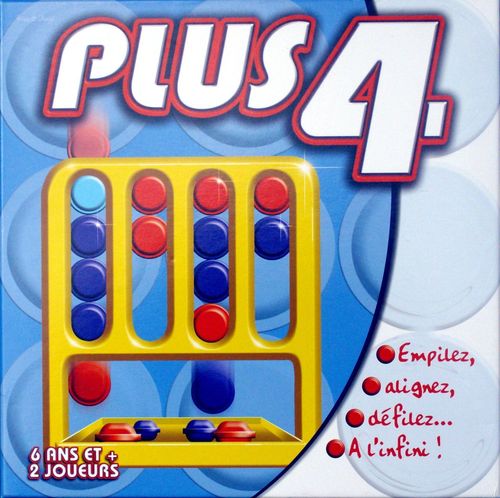
Plus 4
Plus 4 Rulebook
Table of Contents
Table of Contents
Goal
Line up 4 pieces of your own colour, horizontally, vertically or diagonally.
Setup
Place the grid in the centre of the table, open both flaps and raise the 4 fixing legs (figure 1).
Empty the grid of its pieces by turning the two knobs above the grid (figure 2).
Separate the pieces into 2 piles: on one side the red and light red pieces (the light red piece is the red bonus piece), on the other side the blue and light blue pieces (the light blue piece is the blue bonus piece).
How the Grid Works
On each turn, one piece is placed into one of the 4 notched columns of the grid. Instead of falling to the bottom, the piece, held by the notches, can only drop one level. The player places a piece in the grid by pressing it lightly until it clicks into place (figure 3). The piece locks into the top level, and any pieces already in that column all drop down one level (figure 4). When a column contains 4 pieces, adding one more ejects the bottom piece (figure 5). The ejected piece can be reused. In this way, the grid never gets blocked.
With this mechanism, a line-up can be broken at any moment.
Elementary Game Rules
Game Flow
Each player chooses a colour, setting the bonus pieces aside from the game.
The starting player is chosen by lot.
At the start, the grid, made of 4 columns each able to hold 4 pieces, is empty. The players sit face to face, on either side of the grid.
First Turn
Let us suppose the blues play first.
The first player places a blue piece in the grid. The piece locks into the top level (figure 3).
The second player does the same. If they choose to place their red piece in the same column as the blue piece already placed, the blue piece drops down one level. They may also choose another column.
Later Turns and Winning the Game
The grid fills up progressively on each turn, from the top down.
As soon as 4 pieces of the same colour are lined up, that player wins!
Endless-Grid Game Rules
Game Flow
Each player chooses a colour.
The starting player is chosen by lot. At the start, the grid, made of 4 columns each able to hold 4 pieces, is empty. The players sit face to face, on either side of the grid.
First Turn
Let us suppose the blues play first.
The first player places a blue piece in the grid. The piece locks into the top level (figure 3).
The second player does the same. If they choose to place their red piece in the same column as the blue piece already placed, the blue piece drops down one level. They may also choose another column.
Later Turns
The grid fills up progressively on each turn, from the top down.
When 4 pieces of the same colour are lined up, the player scores 1 or 2 points: if the winning line contains the bonus piece (figure 6), it is worth two points; otherwise it is worth only one point.
The game continues without emptying the grid.
Special Cases
If placing a piece creates several lines of 4 at the same time, each one is scored.
Once a line of 4 pieces has been made, it cannot be reused on the next turn to score 1 or 2 points again. For example, the red player has just completed a column of 4 red pieces and scores one point. On their next turn, if the red column is still intact, they could simply place a new red piece at the top of the column, which would eject the bottom piece and create a new column... This move is allowed, but it does not score a point.
Winning the Game
The points won are shown by moving the markers on the sides of the grid (figure 7).
The winner is the first player to reach the top of the marker (11 points).
Variant
Game Flow
Each player chooses a colour.
For the first round, the starting player is chosen by lot. For the following rounds, the loser starts.
At the start, the grid, made of 4 columns each able to hold 4 pieces, is empty. The players sit face to face, on either side of the grid.
First Turn
Let us suppose the blues play first.
The first player places a blue piece in the grid. The piece locks into the top level (figure 3).
The second player does the same. If they choose to place their red piece in the same column as the blue piece already placed, the blue piece drops down one level. They may also choose another column.
Later Turns
The grid fills up progressively on each turn, from the top down.
When 4 pieces of the same colour are lined up, the player scores 1 or 2 points: if the winning line contains the bonus piece (figure 6), and the bonus piece is not the last piece played, it is worth two points; otherwise it is worth only one point.
The round ends as soon as a line-up is obtained, and the pieces are removed from the grid (figure 2) to prepare the next round.
Winning the Game
The points won over the rounds are shown by moving the markers on the sides of the grid (figure 7).
The winner is the first player to reach the top of the marker (11 points).
Note: to shorten the game, the players may agree either to play to 5 points, or to play only 3 rounds.