Fortes fortuna iuvat: Plinius adversus Vesuvium
Fortes fortuna iuvat: Plinius adversus Vesuvium Rulebook
Table of Contents
Table of Contents
Introduction
Solitaire game. The player (as Pliny the Elder) tries to rescue the survivors of the Vesuvius eruption using ships of the fleet.
Objective
Transport as many people as possible to Misenum, or at least avoid their death.
Counters
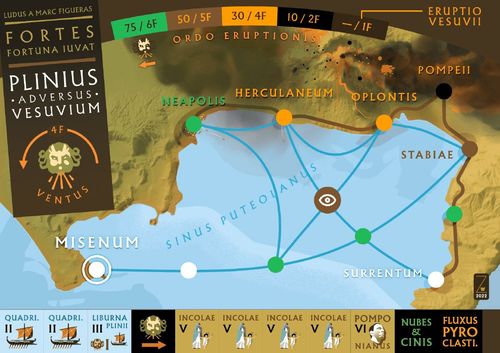
- Ships: 2 quadriremes and the liburna of Pliny.
- Inhabitants: 4 generic (incolae) and senator Pomponianus.
The figure in Roman numerals is the cost to move to an adjacent dot; the reverse shows the counter "stunned" (with higher movement cost).
- Ventus: the arrow indicates the direction of the wind and is placed on the "Ventus" image.
- Nubes (Smoke) and Fluxus (Pyroclastic flow) indicate the progress of the eruption and advance on the eruption track ("Ordo eruptionis", top).
The Board
It shows the bay of Naples. Ships move from dot to dot along the blue lines; inhabitants, along the brown ones. The dots are colored to match colors of boxes on the eruption track.
Set-Up
All ships in Misenum. Pomponianus in Stabiae, incolae in Neapolis, Herculaneum, Oplontis and Pompeii (one in each). The arrow on the Ventus counter should point towards the right. Nubes in the 1st box ("-/1F"); Fluxus off the board.
Shuffle a card deck (without aces, tens nor jokers) and remove 8 cards, without looking at them.
How to Play
The player reveals cards, one by one, from the pile. Black suit cards affect the progression of Flow and Smoke on the eruption track. Red suit cards allow the player to act.
Black Cards
- Face card (J, Q, K): place it next to the board. When the number of faces revealed equals the Flow value of a box on the track (#/#F), put the Fluxus counter in it and remove any inhabitants and ships on dots with the same color.
- Other cards: form a pile next to the board with cards as they are revealed. When the total value of the pile equals or exceeds the Smoke value of a box on the track (#/#F), place the Nubes counter in it and any inhabitants and ships on dots with the same color are flipped to their stunned side.
Example: when the value of the black cards adds up to 30 or more, the Smoke counter is placed on the "30/4F" box; Flow reaches it when 4 face cards have been revealed; its effects are applied to the orange dots on the board.
Smoke and Flow can only advance to the last box if the wind has turned 180º (see below).
Red Cards
- Face card (J, Q, K): place it next to the board. When the 4th red face card appears, turn the Ventus counter 180º, thus pointing to the left of the board.
- Other cards: The value of the card equals the number of Action points (AP) that the player can spend to move ships and/or inhabitants.
AP costs are equal to the movement cost of the counter. Any dot at sea can hold a maximum of two ships (with or without inhabitants on board). Any dot on land holds a maximum of one ship and two inhabitants (Misenum has no limit). APs cannot be saved and are either spent or lost with each card draw.
Boarding and un-boarding: If a ship and inhabitants are located on the same dot on land, inhabitants can board or un-board (one per ship) at the cost of 1 AP; a boarded counter moves with the ship.
Science! Once reached by Pliny, the dot with the observation symbol allows him to make observations of the eruption (only once during the game) for a cost of 6 AP.
Pliny's liburna and Pomponianus: If Pliny's liburna moves with the wind (any direction inside the 180º arc centered on the wind), it uses the lower movement cost. Pomponianus can only be picked up by Pliny.
Victory
The game ends when the deck is exhausted. Victory points (VP) are then counted as follows:
- Each normal/stunned inhabitant at Misenum = 3/2 VP
- Each normal/stunned inhabitant elsewhere = 2/1 VP
- Each ship on the map, stunned or not = 1 VP
- If Pliny has made observations = 4 VP
- Each dead counter = –2 VP.
With more than 13 VP, the player wins.