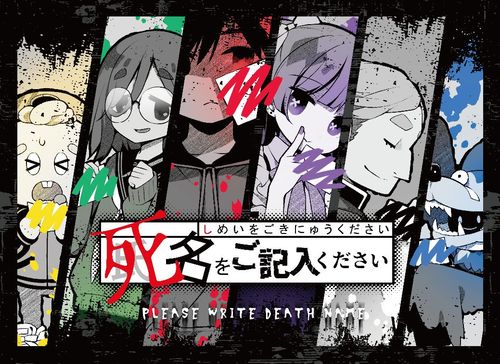
Please write DEATH name
Please write DEATH name Rulebook
Table of Contents
Table of Contents
Components
- Death name cards: 24 (6 colours × 4 each). Each player has 4 of one colour.
- Player boards: 6 (one per colour).
- Whiteboard markers: 6.
- Decree cards: 22 in total, which is 1 practice card plus 7 cards for each player count, sealed in envelopes by player count.
- DAY 1 cards: 4 per player count.
- DAY 2 cards: 3 per player count.
- The back of each normal decree card shows the number of human icons, so you can tell the player count from it.
- Practice decree card: marked "PRACTICE", not in any envelope, used on first play only.
- Rulebook: Quick-Start booklet and Detailed booklet.
Write-on surfaces: the death name cards and player boards have a whiteboard-marker surface on the front. Anything written on the back is permanent, so do not write on the back.
First-play preparation: before the first game, fold each death name card in half along the middle crease, forwards and backwards lightly, so it folds cleanly. Also take the practice decree card, marked "PRACTICE", out of the box before opening the envelopes.
Setup
- Each player chooses one colour from the six: red, purple, yellow, green, grey, or blue.
- Each player takes their 4 death name cards in their colour, 1 player board, and 1 marker, and places them in front of them.
- Prepare the envelope for your player count and return the others to the box. Envelope colours: 4 players = silver, 5 players = gold, 6 players = red-gold.
- Take the decree cards out of the envelope and place them in the centre of the table, with the side that has "命令" (DECREE) written large face up. Place the DAY 1 cards on top.
- Before opening the envelopes on first play, take out the practice decree card marked "PRACTICE" and use it to practise first.
Goal and Flow
Goal: the game is played over DAY 1 and DAY 2, for 7 rounds in total, and players compete for points.
- Each round, the decree card revealed at the start of the round sets a penalty condition. Your aim is to push a death name that matches that penalty condition onto the other players.
- Each round's points depend on two things:
- A. the order of the icons on the decree card;
- B. the order in which the death names chosen by each player fall when sorted in gojūon order (the Japanese syllabary order).
- A death name must be a Japanese surname, a hiragana name, or something that exists in the real world; write it in hiragana. (Detailed rules: see "Death Name Rules" below.)
Game flow:
- DAY 1 (4 rounds) → Mid-Game Scoring → DAY 2 (3 rounds) → Final Scoring → end of game.
DAY 1 flow:
- Writing: write a death name on your death name card and pass it to the neighbouring player.
- Exchange: choose "Keep" or "Pass".
- Scoring: apply the decree's icons to the points for this round.
Important: to avoid receiving a death name that meets the penalty condition, choose "Keep" or "Pass" during the exchange with that in mind.
DAY 2 flow:
- Selection: from the death name cards you wrote on DAY 1, select a name that does not meet the penalty condition.
- Scoring: apply the decree's icons to the points for this round.
Important: to avoid meeting the penalty condition yourself, choose from the death name cards in your hand.
Decree card icons (these are the icons used in the penalty condition and the scoring):
- Minus icon: a white-filled human figure with a red X. There are two kinds, -1 point and -2 points; a -2 icon is labelled "-2 points" under the icon.
- Plus icon: a blue-filled human figure. There are two kinds, +1 point and +2 points; a +2 icon is labelled "+2 points" under the icon.
- No-effect icon: an outline-only human figure. It has no effect; neither a penalty nor a bonus.
Penalty condition (from the detailed rules):
- Each player's death name is compared by its place in gojūon order: "what position is each player's death name in when all the names are sorted?"
- The decree card's icons are read against those positions to decide each player's points for the round (see Scoring, below).
- The rules for tied names are in "Other Detailed Rules" below.
DAY 1: Writing, Exchange, Scoring
DAY 1 repeats "5-1 Writing → 5-2 Exchange → 5-3 Scoring" four times, once per round.
5-1: Writing
- Reveal one decree card face up. Its penalty condition applies to this round.
- Each player writes any death name they like on their own death name card. Once every player has finished writing, move on to "5-2 Exchange."
- Write death names in hiragana. (Kanji and alphabet can have more than one reading.)
- The written death name card is passed to another player in the Exchange, so think about names that could meet the penalty condition.
5-2: Exchange
- Each player passes the death name card they wrote to the neighbouring player.
- Rounds 1 and 3: pass to the player on the left.
- Rounds 2 and 4: pass to the player on the right.
- The top of each death name card also shows which way it passes in each round, for reference.
- Each player looks secretly at the death name card they received, without showing other players.
- After checking the death name, choose one of the two options below, or decide secretly in your head:
- If you think it does not meet the penalty condition → choose "Keep."
- If you think it might meet the penalty condition → choose "Pass."
- Exchange declaration: all players declare their choice at the same time.
- Count together, "Ichi-nose" (いっせーのせ).
- To declare Keep, put your hand face down on the table.
- To declare Pass, raise your hand.
- Any method is fine as long as the declarations are simultaneous; players may use their own way.
End of the exchange: the exchange ends when only one player has declared "Pass," or when all players have chosen "Keep." Then move on to scoring.
5-3: Scoring
- All players reveal the death name cards they are holding at the end of the exchange. Following the penalty condition rules above, record each player's points on their player board.
- A player who receives a penalty marks the human icon on the right side of the death name card they were passed with a × mark.
- The death name card that has been judged stays with the player it was last passed to. Do not erase the death name written on it when judgement ends, because it is used again on DAY 2.
Same-name offense: if the same death name is written by more than one player in the same round, each player who wrote it receives a −1 point penalty. To avoid duplicates, avoid very common names. Scoring is handled differently when this happens; see "Other Detailed Rules" below.
Example 2: DAY 1 Writing → Exchange
- Reveal the top decree card face up. A player writes a death name that could meet the penalty condition on the card. In the example the player thinks: "A name like this might come out second…"
- Pass the death name card to the neighbouring player.
- The receiving player checks the name secretly. In the example, the player who received "Kato" thinks: "The 'Kato' I was passed is in front of 'Kimura', which I wrote; but someone may have written one even further forward. I'll choose 'Pass' and watch."
- All players declare at the same time (see 5-2, step 4). In the example, the player who chose "Pass" passes the card once more in the same direction, as in 5-2, step 5.
Example 3: Scoring
- All players reveal the death name cards they hold at the end of the exchange and sort them in gojūon order, to compare the positions.
- The decree card in this example reads: the 2nd from the front is −1 point; the 3rd from the front is +1 point; the 1st and 4th have no effect (0 points).
- In the example, the player holding the second name from the front receives −1 point, and marks a × on their death name card. The player holding the third name from the front, which is the second from the back, receives +1 point. The players at the first and fourth positions score 0.
- The players' points are recorded on their player boards.
Example 4: Mid-Game Scoring
See "Mid-Game Scoring" below.
Mid-Game Scoring: DAY 2 Preparation and Kill Point Bonus
After the four DAY 1 rounds, do the following before DAY 2 begins:
- Return the death name cards exchanged in rounds 1 to 4 to the player who wrote the name on each card. In other words, sort the death name cards by colour and give each colour back to the player of that colour.
- Each player counts the × marks on the human icons of the death name cards returned to them. For each × mark, the player gains +1 point. Add up these points and write the total in the box at the top right of the player board marked "kill point."
Why do points get awarded? "Someone was penalised" means "someone wrote a death name that met a penalty condition," so the game host awards points as praise.
Example 4 (in the source): the purple player collects the death name cards written by the purple player. A death name card with two × marks gives +2 points.
DAY 2: Selection and Scoring
DAY 2 repeats "7-1 Selection → 7-2 Scoring" three times, once per round. There is no exchange on DAY 2.
7-1: Selection
- Reveal one decree card face up. Its penalty condition applies to this round. The back of DAY 2 decree cards is black, and the top "DAY.2" label is in white.
- Each player chooses one of the death name cards they wrote on DAY 1 (the 4 cards returned in the Mid-Game Scoring) and reveals it at the same time.
- On DAY 2, the chosen death name is simply the player's own score for this round; there is no exchange. So choose a name that does not meet the penalty condition.
7-2: Scoring
- Score as on DAY 1, following the penalty condition rules above, and record each player's points on their player board.
- Turn the death name card used this round face down and set it aside; it is not used again.
Note: the × marking used on DAY 1 is not done on DAY 2. A player who is penalised on DAY 2 receives no reward or other benefit for it.
Final Scoring (End of Game)
- Add the DAY 1 and DAY 2 points. The player with the highest total wins.
- If two or more players are tied, the player with the higher kill point total wins.
- If the kill point totals are also tied, all tied players share the victory.
Death Name Rules
What to write: a death name can be anything, as long as the players share a common vocabulary or theme. The following are suggested as a starting point:
- Japanese surnames. (Given names are also allowed, but choosing either surnames or given names keeps the choices from being too hard.)
- Real names that exist (fictional characters are allowed).
- Do not make them too long.
Variations from the second game onward (recommended): once the rules are understood, change the theme or add restrictions as you like.
- Theme examples: board game titles; J-POP song titles; titles of your favourite works (manga, films, anime, and so on).
- Restriction examples: "no names of four characters"; "only works from the year ___ onward." Restrictions that are too tight may make the game less fun, so set them at your own discretion.
Gojūon sorting rules
The order in which the death names are sorted follows these rules:
- Ordinary characters, then voiced, then semi-voiced. A plain kana sorts before its voiced form (dakuten, ゛), and the voiced form sorts before its semi-voiced form (handakuten, ゜). Example: "kato" (かとう) sorts before "gato" (がとう).
- Small characters are treated as large characters. Small kana (っ, ゃ, ゅ, ょ) are treated as their full-size forms. Example: "ikkaku" (いっかく) is treated as "itsukaku" (いつかく). Example order: "ichikawa" (いちかわ) → "ikkaku" (いっかく) → "itou" (いとう).
- The long vowel mark (ー) repeats the previous sound. Example: "gēmu" (ゲーム) is treated as "geemu" (げえむ). This is rarely needed for Japanese names, but it is needed when playing with other themes.
Other Detailed Rules
Same death name in the same round (same-name offense)
Players who write the same death name in the same round form a block that cannot be put in an order. Because of this, the normal scoring cannot be done, and the following rules apply:
- Players with the same death name have no order between them. They are treated as one block, and each duplicate counts as one place in the order.
- If a plus or minus condition applies, apply all of its effects.
- Add the same-name penalty of −1 point to each duplicate player's total, and record the combined result on the player board.
Example 5: scoring when a same-name offense occurs
- Two players have the same name, and only the minus icon applies: both players receive −1 point. With the −1 same-name penalty, the yellow and blue players each score −2 points in total.
- Two players have the same name, and only the plus icon applies: both players receive +1 point. The plus cancels the same-name penalty, so the purple and green players each score 0 points.
- Three players have the same name, and several icons apply: all three players receive −2 points. With the −1 same-name penalty, the yellow, blue and purple players each score −3 points in total.
Avoiding same names: same names are penalised, so avoid very common names when you write.
Putting the game away
- Before putting the game away, always erase the writing on the death name cards and player boards.
- The whiteboard marker surface is treated to erase, but if writing is left on for a long time it can become hard to remove. If it becomes hard to erase, wipe carefully with a tissue dampened with water.
Q&A
Explanations of situations that are hard to follow. Refer here when the rules are unclear.
Q1: The rules mention a "death name card" written on the back of a death name card. Does this mean the death name card itself? A1: Yes. "Death name card" (死名カード) is a misprint for "death name card" (死名札). Likewise, "judgement" (判定) in the text means "scoring" (点数判定); the two mean the same thing.
Q2: In "5-1 Writing," can any death name be written? For example, "aaaa"? A2: No. Avoid names that are not realistic.
Q3: How many times can "5-2 Exchange" be repeated? A3: The rules set no limit. If it goes on too long, the players should agree on a limit, for example "three times."
Q4: On DAY 1, a player's exchange ended with their own death name card in their own hand. Is that a problem? A4: No. Depending on the Keep and Pass choices, this can happen. Score normally.
Q5: On DAY 1, a player's own death name came back to them and received a penalty. Can they still gain kill points? A5: Yes. Kill points are judged only on whether the name the player wrote meets the penalty condition.
Q6: Which expressions count as a same-name offense? For example, do "e" (え) and "we" (ゑ), or "i" (い) and "wi" (ゐ), count as the same character? A6: Different characters are treated as different death names. The rules do not decide this strictly; players should agree among themselves and adjust the rule as they like while playing.
The Q&A is current only up to this point. More questions will be added on the official website.
Quick-Start Guide (Simplified Rules)
This booklet is for players who want to start playing without the detailed rules. The Detailed rules above are the full rules. The quick start shows the same flow in brief.
- Setup: each player takes 4 death name cards, 1 player board and 1 marker in their chosen colour. Place the decree cards face up in the centre, with DAY 1 on top. Put the 5-player and 6-player envelopes back in the box. (The practice decree card can be used before the first game.)
- Goal and flow: the game is 7 rounds in total, split into DAY 1 (4 rounds) and DAY 2 (3 rounds). The goal is to push the death name that matches each round's penalty condition onto other players. Each round's points depend on the icons on the decree card and on the gojūon order of the death names.
- DAY 1: repeat "3-1 Writing → 3-2 Exchange → 3-3 Scoring" four times.
- 3-1 Writing: write a death name on your death name card (in hiragana).
- 3-2 Exchange: pass the death name card to the neighbour (left in rounds 1 and 3, right in rounds 2 and 4). Look at it secretly, then declare "Keep" (hand face down) or "Pass" (hand raised) at the same time. Those who said "Pass" pass once more in the same direction, and the exchange repeats until only one player has declared "Pass" or all players have chosen "Keep."
- 3-3 Scoring: reveal the death name cards and apply the icons on the decree card. A player who receives a penalty marks the human icon on the right side of the card with a × mark.
- Mid-game scoring: return the death name cards to the players who wrote them. For each × mark, gain +1 point and record the total as "kill point."
- DAY 2: repeat "5-1 Selection → 5-2 Scoring" three times. Each player selects one of their DAY 1 death name cards, and all reveal at the same time. Score as on DAY 1, but there is no exchange and no × marking. Afterwards, set the used card aside face down.
- Final scoring: add the DAY 1 and DAY 2 points. The highest total wins; ties are broken by kill point, and players still tied share the victory.
Same-name offense (quick start): if the same death name is written more than once in a round, each player who wrote it receives −1 point. Scoring for these names follows "Other Detailed Rules" above.
Putting away: erase all writing before putting the game away.