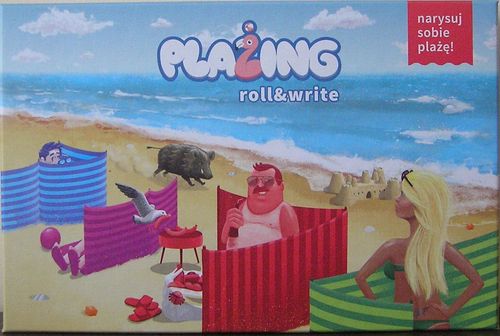
Plażing: roll&write
Plażing: roll&write Rulebook
Table of Contents
Table of Contents
Rules Summary
Overview
Your goal is to surround the resources on the beach (shells, pebbles and amber pieces) with drawn shapes: beach screens (parawany), blankets (kocyki) and beach odds and ends (graty).
Callouts on the sheet's overview diagram read: (2) with screens, blankets and odds and ends you form areas to collect the enclosed resources; (1) the die result decides which screen shape or blanket you may use; (3) play 10 rounds; (4) using a special action, once per round, you may draw 1 screen or 2 odds and ends; (5) scoring covers enclosed resources, sets of resources, enclosed areas and unused special actions.
Setup
Each player receives their own beach board. Place the coloured pencils and the die within reach of all players.
At the start of the game, each player rolls the die individually. Then, depending on the result, each player draws on their board the screen shape that the number of pips points to (a screen may be rotated freely), and crosses off its shape on the right side of the board ("Akcje specjalne" / Special Actions).
If the die shows 6 pips (the blanket), roll again until a screen comes up.
Playing the Game
Once every player has drawn their first screen, the game continues for 10 rounds.
Each round begins with a die roll. One person may roll for everyone, or you may take turns rolling. After the roll, mark the passage of the round on the round track at the top of the board by crossing off the next box. Each player does this on their own board.
Note (1): From the first round on, the die result is shared by all players (unlike setup, where each player rolled individually). Each player draws the same shape on their own board.
Note (4): Five screen shapes and the blanket are available, shown at the bottom of the board. Each corresponds to a number of pips on the die. The die result determines what every player draws on their board.
Note (!): Each screen may be rotated freely.
Special Action
Once per round you may, as a special action, additionally draw:
- one of the screens, or
- 2 odds and ends (you cannot draw just 1 odd and end).
The chosen screen or pair of odds and ends is crossed off, since these shapes are single-use. Over the 10 rounds you may use 4 screens (one of them was already used during setup, drawn individually on your board) and 3 sets of two odds and ends. In total you may take a special action at most 7 times during the game.
Remember: cross off only the shapes used as part of a special action. Shapes shared by all players (those resulting from the die roll) are reusable and may repeat.
Drawing
Draw screens, blankets and odds and ends by enclosing the resources shown on the board: amber pieces, pebbles and shells. Enclosing them (the shapes must touch at least at corners) closes an area. Enclosed areas belong to you and will score at the end of the game, provided you follow the drawing rules, which are:
- Your shapes must connect. Each new shape you draw must touch a shape you have already drawn, either along an edge of any length or at a corner.
- Closing an area to collect resources means enclosing at most 6 squares.
- Closing an area to score means enclosing at most 4 squares. An area may be empty (it does not have to contain resources).
When counting points for resources collected, areas larger than 6 squares are not taken into account. Only areas of 4 squares or fewer score as areas.
Shapes may also be drawn over the resource illustrations. This makes closing areas easier, but resources covered in this way do not score.
Scoring
At the end of the game, add up the points for your resources, your areas and your unused special-action shapes.
Resources
At the end of the game, count the points for enclosed resources. Only resources from areas of at most 6 squares score.
Harder variant (once you are familiar with the game): reduce the area needed to collect resources to 4 squares. Then both the area for collecting resources and the scoring area may be at most 4 squares.
Next to the drawing of each resource, write how many of it you collected, and after the equals sign write the corresponding number of points.
Resources of one kind score according to this table (number collected: points):
| Number collected | 1 | 2 | 3 | 4 | 5 | 6 | 7 | 8 | 9 | 10 | 11 | 12 | 13 | 14 |
|---|---|---|---|---|---|---|---|---|---|---|---|---|---|---|
| Points | 1 | 3 | 6 | 10 | 15 | 21 | 28 | 36 | 45 | 55 | 66 | 78 | 91 | 105 |
In addition, for each set of one amber piece, one pebble and one shell, the player receives 5 points.
Areas
Count how many areas you have and their size. Only areas of at most 4 squares score, whether or not they contain any resources (empty areas count).
Points for areas are calculated by multiplying the size of an area (its number of squares) by the number of areas of that size. Write how many areas of each size you have, and after the equals sign write the corresponding number of points.
Special Actions
For each screen from special actions that you did not use, you get 2 points. For each odd and end from special actions that you did not use, you get 1 point.
Example of Scoring
Kasia collected 4 shells, 5 amber pieces and 3 pebbles. That gives her 10 + 15 + 6 = 31 points for resources. She also has 3 sets, i.e. 3 x 5 = 15 points. She enclosed 3 areas of size 1 square for 3 points (1 x 3), 2 areas of size 2 squares for 4 points (2 x 2), and 3 areas of size 4 squares for 12 points (4 x 3). She used all her special actions, so she gets no points for unused shapes. In total she scored 31 + 15 + 19 = 65 points.
Boards
The sheet describes four beach boards (plansze plaży). The sheet recommends starting with Board 1.
Board 1: The basic board, with which we recommend starting. No edge of the board closes an area, which means that to enclose an area you must draw a screen, a blanket or odds and ends there.
Board 2: Apparently easier than the previous board, but not quite! At the top are the sea and the pier, which close an area: you do not need to draw fences along them to enclose an area and score points for it or for its resources. There are also blankets on the beach, which you may use to close areas. Where is the catch? Remember that even when you use board elements to close areas, your own shapes (screens, blankets and odds and ends) must touch one another at least at a corner. Another player's blanket cannot serve as a link.
Board 3: This board introduces an additional way of scoring: spaces by the bar. It is enough to cover them: draw any of your shapes on them, or enclose them (that is, when they fall within an area you have enclosed). At the end of the game, remember to add the points you earned this way. The bar and the boardwalk at the top of the board close an area, in the same way as on Board 2. The basic rule remains unchanged: a player's shapes must touch one another.
Board 4: This board is made more varied, or rather more difficult, by the waste! You cannot draw shapes on waste, and it may not lie inside an enclosed area: you receive no points for such an area or for its resources. Simply avoid the waste! Remember that you may create empty areas; they also score at the end, provided they are no larger than 4 squares.