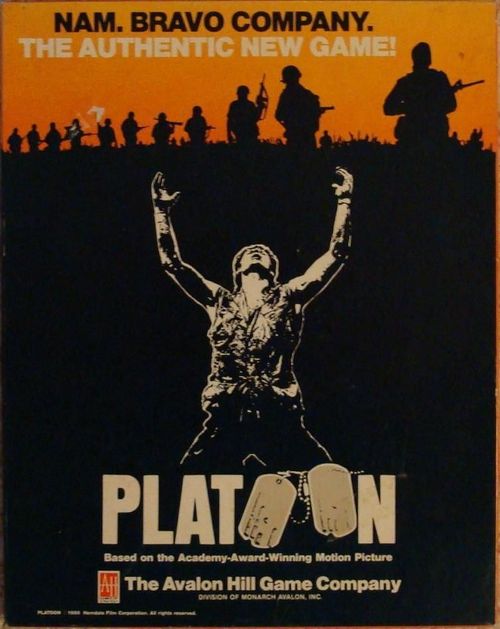
Platoon
Platoon Rulebook
Table of Contents
Table of Contents
(1) Game Equipment
a) Board. The game board represents typical Vietnamese terrain, as identified on its TERRAIN CHART. A hexagonal grid regulates movement and location. Each individual hexagon, identified by its own letter and number code, is called a "hex". The terrain of a hex is determined by the terrain type that covers most of the hex. The two halves of the board must be joined so that the hexes line up, as follows:
b) Game pieces. The square cardboard sheets must be carefully punched out to obtain the game pieces:
-
Units. The following pieces are called "units" and are set upright using the plastic bases when they are used on the board.
- Soldiers. Each of these pieces represents one soldier and his weapons. In the rules they are called "soldiers". The soldier pieces in olive green are American (they have proper names), and those in light brown are North Vietnamese. The numbers and symbols printed on the soldier pieces give the information needed for the game, as identified in the example.
- A soldier with a leader symbol is called a "leader", and a soldier with a radio symbol is also called a "radio".
- Fake soldiers. Pieces with the words "Fake soldiers" are "decoys" and are used to confuse the opponent.
- Substitutes. Pieces with letters, in the same colours as the soldiers, are called "substitutes" and are used to represent several soldiers and/or decoys in the same hex. When more than one soldier and/or decoy is together in a hex, they are called a "group".
- Weapons. These pieces represent weapons alone.
- CLAYMORE: "fire modifier" field.
- BOOBY TRAP: "fire modifier" field.
- Each weapon piece shows "movement factor (has none)" and a "radio of fire" field.
- Soldiers. Each of these pieces represents one soldier and his weapons. In the rules they are called "soldiers". The soldier pieces in olive green are American (they have proper names), and those in light brown are North Vietnamese. The numbers and symbols printed on the soldier pieces give the information needed for the game, as identified in the example.
-
Chips. These pieces are not placed in the plastic bases. They are kept off the board and are used to determine the order in which actions take place. They come in American and North Vietnamese colours.
c) Plastic bases. These are used to keep the units upright.
d) Rules. The sheets contain the rules of the game.
e) Dice. There are two ten-sided dice, numbered from 1 to 0 (the 0 is always counted as 10).
f) Replacement cards (Cartas de Sustitución). Each player has one of two identical sheets to record the turns and to keep the units.
(f) Battle Manual. This booklet contains examples of play to clarify the rules, and other material of interest.
(2) Setting Up the Game
a) The players agree on which side each one will command, and which scenario they will play. Scenario Three is the most recommended for the first games.
b) The board is placed on a table between the players, who should sit on opposite sides, with a replacement sheet at their side. The pieces each side needs, and where they must be placed on the map, depend on the information for the specific scenario. The necessary pieces are selected and placed near the board.
c) Place any unused chips in each of the "1" boxes of the TURN RECORD (REGISTRO DE TURNOS) on the Replacement Cards.
(3) General Rules of the Game
The game begins when the complete setup is finished. The game is played in "Turns", which work as follows:
a) Shuffle the chips. One of the players puts all the chips to be used into any suitable concave container (cup, mug, hat, etc.) and mixes them thoroughly.
b) Draw chips / carry out actions. One of the players draws a chip at random. The player of the side indicated by the chip may carry out "actions" for all of its units located in ONE hex of any choice.
- The player who controls the side may choose which soldier, decoy or group he will use. If he wishes, the same unit may be used repeatedly to carry out actions as chips are drawn during the same Turn. After it has been used, the chip is set to one side.
- Then another chip is drawn, and any soldier, decoy or group of that side is used to carry out actions, and so on, until ALL the chips have been drawn and the resulting actions have been carried out.
c) End of the turn. At the end of a turn, all "pinned down" markers are removed from the board. Then both players must advance the chips on the Turn Records of their Replacement Cards to record the number of the next Turn. A game ends when the turns indicated for the scenario are completed.
(4) Actions
When a chip is drawn, a soldier or decoy used to carry out the "actions" may be used, at the choice of the player who controls it, to do ONE of the following:
a) Move. A soldier or decoy may move a number of hexes equal to or less than its movement factor. For soldiers in a group or alone, this movement may include close-range combat (melee). Alternatively, a soldier may be used to "cut" wire as its movement.
b) Fire. A soldier does not move in any way, but may be used to "fire" at a hex that contains a unit of the other side.
c) Pinned down / do nothing. Any soldier or decoy marked at that moment with a "pinned down" marker may not be used to carry out any action. "Pinned down" markers have no effect on claymore or booby trap markers. Also, if desired, the player whose unit could carry out an action may choose to do nothing (pass).
d) Group and leader actions. The soldiers and/or decoys that form part of a group may ALL be used to carry out DIFFERENT actions if at least one of those that start in the hex is a leader not marked "pinned down". Individual units of a group with a leader may be used to carry out the same or different actions, and may be used one at a time, IN ANY DESIRED ORDER.
Exception: Two or more units may move (but not fire) together at the same time, if desired. If the group contains a leader, only one unit of the group may be used to carry out actions.
e) Fake soldiers. Decoys do not really exist, and these pieces are there to confuse the enemy. They may move in any way desired, similar to soldier pieces. Decoys can never be used to fire, to cut wire, or to move into hexes that contain an enemy unit.
f) Eliminated units / units that have left the board. Whenever possible, eliminated units or those that have left the board should be placed out of sight when they are removed from the board. They are kept aside so that they can be counted at the end of the game. The opponent should not be allowed to examine eliminated or departed units until the end of the game.
(5) How Units Move
Dice are NOT used for movement (they are used for combat, in fire or melee). Only soldiers, decoys, or the substitute units that represent them may be moved. Claymore or booby trap markers, and wire, bunker or trench markers, can never be moved. Players may move their other units as they wish, subject to the following restrictions:
a) Movement directions. A soldier or fake soldier may move from hex to hex in any direction or combination of directions allowed by the hex grid. Hexes may not be skipped.
b) Movement distances. The number of hexes that a unit may move during an action depends on the movement factor printed on the unit. A unit may move a number of hexes less than or equal to its movement factor, but it may never move in excess of its movement factor.
Exceptions:
- Paths (senderos). Any soldier that moves ENTIRELY through CONNECTED path hexes has an additional movement factor.
- Streams (riachuelos). Entering a stream hex costs an additional movement factor.
c) Moving through soldiers / melee. Units may move within or through hexes that contain soldiers and/or decoys of their own side, but they may not move within or through hexes that contain claymore or booby trap pieces of their own side, or through wire markers. When a unit enters a hex that contains a unit of the other side, the movement MUST stop in that hex, and an IMMEDIATE melee (hand-to-hand combat) must be resolved as follows:
- If the hex contains a claymore or booby trap marker, its "fire" is immediately resolved using the normal fire rules (see rules 6e and 6f).
- If the hex entered contains any fake soldiers, these are automatically eliminated and removed from the board.
- So when one side moves a soldier or group into a hex that contains one or more soldiers of the other side, a melee is resolved, with both players rolling one die. Each side's die roll is modified by adding "2" to the result for each soldier of that side present in the hex. This "+2" per soldier does NOT apply to soldiers who are pinned down. The two modified rolls are compared. If the modified number of one side exceeds the modified number of the other side by "5" or more, that side wins the melee and ALL soldiers of the other side in the hex are eliminated. In any other case, all the soldiers that have just entered the hex move back into the adjacent hex they occupied before entering the melee hex.
d) Moving through wire / cutting. Units may not move within or through a hex that contains a wire marker. A soldier may use an action to "cut" wire in an adjacent hex, which is all the soldier may do with that action. An adjacent wire marker is removed from the board when it is "cut".
e) Leaving the board. Units that move off the board (beyond the black border) have "left" the board and may not return to it, although they are not considered eliminated. Units may only leave the board where it is determined in each scenario (see rule 7).
(7) How to Fire
For a soldier to "fire" his weapon, the player who controls it announces that a soldier is firing at a specific target. The exact unit used does not have to be revealed to the opponent IF a grenade is thrown (this is called artillery support) or a claymore is fired. For all other shots, the piece that fires must be turned to reveal the soldier's information to the opposing player. After the fire is resolved, the soldier should be turned back so that its unprinted face is shown to the opponent.
a) General fire procedure. This procedure is followed whenever ANY of the types of fire treated below takes place:
-
The player who fires determines the "radius" by counting the number of hexes from the hex of the firing soldier to the target hex by the shortest possible route. The "radius" never includes the hex of the firing unit, but it DOES include the hex of the target unit. Fire may be directed in any direction or combination of directions following a route of hexes. If the radius exceeds the fire radius printed on the piece, [or] the route passes through a hex blocked by ANY "unit" (markers do not block fire from EITHER side), [or] the route passes through more than three jungle hexes, it is not possible to fire between the two hexes in question. [Editor's note: the Spanish sentence, as printed on the scan, does not make the logical connection between these conditions clear; they are rendered here as listed, joined by "or".]
-
If firing is possible, the player of the firing soldier rolls a die and adds the fire modifier of the soldier or weapon that fires (printed on the piece or set out below) to the result. At the same time, the player of the target soldier rolls a die and adds the target modifier of the target hex (if there is one) to the result. If the hex contains a bunker or trench marker, its target modifier ALSO is added to the result. Modifiers are always cumulative.
-
The two modified numbers are then compared:
- MISS: if the modified number of the target is equal to or greater than the modified number of the firing unit, the shot has missed and has no effect.
- PINNED DOWN: if the modified number of the firing unit exceeds the modified number of the target by 1 to 4, a "pinned down" marker is placed with the target unit.
- ELIMINATED: if the modified number of the firing unit exceeds the modified number of the target by 5 or more, the target unit is eliminated and removed from the board and the game. Exception: if the target unit is a claymore or booby trap piece, it is turned toward the firing player and the unit is NOT eliminated.
b) Firing at groups. If the target is a hex containing a group, the player who controls it must reveal the number of units present by revealing their letters to the other player. The die rolls and modified comparisons are made INDIVIDUALLY against EACH unit in the target hex, with individual results.
c) Hand grenades. ANY soldier, instead of being used to fire a weapon, may alternatively be used to "throw" a hand grenade into any adjacent hex. The fire modifier of a hand grenade is "+4".
d) Calling artillery support. Any LEADER in a hex with a RADIO, instead of being used to fire his own weapons, may be used to call "artillery support" (this represents that the leader uses the radio to call for artillery support (artillery, mortars, gunboats, air missions, etc., located off the map), using BOTH soldiers to carry out the same action.
- Artillery support may be used on any hex of the board, to ANY radio whose shortest route from the leader and the radio does not pass through more than three jungle hexes or is not blocked by other units.
- The combat modifier of artillery support is "+7".
- If artillery support is used in a hex that contains a wire marker, or a claymore or booby trap piece, these are AUTOMATICALLY eliminated from the hex.
- The use of artillery support may be risky. BEFORE the comparison of the dice modified by artillery support in the hex is resolved, both sides roll a die. The die roll of the firing side is modified by the fire modifier of the leader, and the target's roll is not modified. If the target's roll EXCEEDS the modified roll of the firing side, the artillery fire falls "short", and the player on whom it was aimed may IMMEDIATELY move the target hex to ANY hex within a radius of THREE hexes of the original target hex (this radius may pass through any number of jungle hexes and/or other pieces). The fire is then resolved against the soldiers of that hex. In any other case, the fire is resolved in the original target hex.
e) Firing claymores. An American soldier within three hexes of a claymore piece, instead of being used to fire individually, may be used to detonate it. A claymore unit ALSO fires automatically when an enemy unit enters its hex. Once it has fired, the claymore marker is removed from the board. The fire modifier of a claymore unit is "+5". This applies to ALL units in the six hexes of its "impact zone". Unlike all other fire in the game, which is directed at a single hex, a fired claymore is used against soldiers (of either side) in ALL the hexes of its "impact zone", INCLUDING hexes blocked by other units.
The impact zone of a claymore marker is as follows. The direction of fire is ALWAYS chosen by the American player at the moment of firing. [The diagram on the scan shows the shaded impact area; its figure is not reproduced here. Its legend reads: "All hexes on the board that match the shaded area in this diagram are in the impact zone of the claymore."]
f) Firing booby traps. Booby trap pieces fire automatically when an American unit enters the booby trap hex. This is the only way they can be fired. Once fired, a booby trap unit is removed from the map. The combat modifier in a hex with a booby trap marker is "+8".
g) Multiple pinning. Pinned-down results for a unit that is already marked with a "pinned down" marker are ignored.
(7) The Scenarios
Each scenario is a separate game, with its own setup, special rules that apply only in that scenario, and rules on how to win.
a) General setup information for the scenarios:
- Carefully place the "units" (soldiers, decoys, substitutes, claymores and booby traps) needed in the plastic bases so that they can stay upright, as shown in the example. Note that in some cases there are two different American soldier pieces with the same name. These two pieces show different armament used in different combats, and they are told apart by marking in parentheses the weapon that must be used in each specific scenario. North Vietnamese soldier pieces with the same weapons but different values are told apart by noting in parentheses the fire modifier and the movement factor required.
- The players place their pieces on the board in the order given, and follow the instructions found in each scenario. The pieces may be placed as the players wish in ANY of the hexes designated in the individual scenario.
- Any number of soldiers and/or decoys may be placed together in one hex. Soldiers may not be placed in hexes with claymore, booby trap or wire markers. The substitute pieces marked with letters are used whenever two or more soldiers are together in the same hex. The soldiers located in the same hex are placed in the Replacement Card box of the player corresponding to the letter, and the corresponding substitute piece is placed in the hex as the substitute that represents all the soldiers. Since each side has only eight substitute pieces, one side cannot have more than eight hexes that contain more than one soldier at the same time.
- All "units" with plastic bases (soldiers, decoys, booby traps, claymores and substitutes) must be placed with the unprinted face toward the opposing player.
- Bunker, trench and wire markers must be placed face up in their respective hexes, since their position is always known to both sides. There may be no more than one of them per hex. Other pieces may be placed in hexes with trench or bunker markers, but not with wire markers.
The comments preceding the following scenarios briefly cover the events of the film PLATOON that lead to the actions (see the Campaign Manual). To play, one of the following scenarios (battles) is chosen:
b) First Scenario: "Ambush at Night" (Emboscada nocturna)
This combat lasts 4 Turns. 10 North American chips and 8 North Vietnamese chips are used per Turn.
- North Vietnamese deployment. The North Vietnamese player deploys first, placing pieces as he wishes in any hexes numbered "1-4". He has no artillery support. The North Vietnamese player has 2 decoys and the following 20 North Vietnamese soldiers, with the values in parentheses given as (fire modifier, movement factor):
- 2 leaders, AK47 (2,3)
- 2 RPG
- 2 RPD
- 1 SKS (1,3)
- 1 AK47 (2,2)
- 1 AK47 (3,3)
- 11 AK47 (2,3)
- American deployment. The American player deploys when the North Vietnamese player has finished, placing pieces as he wishes in any hexes numbered "8-11". No artillery support is available. The Americans have 5 trench markers, 2 claymore markers, 4 decoys, and the following 16 American soldiers: Barnes, Bunny, Doc, Elias, Gardner, Big Harold, Hoyt, Junior, King Pin (with M16), Manny, O'Neill, Rhah, Sal, Sanderson, Taylor and Tex.
- Special rules. The FIRST American attempt to fire needs a die roll to succeed: a "1" to "4" if it attempts to fire at a "new name" (Gardner or Taylor), and a "1" to "6" if it attempts to fire first at any other soldier. Unless one of the required numbers comes up, NONE of the Americans in the hex used for the action may do anything with this chip. If the first American attempt to fire fails, the North Vietnamese side immediately obtains a free "action", without needing to draw a chip.
- How to win. The North Vietnamese side obtains one point for each North Vietnamese soldier that leaves the board through hexes G11, H11 and/or U11, and one point for each American soldier eliminated. The North Vietnamese side wins if it obtains 8 or more points, or if the number of American soldiers eliminated exceeds the number of North Vietnamese soldiers eliminated. In any other case, the American side wins.
c) Second Scenario: "Return to the Black Virgin" (Regreso a la Virgen Negra)
This combat lasts 5 Turns. 8 American chips and 8 North Vietnamese chips are used per Turn.
- American deployment. The American player deploys first, placing pieces as he wishes in any hexes with the letters "N" to "R", with no more than four units starting in the same hex. The Americans have artillery support. The Americans have 1 decoy and the following 26 American soldiers: Ace, Adams, Barnes, Bunny, Crawford, Doc, Ebenhoch, Elias, Flash, Francis (with M16), Fu Sheng, Gator, Big Harold, Hoyt, Huffmeister, Junior, King Pin (with M16), Morehouse, O'Neill, Parker, Rhah, Rodriguez, Taylor, Tubbs, Warren and Wolfe.
- North Vietnamese deployment. The North Vietnamese player deploys when the American player has finished, placing pieces as he wishes in any hexes with the letters "G" to "L". No artillery support is available. The North Vietnamese player has 3 bunker markers, 4 trench markers, 3 booby trap markers, 4 decoys, and the following 30 North Vietnamese soldiers, with values as given in parentheses (fire modifier, movement factor):
- 1 leader TT33
- 1 leader AK47 (3,3)
- 2 leaders AK47 (2,3)
- 3 RPG
- 3 RPD
- 1 SKS (1,2)
- 4 SKS (1,3)
- 1 AK47 (1,2)
- 1 AK47 (1,3)
- 1 AK47 (2,2)
- 1 AK47 (3,3)
- 11 AK47 (2,3)
- Special rules. The North Vietnamese player may carry out one "free" action at the start of this combat, without needing to draw a chip. American soldiers who are eliminated should be removed from their plastic bases and placed face up in their hex. These eliminated soldiers are no longer considered units and have no effect on movement, melee or fire. An unwounded American soldier that enters or passes through a hex that contains an eliminated American soldier may "carry" that eliminated soldier by moving the eliminated piece together with the unwounded one. To "evacuate" an eliminated soldier, the eliminated piece must be "carried" out by any hex with the letter "U".
d) Third Scenario: "Protecting the Flank" (Protegiendo el flanco)
This combat is recommended for those who are starting to play this game, and lasts 3 Turns. 5 American chips and 4 North Vietnamese chips are used per Turn.
- North Vietnamese deployment. The North Vietnamese player deploys first, placing pieces as he wishes in any hexes numbered "4" to "6", and also with the letters "M" to "U". No artillery support is available. The North Vietnamese player has 2 decoys and the following 10 North Vietnamese soldiers: 1 leader AK47 (2,3), 1 RPD, 1 RPG, 1 AK47 (2,2), and 6 AK47 (2,3).
- American deployment. The American player deploys after the North Vietnamese player has finished, placing pieces as he wishes in any area numbered "3" to "11", and also with the letters "P" to "U". No artillery support is available. The Americans have 4 decoys and 4 American soldiers: Crawford, Elias, Rhah and Taylor.
- Special rules. The American side has one "free" action at the start of this combat, without needing to draw a chip.
- How to win. The North Vietnamese side obtains one point for each American soldier eliminated, and one point for each North Vietnamese soldier that leaves the board from hexes S11, T10 and/or U11. The North Vietnamese side wins if it obtains 6 or more points, if the number of American soldiers eliminated exceeds the number of North Vietnamese soldiers eliminated, or if all the American soldiers are eliminated. In any other case, the American side wins.
e) Fourth Scenario: "Down in the Valley" (Abajo en el valle)
This combat lasts 4 Turns. 8 American chips and 8 North Vietnamese chips are used per Turn.
- American deployment. The American player deploys first, placing wire markers in any hexes with the letters "P" or "Q", and all other pieces in any hexes with the letters "P" to "U". The Americans have artillery support. The Americans have 5 bunker markers, 2 trench markers, 3 wire markers, 4 claymore markers, 3 decoys and the following 15 American soldiers: Adams, Barnes, Bunny, Doc, Ebenhoch, Francis (with M60), Hoyt, Huffmeister, Junior, O'Neill, Parker, Rhah, Rodriguez, Taylor and Wolfe.
- North Vietnamese deployment. The North Vietnamese player deploys when the American player has finished, placing pieces as he wishes in any hexes with the letters "A" to "M". Artillery support is available to the North Vietnamese player. He has 4 decoys and all of the North Vietnamese soldiers, listed on the scan as "38" [the number is printed as "38"; the second digit is hard to read on the scan and should be checked against the original].
- Special rules. At the start of EACH turn, while the American soldier unit "Barnes" is not eliminated, and before any chip is drawn, the American player rolls a die. If the result is "1" to "5", the unit "Barnes" is no longer considered a leader and may no longer be used to fire (it may only be used in melee).
- How to win. The North Vietnamese side obtains one point for each American soldier eliminated; one point for each [one word illegible on the scan] hex with a bunker marker that contains a North Vietnamese soldier at the end of the game; and one point for each North Vietnamese soldier that leaves the board through any hex with the letter "U". The North Vietnamese side wins if it obtains 12 or more points, or if the number of American soldiers eliminated exceeds the number of North Vietnamese soldiers eliminated. In any other case, the American side wins.
[End of the scanned rules. The Spanish document ends after the fourth scenario; no further scenarios, a fifth scenario or a rules index appears on the scan.]
Editor's Notes on the Source
- This is an English translation, made for Rulespal, of the typed Spanish rules document "Reglas para jugar: Platoon" (a Spanish-language version of the 1986 Avalon Hill rules; BGG file 21204). The scan has no text layer and the translator is not named on it. The English follows the Spanish section by section; no English original was available to this transcriber.
- The Spanish text repeats "es un juego es un juego" in its opening sentence; it is translated once.
- Rule numbering follows the scan. The scan jumps from section (5) to section (7), and the melee rule refers to "rules 6e and 6f", which are not printed. These references are kept as printed.
- The fire rules are lettered a) to g) under section (7), and the scan's lettering is kept. The "(f) Battle Manual" item in section (1) repeats the letter f, as printed.
- Where a value or word is illegible or missing on the scan it is marked in square brackets in the body, rather than guessed.
- The scan shows no numerical values in the target-modifier fields of the Bunker and Trench markers. The rules state only that a bunker or trench marker's target modifier is added to the target's roll (7)(a)2.