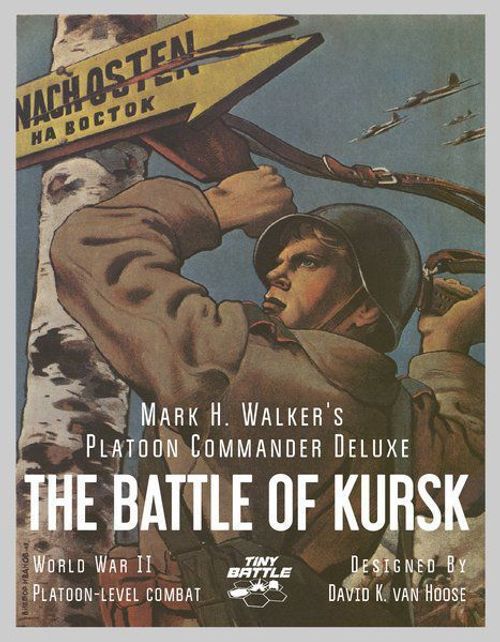
Platoon Commander Deluxe: The Battle of Kursk
Platoon Commander Deluxe: The Battle of Kursk Rulebook
Table of Contents
Table of Contents
1.0 General Concepts
The map covers a fictitious landscape over which the units do battle. The counters represent vehicle platoons (2-5 vehicles), infantry platoons (40-60 men), and various support teams identified by the NATO map symbol and an illustration of the weapon or soldier on their counter, the counters' names, and the scenarios in which they are employed. Each turn represents fifteen minutes to one hour. Each hex represents approximately 150 meters.
1.1 Dice
Numerous ten-sided dice (d10) determine the results of Fire Combat, Close Assaults, and other game functions. "0" is considered "0" and an even number.
1.2 Game Pieces
Platoon Commander Deluxe: Kursk is played using large 1" square game pieces. These pieces fall into two broad categories, Units and Markers.
-
Units. These are the pieces that do the fighting. They include tanks, infantry transports, infantry, etc. In short, a unit is any game piece that contains an illustration of a vehicle and/or a NATO symbol and an illustration of the weapon or soldier. The Soviet units are light green, the German are light gray. The numbers on the counters represent the following:
- Armor Piercing Firepower (APF). Top left number. Represents unit's effectiveness against Armored Fighting Vehicles (AFV) (1.4).
- High Explosive Firepower (HEF). Bottom left number. Represents unit's effectiveness against Leg units (1.4).
The range at which a unit can target an opposing unit with its APF and HEF is represented by the color on which it is printed: Blue, Red, Gold, Green, or Black, and the color of the font. Blue is the longest range, black the shortest. See the Player Aid Card (PAC).
- Armor. Top right. Represents an AFV's armor thickness and difficulty to hit (4.0).
- Close Assault Factor. Bottom right. Represents unit's effectiveness in Close Assault (7.0).
- Movement Factor (MF). Bottom center. Represents the unit's speed, expressed in Movement Points (MPs) (5.0).
- If centered on an explosion, it can move-and-fire (4.4).
- If enclosed by a circle, it can transport Units (5.1).
-
Markers. These are markers that define states or benefits, including Moved, Fired, Disrupted, Wreck, Aid, Dug-In, Barbed Wire, Mines, Aircraft, and Focus markers.
1.3 Stacking
Up to two units may stack in a hex. Stacking limitations apply at all times. Markers do not count against stacking. Leg units being transported by an AFV do not count against stacking.
1.4 Unit Types
- Leg: Includes the troops who fought with rifles, sub-machineguns, light machineguns, rocket launchers, mortars, anti-tank guns, recoilless rifles, etc., and are represented by a NATO symbol and an illustration of the weapon or soldier on their counter.
- Armored Fighting Vehicle (AFV): Any unit with an illustration of a vehicle on the counter. With two exceptions, AFVs are hard targets. The two exceptions are Trucks and Horse Pulling Teams. Trucks and Horse Pulling teams are considered soft targets but use AFV costs for movement and AFV column shifts in combat.
1.5 Eligible Unit
An Eligible Unit (EU) is any unit that is neither disrupted nor marked with any other status marker, such as a Fired or Moved marker.
Mark Says. Read that again. It's a crucial concept in the game.
1.6 Action Cards
There are 18 Action Cards. Each card has two sections, indicated by the combatant's identifying flag. Each scenario will indicate how many Action Cards the players receive at the start of the scenario. Each player draws the scenario designated number of cards per turn (2.2) and may play up to two cards in the turn during the phase indicated on the card, when the player would normally be eligible to take an action or in response to a card played by an opponent.
For example, the Soviet player wins the initiative, hence they are eligible to rally first. Because they are eligible to take an action (i.e. rally) the Soviet player decides to play "Kontrbatar. Ogon", requiring the German player to discard all Artillery cards. In response, the German player slaps down "Nein, Nein, Nein!" negating the Soviet card.
In the Fire phase, playing a card with the keyword ATTACK counts as an attack.
For example, the German player, who has the initiative, plays an Artillery Barrage to open the Fire phase. After resolving the attack, it is the Soviet player's turn to declare an attack (see 4.0).
2.0 Outline of Play
The following is the sequence of play used during the game turn.
2.1 Determine Initiative
Both players roll 1d10. High roll wins the initiative. In the case of a tie during any rolls or rerolls the rolling stops and the player who DID NOT have the initiative the previous turn is given the initiative. Unless the first turn initiative is delineated in the scenario, reroll all first turn ties. Either player may reroll the number of times allowed by the Focus marker in the Initiative box (see 3.1).
2.2 Draw Action Cards
During the scenario setup, draw the designated number of Action Cards from the draw pile. During this phase on subsequent turns, each player draws the scenario-designated number of cards from the pile. The player with the initiative draws first. Cards may be played when appropriate, but no more than two cards may be played per player, per turn.
2.3 Rally Phase
Both sides may attempt to rally disrupted units by rolling 1d10 for each unit and comparing it to the unit's morale. If the number is less than or equal to the unit's morale, it rallies. Each side's morale is defined in the MSR. The play of Action Cards may alter the die roll. Add one to the unit's morale if it occupies terrain that would afford it a left column shift against all potential enemy units during Fire Combat (4.0). This morale boost ONLY applies in the Rally Phase, not during combat. The player with the initiative rallies his or her units first.
Unless stated otherwise in the scenario, the German's morale is 5 and the Soviet's morale is 3.
2.4 Fire Phase
Players ALTERNATE attacks as per the rules for Fire Combat (4.0). The player with the initiative executes the first attack. When neither player wishes to execute any further attacks, the phase ends. Mark firing units with a Fired marker.
2.5 Movement Phase
First one side, and then the other moves all their Eligible Units. The player with the initiative determines who will move first. Note that unlike the Fire Phase, the players do not alternate moving units. One side moves ALL of its units and then the other side moves ALL of its units. Mark moved units with a Moved marker. Opportunity Fire may be conducted by Eligible Units during the movement phase. Mark units that Opportunity Fire with a Fired marker, unless directed otherwise by an Action Card.
2.6 Close Assault Phase
Non-disrupted adjacent units that are not marked Fired may initiate Close Assault. Players alternate declaring and resolving Close Assaults. A unit may only conduct one Close Assault per phase, but may be the target of numerous Close Assaults. The player with the initiative declares and resolves the first Close Assault.
2.7 Housekeeping Phase
Remove all Fired and Moved markers.
2.8 Aid and Focus Phase
Place, flip, move, do nothing, and remove Aid and Focus markers as designated in the rules.
2.9 Advance Turn Marker
Advance the turn marker to the next turn.
3.0 Aid and Focus
This is a crucial step in PCDK. This is where you use your position as a commander to influence the battle. The players alternate performing tasks with their Focus and/or Aid marker as outlined below. The player with the initiative decides who plays first. Players may perform one of the following tasks with the corresponding Focus or Aid markers.
- Do nothing with the marker.
- Remove the marker from the map.
- Flip the marker to the side displaying two dice.
- Move the marker three hexes from its previous position on the map, but NOT if the marker has accompanied a moving unit during the movement phase.
- Place the marker on the map on the side displaying one die.
3.1 Focus Marker
The focus marker represents the commander's focus in a specific area of the battlefield. This might include the assignment of additional assets, intense verbal direction, whatever.
When the marker is present in a hex executing an attack (either 4.0 or 7.0), the owning player may reroll the indicated number of dice. He must accept the final reroll. Each time the player rerolls, the number of rerolls available is reduced by one die. For example, if the single die side of the Focus marker is displayed and the owning player rerolls one die, the marker is removed. If the two-die side of the marker is displayed and the owning player rerolls one die, the marker is flipped to its single side. If all units are eliminated from or depart the Focus marker's hex, the marker is removed from the map. However, the Focus marker may accompany a unit when it moves from the hex in which the focus marker resides.
The Focus marker may also be placed in the Initiative Box. The owning player may use the Focus marker to reroll her initiative roll one or two times, depending on the number of dice on the displayed side. As stated before, the Focus maker is flipped from the two-dice side to the one-die side after use, or if on the one-die side, removed from the initiative box.
3.2 Aid Marker
The Aid marker represents additional medical supplies and encouragement provided to a hex. Units in a hex containing the Aid marker may reroll morale checks during the Rally Phase in a manner similar to using the Focus marker to support attacks. For example, if the single die side of the Aid marker is displayed and the owning player rerolls one die the marker is removed. If the two-die side of the marker is displayed and the owning player rerolls one die, the marker is flipped to its single side. If all units are eliminated from or depart the Aid marker's hex, the marker is removed from the map. However, the Aid marker may accompany a unit when it moves from the hex in which the Aid marker resides.
3.3 Focus and Aid Marker Elimination
Neither the Focus nor the Aid marker may be eliminated. If all units are eliminated from either marker's hex, it is simply returned to the player.
4.0 Fire Combat
Fire combat occurs in both the Fire and Movement Phases.
- In the Fire Phase, players alternate declaring and resolving attacks. The player holding the initiative always attacks first. When neither player wishes to execute any further attacks, the phase ends.
- In the Movement Phase, the non-moving player may have a chance to execute Opportunity Fire (4.3) attacks and the moving player may execute moving fire (4.4).
Always mark units that conduct fire with a Fired marker. Note that certain Action Cards may supersede this rule.
An Eligible Unit or units (4.6), with a Line of Sight (LOS) to an enemy hex, and within range of the hex, may attack all units in the hex (except as noted below). Normally, units may only attack once per turn, but Action Cards might provide additional opportunities, such as conducting Opportunity Fire despite the presence of a Fired marker, or the ability to remove a previously placed Fired marker. A hex may be attacked as many times as the attacker wishes (with different units).
You may always fire at adjacent units, but may not fire at enemy units if a hex containing blocking terrain (a blocking hex) lies between the attacker and target hex. (See Line of Sight, 6.0.) Determine if a hex blocks fire by stretching a thread from the center of the attacker's hex to the center of the defender's hex.
- If the thread passes through a blocking hex or hexes, the fire is blocked.
- If the thread passes exactly down the side of a blocking hex, such as a forest hex, the fire is not blocked.
- If a blocking hex lies on both sides of the thread, the LOS is blocked.
Units are never required to fire. Mark units that fire with a Fired marker, unless directed otherwise by an Action Card.
To resolve combat the attacker must first designate whether he wishes to attack the AFV or Leg targets in the hex. You may not fire on both types of units in the same attack (Exceptions: Artillery and Airstrikes 8.0). If there is only one unit in the hex, or if both units in the hex are the same type of unit, the entire hex is targeted in the same attack.
To attack Leg units, locate the rightmost column on the Fire Results Table (FRT) that is equal to or less than the attacking unit's high explosive firepower. Next, modify the column as dictated by the Terrain Effect Chart (TEC), Range Color Explanation (RCP), Flanking Fire (4.5), Moving Fire (4.4), and Multiple Attacking units (4.6), applying positive (shifts to the right) shifts before applying negative shifts. Consult the appropriate final column on the FRT, and roll 1d10.
To attack AFVs, locate the rightmost column on the FRT that is equal to or less than the attacking unit's armor piercing firepower minus the highest armor rating in the target hex. Next, modify the column as dictated by the TEC, RCP, Flanking Fire (4.5), Moving Fire (4.4), and Multiple Attacking units (4.6), applying positive (shifts to the right) shifts before applying negative shifts. Consult the appropriate column on the Table (FRT), and roll 1d10.
The result for both types of attacks are displayed on the FRT as a number of possible hits or No Effect (NE). The defender rolls 1d10 for each possible hit. Compare each die roll to the target's morale as defined in the MSR. As in 2.3 a roll that is less than or equal to the morale succeeds, negating a hit. The remaining hits are applied to the target (if only one) or evenly distributed among the targets in the hex, if they are both the same type. If evenly distributing the hits among two targets, ensure that both targets receive one hit before any receives two. If there is an odd number of hits, randomly determine which unit receives the extra hit. Mark all units, including assisting units (4.6), with a Fired Marker.
4.0.1 Unit Specific Modifiers
Some units, such as the German Pz-IV tank platoon, have superscripts next to their APF, HEF, or AF called Unit Specific Modifiers (USM). The USM is used to tweak values on the counter, ensuring the unit's performance replicates its battlefield history. The USM is a die roll modifier applied whenever the appropriate factor is used.
For example, the German Pz-IV platoon has a USM of "-1" applied to its AF. If a Soviet T34/76 platoon (APF of 8) attacked the Pz-IV platoon at normal range, the attack would be resolved on the 4 column of the FRT with 1 subtracted from the Soviet attack dice roll.
Another example. A Soviet T-70 platoon (APF of 4) fires on a German Tiger platoon at normal range. The attack would be resolved on the -4 column of the FRT with 1 added to the dice roll.
4.1 Results of Combat
The first hit on a unit disrupts the unit. The second hit reduces the unit (flips it to its reduced side). The third hit eliminates it.
- Disrupted: Place a disrupted marker on the unit. A disrupted unit that receives another hit loses a step instead. Disrupted units may not move, fire, or initiate a Close Assault (CA), although they may defend with 1/2 of their CA Firepower (fractions rounded down, minimum of 1). Units disrupted as a result of Close Assault may not advance after Close Assault.
- Step: A hit on a disrupted unit reduces it. Flip the unit to its lighter color. If already reduced, the hit eliminates it. Eliminated AFVs and Trucks are replaced with a wreck marker (maximum one per hex).
- NE: No effect.
4.3 Opportunity Fire
Opportunity Fire is a form of fire combat that occurs during the Movement Phase. Only Eligible Units (or a unit on whom an Opportunity Fire or other appropriate Action Card has been played) may initiate Opportunity Fire. Two Eligible units in the same hex may combine fire against a target of opportunity. The Op Fire card, however, only allows a SINGLE unit to conduct opportunity fire. It's a balance thing.
If an enemy unit or stack of units moves within the line of sight and range of unit/s eligible for opportunity fire, those units may attack the moving unit(s) after it/they enter a new hex by following the rules for fire combat stated above. The moving unit(s) may only be attacked once per hex that it enters. Units receiving a hit (after rolling to negate possible hits) must stop moving. Mark units that Opportunity Fire with a Fired marker, unless instructed otherwise by an Action Card. If firing on a hex that contains both moving and non-moving targets, the fire affects only the moving targets.
Artillery Action Cards may be used to conduct opportunity fire, but only if the target has a movement factor equal to or less than 2.
Mark Says. Opportunity Fire Action Cards may be played on units marked with a Fired marker.
4.4 Moving Fire
Any unit whose MF is centered on an explosion may move and fire. Such units may spend up to half of their MF (fractions rounded down) and still fire. If the explosion is blue, such fire is shifted two columns left. If the explosion is orange, shift the fire one column left. Moving fire units may fire at any time before, during or after their movement, but if they do fire before moving, the player must announce his or her intention of moving the unit. Moving fire only occurs during Movement (5.0). Mark the units Fired. That's important. If you Move and Fire you are marked Fired and will not be able to Close Assault.
4.5 Flanking Fire
In a single Fire Combat Phase, if a unit is targeted by two enemy units in such a manner that the LOS from the second unit enters the target unit's hex via a hex side or hex spine that is not adjacent to the original firer's hex side or spine of entry, the unit is flanked: mark the unit with a Flanked Marker until the end of the Fire Phase. Subsequent attacks, including the initial attack which met these requirements, during the current fire phase, against the unit (or stack of units) receive a one-column shift to the right.
4.6 Multiple Attacking Units
Only units that are stacked with the attacking unit may assist an attack. One unit is designated the lead unit, and all range and column shifts are based on that unit. Every additional assisting unit shifts the Fire Results Table two columns to the right. In addition to the above requirements, assisting units must be within at least the long range of the appropriate firepower (armor piercing for AFVs and high explosive for Leg). Mark assisting units Fired.
5.0 Movement
A unit's MF is an abstraction of the unit's speed. In each turn, units may move up to, but not exceed, their MF. In the movement phase, the initiative player chooses who will act first, and that chosen player may move all, some, or none of their Eligible Units. Next the other player may move all, some, or none of their Eligible Units. Units that begin the movement phase stacked together may move together and split off at any time.
Units are moved to adjacent hexes, paying the MF cost to enter the hex or cross the hex side as shown on the TEC. Units may not enter an enemy occupied hex (a hex with enemy units in it). Mark units that move with a Moved marker.
5.1 Transporting Units
Units with a circle around their MF can transport Leg units. Each transport unit can transport one Leg unit. Place loaded Leg units under the transport that is carrying them.
5.1.1 Loading Units
If the transporter and unloaded Leg unit begin their movement in the same hex, they can load and move up to 1/2 (drop fractions) of the transporter's MF in the turn. This is the only way that units with a "0" MF, such as the Pak 43 8.8cm, can load onto a transporter. If transporter and Leg unit begin in separate hexes, they can move up to 1/2 of the transport's MF and 1/2 of the Leg unit's MF to reach the same hex, and then load. They cannot move any farther this turn. Loaded transports are considered one unit for stacking and combat resolution.
A disrupted Leg unit cannot load into transports.
5.1.2 Unloading
A transporter and loaded Leg units can move up to 1/2 (drop fractions) of the transporters MF and then unload by placing the Leg unit either on top of the transporter in the same hex or in an adjacent hex. By the same token, the infantry can unload as its first action, remaining in the same hex or moving to an adjacent hex; and the transporter can move up to 1/2 of its MF (drop fractions).
A disrupted Leg unit can unload into the same hex as the transport but not load, as stated above.
A unit cannot unload into a ZOC.
5.1.3 Leg Unit Fire from Transports
Leg units cannot fire from transports. Transports can fire normally with Leg units loaded.
5.1.4 Transports as Targets
With one exception, Leg units share the fate of their transport. For example, if the transport is disrupted (or rallied), so is its passenger. If the transport is reduced, so is its passenger. If, however, the transport is destroyed, roll 1d10. If the result is even the passenger survives, albeit reduced and disrupted. If the result is odd, it does not.
5.1.5 Tank Riders
Special Scenario Rules may designate specific tank types as eligible to carry certain units, such as Infantry. Such transported infantry are tank riders.
- AFVs carrying riders may fire normally. The riders cannot fire (No practical way to use their machinegun or even get a stable platform for rifle fire).
- Riders can, however, assist in an Assault, adding one-half, dropping fractions, of their Assault Factor. They're close enough that stable platforms don't matter.
- Tank riders suffer same result as AFV that they are riding when the ridden AFV is targeted by direct fire, barraged by artillery (or mortar), hit by an Airstrike, or takes losses in Assault combat.
- Tank riders may be targeted exclusive of the AFV by direct HE fire (not artillery, mortar or Airstrike). If disrupted, they dismount. Such fire does not affect the AFV.
- Disrupted riders dismount into the same hex as the AFV they were riding. If such action will overstack the hex, the owning player determines the adjacent hex to which the riders will dismount. If, due to overstacking, enemy units, or enemy ZOCs, no such hex exists, the riders are eliminated.
For example, a hex containing an AFV, with a full-strength tank rider, and a dismounted Infantry unit is the target of an artillery barrage. After rolling to negate possible hits (4.0), 4 hits remain to be distributed. Two will be allocated to the AFV, although it can only be Disrupted (see 8.1), it's tank rider will be Disrupted, reduced, and forced to dismount. The other 2 hits will be allocated to the dismounted Infantry unit, Disrupting and reducing the unit.
Mark Says. So why can you target tank riders with direct fire HE, but not artillery? That's a good question, and honestly, the answer isn't based on historical data, but rather game mechanics. Doing so just raises too many corner cases and unrealistic results.
5.2 Minimum Movement Rule
An Eligible Unit with a Movement Factor of 1 or more may spend all its MF to move one hex, if the hex that it wishes to enter is not prohibited to its unit type. Note exception under 5.1.2 Unloading.
5.3 Zone of Control (ZOC)
Any non-disrupted unit exerts a ZOC into the six surrounding hexes. It costs units one additional MP to enter a ZOC. The presence of a friendly unit in a hex affected by a ZOC does not negate the ZOC.
6.0 Line of Sight
To attack a unit in ranged combat, the attacker must have a clear Line of Sight (LOS) to the target unit. An attacker can always attack an adjacent unit. If the attacker is on ground level it cannot fire at an enemy unit if a blocking terrain hex is between the attacker and the target's hex. Blocking terrain is defined on the PAC. Terrain in the attacker or defender's hex never affects LOS.
Two levels of hills exist in Platoon Commander Deluxe: Kursk. Light brown hills are level 1 hills and dark brown are level 2 hills. If an attacker is on a hill, it normally may not fire at an enemy unit if its LOS crosses a crest line. Crest lines are the white lines that outline hills. An intervening crest line may be ignored if the unit(s) adjacent to the crest line occupies higher terrain. Blocking terrain may also prevent an attacker on a hill hex from tracing LOS to a target on a hill hex. LOS is blocked by forest, city or town hexes that are also on the same level hill.
If the attacker is on a hill, it may not fire at a ground level or lower level enemy unit that is immediately behind (i.e. adjacent to) a forest, city, or town hex. The target is considered behind the blocking hex if the LOS from the attacker to the defender crosses the hex before it reaches the target's hex.
If the attacker is on a hill, it may not fire at an enemy unit on ground level if there is a same-level hill between the attacker's hex and target's hex.
Rolling terrain blocks LOS from and to the ground level when there are two consecutive hexes of rolling terrain. (When either the firing unit or the target are on a hill, rolling terrain does not block LOS.)
Determine if a hex blocks fire by stretching a thread from the center of the attacker's hex to the center of the defender's hex. If the thread passes through a blocking hex or hexes, the fire is blocked. It does NOT need to touch the silhouette of the forest, city, hill or whatever. If the thread passes exactly down the side of a blocking hex, such as a city hex, the fire is not blocked; but if the thread passes down the side of two blocking hexes (i.e. splitting them), the LOS is blocked.
7.0 Close Assault
Undisrupted units that are not marked Fired may Close Assault adjacent units in the Close Assault Phase. Units whose Close Assault Firepower (CAF) is succeeded by an asterisk may not initiate Close Assault but may defend. It is NOT mandatory to attack adjacent units, and to participate in the attack the target hex terrain type must not be prohibited to the attacker, nor may the attacker attack across a prohibited hexside. The side with the initiative conducts the first Close Assault, and then the players alternate Close Assaults. A unit may not initiate more than one Close Assault in a turn.
All adjacent units may attack the target unit. The player initiating the Close Assault is the attacker. Add the CAF of all attacking units and compare the attacking total to the CAF of the units in the target hex. Express the result as an odds ratio, attacking combat factors versus defending combat factors. For example, 8 attacking combat factors versus 4 defending factors would be 2-1 odds. Fractions are dropped. So, 10 attacking combat factors versus 4 defending combat factors would still be 2-1 odds, but 12 attacking factors versus 4 defending is 3-1 odds. Disrupted defenders defend with 1/2 of their CAF (fractions rounded down), but always with at least a CAF of 1. This odds ratio corresponds to a column on the Close Assault Table (CAT). Modify the column as per the TEC. If both Leg and AFVs are defending a hex use the most beneficial TEC modifier to the defender. Roll 1d10 and consult the CAT.
The results are displayed as a number of possible hits. The number to the left of the slash is the number of possible hits inflicted on the defender, the number to the right is the number of possible hits inflicted on the attacker.
The defender rolls 1d10 for each possible hit. Compare each die roll to the target's morale as defined by the MSR. As in 2.3 a roll that is less than or equal to the morale succeeds, negating a hit. The remaining hits are applied to the target (if only one) or evenly distributed among the targets in the hex if there is more than one. If evenly distributing the hits among two targets, ensure that both targets receive one hit before any receives two. If there is an odd number of hits, randomly determine which unit receives the extra hit. Next, the attacker rolls 1d10 for each possible hit in a similar manner as the defender.
If the defender receives more hits than the attacker, it must retreat one hex, and the attacker may occupy the vacated hex. Only Eligible Units that participated in the attack may advance into a vacated hex. The defenders' retreat must be in a general direction away from the attacking forces. If the defender must retreat into a hex containing two friendly units, it must continue retreating and both of the friendly units are disrupted. A defender may not retreat into an enemy's hex or enemy ZOC. If a defender cannot retreat, it is eliminated. If the defender is eliminated the attackers may also advance into the vacated hex. The defenders may never advance, even if the attackers are eliminated. Place a Fired Marker on units that participate in a Close Assault.
7.1 Flanking
If the assaulting units are attacking the defender from two, non-adjacent hex sides, the defender is flanked. Shift the odds on the CAT one column to the right.
8.0 Fire Support
Fire support in Platoon Commander represents artillery and air strikes supporting the soldiers fighting the battle.
8.1 Artillery
Artillery may either be called by playing an Artillery Action Card or when allowed by special scenario rules (SSR). To target a hex, a friendly EU must have a LOS (6.0) to the hex. Artillery attacks the target hex and two adjacent hexes with the firepower marked on the Artillery Action card or in the SSR. Resolve each hex attacked as per the rules of Fire Combat (4.0) and as altered below.
Artillery firepower IS modified by an AFV's armor, terrain, and stacking. If the target hex contains two units, shift the odds one column right. Because of the lethal effect of shells bursting in tree tops, units in the Forest only get a one column shift left instead of the two-column shift normally associated with Forest cover on the TEC. If barraging a hex containing both an AFV and a Leg unit, the defender modifies the attack by the AFV's armor and the AFV's TEC cover factor.
The hits are applied to the target (if only one) or evenly distributed among the multiple targets in the hex, when appropriate. AFVs cannot be reduced by an Artillery attack except by critical hits (see below), but they still "absorb" their share of the evenly distributed hits.
For example, a hex containing an AFV and a Leg unit is the target of an artillery barrage. after rolling to negate possible hits (4.0), 4 hits remain to be distributed. Two will be allocated to the AFV, although it can only be Disrupted (1 will be absorbed), and 2 will be allocated to the Leg unit, Disrupting and reducing the unit.
8.1.1 Mortars
Onboard mortars, as marked by the NATO symbol for mortar (see accompanying illustration) and a picture of the mortar team, attack exactly like offboard artillery with the following exceptions.
- Mortars attack the target hex only.
- The target must be within range.
- Mortars only inflict a critical hit on an AFV (8.1.2) on a roll of "0".
8.1.1 Critical Hits (Artillery/Mortars Only)
(Numbered 8.1.1 a second time in the source document.)
When resolving an artillery barrage, if the attacker rolls "1" or "0" and there is an AFV in the target hex, it--or a randomly determined AFV, if there is more than one AFV in the hex, suffers a step loss. This is in addition to any other results from the artillery barrage.
Mark Says. We colored the top two lines of the FRT to remind you about the critical hits that artillery and mortars can inflict.
8.2 Airstrikes
An airstrike is called by playing the Airstrike Action Card. The airstrike may attack up to two adjacent hexes. At least one of the hexes must be within the LOS of a friendly EU. The airstrike follows the rules for Combat (4.0) with the following exceptions.
- Airstrikes use their appropriate firepower (APF or HEF) when attacking.
- An airstrike attacks both units in the hex even if one is a hard target and one a soft. If such is the case, the airstrike applies uses its APF (one die roll, results distributed evenly between two targets).
- Airstrikes are ALWAYS considered Flanking Fire (4.5)
- Targets receive no cover modifier for being on a Hill. Otherwise, targets receive normal TEC column shifts. Leg units in Forest get the full, 2-column shift.
- If there is more than one unit in the target hex shift the FRT column 1 right.
- Airstrikes may reduce/eliminate a hard or soft target.
9.0 Fortifications
Both sides used mines, improved positions, bunkers, and such to enhance their defenses. Below are the rules regarding these fortifications.
9.1 Minefield
When a unit enters a minefield hex, or a mine field is placed in a unit's hex it's immediately attacked with an AP/HE firepower of six before any other forms of attack. If moving into a minefield hex, the attack only affects the moving unit(s). However, when a player initially places the minefield in hex it affects all units in the hex. Minefields attack exactly like an artillery barrage with three exceptions:
- The attack only occurs in the minefield hex.
- AFVs can be reduced by minefield attacks.
- A "0" or "1" have no special effect on the target units.
- The target of a minefield attack does NOT receive terrain modifiers.
(The source says "three exceptions" but lists four.)
Placing a minefield during the Fire or Movement Phase counts as a fire action.
9.2 Dug-In
Dug-In markers may only be placed as directed by the scenario. They may not be placed in City or Town hexes, nor may they be created during a scenario. Once placed, they may not be removed, even if their initial occupants are eliminated. Units in the same hex with a Dug-In marker are considered to be Dug-In. During each attack, units in a Dug-In may ignore the first unnegated hit against them.
9.3 Wire
Wire may only be placed prior to the scenario, and only as the scenario directs. As their FIRST action on entering a Wire hex each unit must roll 1D10 and compare it to their morale. If they roll equal to or less than their morale, there is no effect. Greater than their morale and they are disrupted.
Wire shifts the FRT odds 1 column right if the target is a Leg unit, no shift for AFVs, and no shift on the Assault table (both combatants are impeded).
10.0 Scenarios
The following are the scenarios that bring Platoon Commander Deluxe: Kursk to life. There are a few rules that apply to all scenarios unless the Scenario Special Rules (SSR) state otherwise.
10.1 Control
A side controls a hex if it currently occupies the hex or was the last side to have a unit in the hex. A side initially controls any hex that it could set up in.
10.2 The Hill
When a scenario references "The Hill" this is indicating the following hexes found on MAP A: D5, E3, E4, E5, F3, F4, F5, G3, G4 and H3.
10.3 Half Hexes
Half hexes are playable unless SSR states differently.
Northern Face Operations
Scenario 1: Take the High Ground
July 4, 1943 elements of the Gross Deutschland Panzergrenadier Division moved forward with orders to take the high ground. Once the high ground was taken artillery observation posts would deploy to prepare for the main assault.
Map
- Use Map A with a playing area made up of the box A1, A12, K12 and K1.
Victory Condition
- To win the German must control all the hexes on The Hill.
Soviet (sets up first)
- INFANTRY x 4, setup on The Hill.
(The rules document available ends here, partway through Scenario 1.)