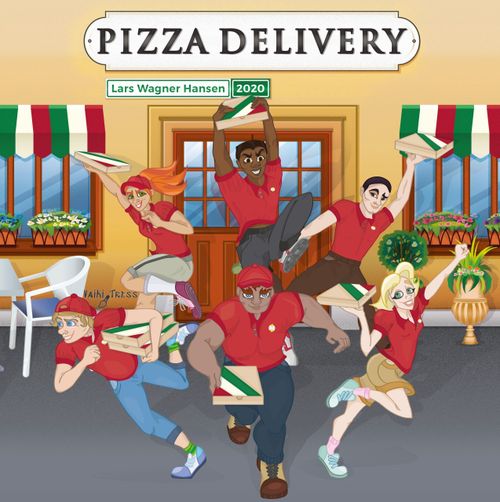
Pizza Delivery
Pizza Delivery Rulebook
Table of Contents
Table of Contents
Components
- 1 game board
- 28 player pieces (7 in each colour): bike, roller, scooter, meeple, disks
- 115 cards:
- 45 order cards (15 for each residential area)
- 24 equipment cards
- 10 objective cards
- 36 pizza cards
Equipment Card Icons
The equipment cards show their cost and effect as icons. Each card costs coins (gold coin) and one unit of time (blue clock). The printed equipment cards are:
- Bike (10 coins, 1 time): on the card, the movement icon is shown with a minus sign and one unit of time (blue clock).
- Moped (7 coins, 1 time; illustrated as a teal scooter): on the card, the movement icon is shown with a crossed-out energy (heart) icon, a minus sign and one coin.
- Electric scooter (5 coins, 1 time): on the card, the movement icon is shown with a minus sign and one energy (heart).
- Pizza box (3 coins, 1 time): on the card, a plus sign and a pizza icon are shown.
Source note: the icons on the bike and electric-scooter cards do not match the Change Transportation and Move to Another Area text, which gives the bike an energy reduction and the scooter a time reduction. The card icons are transcribed as printed above, and the rules text is transcribed as printed in the Move to Another Area section below. The pizza icon on the pizza box card is not explained in the printed text.
The Board
The upper part of the board is divided into four areas - the pizzeria and three districts. The lower part of the board has tracks for time, energy and money. Each time the player has to spend any of these resources their counter is moved down on the track. Each time the player earns coins or energy, their counter is moved up on the track. A player can never have less than zero coins, energy or time. If the player earns more than 100 coins simply continue around the track and remember that he is now at 100 coins plus the number the counter is on.
The board diagram on page 5 of the rulebook carries numbered markers (1 to 6) that the printed text does not explain. The diagram's area names and track values are not described separately beyond this section.
Game Setup
Material distributed to each player at the beginning of the game: 1 meeple, 3 counters.
- Each player puts their meeple on the pizzeria.
- Each player puts one counter on the 30 space of the energy track.
- Each player puts one counter on the 12 space of the money track.
- Each player puts their last counter on the 50 space of the time track.
- The Pizza Cards are shuffled, and 4 Pizza Cards are placed face up on the counter and 4 Pizza Cards face up in the ovens.
- For each residential district shuffle the appropriate order cards, and put 3 Order Cards face up.
- Place the Equipment Cards next to the game board.
- Shuffle the Objective Cards, and deal one Objective Card to each player. These cards are kept secret until the end of the game. Put the rest of the Objective Cards back in the box without looking at them, they will not be used in this game.
Playing the Game
The player whose time counter is furthest back on the time track is always the player to have the next turn. In case of two (or more) players being on the same space, the player whose counter is on top will have the next turn. That way it will be possible for a player to have several turns, as long as their counter is furthest back.
During a player's turn they have different possible actions, depending on the area they currently occupy.
In the pizzeria a player can perform following actions:
- Buy new equipment
- Change transportation
- Take pizzas from the counter
- Move to another area
- Drop pizzas
- Wait
In the residential district a player can perform following actions:
- Deliver pizzas for one or more orders
- Move to another area
- Drop pizzas
- Wait
Buy New Equipment
When a player is in the pizzeria they can choose to buy any number of new equipment cards. Each piece of equipment cost one unit of time, and a variable amount of coins as depicted on the card. If a type of equipment runs out, then it's not possible to buy any more of that type. A player can never have more than 7 pieces of equipment.
Change Transportation
A player can choose to use another type of transportation they own; replace the meeple with the desired type of transportation. This does not cost any resources.
Take Pizzas From the Counter
When a player is in the pizzeria they can choose to take any number of pizzas from the counter. Picking up a pizza costs one unit of time and one unit of energy. Multi-pizzas cost an extra unit of time as depicted on the card. After the player has taken the pizzas, they must slide pizzas from the ovens towards the counter and fill up the empty spaces, and finally fill up the ovens with new pizzas from the draw pile.
If the counter ends up with three or four pizzas of the same type, then the counter will be cleared of pizzas.
Put all four pizzas on the counter in the discard pile, and slide the counters from the oven to the counter, then fill up the ovens with new pizzas.
If a player ends up with more pizzas than he has pizza bags, they will have to discard pizzas until they have the same number of pizzas and pizza bags.
If the draw pile runs out of pizzas, shuffle the discard pile and put the cards on the draw space.
Move to Another Area
Moving from one area to another always costs two time, plus one energy for each pizza the player is carrying. This cost is modified by the type of transportation:
- Using a bike reduces the energy cost by one, to a minimum of zero energy.
- Using a scooter reduces the time cost by one, to a minimum of one time.
- Using a moped eliminates the energy cost entirely, but costs one coin each time it used.
Drop Pizzas
A player can at any time drop any number of the pizzas they are carrying. Simply put the unwanted pizzas on the discard pile in the pizzeria.
Wait
Players can always choose to wait:
- Short break costs one unit of time.
- Rest costs 3 units of time, but the player receives 2 units of energy in return.
- Nap costs 10 units of time, but the player receives 9 units of energy in return.
Deliver Pizzas
The player can choose to deliver any number of pizzas to fulfill orders in the area where they currently are. In order to fulfill an order, the player must discard a number of pizzas equal to the number of pizzas on the order card and pay a number of time and energy units as depicted above the order space plus the time and energy units depicted on the order card.
In return the player receives a number of money equal to the amount depicted on the order, modified by the amount depicted above the order space. The player keeps the fulfilled order card, as it can give bonus points at the end of the game. The player can choose to deliver the wrong type of pizzas; if one (or both) pizza does not match the type on the order card, the player will only receive half the amount of coins (rounded down) they would usually receive for the order.
Once the player has delivered all the pizzas they wish, they must slide order cards down on the order track (from left to right) and turn over new orders from the draw pile. If there are no more order cards in the draw pile for a district, it means that that area has had their share of pizzas and does not need any more in this game.
Game End
Once a player does not have enough time and/or energy to perform an action in the area they currently are, then that player does not take any more actions. When no player is able to perform actions anymore then the game is over.
Players now reveal their objective card. For each pizza on an order card of the type the player has on their objective card, that player receives 3 extra coins. The winner of the game is the player with the most coins. In case of a tie, the player with the most fulfilled orders is the winner. In case that is also a tie, the tied players share the victory.