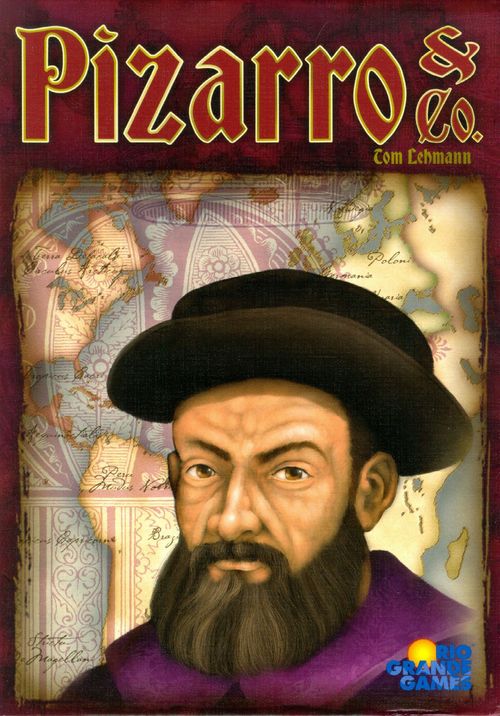
Pizarro & Co.
Pizarro & Co. Rulebook
Table of Contents
Table of Contents
Contents
- 36 Explorer cards, 6 of each explorer
- 63 Money cards, 7 each of values 1–9
- 36 wooden ships, 6 each in 6 colors
- 2 game boards, usable on both sides (4 possible combinations)
In Brief
The players slip into the role of kings who try to draw the best and boldest explorers to their side. To do this, they naturally offer them money. Columbus, Magellan, and all the rest set out to sea for the highest bidder.
The game runs over 3 phases. In Phase I, 3 ships per explorer are placed into play in Europe. Sea voyages into the unknown naturally carry all manner of dangers, so in Phase II only 2 of the ships reach a waypoint. In Phase III, finally, only 1 ship reaches the destination. Each explorer has his own personal strengths and weaknesses and brings his king victory points, new money, and possibly actions. The winner is whichever player has the most victory points at the end.
Setup
The two game boards are laid out side by side. Each board can be used on either side. For your first game, lay out the boards as shown in the rulebook's illustration. Before later games, the players agree together which sides they want to use. In the text that follows, the two boards together are simply referred to as "the board."
Each player receives:
- 6 ships of one color, and 1 set of money cards from 1–9.
The money cards are held face-down in hand. The remaining money cards are shuffled well and placed face-down in a stack next to the board.
The explorer cards are shuffled separately by their backs, I, II, and III. After shuffling, the III cards (6 of them) are placed face-down as a stack next to the board, and the II cards (12 of them) are placed face-down crosswise on top of them. The youngest player (or another player agreed on by everyone) receives the I cards (18 of them), which he places face-down in a stack in front of himself. He is the auctioneer. Over the course of the game he turns up the cards one after another for auction — first those of stack I, later those of stacks II and III.
Sequence of Play
The game runs over 3 phases (I, II, and III). In each phase, the following happens:
- Turn up 1 explorer card and auction it off (the auctioneer does this).
- Place a ship (Phase I) or move a ship forward (Phases II and III), and carry out the action of the space (the player who won the explorer card does this).
- Steps 1 and 2 are repeated until all explorer cards of the current phase have been auctioned.
- Once the last explorer card of a phase has been auctioned, that phase ends and all players receive money cards from the stack.
- The next phase begins.
After the last card of Phase III has been auctioned, the game ends and scoring takes place.
Sequence in Detail
1. Auctioning the Explorer Cards
The auctioneer turns up the top card of the stack lying in front of him. He asks the player who won the previous card to make a bid (minimum bid 1) or pass ("Inge, make your first bid for Pizarro"). On the very first card of Phase I, he himself begins bidding or passes. Then the next player clockwise follows, bidding or passing. A player who passes is out of the auction for that card. The auction continues around the table until a highest bid stands (the auctioneer bids along like every other player).
Bidding is done with money cards. The numbers in the money bags count. The highest bidder pays his bid with the corresponding money cards (see page 5) and lays them face-up on the discard pile (placed next to the face-down stack). The player places the won explorer card face-down at his own place (exception: see "Columbus" and "Magellan"). This way it can always be checked who has won which card. Immediately after winning the card, a ship is placed or moved forward.
Important: In Phase I, every player may bid on every explorer card and may also win it on a high bid (so a player may win up to three copies of the same explorer card). In Phase II, only those players who won at least 1 card of that explorer in Phase I may bid. In Phase III, only those players who won at least 1 card of that explorer in Phase II may bid.
An explorer card that no player wins goes back into the box (in this case, no ship is placed or moved, and no action is carried out).
2. Placing or Moving Ships, and Possibly Carrying Out an Action
In Phase I, ships are placed into play; in Phases II and III, the ships placed in Phase I are simply moved forward. Ships not placed in Phase I go back into the box.
A player who wins a card in Phase I places one of his ships on Space I of the corresponding explorer. If this player wins another card of the same explorer in Phase II, he moves his ship from Space I to Space II. Correspondingly, he moves it from Space II to Space III in Phase III.
Explorers can carry out actions. These actions are shown on the action spaces and are explained under "The Action Spaces."
3. Repeat Steps 1 and 2
Steps 1 and 2 are repeated until all explorer cards of the current phase have been auctioned. In Phase I there are 18 cards, in Phase II 12 cards, and in Phase III 6 cards.
4. New Money Cards at the End of a Phase
At the end of Phases I and II, all players receive 2 new money cards. To do this, the auctioneer shuffles the discard pile together with the remaining face-down stack. From this new stack, he deals every player 2 money cards face-down. Some players also receive additional money cards (see pages 6 and 7).
5. The Next Phase Begins
The auctioneer places the explorer-card stack of the new phase (II or III) in front of himself and turns up the top card. Play continues in the same way as described under points 1–5.
Scoring at the End of the Game
After the last explorer card of Phase III has been auctioned, the (single) scoring takes place and the winner is determined (see under "Scoring").
In what follows, the explorer cards, the money cards, the board with money bag, crown, and action spaces, as well as the scoring, are explained in more detail.
The Explorer Cards
Christopher Columbus, Francisco Pizarro, Ferdinand Magellan, Marco Polo, Vasco da Gama, James Cook.
The cards have backs I, II, and III. Under back I, each explorer appears three times; under back II, twice; under back III, once.
The Money Cards
There are 63 money cards, seven each of the values 1–9. They are needed to win the explorer cards at auction. If a player still has money cards left at scoring, they bring him additional victory points.
Every card shows a money bag with a number between 1 and 9 in each of the 4 corners. Between the money bags, a crown is shown with the numbers 1, 2, or 3.
The number in the money bag shows its money value at auction. If a player wins an explorer card for, say, 7 ducats, he can pay with 1 money card worth 7, or with 2 money cards worth 5 and 2, or with any other combination of his choosing. If a player wins an explorer card for 13, he can pay with the 9 and the 4, and so on. If a player has no matching money cards, he may overpay, but receives nothing back.
The number in the crown shows the victory points a player receives in addition to his other victory points if he still holds this card in hand at scoring.
Attention: players do not draw money cards during the phases (exception: see page 7, under "Vasco da Gama"). They only receive new money cards at the end of the phases!
The Board
Each individual board shows 3 explorers and 1 scoring track. Each explorer has 3 spaces next to each other: the left one for Phase I, the middle one for Phase II, and the right one for Phase III. Players place or move their ships forward onto these spaces. In addition, the spaces also show a money bag, a crown, and an action space.
The Money Bag
The number in the money bag shows how many money cards the player receives at the end of the phase for each of his ships standing on that space. These money cards are in addition to the 2 money cards that all players receive. A player only receives the money cards of the phase that has just ended. (For ships that remain standing on spaces of earlier phases, there are therefore no more money cards.) The money cards are drawn from the face-down stack.
The Crown
The number in the crown shows the victory points for each ship at scoring.
The Action Spaces
Here the actions are shown that a player can carry out when he places his ship on the space or moves it forward. Some actions are carried out immediately, and some later. Some spaces have no action. The actions can differ between the board sides (A and B). In detail:
Christopher Columbus
Board sides A and B are identical.
Space I (Veto): Columbus cards of Phase I give their respective owners a right of veto in the further auction.
The player first lays the won Phase I Columbus card face-up in front of himself. From then on, he may play it at any time the auctioneer turns up a new explorer card. This works as follows: before the first player makes a bid for the just-revealed explorer card, the player who owns the Columbus card says: "Veto — this card will be auctioned later!" The auctioneer slides the card under the stack. The owner of the Columbus card then turns it face-down. He cannot play it a second time. Now the auctioneer turns up the next explorer card.
Spaces II and III: No action. The Columbus cards of Phases II and III give no right of veto.
Francisco Pizarro
Board side A: No actions.
Board side B
Spaces I, II: No actions.
Space III (Fix victory points): This action is only carried out at the player's scoring. First the player scores all his other ships, then he adds the victory points of the money cards remaining in his hand, and only then does he score the ship on the last Pizarro space. To do this, he shuffles the face-down money-card stack, draws card after card, and lays them face-up in front of himself. He adds up the numbers in the money bags — not the numbers in the crowns! He may stop drawing at any time. If the total is 20 ducats or less, he counts it as victory points added to his other total. If the total is over 20, he receives 0 victory points for Pizarro.
Ferdinand Magellan
Board side A (slide a money card from your hand under the Magellan card)
Space I: The player lays the won Magellan card face-up in front of himself. Then he must immediately choose 1 money card from his hand and slide it face-down under the Magellan card (tip: preferably a card with a 3 in the crown). Magellan therefore costs 1 card in addition to the bid. If the player would have no card left in hand after paying his bid, he cannot win Magellan.
Spaces II and III: The newly won Magellan card is laid face-up on top of the Magellan card(s) already laid out from the previous phase(s). Then the player must again choose 1 card from his hand and slide it under the 2 or 3 face-up Magellan cards.
The slid-under money cards count at scoring as the combined total of the crown values ×1, ×2, or ×3 (see Scoring, page 8).
Board side B (slide a money card from your bid under Magellan)
Spaces I, II, III: Scoring works as above. The difference from side A: the money card that the player slides (now face-up) under the Magellan card must be chosen from his bid, not from his hand. If the bid contains more than 1 money card, the remaining money cards go onto the discard pile. On side B, the money cards are slid underneath face-up!
Marco Polo
Board side A (money-card exchange as the last action of a phase)
Spaces I, II: At the end of Phases I and II, after receiving all his new money cards, the player may — per ship, one after another — lay up to 3 of his hand money cards onto the discard pile and draw the same number from the face-down stack. He takes the newly drawn money cards into his hand.
Space III: No action.
Board side B: No actions.
Vasco da Gama (drawing money cards directly)
Board side A
Space I: Immediately after winning the "Vasco da Gama" card, the player draws 1 money card from the face-down stack and takes it into his hand.
Spaces II, III: The player immediately draws 2 or 3 money cards, respectively, from the face-down stack and takes them into his hand.
Board side B
Spaces I, II, III: In each phase, the player must decide anew whether to place or move his ship into the left or right part of the space. If he chooses the left part, he may immediately draw 1 (or 2, or 3) money cards from the face-down stack. If he chooses the right part, he has no action (but he does receive victory points if his ship stands there at the end of the game).
James Cook
Board side A (money cards laid out face-up)
Spaces I, II, III: After the player has paid his bid, he must immediately lay out face-up, in front of himself, all the money cards he still has in hand. If he gains new money cards during the current phase through Vasco da Gama (see above), he must also lay these out face-up immediately. If the player has no money cards left in hand after paying his bid, he does not need to lay any out. At the end of the phase (before he receives his new money cards), he takes all remaining laid-out money cards back into his hand.
Board side B (a money card drawn from your hand)
Spaces I, II, III: After the player has paid his bid, his left-hand neighbor immediately draws 1 money card from his hand and lays it face-up on the discard pile. A player may only win a Cook card if, after paying, he still has at least one other money card in hand that can be drawn from him.
Scoring
The very last explorer card has been auctioned, the additional money cards have been dealt out. Phase III has ended. The player who won the last explorer card begins the scoring.
He counts his victory points as follows: first he counts the numbers in the crowns of the spaces where his ships stand. To this he adds the numbers in the crowns of all the money cards he still holds in hand. He sets this result using two of his ships on the scoring track. Then the next player clockwise follows, and so on.
Example: Red scores last.
For Marco Polo, Red receives 0; for Vasco da Gama, 1; and for the remaining money card, also 1 victory point.
Red concentrated heavily on Magellan in this game and won 2 Magellan cards in Phase I. Under the first he slid the money card 1, and under the second the money card 2. In Phase II he won both Magellan cards again and slid the money cards 1 and 4 underneath. In Phase III he slid the money card 5 under the third won Magellan card. Magellan therefore brings him a total of 8×3=24 victory points + 5×2=10 victory points. So far he has 36 victory points.
Now he scores Pizarro. He draws from the face-down money-card stack: first the 5, then the 6, then the 2 (note: here the numbers in the money bags are added). If he stopped there, he would reach 13 victory points for Pizarro, i.e. a total score of 36+13=49. But Blue has 52 victory points. To beat him, Red must draw at least one more card for Pizarro. He draws an 8, giving him a Pizarro total of 21. For this he now receives no victory points at all. He therefore stays at 36 victory points overall and finishes second.
The victory points in detail:
- Marco Polo: 0
- Vasco da Gama: 1
- Magellan: 34
- Pizarro: 0
- Money cards: 1
- Total: 36 victory points
Closing
For many test rounds, the author and publisher especially thank Dieter Hornung, Nathali Klingen, André Maack, Andreas Maszuhn, Karl-Heinz Schmiel, Schorsch, Andreas Trieb, Alex Weiß, Volker Weitzel, Hannes Wildner, and Tom Lehmann's testers in the USA.
© 2002 Hans im Glück Verlags-GmbH