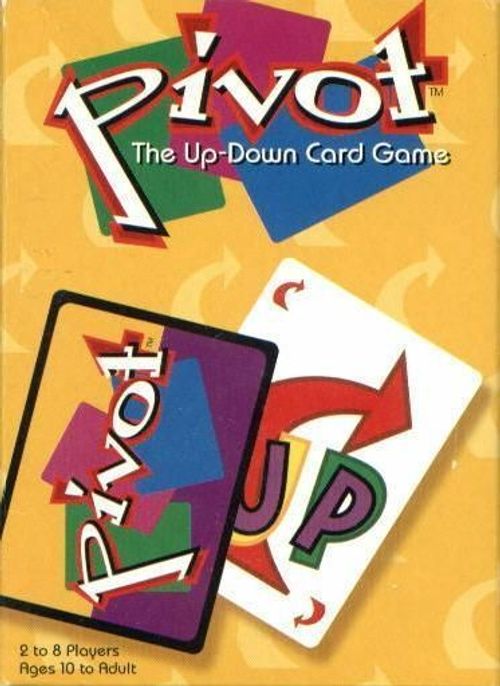
Pivot
Pivot Rulebook
Table of Contents
Table of Contents
Number of Players
3-6
Equipment
108 Pivot cards: 80 cards numbered 1-80, and 28 direction cards (11 UP cards, 11 DOWN cards, and 6 PIVOT cards).
Object
Be the first player to get rid of all your cards.
Setup
Each player takes a card from the deck; whoever gets the highest number is the dealer. (If you get a direction card, ignore it and take another card.)
The dealer shuffles and deals 7 cards to each player. Put the rest of the cards in a face-down pile in the middle of the table. This is the draw pile.
Turn over the top card from the draw pile to start the discard pile. (If you turn over a direction card, ignore it and turn over the next card.)
The player to the left of the dealer begins play.
Play
Play begins "going up," so the first player must either play a number higher than the number of the card on top of the discard pile or change the direction of play (see below). Then the next player to the left either plays an even higher number or changes the direction of play, and so on.
Note: There are three types of direction cards: UP, DOWN, and PIVOT.
Direction Cards
Instead of playing a number card, you may play a direction card to reverse the direction of play.
- UP: Makes play go up. Players must play numbers higher than the number of the top card of the main discard pile, and the direction of play is now clockwise.
- DOWN: Makes play go down. Players must play numbers lower than the number of the top card of the main discard pile, and the direction of play is now counterclockwise.
- PIVOT: Changes the direction of play from up to down or from down to up. In other words, if the game is going up when a PIVOT card is played, it then goes down (and play goes counterclockwise), and if the game is going down when a PIVOT card is played, it then goes up (and play goes clockwise).
Note: You can't play an UP card if play is already going up or a DOWN card if play is already going down.
Extra Discard Pile
It's hard to remember which direction play is going when a number card covers up the last direction card that was played. You should use the main discard pile just for number cards and create an extra discard pile for direction cards. This will help you easily see both the direction in which play is going and the last number card that was played.
If You Can't Play
If you can't play a card on your turn or you don't want to, you must draw one card from the draw pile. If that card is playable, you can play it if you want to. Either way, the next player then plays. (Remember, that's the player to your left if play is going up and the player to your right if play is going down.)
Special Number Cards
Some of the number cards have words on them as well. These are played as normal number cards but also have special effects on the game.
Note: There are three types of special number cards: EXTRA TURN, NEXT PLAYER DRAWS, and SKIP NEXT PLAYER.
- EXTRA TURN: If you play this card, take another turn. (That is, play another card or draw a card.)
- NEXT PLAYER DRAWS: If you play this card, whoever plays after you must draw an extra card before his or her turn.
- SKIP NEXT PLAYER: If you play this card, whoever would normally play after you loses a turn, and play goes to the person to his or her left (if play is going up) or to his or her right (if play is going down).
Free Play
If you play a card and play goes all the way around the table without anyone else playing a card, you get a free play. This means that you may then play any number card, no matter which direction play is going. Play then continues as normal, in the same direction as before.
If the Draw Pile Runs Out
If there are no more cards in the draw pile, set aside the top card of each discard pile (the direction pile and the number pile) so you remember the direction of play and the last number card played. Reshuffle the remaining cards and turn them face down to make a new draw pile. Play then continues as normal, in the same direction as before.
Optional Scoring
One way to keep score over several games is to assign each player points for each card in his or her hand when the game ends:
- 1 point for each number card
- 2 points for each UP or DOWN card
- 3 points for each PIVOT card
The player with the fewest points at the end of five games wins. If you like, you can end each game when the first person runs out of cards or when the deck runs out, whichever comes first. The deal rotates to the left after each game.