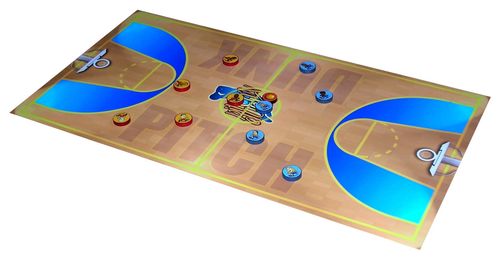
Pitch'n Dunk
Pitch'n Dunk Rulebook
Table of Contents
Table of Contents
Equipment
1 Court, 10 Player tokens (2 teams of 5) and 1 Ball token.
- Player's "Player" side
- Player's "Shotclock" side
- Ball's Dribble side / Shot/Pass side
Please store the rolled playing mat inside the tube, printed side visible, to keep the playing surface flat.
Court
The court is delimited by sidelines and endlines. The court is divided into 2 halves. Each half is divided into 2 zones: a 3-point zone and a 2-point zone. These 2 zones are separated by a 3-point line. The 2-point zones and the 3-point zones represent 4 successive movement zones. Downward:
- 2-point zone A
- 3-point zone A
- 3-point zone B
- 2-point zone B
These movement zones are used for the DRIBBLE rule. Each 2-point zone includes the paint (the trapezoid area) and the free-throw half-circle.
(The court illustration labels: endline, paint, free throw half circle, sideline, center circle, midcourt line, 3-point line, basket.)
Coaches and Players
In Pitch'N Dunk, gamers are called COACHES and tokens are called PLAYERS.
The "Pitch"
Coaches move their players and the ball by a "pitch", i.e. by flicking the respective token.
Players and ball may only be pitched by the end of a finger. Touching any other token except the played token is not allowed (exception: a coach may (and must) touch the ball when dribbling with the ball handler).
Setup and Jump Ball
Each coach places 4 players in his own 3-point zone, outside the center circle. The 2 remaining players are placed, inside the center circle, each in his own half. One coach then tosses the ball, while his opponent calls a side (red or green). The coach who wins the toss places the ball on his player in the center circle, SHOT/PASS side visible, and begins the game.
Example: Each coach places 4 players in their own 3-point zone, outside the center circle. Then each coach places his last player in the center circle. The red coach wins the toss: he places the ball on his player in the center circle, SHOT/PASS side visible. The red coach begins the game.
Flow of the Game
Actions
The coaches take alternating turns: coach A takes an action with one of his players, then coach B takes an action with one of his players, then again coach A, and so on.
The coach whose turn it is can activate any one of his players. He can choose and take 1 ACTION from those indicated below. The actions that a coach can perform with a particular player depend on whether that player is the ball handler or not.
Shot Clock
The coach whose team has the ball is called the offensive coach. The coach whose team does not have the ball is called the defensive coach.
The defensive coach triggers the SHOTCLOCK when all of his players are in his 3-point zone, or when an offensive player is in the defensive team's 2-point zone. He advances the SHOTCLOCK by turning his players over to the SHOTCLOCK side.
After the SHOTCLOCK is triggered, the offensive player has 5 turns to score a basket.
Actions of the Player Who Holds the Ball
The ball handler is the player on whom the ball is placed. He can perform one of these 2 actions: DRIBBLE or SHOOT/PASS.
As long as he has not dribbled since becoming the ball handler, the ball handler may DRIBBLE or SHOOT/PASS. If he has already dribbled, he may only SHOOT/PASS.
Dribble
- If the ball shows its DRIBBLE side, the ball handler may dribble.
- Take the ball in hand.
- Propel the player in the same or adjacent movement zone.
- Place the ball on player, SHOT/PASS side visible.
Note:
- DRIBBLE is the only action with limited movement.
- Before and after a DRIBBLE, if the player is on (or at least partly covers) the line separating 2 movement zones, he is considered to belong to both zones.
- When exceeding his movement (the player crosses a whole movement zone with one pitch), the player commits a TRAVELING VIOLATION (see VIOLATIONS, below).
Shoot / Pass
- The ball handler may perform this action regardless of the visible side of the ball (DRIBBLE or SHOOT/PASS).
- Take the ball in hand.
- Place the ball anywhere against the player without the ball touching any other player.
- Pitch the ball.
The Ball Rule
The ball moves teammates. The ball may not move opponents: when the ball hits an opponent player, that player's coach replaces him in his previous position.
(Transcribed as printed; the verb after "moves" appears to be missing in the source.)
3 Seconds Rule
When the ball handler is in the defensive paint, he may only SHOOT or PASS. As soon as the ball handler is in the opponent's paint, his coach's next action must be a SHOT or a PASS.
If the coach takes any other action (like performing a RUN with another player), it is a rules violation. The opponent then performs a BALL RECOVERY.
Example: The player has caught the ball. He touches the paint line, so he is considered to be in the paint. As his next action, the red coach may only perform a SHOT or a PASS. If he does not, the blue coach performs a BALL RECOVERY.
Reception and Interception
During a SHOT or PASS, the ball is caught by the first player it touches.
RECEPTION: If the ball hits a teammate first, that teammate catches the ball. His coach takes the ball and places it on this player, DRIBBLE side visible.
INTERCEPTION: If the ball hits an opponent first, that player catches the ball. His coach replaces the player in his previous position, takes the ball and places it on this player, DRIBBLE side visible.
RECEPTION and INTERCEPTION do not count as actions (unlike BALL RECOVERY).
Example: The blue player tries a difficult PASS to his teammate. It's difficult because a red player is partly in the way. The ball hits the red player, then the blue player. This is an INTERCEPTION because the 1st player the ball hit is an opponent player. The red coach replaces his player in his previous position, places the ball on that player, DRIBBLE side visible. It is then the red coach's turn to perform an action (with this player or any other).
Note: During a SHOT/PASS, if the ball does not hit any player at all, it remains on the court where it came to rest. The ball may later be picked up by a player (see the PICK UP THE BALL action below).
Non-Ball Handler Actions
A player who does not hold the ball may perform one of the following actions: RUN - PICK UP THE BALL - RETURN INTO PLAY - BALL RECOVERY.
Run
Situation: all. Pitch the player.
Note: Unlike DRIBBLE, RUN is not limited by movement zones.
Pick Up the Ball
Situation: Loose ball - the ball is on the court, not on a player (after a missed SHOT or PASS, or after a teammate hits the ball handler knocking the ball onto the court).
- Pitch the player.
- If the player hits the ball, place the ball, DRIBBLE side visible, on that player after the player has come to rest.
Return in Play
Situation: the player is out of bounds.
- Place the player on the spot where he left the court (as indicated in the illustration).
- Pitch the player.
Ball Recovery
Situation: After a VIOLATION committed by an offensive player, after an opponent sends the ball out of bounds, after a successful SHOT, or when the SHOTCLOCK has run out:
- Take the ball in hand.
- Place the ball on the player in bounds nearest to your edge of the table, SHOT/PASS side visible.
Important note: Ball Recovery is an action! After a BALL RECOVERY, it's the opponent's turn.
Example: The red coach has just committed a VIOLATION. As his next action, the blue coach performs a BALL RECOVERY. He takes the ball and places it on his blue player in bounds nearest to his edge of the table, SHOT/PASS side visible. The blue player on the endline is out of bounds, so he may not perform a BALL RECOVERY. It's now the red coach's turn.
Shotclock
As soon as:
- All defensive players are in their 3-point zone OR
- An offensive player is in the defender's 2-point zone (i.e. at least touching the 3-point line).
The defensive coach triggers the SHOTCLOCK by turning one of his players over to the SHOTCLOCK side. The offensive coach then has 5 turns to score a basket.
SHOTCLOCK starts: At the end of a defensive action, if all 5 defensive players are in their 3-point zone, or if an offensive player is in the opponent's 2-point zone (i.e. at least touching the 3-point line), the defensive coach announces: "SHOTCLOCK!" and turns over one of his players to the SHOTCLOCK side. Players who show their SHOTCLOCK side behave in every respect as they would normally.
Note: The midcourt line and the 3-point line are considered to belong to the 3-point zone; if a player is touching one of these lines, he is in the 3-point zone.
Following shotclock turns: During his next turn, the defensive coach performs his action and then turns over a second player. On each of his following turns, he turns over one more player.
Note: During the following shotclock turns, even if the defensive team's players move out of the 3-point zone, the SHOTCLOCK still continues winding down.
Example: The blue coach moves a player back for defense (1). All blue players are in their 3-point zone, which triggers the SHOTCLOCK: the blue coach says "SHOTCLOCK!" and turns over one of his players, SHOTCLOCK side visible (2). Note: The blue player on the midcourt line and the player on the 3-point line are considered to belong to the blue team's 3-point zone.
SHOTCLOCK ends: At the beginning of the defensive coach's turn, if all defensive players show their SHOTCLOCK side (after 5 SHOTCLOCK turns), the defensive coach announces that the SHOTCLOCK has run out. He turns over all his players, player side visible, and performs a BALL RECOVERY as his action for this turn.
Example: The blue coach has defended hard: he just turned his last player over after his action. The red coach now has only 1 action to avoid a SHOTCLOCK violation: the only thing he can try is a 3-point SHOT despite the distance and the blue player in the way. For his next turn, the blue coach will turn over all of his players and perform a BALL RECOVERY action (regardless of whether the red player scored a basket or not).
As soon as the defensive coach takes the ball, he turns back all his players to their "player" side before completing the BALL RECOVERY action.
Violations and Fouls
3 OFFENSIVE FOULS: TRAVELING - CHARGING - BACKCOURT VIOLATION 3 DEFENSIVE FOULS: BLOCKING - BLOCKING THE BALL HANDLER - ILLEGAL DEFENSE
Offensive Fouls
Traveling
While dribbling, a player exceeds his movement allowance from one zone to an adjacent zone. Penalty: Opponent's next action is a BALL RECOVERY.
Example: Player 1 (as ball handler) doesn't commit a traveling violation when he moves to position A, nor to position B because he stays in the 3-point zone. If he moves to position C, however, he exceeds his movement allowance and commits a traveling violation. Player 2 (as ball handler) does not commit a traveling violation by moving to position D because he is on the midcourt line at the beginning of his action: he is considered to be in the 3-point zone at the beginning of the action.
Charging
An offensive player hits an opponent, even indirectly. Penalty: Opponent's next action is a BALL RECOVERY. Furthermore, the defensive coach may cancel his player's move by replacing him in his previous position.
Backcourt Violation
After crossing the midcourt line, the ball handler brings back the ball into his own half (i.e. at least touching the midcourt line) through a DRIBBLE or a PASS. Penalty: Opponent's next action is a BALL RECOVERY.
Example: Player 1 PASSES the ball to his teammate, player 2. Unfortunately, the PASS pushes player 2 onto the midcourt line: the team commits a backcourt violation because player 2 receives the ball by returning to his own half. The blue coach's next action is a BALL RECOVERY.
Defensive Fouls
Blocking
A defensive player hits an offensive player. Penalty: This action is cancelled, and all tokens are replaced in their previous positions; then it's the offensive coach's turn.
Note: Hitting an opponent player is illegal, but a player is allowed to hit his teammates.
Blocking the Ball Handler
A defensive player hits the ball handler in the defender's half. Penalties:
- The action is cancelled, and all tokens are replaced in their previous positions;
- the ball handler can immediately try a SHOT;
- the offensive coach is given a number of FREE THROWS: If the SHOT is successful, the offensive coach gets 1 FREE THROW. If the SHOT missed, the offensive coach gets 2 FREE THROWS if the player was blocked in the 2-point zone, 3 if he was blocked in the 3-point zone.
- After the last FREE THROW, the opponent performs a BALL RECOVERY.
Note: If a defensive player blocks (hits) the ball handler in the offensive team's half, it is resolved like a block to a non-ball handling player (see above).
Illegal Defense
At the end of the offensive coach's turn, if a defensive player is in his own paint and no offensive player is in that paint, the offensive coach can announce an illegal defense of that defender. In this case the defensive coach will have to use his next action to get the defender out of his paint with a RUN or PICK UP THE BALL action (i.e. the player must be moved so that he does not even touch the paint line). He is not allowed to perform an action with any other player. If the defensive coach does not succeed in getting this player out of his paint, the offensive coach is given 1 FREE THROW. Then THE OFFENSIVE COACH performs a BALL RECOVERY.
Free Throws
Beginning with the offensive coach, the coaches alternate in taking one of their own players out of the defenders' 2-point zone and placing them in the adjacent 3-point zone. The offensive coach places the ball inside the free throw half-circle (without touching any of the lines). He pitches the ball. If the ball comes to rest on the basket (i.e. at least part of the ball overlaps with part of the basket), he scores 1 point. He does this 1, 2 or 3 times, depending on how many FREE THROWS - 1, 2 or 3 - he was given.
Out of Bounds
Court limits are the endlines and the sidelines. When the ball or the ball handler crosses one of these lines, the ball is out of bounds. The opponent's next action is a BALL RECOVERY.
Note: The ball or the ball handler just has to touch the sideline or the endline for the ball to be out of bounds.
Important: The ball never pushes an opponent player out of bounds. When a player is pushed out by an opponent's SHOT/PASS, he is replaced in his previous position. But the ball can push a teammate out of bounds.
Successful Shot
The baskets are the two white circles at either end of the court. A SHOT is successful when the ball thrown by a player (i.e. pitched by a coach) comes to rest at least partly overlapping with the opponent's basket.
DUNK: A coach can attempt to score a basket by DUNKING the ball. To do so, the coach activates the ball handler and, instead of taking a SHOT, the coach places the ball against the ball handler. If the ball at least partly overlaps with the opponent's basket, the offensive coach scores 2 points.
Note: When the ball comes to rest on the opponent's basket after hitting an opponent, this opponent performs an INTERCEPTION, and the SHOT is a miss.
Note: When the ball comes to rest on both the basket and the endline, the basket is good.
Example: The red team scores a shot. If the shooter was player 1, the team scores a 3-pointer. If the shooter was player 2, the team scores a 2-pointer. If the shooter was player 2 [sic, player 3 in the illustration], the team also scores 2-pointer.
Example: The blue coach places the ball against the player instead of performing a SHOT/PASS. The ball touches the basket: DUNK! The blue team scores a 2-pointer.
Goal-Tending Rule
When a defensive player touches his own basket, he is in GOALTENDING position: when taking a SHOT, the opponent's ball handler just has to hit that defender with the ball to score a basket. His team scores 2 points if he shoots from the 2-point zone and 3 points if he shoots from outside the 2-point zone.
Victory
The first team to score at least 11 points, while at least 2 points ahead, wins the game.
"Street" Variant
The first team to score at least 21 points, while at least 2 points ahead, wins the game.