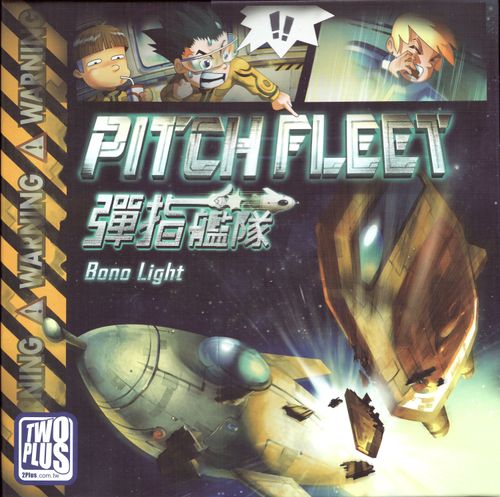
Pitch Fleet
Pitch Fleet Rulebook
Table of Contents
Table of Contents
Game Components
- A. Planet Board x 9
- B. Basic Power Card (Silver Border) x 50
- C. Planet Card x 9
- D. Team Card x 6 (3 in Red and Blue each)
- E. Starship Token x 6 (3 in Red and Blue each)
- F. Starship Stickers x 6
- G. Record Token x 6
- H. Starting Player Token x 1
- I. Restart Card x 6
- J. VP Token: 1 VP x 18, 3 VP x 18
- K. 10 VP Card x 10
- L. Magnetic Beam Token x 6
- M. Summary Card x 6
- N. Advanced Power Card (Gold Border) x 25
- O. Challenge Card x 28
- P. Rule Book x 1
Stick the stickers (F) according to the color of the Starships (E) before your first game. Starship graphic has no impact during the game.
Preparation
Illustration is on the left page.
- Randomly place all planet boards (A) into a 3x3 matrix. You can design your own placement as well.
- Shuffle all basic power cards (B), and stack them face down to form the "Power Deck". Then, for each player, draw three cards to form a pile, which would be the "Available Power Card Piles". Flip the top cards of each pile face up.
- Depending on the number of players, draw planet cards (C) according to the table below. Shuffle these planets to form the "Planet Deck". Remove all other planet cards from the game.
| Number of Players | 2 | 3 | 4 | 5 | 6 |
|---|---|---|---|---|---|
| Number of Planet Cards | 8 | 7 | 6 | 5 | 4 |
- Draw a planet and put it face up as the starting planet of this stage of the race. Draw another planet and put it face up as the goal planet of this stage. We recommend placing the starting planet closer to the deck in order to distinguish them.
- Select team cards (D) according to the number of players (as indicated on the bottom right corner of the cards.) Shuffle them, and deal one to each player. Players with the same color are of the same team. Remove all other team cards from the game.
- According to his or her team, each player takes Starship tokens (E) and record tokens (G) accordingly. Place the record tokens on the starting planet. Place your team card in front of you to indicate which Starship is yours.
- The player who has the card on the right becomes the starting player. Give the starting player token (H) to him or her. (Note printed with the illustration: there is an icon of the starting player token on the bottom left corner of the team card.)
- Each player takes a restart card (I).
- Each player takes a 3 VP token (J). In addition, place one 3 VP token on the goal planet card. Place all remaining VP tokens and 10 VP cards (K) aside.
- Place the magnetic beam token (L) aside.
- If needed, take the summary card (M) to remind for game scoring.
- The game begins, starting with the starting player.
For First-Timer
The game requires precision hand movements. For first time players, we recommend you to practice various basic movements on basic power cards before you begin the game. See the last page for the description of basic power cards. Advanced power cards (N) are for players familiar with the game. Challenge cards (O) are for solo/family mode; see related chapters.
Game Sequence
The game consists of several stages. Each stage consists of three rounds. In each round, starting from the starting player, players take turn in clockwise order. At the end of each round, the starting player hands the starting player token to the one on his or her left.
On your turn, you proceed the followings in order:
- Evaluate Starship allocation
- Move a Starship (you may restart)
- Outbound examination
- Arrival examination
After all of the above, your turn ends, and the next player begins his or her turn.
Evaluate Starship Allocation
- You first decide which Starship to move; it can be yours or your teammate's Starship. If the Starship you choose is not on the board, place it on the starting planet, and proceed from there. Otherwise, you proceed from wherever that Starship was.
- You can place and move your teammate's Starship instead of yours, even in the first round.
- When placing the Starship, make sure it stays flat on the board. When evaluating whether the Starship is on a planet or not, simply check whether it touches the dotted line around the planet. (See picture A on the right.)
- Starship can exceed the boundary of a planet, but cannot touch other Starships or magnetic beam, as shown in the illustrations.
- In rare cases, players may not be able to place their Starship on the starting planet. In this case, you are allowed to place your Starship on any place of the planet board on which the starting planet is.
Illustration captions: "Starship cannot be placed vertically." / "Starship cannot touch other Starships or magnetic beam." / "Starship must touches or within the dotted line of the starting planet." / "Starship cannot touch the dotted line of other locations."
Move A Starship
- To move a Starship, you first pick a face-up power card from the Power Card Piles, and make one attempt to move the Starship you just choose in the way that the card indicates. Place the used power card into the discard pile aside.
- The gesture on the upper part of the card indicates which fingers you can use. You must use one and only one of those fingers to move the Starship. The movement is execute by "shooting" your finger, as illustrated below.
- You can use the finger on either hand.
- Shoot via the finger indicated. You can also shoot backward.
- You can't "push" the Starship.
- The symbol of a hand with the ring or little finger means that you can only use your ring or little finger.
- If the card indicates special movement (Ex. Magnetic Barrier or Warp Drive), you must execute it.
- When attempt movement, you can use the other hand to stable the boards. You can also put your shooting hand on the board for easy aiming. Beware not to touch other Starships or magnetic beams!
- You must stay at your place when shooting. By doing so, players would experience shooting from different angles. You can stand up, though, just beware not to leave your spot.
- There are two possible consequences of movements: Outbound or Arrival. Please examine them in order as described below.
Outbound Examination
- If, after the movement, a Starship touches the table, it is considered outbound, as shown on the right. Notice that if a Starship exceed the border but does not touch the table, it is not outbound.
- Illustration: "It is fine to exceed the border." / "You touch the table! Outbound!"
- If any Starship of your team outbounds, the current player lose 1 point, and would not gain any points or Power card.
- If any Starship of the opponent's team outbounds, the controller of these Starships all lose 1 point. For each of these Starships, the current player gain 1 point.
- If both cases above happen, execute the first case only.
- All outbound Starships are removed and set aside, waiting to be relocated.
Arrival Examination
If no Starship of your team outbound, proceed to arrival examination. The objective of Starship movement is to gain points through landing the Starship on the goal planet (satellite), or matching the requirement on the power card.
- When a Starship touches or stops within the dotted line around a specific location, it is considered to arrive that location.
- Location effects only activate when a Starship is "moved" to that spot. If a Starship is "knocked" by other Starships, it does not activate any location effect.
- All effects (score adjustments or draw cards) act to the current player, not the player who owns the moving Starship.
- In principle, only the locations on the same board with the goal planet would be activated. For example, see picture A on the right, the goal is the Mercury on the upper-left corner, so only the asteroid belt on that board would make you lose point. Location on other boards have no effect.
- However, if the selected power card indicates effect of arriving certain location, then all such locations count, regardless of which board they are on.
- If you simultaneously arrive multiple locations, all locations count. For example, see picture B on the right, the Starship arrives the asteroid belt and two 1 VP satellites at the same time.
- If, after the movement, your Starship somehow stays at the original location, the effect of that location does not activate. Because of that, if you want to activate a location twice, you would have to first leave the spot, and then came back on some later round. For example, a player starts as in picture B, and ends as in picture C. Since it already arrived the asteroid belt, it would not lose points twice. However, it does enter a new satellite on the right, so the player would gain points.
- Whenever a player gain points, take the VP tokens accordingly. If a player gain and lose points simultaneously, gain points first, and then lose points. A player's point would never fall below zero.
Location effects on the board of goal planet:
- If a Starship arrives a VP satellite, gain VPs equal to the number of stars on it. Take VP tokens accordingly.
- If a Starship arrives a Charging satellite, the current player draws a power card from the deck, and decides to use it immediately or place it face down in front of him or her. Two face-down power cards count as 1 VP.
- If a Starship arrives the goal planet, move the record token of that Starship from the starting planet card to the goal planet card.
- If a Starship arrives an asteroid belt, current player loses 1 VP.
Restart
- After you move the Starship, if there was no collision with any other Starships or magnetic beam, you can use the restart card. If so, you put the Starship you just moved back to where it starts this turn, and move that Starship again by the same power card you just used. Put the Restart card aside afterward.
- Notice that you can use the Restart card even the Starship outbounds. You won't lose point if you choose to restart.
Round Ends
- A round ends after all players have made an attempt to move. Flip the top cards of each power card stacks face up, and pass the starting player token to the left. Next round begins.
- If, upon the end of a round, all Record token of a team are moved onto the goal planet, and there is a 3 VP token, remove that token, and all players of that team gain 3 VP. However, if both teams meet this requirement, both sides gain no points. The 3 VP token is still removed. If, after the last round of a stage, no team meets this requirement, the 3 VP token is removed as well.
New Stage
After three rounds, there should be no power card piles left. Set up the next stage as follows:
- Place the goal planet card on the starting planet card, which becomes the new starting planet. Flip over a new planet card as the new goal, and place a 3 VP token on it.
- As in the preparation, for each player, form a power card pile of three cards, and flip the top card face up. If the power card deck runs out, shuffle the discard pile to form a new deck.
- Remove all Starships and magnetic beams from the board.
- Repeat 5-7 in the preparation. Note that the team would be redistributed.
- All players with the lowest score take a restart card. A player can only have at most one restart card.
- New stage begins, starting from the starting player.
Game Ends
- The game ends when there are no card available for goal planet. In other words, the total number of stages is the number of planet cards used minus one.
- The player with the highest total score wins, share victory if there is a tie.
Solo / Family Mode
The solo mode provides a special setup for you to practice and evaluate your skills. When playing with your kids, we also recommend this mode so the kids can practice, and you can take turns with your kids as a cooperating game. In this mode, set up the game as follows:
- Randomly place all planet boards into a 3x3 matrix.
- Take one blue Starship. This is the Starship you move throughout the game.
- For first timer of this mode, we suggest you remove all advanced power cards (with gold border), as these cards require higher skills. You can also adjust the difficulty by choosing the Challenge cards according to their VP.
- Shuffle the Challenge cards you chose, and place 7 cards faced down as a deck.
- Put power cards, other Starships, magnetic beams, VP tokens and 10 VP cards aside for later usage.
Game Sequence:
-
Flip over the top challenge card. Setup according to its illustration, as well as the additional descriptions on the right.
-
Take VP tokens according to the bottom right corner on the challenge card, and put them on the card.
-
Place your Starship on any planet other than the goal. In this mode, you are allowed to leave your seat when shooting.
-
On the bottom left corner of the challenge card, a gesture represents which fingers you are allowed to use for this challenge, and the maximum number of moves for you to complete this challenge. If, in addition, there is a name of power card listed on the bottom right corner, you are restricted to the movement of that power card for this challenge.
Example: Challenge No. 20 requires you to arrive 5 satellites of Uranus, but the maximum movement is 3. After examine the board, you realize that you are asked to arrive multiple satellites simultaneously! Also, this challenge asks you to move in the way of "magnetic barrier" power card, so by carefully setting the magnetic beam, you should complete the challenge!
-
If you complete the challenge within the movement limit, you gain VP tokens on the challenge card. Clear the board, and restart from Step 1.
-
If you fail the challenge, outbound your Starship or violate any rule as the challenge indicates, remove 1 VP from the challenge card, clear the board, re-setup, and re-challenge.
-
When re-challenge, you can also reset the configuration of the boards.
-
If all VP tokens are removed, discard this challenge card! Restart from Step 1.
-
Solo/Family mode ends after 7 challenge cards are either completed or discarded. See your evaluation according to the table below.
| Total Score | Evaluation |
|---|---|
| 18+ | Solar-mighty |
| 15 - 17 | Impressive |
| 11 - 14 | Expert |
| 7 - 10 | Average pilot |
| 5 - 6 | Don't drive my Starship |
| 0 - 4 | Back to internship! |
Challenge Cards
For multiple goals, the arriving order is irrelevant.
- Setup: One red Starship on the asteroid belt of Venus. Challenge: Let the red Starship arrive Venus.
- Setup: Two red Starships on both satellites of Mars. Challenge: Arrive Mars and let both red starships moved.
- Setup: Equally separate your Starship and Saturn by four magnetic beams. Challenge: Arrive Saturn and let all magnetic beams moved.
- Setup: One red Starship on Saturn and equally separate your Starship and Saturn by two magnetic beams. Challenge: Outbound the red Starship.
- Setup: One red Starship on any planet of a corner board. Challenge: Outbound the red Starship.
- Setup: None. Challenge: Arrive Pluto without arriving any satellite.
- Setup: One upstanding magnetic beam on each of the three satellites of Jupiter. Challenge: Arrive Jupiter without knocking down any beam.
- Setup: One red Starship on Mars, surrounded by four magnetic beams. Challenge: Outbound the red Starship.
- Setup: Six upstanding magnetic beams side-by-side on the asteroid belt of Venus. Stable the beams with your other hand. One red Starship on Venus. Challenge: Bounding with the beams, and then outbound the red Starship.
- Setup: Six upstanding magnetic beams side-by-side on the asteroid belt of Venus. Stable the beams with your other hand. Challenge: Bounding with the beams, and then arrive Venus.
- Setup: Two red Starships on both satellites of Neptune. Challenge: Outbound both red Starships.
- Setup: None. Challenge: Arrive Venus and Neptune.
- Setup: Set six magnetic beams on Mercury. Stack them up as a campfire. Challenge: Arrive Mercury.
- Setup: Surround Earth with three magnetic beams. Challenge: Arrive Earth with your Starship not overlap any beam.
- Setup: Stack three red Starships on Mars. Challenge: Let all red Starships touch the board.
- Setup: Stack two red Starships on Mercury. Challenge: Outbound one and only one red Starship.
Figure A, Figure B and Figure C are set-up diagrams printed in the rulebook beside challenges 26-28.
Q&A
Q: During my movement, the Starship bumps into the crack between two boards. Can I restart?
A: There are many unexplained supernatural phenomenon in space; cracks are just one of them. As a pilot, you can only live with it. Other players can help stabilizing the boards to reduce this type of things.
Q: An accident occurs that mess the boards up, or the game requires us to reset Starships or beams. What should we do?
A: Just roughly place the objects so that they remain at the same spot (according to the dot lines.) Minor shifts would not cause major interference.
See the picture on the right: the blue Starship is on Earth. If you need to reset due to an accident, place it anywhere on Earth. The red Starship is on Earth and the satellite simultaneously, so you have to put it on both spots as well.
Q: If, after a movement, a Starship stacks on another Starship or beam. What should we do?
A: If your Starship stacks on another object, treat it as outbound. Proceed as in [Outbound Examination] on page 4.
Q: If I use a card that requires me to put a magnetic beam, but all beams are already on the board, what should I do?
A: Just take any beam on the board and use it. You don't have to put it back afterward.
Q: I can't put my Starship on the starting planet since it's already too crowded. What should I do?
A: Put it anywhere on the board where the starting planet is on.
Q: I have a wounded finger so I couldn't do what the power card ask me to do. What should I do?
A: Use the finger on your other hand. If both fingers are wounded, you can use any finger instead, but we recommend you take a good rest in this case.
Advanced Power Cards
Advanced power cards (gold border) are for players familiar with the game. Each card's effect is listed below.
- Use the second joint of your index finger to shoot Starship. After the movement, if your Starship arrives any planet, gain 1 VP.
- After the movement, if your Starship arrives two or more non-asteroid-belt special location, gain 2 VP. Do not count the location that you start with.
- Replace the Starship into a beam by placing the beam in the same location. If you select a Starship that is not on the board, put the beam on the starting planet. You gain 1 VP for each opponent's Starship you knocked, with a maximum of 2 VP.
- You gain 1 VP for each Starship other than the moving Starship that outbounds (that includes outbounding Starships of your own team, as long as the moved Starship stays inbound.) Ignore [Outbound Examination rule 1.] in this case.
- Use this card as a springboard by putting a beam underneath as a fulcrum, adjust the angle freely. Shoot your Starship from this springboard. You gain 3 VP if it arrives any planet. The move is considered failed if Starship stays on the springboard after your attempt, and put it back to the same location before move.
Basic Power Cards
See the last page for the description of basic power cards. Basic power cards (silver border) form the Power Deck.
- Gain 1 VP if you arrive any asteroid belt. If you arrive the asteroid belt of the goal planet, you don't lose 1 VP and gain 1 VP instead.
- For each other Starship that is "knocked" by the moved Starship and arrives on any planet, you gain 1 VP.
- If you arrive any VP satellite, you lose points instead of gain points.
- Place a magnetic beam anywhere without touching any other Starship or beam, then make your move. The beam would stay on the board until it is knocked by any Starship; remove it from the board after that.
- You use a beam instead of a finger to shoot Starship. You still can't move by "pushing."
- Before movement, relocate the Starship you attempt to move on any planet other than the goal planet.
- You gain 1 VP if you arrive any charging planet.
- Shooting without your eyes open. That's right, close them!
- You won't lose point if you outbound the moved Starship. Other outbound examination still follows.
- Before movement, relocate the Starship you attempt to move by the length of the long side of this card, in any direction you wish. If the Starship is not on the board, place it on the starting planet first, adjust it by the length, and then make your move. The Starship cannot touch other Starship or beam after this adjustment.