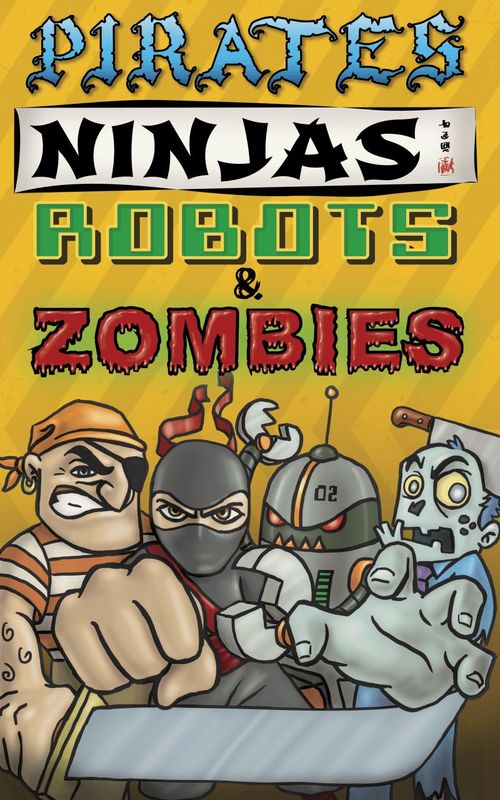
Pirates, Ninjas, Robots, & Zombies
Pirates, Ninjas, Robots, & Zombies Rulebook
Table of Contents
Table of Contents
Objective
Claim victory by placing the highest-scoring connected area of your selected character(s).
Contents
4 double-sided base tiles, 54 game tiles.
Setup: Choose Your Character(s)
Choose which of the 4 characters you want to play and take its base tile. In a 2-player game, each player chooses 2 characters and therefore 2 base tiles. In a 3-player game, discard the extra base tile, as it will not be used in the game. Shuffle the game tiles and deal 3 to each player, placing the rest of the tiles within everyone's reach. These 3 game tiles, plus the base tile(s), are the players' starting hand.
Play Area
Since there is no board, the tiles themselves become the play area. Tiles are placed edge to edge, and the play area is built as the game progresses. Tiles are placed orthogonally, that is, a tile must connect to the rest of the play area by at least one complete side, not just diagonally or by half an edge. The pictures do not need to match the pictures they are placed adjacent to.
Tile placement: Orthogonal — Correct. Half edge — Incorrect. Diagonal — Incorrect.
Taking Your Turn
A player's turn consists of either playing 1 tile from their hand onto the table or playing a base tile. At the end of the turn, the player draws another tile. Also, instead of playing a tile from their hand and then drawing, a player may choose to move one of their own base tiles that is already in play. Some tiles allow an additional action (see below). Any picture can be next to any other picture, but it is an advantage for players to create a large section(s) of their own character(s), making sure they can always add more to it, while using tiles that are not advantageous to them to block their opponents.
Extra Action
Some tiles have 1 of 3 icons in the center. When these tiles are played, the player who placed it has the option to use the indicated action. Only 1 extra action is allowed per turn, even if another card with an action icon is placed.
- Rotate: When played, allows the player to rotate any 1 tile already in play. It may be rotated 90° to the right or to the left. It may also be rotated 180°.
- Swap: When played, a player may swap and rotate the position of any two tiles already in play, including the tile just played.
- Replace: When played, a player takes any tile (except opponents' bases) out of play into their hand, and replaces it with a different one from their hand.
Scoring
| Pirate | Ninja | Robot | Zombie | |
|---|---|---|---|---|
| 1 point | Pirate | Ninja | Robot | Zombie |
| 3 points (bonus item) | Treasure chest | Throwing star | Battery | Brain |
| 5 points (base tile) | Pirate ship | Castle | Factory | Graveyard |
| Arch-enemy | Kraken | Dragon | Soldiers | Hunter |
Each character is worth 1 point. Each character also has a unique bonus item. These are worth 3 points each. The base tiles are worth 5 points. There are also 4 arch-enemies, one specific to each character (see above). At the end of the game, any character or bonus item that is adjacent to its arch-enemy will not be scored. Although all enemies serve to block, only the character's arch-enemy will negate points. As with tile placement, scoring is done orthogonally.
Winning the Game
Once the last tile has been drawn, each player gets one last turn. After this, scoring takes place. Each player counts the section of their character(s) with the highest score. Normally this will be the largest section, but not always. Only the highest-scoring section is counted. In a 2-player game, each player's two characters are scored separately, and then added together. The highest score wins.
Example:
- Robot score = 9 (Base + 4 robots)
- Ninja score = 11 (2 bonus items + 5 ninjas)
- Pirate score = 10 (1 bonus item + 8 pirates - 1 Kraken touching)
- Zombie score = 6 (1 bonus item + 5 zombies - 2 Hunters touching)
Note that neither the Robots nor the Ninjas score points for this tile since both icons are only connected diagonally to the scored sections.