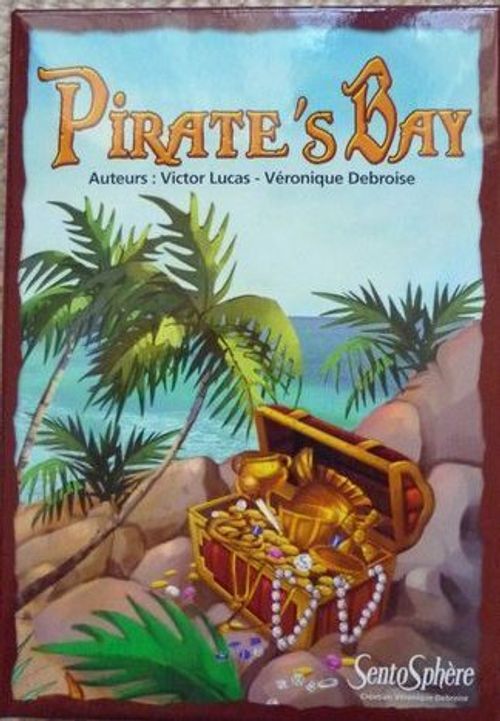
Pirate's Bay
Pirate's Bay Rulebook
Table of Contents
Table of Contents
Components
- 50 cards:
- 18 BUCCANEER cards (shades of blue). They come in 6 card types, valued from 1 to 6: Buccaneer (6), Galleon (5), Treasure Map (4), Compass (3), Boat (2), Shovel (1).
- 18 FLIBUSTIER cards (shades of yellow), identical to the blue set above.
- 8 VISIBLE TREASURE cards (back shows a chest), valued from 5 to 20.
- 6 HIDDEN TREASURE cards (back shows a chest with a question mark), valued from 0 to 30.
Setup
The game is played over 2 rounds. At the start of each round:
- Take the 8 VISIBLE TREASURE cards, shuffle them well, and place them in the middle of the table, picture side up, 4 horizontally and 4 vertically, as shown in the setup diagram (diagram 1, not reproduced in the sheet's text).
- Take the 6 HIDDEN TREASURE cards, shuffle them well, and place 4 of them in the middle of the table, face down, 2 horizontally and 2 vertically, as shown in diagram 1. Set the unused cards aside.
- Each player chooses a colour (yellow or blue), shuffles their cards, places their deck face down in front of them, and takes the top 4 cards into hand. The player using the blue cards begins the first round. Their opponent begins the second round.
Playing the Game
Players take turns. On your turn, play one of the 4 cards in your hand, face up, next to (horizontally or vertically) a TREASURE card or another card already on the table. Cards may not extend beyond the boundaries of the virtual play area (6 x 6), which is defined horizontally and vertically by the TREASURE cards, as shown in diagram 2. After playing, draw a new card from your deck.
Try to arrange your cards so that the cards in the same column or row show different elements. The goal is to control rows and columns in order to win the treasures, bearing in mind that 4 of the treasures have unknown values.
Which buccaneer is the boldest, and does the risk pay off?
End of Round
A round ends when the virtual play area is full, that is, when all 36 player cards have been placed (18 per player), as shown in figure 3 (not reproduced in the sheet's text).
Scoring a Round
For each of the 12 treasures (6 columns and 6 rows), add up each player's cards in that column or row to find their strength. If a player has several cards with the same element in a column or row, only the value of one of those cards counts; the other has no value.
The player with the highest total in that column or row wins the corresponding TREASURE card. If the totals are tied, nobody wins that treasure.
After all columns and rows have been totalled, each player adds up the points on the TREASURE cards they have won and writes these sums down.
Example of End of Round
- Row A: Yellow = 13 (3+6+4), Blue = 11 (6+3+2). Yellow wins the treasure from this row (= 10 points).
- Row B: Yellow = 7 (2+1+4), Blue = 12 (5+3+4). Blue wins the treasure from this row (a surprise value, revealed when the card is turned over).
- Column G: Yellow = 11 (2+6+3), Blue = 11 (4+2+5). Tie, nobody wins the treasure from this column.
- Column L: Yellow = 7 (4+3; the second card with value 4 does not count), Blue = 9 (3+2+4). Blue wins the treasure from this column (= 25 points).
End of Game
The game ends after the points from the second round have been totalled. The player who has gathered the most points wins.
Translator's notes: The sheet does not state when HIDDEN TREASURE cards are turned face up; the worked example implies they are revealed at scoring. The sheet also gives no tie-break for the overall game.