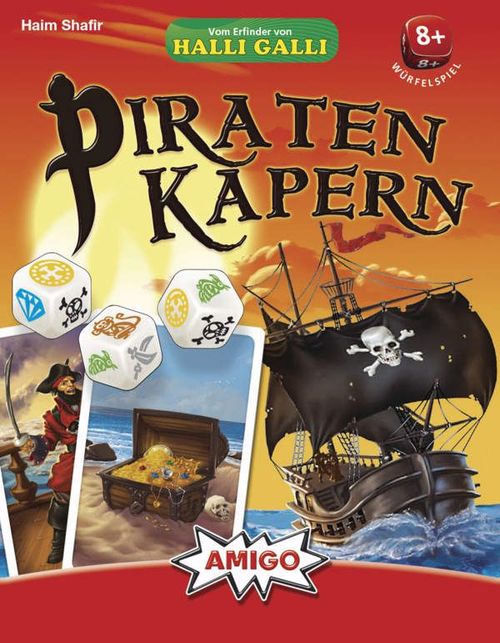
Piraten Kapern
Piraten Kapern Rulebook
Table of Contents
Table of Contents
Game Components
- 8 raiding dice
- 38 pirate cards
- 2 overview cards
- 1 score pad
Setup
Write your names on the score pad and note your points scored there over the course of the game. Then shuffle the pirate cards and place them as a face-down draw pile in the middle of the table. Set out the overview cards. They show the possible dice combinations and how many points each is worth. The youngest person aboard begins and sets out on a raid; after that, the other crew members try their luck in clockwise order.
On the High Seas
If you are on a raid, you reveal the top pirate card and place it beside the draw pile. This pirate card affects your rolls (see also the chapter "The Pirate Cards"). Your first roll must be made with all eight dice. After that, you may roll dice again. You try to roll as many matching symbols as possible. Diamonds and gold coins are especially lucrative here, because they bring extra points. When you have finished your raid, you pass the dice to the person on your left. Write down the points scored. Should the draw pile run out, shuffle the discard pile and set it out as the new draw pile.
The Dangers of the Raiding Dice
After your first roll with all eight dice, and depending on which pirate card you revealed, you decide which dice to set aside and which to roll again. You are not required to set aside any dice at all. You may re-roll any die, including dice you had previously set aside.
If you roll again, there are two restrictions:
- The new roll must consist of at least two dice. You may not roll a single die by itself.
- You may not re-roll any dice that show a skull. These dice remain unchanged until the end of the raid.
Watch out: as soon as you roll a third skull, your raid ends immediately and you receive 0 points for this raid — none of your other dice count.
Scoring at the End of a Raid
To score points, you must voluntarily end your raid before rolling a third skull. You then add up your points for individual dice and combinations and write down the points.
Which combinations are there?
- 3 of a kind = 100 points
- 4 of a kind = 200 points
- 5 of a kind = 500 points
- 6 of a kind = 1000 points
- 7 of a kind = 2000 points
- 8 of a kind = 4000 points
Diamonds and gold coins each give 100 points for every rolled symbol. These points count in addition to the points for the combination.
Example: four gold coins = 600 points (400 points for 4 gold coins and 200 points for the 4-of-a-kind combination).
Full treasure chest: If you manage to score with every one of the eight dice, you receive a bonus of 500 points in addition to your rolled combinations.
Example: 400 + 200 + 100 + 100 + 500 = 1300 points.
No bonus is possible with a skull among your dice.
Skull Island
If, on your first roll with all eight dice, you roll four or more skulls, you sail to Skull Island. You set the skulls aside and re-roll the remaining dice. As long as you roll and set aside at least one skull, you keep rolling. The other symbols have no meaning here. If you roll no skull, your raid ends. You receive 0 points. Everyone else loses 100 points on the score pad for every skull you rolled. Because of this, a person's score can go into the negative.
The Pirate Cards
The pirate cards affect your raid and bring you bonus points or even penalty points.
Treasure Island: After your roll, you may place one or more dice on this card. You may also take these dice back off again and roll them once more. If you roll a third skull, your raid ends, and you may not place any die from that roll onto the card either. However, the points for the dice already lying on the card are safe and are written down.
Pirate: Your points scored on this raid are doubled. If you sail to Skull Island, your fellow players lose 200 points for every skull.
Watchwoman: Once during your raid, you may re-roll one rolled skull. In this case, you may also roll a single die showing a skull by itself.
Skull: Depending on the picture, your raid begins with one or two skulls. You add these to the skulls you roll. This makes it easier for you to reach the four skulls needed for Skull Island.
Pirate Ship: You must roll at least the number of sabers shown on the card and voluntarily end your raid before rolling a third skull. You then receive, in addition to your dice result (rolled sabers count as a combination as usual), the points shown at the bottom of the card as a bonus. If you fail to do this, your dice result counts as 0 points, and the points shown on the card are deducted from your score on the score pad. If you reveal a Pirate Ship, you cannot sail to Skull Island.
Gold Coin: Your raid begins with a gold coin. It counts for you individually and in a combination with the dice.
Diamond: Your raid begins with a diamond. It counts for you individually and in a combination with the dice.
Animals: Your rolled monkeys and parrots count together as one combination. For example, two parrots and three monkeys count as a 5-of-a-kind combination.
Peace: You must end your raid without a rolled saber. You may re-roll sabers as usual, but there may be no sabers present after your last roll. If you succeed, you double the points of your raid. If you fail, you receive no points and additionally lose 500 points for every rolled saber. If you sail to Skull Island, you must also end your raid there without a rolled saber.
Zombie Attack: You must keep rolling until every die shows either a skull or a saber. Skulls cannot be re-rolled here either; however, three skulls do not end your turn, and you also cannot sail to Skull Island. In addition, you may roll individual dice by themselves. If you have rolled at least 5 sabers, you receive 1200 points. If you fail to do this, the 1200 points are divided evenly among all the other players. You do not receive points for the saber combination here.
Shipwreck: You may only roll twice. You receive points for diamonds and gold coins as usual. You disregard all other symbols, including skulls — so if you roll three or more skulls on the first roll, you may still take the second roll. You may not re-roll skulls here either. You cannot sail to Skull Island. All your points for this raid are doubled.
The Raiding Comes to an End
As soon as a person has reached 8000 points or more, everyone else still completes one more raid each. If a person's score is then topped, that person may also take one final raid. Whoever then has the most points wins!
Watch out: if, after these final raids, no one has 8000 or more points on the score pad, you keep playing until someone again reaches at least 8000 points. That person then wins immediately, without playing another round.
Pirate Magic: If a person achieves a 9-of-a-kind combination — for example, with a gold coin card and all eight dice showing gold coins — that person wins immediately. Pirate magic is not possible with skulls.
Example of a Raid
Your first dice roll:
You must set aside the skull; in addition, you decide to keep the three sabers and the two coins. You roll the monkey and the parrot again.
On the second roll, you roll:
What luck! To score more points, you add the two coins to the other two coins and roll the three sabers again.
On your third roll, you roll:
This is disappointing now. Since you already have two skulls, you no longer take the risk of a fourth roll and end your raid. Your dice result is:
- A 4-of-a-kind combination — 200 points
- Four gold coins — 400 points
- One diamond — 100 points
- Total — 700 points
- Doubled by the pirate card — 700 points
- Result of this raid — 1400 points