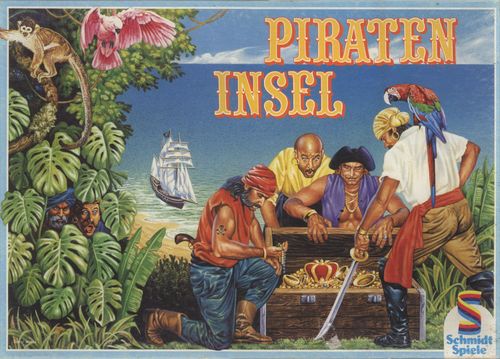
Pirate Island
Pirate Island Rulebook
Table of Contents
Table of Contents
1. Components
Pirate Island contains:
- 1 game board
- 2 dice
- 24 pirates; 6 in each colour
- 4 ships; 1 in each colour
- 1 storm card
- 6 treasure chests of the same colour, one of which is specially marked
- 1 rulebook
2. Setup and Start of the Game
Before the treasure chests are distributed, all of them are thoroughly shuffled so that no player can remember which one holds the treasure. The treasure chest is marked with a coloured dot on its bottom.
One treasure chest is placed in each of the six sectors around the volcano in the centre of the board. The relevant fields are numbered so that the chests can be assigned by a dice roll. For example, if a "4" is rolled for sector 1, the chest must be placed on field 14. Each player then chooses a pirate band and the ship of the matching colour, but does not yet place either on the board.
The game begins with the player who rolls the highest number on one die. That player rolls two dice. If the player rolls a "7" or higher, they may move their ship into a harbour. The other players then follow in clockwise order. At the start of the game, a ship may only be moved into an unoccupied harbour.
3. Structure of a Round
During a round, each player may take one turn. A turn consists of:
- Movement phase
- Event phase (does not always occur)
- Combat phase (optional)
4. Movement
Once a player's ship has reached a harbour, the player rolls two dice in the following round. The result is the movement points (BP) that the player's pirate band has available in this turn (but see also doubles, section 5).
Movement points may be used to move ships into another harbour, to let pirates disembark or embark, to move pirates on the island, or to load the treasure aboard. Any combination of these options is allowed.
The individual types of movement cost the following BP:
- Move ship to another harbour: 8 BP
- Disembark or embark (without treasure): 6 BP per pirate
- Swamp field: 2 BP per pirate
- Hill field: 2 BP per pirate
- Mountain field: 3 BP per pirate *
- Plain: 1 BP per pirate
- Fortress: 1 BP per pirate
- Crossing a river: +1 BP per pirate
- Loading the treasure aboard: see section 12
* The asterisk is printed in the movement table but the rules give no footnote for it.
Example: A player rolls an "11" and moves a pirate without the treasure out of the ship (6 points). The same pirate then goes one more field inland onto a plain (1 point). Another pirate of the band crosses a mountain field and then enters a plain field (3+1=4 BP). The player has thus spent 11 BP.
A pirate carrying the treasure always pays double the BP listed above. Exception: crossing a river (+1). No more than 7 BP may be spent on a single pirate, unless that pirate carries the treasure chest. In that case the pirate may spend at most 9 points.
A player does not have to spend all BP. Unspent BP cannot be saved; they lapse automatically at the end of the turn.
No more than one pirate may end its movement on the same field. Pirates in motion may, however, move through fields occupied by the player's own pirates. Fields occupied by enemy pirates may never be entered. The crater in the centre of the board cannot be entered. Lakes may not be entered.
5. Doubles (Pasch)
If a player rolls doubles while determining movement points, the player may not use the points to move their pirates or ship. Instead, one of the following events occurs (event phase):
- Doubles 6: New recruits. If one of the player's own pirates is in the Totenkiste (see below), the player may bring it back into play. The new recruit is placed either on the player's own ship, in an unoccupied fortress, or on an unoccupied enemy ship.
- Doubles 5: Storm at sea. All ships must remain in their harbours. Embarking, disembarking and loading the treasure are not allowed. As a reminder of this event, the storm card is placed on the board. At the next doubles the storm is over, unless doubles 5 is rolled again.
- Doubles 4: Moving a ship. The player may move their ship into a harbour in which an enemy ship already lies. For this, the player's own crew must be larger in number than the enemy ship's crew. The enemy ship may then be moved, with its entire crew, to another, unoccupied harbour. If the enemy ship is unoccupied, the player may also gain control of it by placing at least one pirate from their own ship's crew on it.
- Doubles 3: Fog. One of the player's own pirates loses its way on the island. The player to the left of the player whose turn it is may move one pirate of that player's band in any direction, observing the movement rules, by up to three fields.
- Doubles 2: Volcano eruption. The player must roll one die to determine which sector (1-6) is affected by the eruption. All pirates in that sector are in danger of being engulfed by the lava and going to the Totenkiste (see rescue rolls).
- Doubles 1: Fever. All pirates of the player whose turn it is are in danger of succumbing to a deadly fever, especially those currently on a swamp field (see rescue rolls).
6. Rescue Rolls
Pirates who are in danger of being engulfed by lava or struck down by fever have a chance to escape their fate. The player in charge of the pirates states the order in which they want to make the rescue rolls for their pirates. The player then rolls two dice. Depending on the situation the pirate is in, different results must be reached for success. If the roll fails, the pirate is placed in the Totenkiste. Otherwise, the pirate continues the game unharmed.
Volcano eruption: required dice result
- Pirate on a field directly adjacent to the crater: 9+
- Pirate one field away from the crater: 8+
- Pirate two fields away from the crater: 7+
- All pirates on unnumbered fields are safe.
Fever: required dice result
- Pirate in a swamp field: 7+
- Pirate in a field adjacent to a swamp field: 6+
- Pirate in another field in the interior of the island: 5+
- Pirate in a coastal field: 4+
- Pirate aboard a ship: 3+
For the fever, only the pirates of the player who rolled the doubles are affected.
7. Combat
Each pirate on the island may, during a turn in the combat phase, attack an enemy pirate. After the movement or event phase, the player whose turn it is announces which enemy pirate(s) they want to attack. To carry out an attack, at least one of the player's own pirates must be in a field adjacent to a field occupied by the enemy pirate. Several pirates may attack together, but only one enemy pirate may be the victim of an attack.
To determine the outcome of combat, the player whose turn it is (the attacker) rolls two dice. The other player is called the defender.
Combat result: required dice result
- Defender is killed (Totenkiste): 11 or more
- Defender is beaten and flees. The attacker may move the defender five fields in any direction away from the combat field: 9-10
- Nothing happens: 5-8
- Failure. An attacking pirate is killed. It goes to the Totenkiste. The defender chooses which pirate has been killed: 4 or less
Attacker bonus (based on the number of attacking pirates)
- 1 pirate: no bonus
- 2 pirates: +1 dice point
- 3 or 4 pirates: +2 dice points
- 5 or 6 pirates: +3 dice points
Defender modifiers (good defensive position)
- Defender in a field with a fortress: -3
- Defender in a mountain field: -2
- Defender attacked only across a river: -1
All applicable minus points are added together.
Example: A player attacks an enemy pirate with two pirates. The enemy pirate is in a fortress behind a river. The dice result is 9. One point is added (2 pirates). Then 4 points are deducted (fortress field behind a river). This gives a result of 9+1-4=6. According to the combat table, nothing happens to either party.
Attention: If a defender is surrounded on all six sides by attackers, or has no free retreat path because of impassable fields (volcano, lake), the defender is killed on every successful attack (9 or more). Fleeing pirates that carried a treasure chest leave it on the combat field. After a successful combat, the attacker may let one of the attacking pirates occupy the vacated field (and pick up any treasure chest left there). The defender is not allowed to do this if the attack ends as a failure.
8. Totenkiste
All killed pirates immediately leave the playing area and are placed on the field with the pirate flag. It does not matter how the pirates lost their lives.
9. Ships
Ships may only be located in the ten fields marked as harbours on the board. To move a ship from one harbour to any other, unoccupied harbour, at least one of the player's own pirates must be aboard. Ships cannot be attacked. However, pirates aboard a ship may attack enemy pirates in a field adjacent to the harbour symbol.
10. Landing Places
The ten landing places are marked by a skull or a fortress and always lie next to a harbour field. Only via a landing place can pirates go ashore or return aboard. The treasure can only be brought onto a ship from a landing place.
11. Discovering the Treasure
Only one of the six treasure chests placed on the slopes of the volcano contains the treasure. Each time a player enters a field with a chest, the player takes it and checks, without the other players seeing, whether it contains the treasure. The player now knows whether the treasure is at this location and places the chest on their pirate figure.
If the treasure is in the checked chest, the player may, on their next turn, have the pirate take it along, or put the chest back on the field and move the pirate out, or finally leave the pirate with the chest standing on the field. This allows the player to mislead opponents and wait for a more favourable opportunity to take the treasure.
If the chest does not contain the treasure, the player must leave it on the field.
The pirate equipped with the chest now has the important task of bringing it as quickly and safely as possible aboard one of the player's own ships. Note that a pirate loaded with the chest must always spend double the BP per field entered, and may move no more than 9 BP in total.
12. Loading the Treasure
If a player has succeeded in bringing the treasure safely with the help of a pirate to the landing place of one of the player's own ships, the treasure can be loaded aboard on the player's next turn, provided at least one of the player's own pirates is in the field with the landing place.
The treasure cannot be loaded if a storm is blowing, or if an enemy pirate is in a field adjacent to the landing place.
Loading the treasure costs the following BP:
- Normal landing place: 9 BP
- Landing place with fortress: 8 BP
Whoever succeeds in bringing the treasure aboard is the winner, even if not all pirates are aboard the ship.