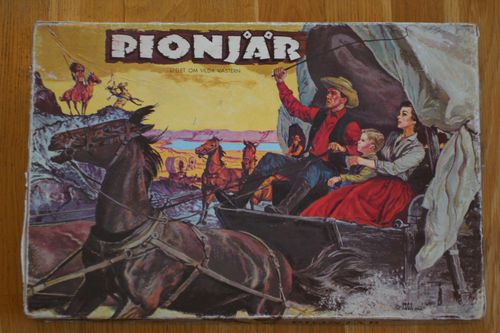
Pionjär
Pionjär Rulebook
Table of Contents
Table of Contents
- Components
- Number of Players
- Preparation
- How to Play
- Moving Into the Country (Färden in i landet)
- The Almanac (En "almanacka")
- Selling Harvests and Timber (Försäljning av skördar och timmer)
- Paying Off Property (Lösen av egendom)
- Post and Telegram (Post och telegram)
- Hunting and Fishing Trails (Jakt- och fiskestigarna)
- The Saloon (En saloon)
- Trading Post (Handelsboden)
- Auctions (Auktioner)
- Fur Trappers (Pälsskojare)
- Prison (Fängelse)
- End of the Game (Spelet är slut)
Components
The game consists of:
- 1 game board
- 1 marking board
- 6 playing pieces in the form of prairie schooners
- 2 Indians
- 9 marking pegs in the form of buffalo heads
- 6 property cards
- 24 buffalo cards
- 12 fish cards [?] (printed as "finkkort", read as fiskkort)
- 12 harvest cards
- 12 timber cards
- 6 gold cards
- 12 post cards
- 12 proclamation cards
- 120 banknotes in various denominations
- 1 die
- 1 house
Number of Players
2 to 6 persons can take part in the game.
Preparation
Shuffle the post cards and the proclamation cards separately, and place each as a face-down stack on its own space on the game board.
Likewise shuffle separately the three stacks of buffalo, fish and gold cards, and place each face-up on its matching space on the game board.
Choose one of the players to be the banker, and another player (or possibly the same person) to take care of the marking board.
Place 10,000 at the Saloon on the game board.
Give each player 5,000 as starting capital, and one prairie schooner, which is used as the playing piece. The prairie schooners are set up on the starting space.
How to Play
Moving Into the Country (Färden in i landet)
Following the yellow dots and the road is a common start for everyone. In Missouri the players divide up into the various properties, but the distance is the same for everyone. The properties have somewhat different values. The best are Green Valley and Buffalo Head [?], followed by High Falls and Great Lakes, and last come Golden Mountains and Silent Forest.
Movement takes place with the help of the die, and you always move the number of steps the die shows. The faster you reach a property, the better.
Black dot (svart prick): If you land on a black dot, you meet a first problem. A downpour has washed out the road, and you are forced to skip a turn to repair it.
Red dot (röd prick): If you land on a red dot, you have been lucky and found a good road, and you may move five extra steps.
If several players head for the same property, the one who arrives first naturally gets it, while the others must go back and look for other properties.
When you reach the end point, you have arrived at the area that is to become your new home. Move the prairie schooner directly to the Land Office in Pioneer City, in the upper left corner of the game board. At the Land Office you "register" your claim and receive a card as proof of your property. You have become a squatter. From then on you normally move clockwise around the game board on the square spaces, and you no longer move by the die but by the almanac.
While you are in Pioneer City, you should also take the opportunity to buy equipment and tools, so that you can run farming and forestry on your property.
If you have, for example, received Green Valley, the card over this area shows that it comprises three farmland fields of 40 acres each, and a stand of forest of likewise 40 acres. You should therefore buy three cards with a harvest scythe [?] and one with an axe, at 500 for each card. You place these on the spaces of your property card: the card with the axe goes on the forest space and the other cards on the farmland spaces.
The Almanac (En "almanacka")
The almanac is found partly on each property card and partly on the marking board. Time counting begins as soon as the first person reaches a property and claims it, and becomes a squatter. A marker peg (buffalo head) is placed in the hole on the marking board that marks January 1858. The next time the squatter who first became a squatter is due to move, he moves clockwise around the board on the square spaces, as many steps as the number given for January 1858 on his property card. When it is his turn again, the marker peg is moved to February 1858, and he moves the corresponding number of steps according to his card, and so on.
Players who are still on their way to their properties, after the time count has begun, continue to move by the die until they have claimed their respective properties. When they then begin their trip around the board, they start in the month that is currently marked in the almanac on the marking board. It is therefore only the one who first reaches the Land Office who starts in January 1858.
Time never stands still. If the first squatter should ever have to skip a move, the marker is nevertheless moved forward one month at the point when he would have moved, had he not had to skip.
Selling Harvests and Timber (Försäljning av skördar och timmer)
Sales take place during the journey around the game board, whenever you come to a space with the order "sell" and, beneath it, pictures of a harvest scythe [?] or an axe respectively. You must then sell, and you receive the prices stated on each "grain" and "axe" card. Note that prices differ at different times, so do not forget to check the month and year on the almanac of the marking board. Prices may further be raised or lowered by proclamations.
When selling, you return the cards to the bank. New cards may be bought the next time you visit Pioneer City.
Paying Off Property (Lösen av egendom)
During the first lap around the game board you do not yet own your land. As soon as you have completed this lap, you must redeem the property at the Land Office in City (Pioneer City) for the amount stated on the marking board.
If you do not have enough money to pay the redemption sum, you may nevertheless continue to farm the land, and you may later become its owner. You are, however, then forced to pay the property's full value, which is considerably higher than the redemption sum. (See the marking board.)
There is therefore every reason to be frugal during the first lap!
Post and Telegram (Post och telegram)
When you come to a space with one of these markings, take the top card of the corresponding stack and follow its instructions. Cards that are not to be kept are set aside. When the cards run out, shuffle the used cards and place them again on the game board.
Hunting and Fishing Trails (Jakt- och fiskestigarna)
The hunting and fishing trails, where you can also find gold, begin at the upper left, and you may enter them at any time during the game, once you have passed the road.
Once on the hunting trail you no longer move by the almanac but roll the die and move the number of steps it shows. If you thereby reach a circle with a buffalo, a fish or gold, you receive the corresponding card (the top one). The trade value is stated on the back of the card. When you leave the trail, which can be done to the right on the game board or at the bottom edge, you move again on the square spaces according to the almanac.
If the player who first became a squatter is on the trails, the time marker on the almanac is nevertheless advanced in the normal way, each time that player is due to roll.
Indians (Indianer): Indians are placed out now and then on the hunting or fishing trail. If you happen to land exactly on an Indian circle, where an Indian stands, you lose your entire haul of gold, buffalo and fish. If you instead pass a placed Indian, you fare better. You must admittedly give up your haul, but you still receive money equal to half the value stated on the back of the cards.
Selling hunting spoils, fish and gold (Försäljning av jaktbyte, fisk och guld): Sales take place when you come to one of the spaces with the instruction "sell" above the pictures of buffalo, fish and gold. You receive the prices stated on the backs of the cards, unless they have been changed by a proclamation. You must sell when you reach a "selling space".
When selling, the cards are handed to the bank and removed from the game.
The Saloon (En saloon)
A saloon is of course included, where all sorts of people gather to play games and gamble. But even an idle fellow may try his luck, and you may do so too if you feel like it, once you have passed the road.
Stake the amount you can afford and roll the die. If it shows:
- 1: you get your stake back
- 2: you get your stake plus 2 times the stake
- 3, 4 or 5: you have unfortunately lost
- 6: you get your stake plus 6 times the stake
You can of course not win more than is in the saloon. If, for example, you have staked 5,000 and roll a six, and there is no more than 20,000 in the saloon, you do not get more either. If, on the other hand, there is, for example, 50,000 in the saloon, it is enough for a full payout, i.e. 5,000 + 6 × 5,000 = 35,000.
The basic capital in the saloon is 10,000, and this amount is increased by the losses the players may make. In addition, the bank pays 10,000 into the saloon every January.
If you have rented the saloon, which you may do after notice on a post card, you may become rather wealthy, since everything left in the saloon in December of that year falls to you. But it may also happen that a bold player with luck "plays your shirt off" you. Let us say that there is 50,000 in the saloon and a player comes in and stakes 10,000 and happens to roll a six. Then everything disappears. Strictly speaking the player should have won 10,000 + 6 × 10,000 = 70,000, but, as in the example above, he must be content with what is in the saloon.
At the end of the game, in December 1862, all the players gather in the saloon and play for everything that is there. Each one rolls the die once, and the one who rolls highest gets the whole amount. If the saloon has been rented out, this naturally does not apply, and the balance instead falls, in the usual way, to whoever rents the saloon.
Trading Post (Handelsboden)
The trading post in Pioneer City is for sale. Whoever buys it keeps it for the rest of the game, and receives the income from all auctions of buffalo and gold. The price is 7,000, and a purchase can only be made when visiting Pioneer City.
The owner of the trading post places the green house on his property card.
Auctions (Auktioner)
Now and then auctions take place for buffalo and gold. When a proclamation of an auction is made, all the players gather in Pioneer City, and the owner of the trading post conducts the auction. If there is no owner of the trading post, the person who runs the bank acts as auctioneer.
The auctioneer takes the number of buffalo or gold cards stated in the proclamation, without showing them to any of the players and without looking at them himself, to see what the cards are worth.
The cards are auctioned off one at a time. They go to the highest bidder, and only against cash payment. The payment is made to the owner of the trading post or, if the trading post is unowned, to the bank.
The values of the buffalo cards vary between 1,000 and 3,000, while the values of the gold cards lie between 2,000 and 10,000. If you are lucky you can make a good deal, and if you are unlucky you have had to pay more than the card is worth!
Fur Trappers (Pälsskojare)
Fur trappers are shown on 4 spaces on the game board. If you come to one of these spaces and have buffalo cards, one or more, you must sell them all at half their value. If you are sheriff, which you may have become through a notice on a post card, you must also sell buffalo cards on the fur trapper spaces, but you do not let yourself be cheated, and you receive the values stated on the cards.
Any proclamations about price changes on buffalo do not apply to sales at the fur trapper spaces.
Prison (Fängelse)
If you are "locked up" (inburad), you move your playing piece to the circle in the lower left corner of the game board, to "sit inside" for two months. The time when you are released is stated on the marking board. For example, if you go to prison in March of a year, you must sit inside April and May, and so you come out in June. A marker peg is then placed in June at the prison space on the marking board. The peg is removed when you come out.
End of the Game (Spelet är slut)
The game ends in December 1862, unless the players have agreed before the start to end it at an earlier time. The winner is the one with the largest capital in land, gold, hunting and fishing spoils, and cash.