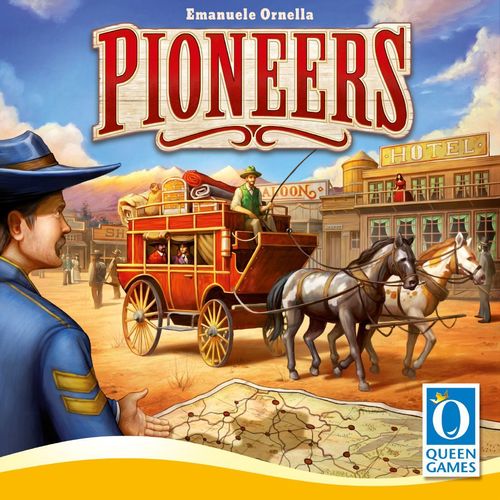
Pioneers
Pioneers Rulebook
Table of Contents
Table of Contents
Box Contents
- 1 Game board — double-sided: one side for 4 players, one side for 2 & 3 players
- 49 Pioneer tiles — 7 each of Banker, Barkeeper, Merchant, Sergeant, Gold digger, Farmer and Hotel
- 80 Pioneers — 20 each of Blue, Green, Red and Yellow
- 24 Coaches
- 4 Starting coaches (which are longer than the other 24 coaches)
- 4 Player boards — 1 each of Blue, Green, Red and Yellow
- 4 Shop tiles — 1 each of Blue, Green, Red and Yellow
- 8 Covering tiles
- 10 Gold nuggets — 6× 3 victory points, 3× 4 victory points, 1× 5 victory points
- 45 Dollar coins — 27× 1 Dollar, 18× 2 Dollar
- 60 Roads — 15 each of Blue, Green, Red and Yellow
- 4 Scoring markers — 1 each of Blue, Green, Red and Yellow
- 1 Stagecoach
- 1 First player marker
- 1 Rules booklet
Note: The image of a 1 or 2 Dollar coin on any of the components means that players will earn this much money. Just a number preceded by the Dollar sign means that players have to pay this much money.
Setting Up The Game
-
Place the game board in the center of the playing area, its side matching the number of players up.
Only when playing with two players, place the covering tiles on city spaces at the edges of the game board, as shown in the illustration. These spaces will not be used in this game. (The stagecoach can not travel onto or through these spaces.)
-
Depending on the number of players, remove the following pioneer tiles:
- In a 2-player game, remove two tiles each of Banker, Barkeeper, Merchant, Sergeant, Gold digger, Farmer and Hotel; return all these tiles to the game box.
- In a 3-player game, remove one tile each of Banker, Barkeeper, Merchant, Sergeant, Gold digger, Farmer and Hotel; return all these tiles to the game box.
- All pioneer tiles are used in a 4-player game.
Flip all remaining pioneer tiles to their back and mix them thoroughly. Randomly place one tile each on each city space. Finally, turn all pioneer tiles front side up.
Any leftover tiles will not be used in this game, and are returned to the game box.
Note: If two identical pioneer tiles were placed on both city spaces next to the starting space "Boston", exchange one of them with one of the remaining tiles.
-
Randomly determine a first player and give them the first player marker.
Sort the Dollar coins by their value, and keep them near the game board as common supply. Mix the gold nuggets face-down, and put them next to the game board as well.
Place the stagecoach on the starting space "Boston".
-
Mix all coaches, except for the 4 starting coaches (longer than the normal coaches), face down and stack them next to the game board. Depending on the number of players, take a certain number of coaches from top of the stack, and return them to the game box without looking at them.
Number of Players
Playing the Game
Pioneers is played over a series of game rounds. Starting with the first player, and the other players following in clockwise order, each player takes their turn. The game ends after that game round during which at least one player has constructed all their roads, and/or the stack of coaches has been emptied, whatever happens first. Then, the final scoring takes place.
A player's turn in detail
A player's turn consists of 3 phases, to be performed in this order:
- Phase 1: Bank
- Phase 2: Purchase
- Phase 3: Movement and Colonizing
Then, the next player takes their turn.
Phase 1: Bank
The player receives their Dollar income from the common supply.
The amount of their income is shown on the player board in Section 1: Bank.
The basic income is 3 Dollars.
If a player gains a Banker tile during the course of the game, they place it on a free space of the Section 1: Bank of their player board. For each Banker tile the income is increased by 1 Dollar. A player may have no more than 2 Banker tiles.
Example: Bill (green) takes $4 from the common supply: $3 as his basic income and $1 because he already has acquired one banker tile.
Phase 2: Purchase
By using their shop tile, a player may buy roads or a new coach.
Section 2: Purchase of the player board shows three possible purchase actions:
- The player may buy one road from their personal supply for 2 Dollars, and place it on the game board immediately.
- The player may buy two roads from their personal supply for 5 Dollars, and place them on the game board immediately.
- The player may buy one of the four coaches from the coaches display, paying the purchase price as shown on the game board.
In order to use one of the three purchase actions, the player moves their shop tile onto the corresponding purchase space, and then performs that action.
If a player gains a Merchant tile during the course of the game, they place it on a free space of the Section 2: Purchase of their player board. For each Merchant tile, the player may perform one additional purchase action during their turn. The player moves the Merchant tile onto one of their unoccupied purchase spaces, and then performs that action. A player may have no more than 2 Merchant tiles, additionally to their shop tile.
Example: Katie (yellow) places her shop tile on the one road purchase space, pays the $2 and places one of her roads on the game board. Additionally she uses her merchant tile to buy one coach from the display of coaches.
Note: A purchase action covered by a tile cannot be used again during this turn.
The purchase actions in detail
Buying and placing roads: The player pays the cost of their chosen action to the common supply and constructs the road(s) on the game board, taken from their personal supply. A road may be placed on any line connecting two cities that has not a constructed road on it. Once one road is constructed on such a line, no other road may be constructed there.
Example: Annie (red) has payed $5 to construct two roads. She places one road directly in front of the stagecoach, the other she places in a spot, where she hopes to profit from later in the game.
Buying a coach from the display: The player decides for one of the four coaches from the display, and pays the purchase price as shown on the game board above that coach to the general supply. Then, they place the coach in front of them, then place one pioneer from their personal supply on each vacant space of the coach.
Please note: If the player has not a sufficient number of pioneers in their personal supply to fill all spaces of the coach, they may not buy that coach!
Important: If a player does not own any coach at the start of their turn, they must use their purchase action to buy a coach from the display.
Replenish the display after a coach has been purchased. Shove the remaining coaches to the left, leaving the fourth space ($4) of the display free. Take the topmost coach from the stack and put it face up on that space.
Example: Jim (blue) pays $2 to take the second coach from the display. He places the coach in front of him placing one pioneer on each vacant space of the coach. Then the display is refilled.
A player may decide to forfeit the purchase action and proceed straight to Phase 3: Movement and colonizing (unless they have no coach currently, in which case they have to purchase a coach).
Phase 3: Movement and colonizing
a) Move the stagecoach
The player moves the stagecoach along the connecting lines from one city to the next. They have to pay 1 Dollar for each movement along one line.
- In case there is no road on the line, they must pay the money to the common supply.
- In case there is a road on the line belonging to another player, they must pay the money to that player.
- In case there is the player's own road on the line, the movement is for free.
Example: Katie (yellow) moves the stagecoach 3 times. She has to pay $1 to the common supply, $1 to Annie (red) and the last move is over one of her own roads, so she does not have to pay $1.
If a player moves the stagecoach along a connection with two roads, they must pay 1 Dollar each to both players. However, if one of the roads is their own, the movement still is for free.
Important: The maximum number of roads connecting two cities is two!
Example: Annie (red) places the road right next to the yellow road.
b) Settle your pioneer in a city
When the player moves the stagecoach to a city containing a pioneer tile, they must end the movement there. Then, they replace the pioneer tile from that city with one of their own pioneers. That pioneer must come from a corresponding space (same image as the tile) in one of the player's own coaches.
If the pioneer tile is a Hotel, the player may place any pioneer from their coaches on that city.
Important: A player must move the stagecoach, if he can reach a city with a pioneer tile for which he has a corresponding pioneer on one of his coaches. If he has no matching pioneer on one of his coaches or has not enough money left to pay for the movement, they must pass, and are not allowed to move the stagecoach. The stagecoach may never end its movement in a city without a pioneer tile.
Example: Annie (red) has only $1 left, which let's her move the stagecoach one space. Since she has no barkeeper or farmer on one of her coaches, she can only move to the city with the hotel or the sergeant. She decides to move to the city with the sergeant tile to take the tile and place her corresponding pioneer on the city.
c) Perform Special actions
Next, the active player performs the special action of the pioneer tile they had just replaced with their pioneer.
There are two types of special actions: permanent actions and immediate actions.
Permanent special actions:
- Banker: The tile is placed on a free space in Section 1: Bank of the player's own board. Starting with their next turn, the player's income during Phase 1: Bank is always increased by one Dollar for each of their Banker tiles. A player may have no more than 2 Banker tiles. Any further Banker tile they would gain is useless, and put back into the game box.
- Merchant: The tile is placed on a free space in Section 2: Purchase of the player's own board. Starting with their next turn, the player may always perform one additional purchase action during Phase 2: Purchase for each of their Merchant tiles. A player may have no more than 2 Merchant tiles. Any further Merchant tile they would gain is useless, and put back into the game box.
Immediate special actions: These actions must be performed immediately when the tile is taken. Subsequently, the tile is put back into the game box.
-
Sergeant: The player may construct one road from their personal supply on the game board for free. a) It may be placed on any unoccupied connection line. b) It may be placed on a connection line already occupied by exactly one road of another player.
-
Barkeeper: The player may return any one pioneer from any one of their coaches to their personal supply. If they have no pioneers on their coaches at this time, the action is wasted.
Example: Jim (blue) moves the stagecoach onto a city with a barkeeper tile. He takes the tile placing his barkeeper pioneer on the city. Then he uses the immediate action of the barkeeper to take his banker pioneer and place it back into his personal supply.
-
Gold digger: The player takes one gold nugget from the common supply, may secretly look at it, and keeps it face down in front of them.
-
Farmer: The player may settle up to two more pioneers in that city. These additional pioneers must come from "Farmer" spaces in their coaches.
Example: Katie (yellow) moves to a city with a farmer tile. In total she places 3 farmer pioneers from her coaches onto that city.
-
Hotel: The player gains 3 Dollars from the common supply.
Empty Coaches
As soon as a player manages to empty one of their coaches completely (there are no more pioneers in the coach), the player advances their scoring marker on the scoring track by the number of victory points shown on that coach.
Additionally, they flip the coach to its back and immediately gain 1 dollar from the common supply.
The coach is then discarded.
Example: Katie (yellow) has emptied 2 of her coaches in one turn. She gets 7 and 4 victory points. Then she turns both coaches on the other side, takes $2 dollars, $1 for each coach. At last she discards both coaches.
d) Invite other players to settle one of their pioneers
Finally, exactly one other player gets the chance to settle one of their pioneers in that city. The active player invites the other players, one after the other in clockwise direction, if they want to join them settling in that city for 2 Dollars. The first player to agree must pay 2 Dollars to the active player, and then places one pioneer from one of their coaches in that city, matching the pioneer tile that was taken from that city. The player must not perform that pioneer's special action. Any remaining players will not be asked anymore. It may happen that no other player wants to join in or cannot do so.
Important: If the active player had placed any pioneer of their choice due to a Hotel tile, the player joining them must place a pioneer of the same kind.
Example: Bill (green) moves to a city with a hotel tile. He places a banker pioneer on the city and then asks in clockwise direction if another player wants to join. Annie (red) does not have a banker pioneer, so Jim (blue) is asked next. Since Jim has no money left, finally Katie (yellow) is asked. She pays Bill $2 and also places a banker pioneer from one of her coaches on the city.
At the end of their turn, the active player returns the shop tile and any used Merchant tiles to their dedicated spaces in the upper part of Section 2: Purchase of their player board.
Then, the next player in clockwise direction takes their turn.
End of the game and final scoring
The game ends after that game round during which at least one player has constructed all their roads, and/or the stack of coaches has been emptied (meaning the last coach is flipped up and put into the display), whatever happens first. The players continue playing until the right neighbor of the first player has finished their turn. Then, the players proceed with the final scoring.
During the final scoring the players are awarded victory points for the following:
-
Empty coach spaces — Each empty space in all of a player's coaches still holding at least one pioneer is worth 1 victory point.
Example: Annie (red) gains 2 VP.
-
Gold nuggets — Each gold nugget is worth as many victory points as shown on the nugget's front side.
Example: She gains 9 VP total for her gold nuggets.
-
Largest road network — Each player gains 2 victory points for each pioneer connected to their own largest contiguous road network.
A pioneer is part of a particular road network, if the pioneer's city space is connected by road to that network. It is not necessary for all pioneers within a player's network to be that player's own pioneers. It is sufficient that all roads connecting one pioneer to the next belong to the same player and are uninterrupted by other roads. Junctions are allowed, they merely expand the network.
Important: A player's largest network is that network of theirs including the most own pioneers of that player, not necessarily the network made of that player's most roads!
Example: Annie (red) has constructed two road networks. The top one is the larger one connecting 9 pioneers along 6 roads. She gains 2 VP for each pioneer in that network, resulting in a total of 18 VP.
The player with the most victory points is the winner of Pioneers! In case of a tie for the most victory points, the tied player owning the most Dollars is the winner. If the tie persists, the tied players share the victory.
Hints and Tricks
- Paying $2 to a player to place a pioneer alongside theirs on a city can be very lucrative, despite the fact that he can not use the special action of the pioneer tile.
- They get to empty their coaches faster, which brings money and victory points.
- If there are only little amounts of the same pioneer tiles left on the game board, that is a good way to ensure that you can place that particular pioneer.
- The pioneer may directly integrate into their road network.
- If a player has pioneers of which kind there are no corresponding pioneer tiles left on the game board, there are still two ways to place those pioneers:
- A hotel tile allows to place a pioneer of the player's choice.
- The special action of the barkeeper allows to take any one pioneer from a coach, placing it into their personal supply.
- Extending the road network not only awards victory points at the end, it also can generate money during the game, when other players move the stagecoach along those roads. Additionally, a big road network allows to travel great distances with minimal costs making it more flexible which city to approach next.