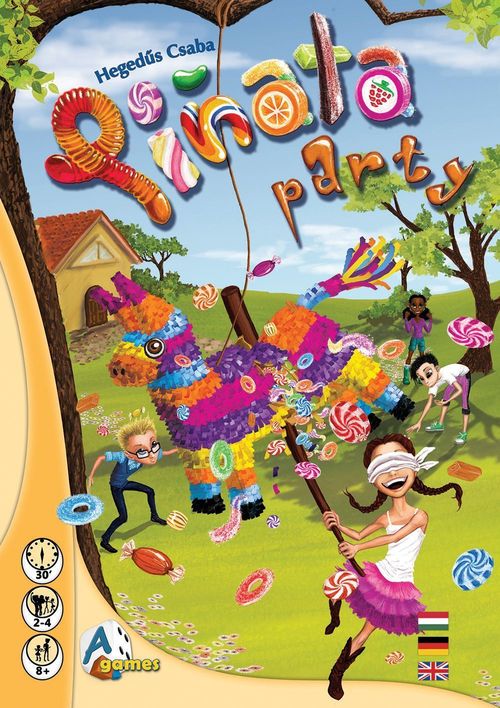
Piñata Party
Piñata Party Rulebook
Table of Contents
Table of Contents
Summary
The players try to collect the tastiest and most valuable candies from the grass. All players must perform 2 moves with a candy before any can be picked up. Be the most vigilant and you are guaranteed a sweet time.
Contents
- 4 double sided boards – one side divided into 5x5, the other into 4x4 squares
- Scoring frame, constructed from 8 puzzle pieces
- 48 candies, 8 of each colour (green, yellow, white, blue, orange, purple)
- 8 score markers, one of each colour
- 10 movement cards
- 3 scoring cards
- 1 movement card for little candy lovers
- 1 scoring card for little candy lovers
- 1 rulebook
- Stickers
Setup
Before the first game, attach the candy stickers to the wooden candy markers, each corresponding to its own colour. The box contains 2 stickers for each marker.
Place the 4 boards (with the 5x5 side facing up) on the table forming a 10x10 square shape. The boards can be rotated in any direction, resulting in different flower placement in each game. When the boards are set, connect the puzzle pieces around them. Place a candy on each of the flowers corresponding to its colour. Shuffle the 10 movement cards and the 3 scoring cards, then draw 2 movement cards and 1 scoring card from the stacks. Place them facing up next to the board. Finally each of you have to choose to yourself a scoring frame. With these frames you can indicate your acquired points at the end of the game. The player that can eat the most sweets in a minute is the starting player.
Game overview
Players take turns in clockwise order. Each player has 3 actions per turn.
1st and 2nd action: The active player selects a candy, this will be the active candy. When a tower is built and/or selected, all elements are considered as active. Then the active candy or candy tower is moved on the board according to the movement cards next to the board. The player has 2 moves each turn, both moves must be made with the same active candy or candy tower. The player decides the order of moves. Following the second move, due to the movement a group of candies must be formed in which at least 2 candies of the same colour must be side by side (Example 1). If no such groups are formed, the move cannot be made.
Important: Both moves cannot be the same, both movement card actions must be carried out each turn. Both moves must be made with the same active candy.
3rd action: The player is then rewarded for the previous moves. He/she looks for groups of candies for which all of the following conditions are true, and takes the candies in these groups.
- Consists of the same colour candies that are next to each other (not diagonal).
- Consists of at least 2 candies.
- At least one of the candies of the group was moved during actions 1 and/or 2, and ended up in a different square.
- When building a tower, only the top candy in the tower is considered; so only the surrounding candies that are the same colour as the top candy can be removed from the board. If after its removal more colour matches are revealed, the player can continue to collect more candies as long as there are colour matches left. If the player has built or moved a tower during the first or second actions, then all candies in the tower are considered active and moved.
Important: It may happen, that during setup a group of same coloured candies are placed next to each other. If a player has not moved any of the candies of this group during actions 1 or 2, and no new candies of the same colour were moved next to this group during those actions, then the candies of this group cannot be removed during action 3 (Example 2).
Note: If the active player after several tries cannot make a move resulting in the removal of any candies during the 3rd action, then this player must pass. Then the next player's turn begins. When the passing player becomes active again, he/she can again move and pick up candies if a legal move can be made.
After a player is finished with action 3, and has taken the candies or has passed, the next player to the left becomes the new active player.
Ending
The game ends when all players have passed on making a move. At this stage the scores are calculated.
Scoring
Scores must be added up and indicated by moving the markers on the scoring frame according to the scoring card placed next to the board. The player with the most points is the biggest sweet tooth, and is the winner. In the case of tied scores, the player with the least amount of candies is the winner.
Rules for movement cards
Hopscotch
The candy to be moved is placed behind the neighbouring candy in a horizontal or vertical line (not diagonal), on the next empty space behind it. The number of empty spaces between the 2 candies does not matter. If there is no empty space immediately behind the neighbouring candy (eg. there is another candy or the side of the board), then the selected candy cannot be moved.
Chase
The candy to be moved must be moved in a straight line next to the nearest candy in the row or column. At the end of the move, the moved candy must be stopped by another candy in the direction moved; if it is stopped by the side of the board, then the move cannot be made. The distance between the 2 candies does not matter. The moved candy must move at least 1 empty space on the board.
Labyrinth
The candy to be moved can make a maximum of 3 moves. The moves must be made in the horizontal or vertical direction (not diagonal), and must end next to the nearest candy or the side of the board. The candy must change direction after each stop, which can be in the opposite direction of the move just made. It is not necessary to make 3 moves! The active player can choose to make 1, 2 or 3 moves.
Long jump
The candy to be moved is placed behind the neighbouring candy or row of candies in a horizontal or vertical line (not diagonal), on the next empty space behind them. The number of empty spaces between the candies does not matter.
Leapfrog
The candy to be moved is moved vertically or horizontally (not diagonally) in line to any empty space. When selecting the empty space, the distance and the candies in between them do not matter. The candy must be moved at least 1 space.
Train
The candy to be moved and all other candies in the same column or row in the direction moved are moved to the side of the board. The chosen candy can be anywhere on the board. Candies cannot be pushed off the board, and at the end of the move only one candy can be on one space. If the player cannot push at least 1 candy a distance of 1 space, then the move cannot be made with the chosen candy!
Pileup
Using the candy to be moved, a pile of 3 candies must be built. This can be done in several ways. Either the player uses the 2 candies next to the selected candy in a line; or the player can place the selected candy on top of a neighbouring two high pile; or the player can move an existing two high pile onto the next single candy. In each case, the candy or candy pile can only move in one direction, it's not possible to change during building stacks. The number of empty spaces between the moved and the neighbouring candies does not matter. The selected candy or candy piles must always end up on top of the stack. Using this movement card, stacks of exactly 3 candies must be built; it cannot be more or less than 3.
Somersault
The candy to be moved is moved diagonally in any direction, so that it jumps over at least 1 other candy. The player decides which empty space is taken in the selected direction. The moved candy can only be placed on an empty space. When selecting the empty space, the distance and the candies in between them do not matter.
Horsey
The candy to be moved is moved vertically or horizontally (not diagonally) in a line on the top of any neighbouring candy or candy stack. The number of empty spaces between the candies does not matter. The height of the resulting stack of candies is not restricted. For example, it is possible to jump on top of a stack of 2 candies left on the board from previous turns, resulting in a stack of 3 candies.
Piggy back
The candy to be moved is moved vertically or horizontally (not diagonally) on the top of any other candy. The selected candy can go on top of any candy in the column or row. The height of the created stack is unlimited.
Candy stacks
During the game, stacks of candies might be formed, when candies are placed on top of other candies using certain movement cards (Horsey, Pileup, Piggy back). The following rules must be followed during building of stacks:
- Stacked candies always move together.
- Candies of the same colour on top of each other in a stack cannot be removed during action 3.
- When taking candies from the board, only the top candy in a stack can be considered. At all times only the top candy and the surrounding candies of the same colour are removed. If after a removal, further colour matches are revealed, the player may collect more candies according to the rules.
Example: The player removes 3 pink candies from the board, and a new colour pairing is revealed. He/she may then remove another 2 blue candies as well. Following removal, a pink candy will be on top again. This has no pair, so the player only gets the first 3 pink candies.
Reminder: Candies can only be removed after the second action is completed. After the second action, irrespective of the move, there must always be 2 candies of the same colour side by side for the move to be valid!
Scoring cards
Scoring card 1
The value of the candy depends on the number collected. 2/3/4/5/6/7/8 candies are worth 1/2/4/7/11/16/23 points. The candies are counted by players colour by colour separately, everyone adds up the scores for their own collection.
Scoring card 2
Scores are decided by majority, rankings are given based on who collected more of each colour. A player must have collected at least one candy of a given colour for that colour to be counted for scoring purposes. In case of a tie for a particular colour, all players receive points for the lower rank!
Example: Anette collected 3, Eric collected 2, Monica collected 2 and Attila collected 0 red candies. Based on this, Anette scored 7 points, Eric and Monica gains 1 point each and Attila gets 0 points for red. Monica collected 2, Attila collected 2, Eric collected 2 and Anette collected 0 blue candies during the game. Monica, Attila and Eric all gain 1 point from blue, while Anette got 0 points from this colour. From the yellow candies Eric collected 3, Attila collected 3, Anette and Monica both collected 2 pieces. Eric and Attila get 3 points, while Anette and Monica get 0 points from the yellow candies.
Scoring card 3
The value of the candy depends on the remaining candies of the same colour. Each candy is worth 0/1/3/6/10/15 points if 0/1/2/3/4/5 or more candies of the same colour remain on the board.
Example: Eric collected 3 red candies, while 2 reds are left on the board. Therefore his reds are worth 3 points each, so he collected 9 points from red candies. Anette collected 1 green candy while 4 greens remain on the board, so gathered 10 points from green candies.
Recommendations for beginner candy lovers
During the first few games, do not select the movement and scoring cards randomly, but instead try the following combinations:
- Level 1: Hopscotch, Chase, Scoring card 1
- Level 2: Train, Long jump, Scoring card 1
- Level 3: Labyrinth, Piggy back, Scoring card 2
Game variant for young candy lovers under 8 year
The 4 board pieces are placed in the same way as the base game, but using the other side, with the 4x4 squares facing upwards. Candies are placed on the flowers of the corresponding colour (2 of each colour should be left out). The supplementary movement card and the supplementary scoring card are placed next to the board. Let the fun begin.
Game overview
The game is played in the same way as the base game, with one notable exception. The active player can decide each turn if they want to use both or just one of the movement types found on the supplementary movement card. If they only perform one of the moves, any of the two moves can be selected; if both, the order of moves can be freely decided. If the player decides only to do one move, he/she may already remove candies from the board after this step, unlike in the base game rules.
The other rules, the end of game and the scoring is the same as in the base game.
Description of the supplementary movement card (Seesaw)
- 1st move (Piggy back): The selected candy can be moved to the top of any candy in the same row or column.
- 2nd move (Leapfrog): The selected candy can be moved to any empty space in the same row or column.
Description of the supplementary scoring card
The value of the candy depends on the number collected. 2/3/4/5/6 candies are worth 1/2/4/7/11 points. The candies are counted by the players separately colour by colour, everyone adds up the scores for their own collection, and adds them to the scoring track.