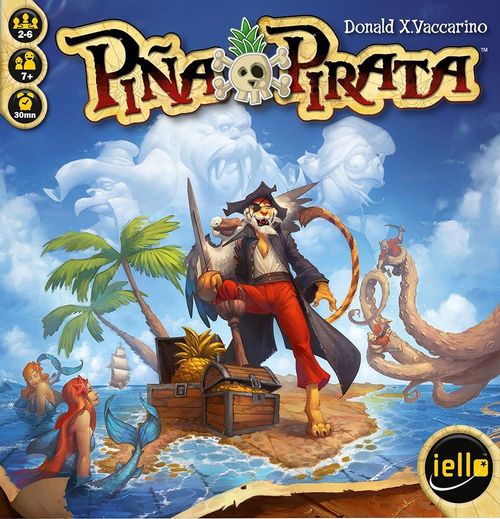
Piña Pirata
Piña Pirata Rulebook
Table of Contents
Table of Contents
Contents
- 55 Pirate cards
- 40 Adventure tiles
- 1 rulebook
The Game
In Piña Pirata, you pit your crew members against those of the other players in a series of rounds. Your goal each round is to be the first player to end his turn with an empty Hand. The winner of each round gets a piece of the treasure map.
Pirate cards have either one or two pirate types (Here Parrot and Walrus). Adventure effects can be triggered when you play a type of pirate.
A pirate on a card that has only one pirate is called a Solitary pirate.
Setup
- Shuffle the Pirate cards into a deck, and place it face-down in the center of the table. Provide a space next to it for the Action pile: this is where cards are played. Any time the Action pile is empty (for example at the start of the game), put the top card of the deck face-up on the Action pile.
- Shuffle the Adventure tiles face-down into an Adventure pile. Draw the first two tiles and place them face-up next to the Adventure draw pile. They represent the challenges and mishaps of your next voyage.
- Draw straws to determine the first dealer, or choose by any method you like.
- The dealer deals 8 cards (7 if there are 6 players) to each player. You may look at your cards.
Each player receives 8 cards. They make up his Hand.
Note: There are 10 types of pirates. Each card is a unique duo of two pirates, or a Solitary pirate. Each pirate is on 10 cards: 9 in a duo with each other pirate, and 1 Solitary.
How to Play
Starting with the player to the left of the dealer, players take turns, clockwise.
On Your Turn
- If one of the cards from your Hand has at least one pirate in common with the card on top of the Action pile, play it face-up on the Action pile. Check all Adventure tiles in play to see if you triggered a rule (see Adventures).
- Otherwise, draw a card (if there are no cards in the deck, shuffle all but the top card of the Action pile to make a new deck).
In either case, your turn is over and the next player is up.
Example: It is Vincent's turn and the card on top of the Action pile shows the Tiger/Rat duo. Thus, Vincent can either play a card with a Tiger, or a card with a Rat. He decides to play the Tiger/Octopus duo. It is now Marie's turn to play and she must play a Tiger or an Octopus. Because she has neither, she draws a card.
End of Round
At the end of your turn, if you have no cards left in your Hand, you win the round. The round ends immediately.
Draw the top three tiles from the Adventure pile, look at them, and pick one. Add it face-up next to the Adventure tiles already in play.
Put the second tile in front of you, with the Treasure Map facing up. You just found a piece of the Treasure Map!
Put the third tile on the bottom of the Adventure pile.
You are now the dealer. Shuffle all the cards together, and deal 8 cards to each player (7 if there are 6 players). Place the rest face-down as the deck in the center of the table. A new round starts. The player to your left is the new first player.
End of Game
There are two ways to play Piña Pirata:
Cruise Mode
In Cruise mode, play as many rounds as you want in a row, and add an Adventure tile at the end of each round. When the cumulative Adventures make the game too confusing or complex (usually when there are 8), shuffle all the tiles together and start a new game. You can add or drop players between rounds. When you're done playing, you can see who won the most rounds, but everyone who won a round is a winner.
Treasure Hunt Mode
In Treasure Hunt mode, your goal is to be the first player to reassemble the map and find the Golden Pineapple. During setup, give each player a tile that represents the first part of the Treasure Map.
Play as many rounds as necessary: The first player to collect three missing pieces of the Treasure Map wins the game. If you win a round in Treasure Hunt mode and 6 face-up tiles are already in play, discard one tile in play and replace it with one you just drew.
Adventures
Each Adventure tile brings a new rule that players must follow. If a tile contradicts the basic rules, the Adventure tile prevails.
Before each round, read the tiles carefully and make sure every player understands their effects. When in doubt, players should agree on a common interpretation.
Always resolve tiles from oldest to most recent.
If you can't do everything an Adventure tells you to, just do as much as you can.
Note: In Treasure Hunt mode, there are never more than 6 Adventure tiles in play at a time.
If you win a round and 6 Adventure tiles are already in play, the tile you choose replaces one in play. Remove the replaced tile from the game.
Example Adventures
The following tiles are shown as examples in the rulebook:
- Follow the Penguin — Whenever you play a Penguin, reverse the turn order.
- Man Overboard — Whenever you play a Parrot, put a card from your Hand on top of the deck.
- No Other Walrus — You cannot play a Walrus on a Walrus. The solitary Walrus is every pirate type (he can be played on any other pirate, and triggers all Adventure tiles that are triggered when particular pirates are played).
- Tick Tock — Whenever you play a Crocodile, the player to your left draws a card.
- Mating Season — The top card of the deck is face-up. While that card is an Octopus, Octopuses are Jokers.
Vocabulary
- Play a pirate: Put a card from your Hand onto the Action pile. The card you play and the card on the pile must have a pirate in common. Playing a pirate can trigger one or more Adventure effects.
- Discard a pirate: When a tile effect requires you to discard cards (from your Hand or from the deck), put the card on the Action pile without any restrictions (no need to match a pirate) and without triggering any further Adventure effects.
- Solitary: A solitary pirate is a pirate that is the only one on the card, with no other pirate in the illustration.
- Joker: When a pirate is designated as a joker, cards depicting this pirate can be played on any other card.
- In front of you: (Rabbit Hunt, Voodoo, New Captain) Cards put "in front of you" due to an Adventure are still "in front of you" for another Adventure that refers to them.