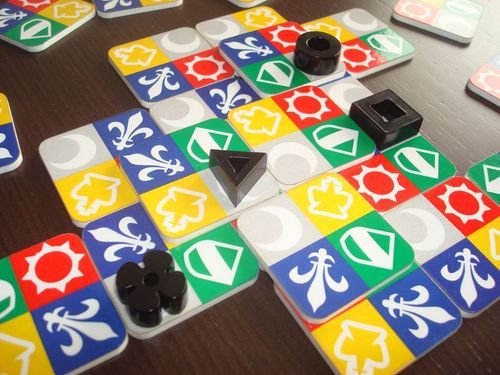
Pilus
Pilus Rulebook
Table of Contents
Table of Contents
Material
- 30 tiles
- 4 pawns
- Carrying case
Game Set-Up
Shuffle the tiles and place them into several face-down stacks to the side. Take a random tile from the top of a stack and place it face-up in the middle of the table as the starting tile. Each player takes his pawn, for now placing it on the table in front of himself. Then each player draws 3 tiles from the top of the stacks, forming the player's "hand", which is kept secret from the other players.
To ensure that each player gets an equal number of turns, remove a certain number of tiles from the game:
- For a 2 player game, remove 1 tile.
- For a 3 player game, remove 2 tiles.
- For a 4 player game, remove 1 tile.
Grab a pencil and paper to keep score.
Game Play
Choose a player to be the start player. The start player now takes his turn, followed by his left neighbor, and so forth, clockwise around the table. On each turn, a player does the following, in order:
- Plays a tile
- Moves his pawn (optional)
- Scores
Play a Tile (required)
The player chooses a tile from his hand and lays it down.
Tiles may be played to the table or on top of other tiles:
When playing to the table…
Tiles are placed next to other tiles, with at least one square of the new tile adjacent to a square of a tile already played. The new tile may be played next to any other tile(s), regardless of the height or colors of the tile(s).
When playing on top of other tiles…
The tile must be resting on at least two other tiles. The new tile may not simply be placed directly on top of another tile.
(Resting on only two squares! Not allowed.)
The tile may not be played unless 3 or 4 of its squares are resting directly on other tiles. A tile may not be resting on only one or two squares of lower tiles. In other words, it is allowed to have an empty space under your tile, but only one.
The tile may not be played on top of a square containing an opponent's pawn, or on any square protected by an opponent's pawn. (See PAWNS below).
For a tile played to the second level (on top of one level of tiles) at least one of its squares must be placed on top of a square of the same color. To play a tile to the 3rd level (on top of two layers of tiles) at least two of its squares must be above squares of the same colors. Three and four colors must match for the 4th and 5th level, respectively. (It is therefore not possible to place tiles to a 6th level.)
Another color-matching example
(**To place on two layers, two of the colors match. Grey matches and green matches, even though it's further down.)
Move Pawn (optional)
On his first turn, the player places his pawn on one of the 4 squares of the tile he just played.
On later turns, after placing a tile, the player may move his pawn to any square of the tile he just played, or to any square adjacent to the pawn's current location (not diagonal). Pawns may never move onto a region protected by another pawn (see PAWNS below).
Score
After playing a tile (and possibly moving his pawn), the player scores colored regions. Any group of two or more connected squares of a single color that include a square from the just-played tile is a "scoring region". Each scoring region will score 1 point for each square in the region if the tile was played on the table.
(The new tile created a blue region for 3 points, and a yellow region for 2 points.)
A region is worth 2 points per square if the tile was played to the 2nd level (one level up from the table). Score 3 points per square for the 3rd level, etc.
(The new tile on top created a yellow region and a grey region (5 total). The new tile is on the 3rd level, so the score is 5x3 = 15 pts.)
Pawns
A pawn protects the region it is standing in from opponents. If a player's pawn is standing in a region, the following rules apply:
- Other players may not cover any square of the region.
(The player with the triangle may not play here, since it would cover part of the blue region protected by the circle pawn.)
- If another player makes the region larger, it scores no points for them.
(The triangle player may play the tile here, and score 2 points for the grey region. However, the triangle player will score no points for the blue region, since it is protected by the circle pawn.)
NOTE: A player's actions are never affected by his own pawn. A player may even place a tile on the square where his pawn is -- he temporarily removes the pawn from the board while he places his tile, then replaces the pawn.
At the end of his turn, the player draws another tile.
End of the Game
When there are no more tiles to be drawn and all players have played the tiles in their hands, the game is over. The player with the most points wins.
Rules Clarifications
- If the tile you are placing only rests on 3 of its 4 squares, it is ok for one of your "matching colors" to be the one that is not resting on the next level down. That is, a square is considered to be matching the color below it, even if it is not directly below it – even if there is air between the two. (see the example marked ** on Page 2.)
- It is not legal to play a tile that would connect two regions which are each protected by a pawn.