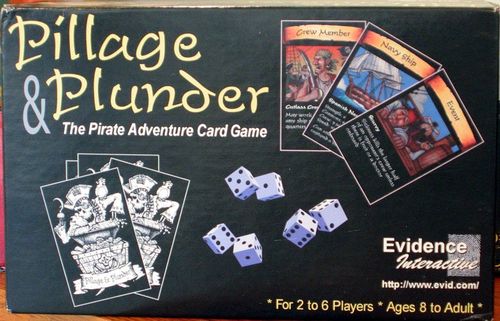
Pillage & Plunder
Pillage & Plunder Rulebook
Table of Contents
Table of Contents
Game Equipment
Pillage & Plunder includes the following game equipment:
Game Cards
There are twelve basic types of cards in the game and a total of 298 cards in the deck. The following is a brief description of the twelve basic card types:
Ship Hull
Ship Hull cards portray various types of ships that you can purchase.
Ship Add-On
Ship Add-On cards represent features that can be added to your ship to give it special advantages and abilities.
Cannon
Cannon cards are placed aboard your ship and are used in battle.
Crew Member
Crew Member cards depict various types of pirate crewmen and officers that can work and fight aboard your ship.
Cargo
Cargo cards represent commodities and supplies that can be bought, placed in your cargo hold, and later sold for profit.
Event
Event cards are played on your opponents and portray negative events that occur while at sea.
Repair Ship
Repair Ship cards allow you to quickly repair all of your ship's damage.
Treasure Hunt
Treasure Hunt cards allow you to search for buried treasure.
Bury Treasure
Bury Treasure cards are used to bury a portion of your wealth to help protect it from rival pirates.
Merchant Ship
Merchant Ship cards depict ships of various nationalities that you can attack for fun and profit.
Navy Ship
Navy Ship cards represent pirate-hunting military ships of various nationalities. They are played on opponents who have captured a merchant ship of that nationality.
Attack
Attack cards are used to attack other players.
Dice
There are a total of twelve dice in the game - six black and six white. The dice are used when you meet another ship in battle, in determining the outcome of certain events, and to determine the price at which cargo is bought and sold.
Coins
There are 200 coins, which represent pieces-of-eight. Gold coins are each worth 1000 pieces-of-eight, silver coins are worth 100, and copper coins are worth 50.
Damage Markers
The 25 small, red markers are used to represent damage to a ship. Each marker represents one unit of damage. These markers are placed on top of your Ship Hull card when your ship takes damage. They are also placed on top of Navy Ship and Merchant Ship cards when they take damage. Ships can be damaged in battle or by Event cards.
Player's Guide
The Pillage & Plunder Player's Guide which are you reading contains rules, strategy tips and optional variations for the game. For additional information about Pillage & Plunder, be sure to visit the Evidence Interactive web site at http://www.evid.com/
Game Setup
Before shuffling the cards, search through the deck and give the following set of cards to each player:
- 1 Sloop ship hull card
- 1 Cannon card
- 2 Cutlass Crewman cards
Players should arrange these cards in front of them, face up, as shown in figure one. The remaining cards should then be shuffled thoroughly.
Figure 1 - Each player starts with a set of these four cards
Each player receives 3,250 pieces-of-eight as follows:
- 2 gold coins (worth 1,000 each)
- 10 silver coins (worth 100 each)
- 5 copper coins (worth 50 each)
Each player is dealt five cards. These cards are held in the player's hand and may be looked at, but should not be shown to other players.
One card is dealt face up in the center of the table forming the beginning of the discard pile. The remaining cards are divided into two roughly equal stacks and placed face down in the middle of the table forming the draw piles.
Assuming you have a four-player game, your initial table set up would look something like the one shown in figure two.
Figure 2 - A typical table setup for a four-player game
Each player rolls one die and the player with the highest roll takes the first turn. Play continues in a clockwise direction.
Chapter II: Your Ship and Other Resources
Your Ship
The group of cards face-up in front of you represents your ship and the crew, cannons and cargo that it carries. Throughout the game you will play cards representing these items into four distinct rows, which are called your Hull Layout, Cannon Deck, Crew Quarters, and Cargo Hold.
Hull Layout
Your hull layout consists of your ship hull and any ship add-ons that you have installed on it. These are discussed below:
Ship Hull
There are four different types of ship hulls. Your Ship Hull card displays the basic characteristics of your current ship, which are, strength, speed, cannon capacity, crew capacity and repair cost. Each Ship Hull card also displays a level on it.
When you upgrade your ship to the next level, any ship add-ons that you have on your ship stay with the current ship hull and do not carry over to the new ship hull. When upgrading, you first pick up any ship add-on cards that are in your hull layout area and stack them on top of your current ship hull card. You then place the new ship hull card on top of this stack.
Your ship hull can become damaged by other ships and by events. The strength value shown on your ship hull card indicates the number of damage points required to destroy it. Damage points are represented by the small red markers, and are placed on top of your ship hull card when your ship receives damage. You cannot upgrade a damaged ship to the next level until all of its damage has been repaired. When the number of damage points on your ship's hull is greater than or equal to its strength value, your ship is destroyed. If this happens, your current Ship Hull card and any Ship Add-On cards associated with it are placed on the discard pile. If the ship you just lost was an upgrade to an existing ship, this action exposes whatever ship hull and ship add-ons you had prior to upgrading. If your last ship hull is destroyed, you are eliminated from the game.
Ship Add-On
There are four types of Ship Add-On cards, which enhance your ship's capabilities. Ship add-ons provide additional speed, strength, cargo space and visibility. You may only have one of each type of ship add-on installed on your ship at any one time.
Cannon Deck
Your cannon deck holds all of the cannons that you place aboard your ship. The maximum number of cannons that can be placed on your cannon deck is indicated on your Ship Hull card.
Crew Quarters
Your crew quarters provide space for the men who work aboard your ship. The maximum number of crewmen that can be housed in your crew quarters is indicated on your Ship Hull card.
Cargo Hold
Your cargo hold is where cargo is stored aboard your ship. The maximum number of cargo units that can be stored in your cargo hold is indicated on your ship hull card.
Treasure Maps and Prize Ships
In addition to the locations described above, you play cards in two additional piles known as your treasure maps area and your prize ships area, which are described below.
Treasure Maps
When you bury a portion of your wealth with a Bury Treasure card, the card is placed face up in your treasure maps area and the coins you buried are placed on top of it. You may bury as many treasure maps as you like.
Prize Ships
When you successfully capture a merchant vessel, the merchant vessel card is placed face up in your prize ships area. This indicates that the nation shown on the card considers you a pirate and your opponents may play a Navy Ship card of that nationality on you.
Your Hoard
The collection of coins carried aboard your ship is called your hoard. It is kept in front of you so that other players can see how much wealth you are carrying. Only the money in your hoard counts towards the total needed to win the game.
Chapter III: Taking Your Turn
The Basics
There are a number of important rules that affect what you can do during your turn. This section begins with the basic rules that apply to every turn. It then discusses all of the actions that can be taken during your turn and the rules that apply to those actions.
The Three Stages of Your Turn
Each of your turns consists of three stages, which are summarized briefly here. The actions that can occur during these stages are discussed in detail in the next section.
Stage 1: The pre-draw stage
This stage occurs before you draw any cards from the draw piles and only occurs when you want to sell cargo or retrieve treasure that you buried on a previous turn. Selling cargo and retrieving buried treasure can only be done during the pre-draw stage. You cannot perform one of these two actions if you have already drawn cards from the draw piles.
Note: Retrieving buried treasure is not the same thing as going on a treasure hunt, which is described later on.
Stage 2: The draw and play stage
After the pre-draw stage you draw as many cards as necessary to give you a total of eight cards in your hand. One of these cards may come from the top of the discard pile if you wish, and the rest come from either of the draw piles.
With eight cards in hand you must now play any two of them. Event, Attack, and Navy Ship cards are played on opponents. All other cards that you play affect yourself.
When playing a card on an opponent, the following rule must always be observed: You may only play one card on each opponent during any one turn. For example, during your turn you may play an Event card on one opponent and an Attack card on another opponent, but you may not play both cards on the same opponent.
If you cannot play a card or simply do not wish to do so, you must play one on the discard pile instead.
To end this stage, you play a final card face up on the discard pile. This will typically leave you with five cards in your hand although under some circumstances, which are explained later, you may be left with fewer than five.
In short, this stage of your turn typically goes like this: draw three cards, play two cards, discard one card. There are times however, when you may need to draw more than three cards as will be explained later.
Stage 3: The repair stage
After you have played your discard, all players have the opportunity to repair one of their ship's damage points by paying the repair cost indicated on their ship hull card. Any player wishing to perform these repairs may pay this money to the bank and then remove one damage marker from his ship. After all players have had the chance to perform these repairs, the next player's turn begins.
Note: During this repair stage you cannot use a Repair Ship card to repair your ship. Repair Ship cards can only be used during the second stage of your own turn.
"Working" – An Alternative For Desperate Pirates
On any turn, you can choose to "work on the docks" instead of playing stages one and two of your turn. This means that instead of performing the pre-draw actions, drawing or playing any cards, you simply receive 200 pieces-of-eight from the bank. After this, all players may perform repairs as they would at the end of any turn.
Working on the docks is a shameful thing for any self-respecting pirate to do, but it can help get you on your feet again when your hoard is running low.
Actions Performed During Your Turn
This section contains a complete description of all the possible actions that you can perform during each stage of your turn:
During the pre-draw stage
The following actions may only be performed during the pre-draw stage of your turn:
Sell Cargo
Cargo cards in your cargo hold may be sold to the bank. To do so, you declare which of your cards you will be trying to sell and then roll the number of dice indicated on the card. Use this roll to determine the cargo's selling price in accordance with the instructions on the card. You must then decide whether or not to sell the cargo to the bank for that price. If you choose to sell, place the Cargo card under the top card of the discard pile (so that the previous player's discard remains on top), take the appropriate amount of money from the bank and add it to your hoard. If desired, you may repeat this process for each of the cards in your cargo hold. You can only sell cargo during the pre-draw stage.
Retrieve Buried Treasure
A treasure that you have buried on a previous turn or stolen from another player may be retrieved during the pre-draw stage. To retrieve it, the Bury Treasure card that was used to originally bury the treasure is placed on the discard pile beneath the top card (so that the previous player's discard remains on top) and the buried coins are returned to your hoard. You may retrieve as many of your buried treasures as you wish, but each treasure that you retrieve must be retrieved in its entirety. You may not simply retrieve a portion of a buried treasure. Buried treasure can only be retrieved during the pre-draw stage of your turn.
During the draw-and-play stage
The following actions may only be performed during the draw-and-play stage of your turn:
Buy Ship Add-On
There are four types of Ship Add-On cards that can enhance your ship's abilities. The cost of these ship add-ons is always a percentage of the hull cost indicated on your current Ship Hull card. You buy a ship add-on by placing it in your Hull Layout and paying its cost to the bank. You may only have one of each type of ship add-on installed on your ship at any one time. Ship add-ons are permanently attached to the ship hull that they are installed on. They do not carry over when you upgrade your ship hull to a higher level.
Buy Ship
If you have a Ship Hull card in your hand that is exactly one level higher than the level of your current ship, you may upgrade your ship to the next level. The cost for doing so is indicated next to the word "cost" on the new Ship Hull card, and the money is paid to the bank. You may not upgrade a ship that is damaged – it must be repaired first. Any ship add-ons attached to your current ship are not carried over to the new ship. Instead, they are stacked on top of your current Ship Hull card and the new Ship Hull card is then stacked on top of this pile.
Buy Cannon
You may play a Cannon card from your hand onto your cannon deck as long as you have enough room for it. The cost of the cannon is paid to the bank. The maximum number of cannons that your ship can carry is indicated on your Ship Hull card. Keep in mind that for a cannon to be used in battle, there must be a crew member to fire it.
Hire Crew Member
If you have enough room aboard your ship, you may play a Crew Member card from your hand and place it in your crew quarters. The maximum number of crew members that your ship can hold is indicated on your Ship Hull card. The cost indicated on the Crew Member card must be paid to the bank. There are two basic types of crew members: Cutlass Crewmen and Pistol Crewmen. Pistol crewmen cost a bit more than cutlass crewmen, but having one aboard your ship will give you an advantage when in battle with a ship that does not have any pistol crewmen on board. There are also fives types of ship's officers. Officers fight as cutlass crewmen in battle but are considerably more expensive because they have characteristics that give you special advantages. The five types of ship's officers are Navigator, Quartermaster, Doctor, Cartographer and Master Gunner. You may only have one of each type of ship's officer aboard your ship at any one time.
Buy Cargo
You can buy cargo and place it aboard your ship if there is enough room in your cargo hold. The maximum number of cargo units that you can hold aboard your ship is indicated on your Ship Hull card. Cargo placed in your cargo hold can be sold at the beginning of a future turn – often at a substantial profit.
Fruit and Rum are important types of cargo that you should always keep onboard if possible. They prevent other players from playing Scurvy and Mutiny event cards on you, respectively.
To buy cargo, you first lay a Cargo card from your hand on the table and roll the number of dice indicated on the card. The price of buying the cargo is based on the dice roll according to the instructions on the card. After the buying price is determined, you may choose to either pay that amount to the bank and place the cargo in your cargo hold, or turn down the offer and place the card on top of the discard pile.
Play Event Card
You may play an Event card from your hand on an opponent by simply laying it down in front of him. He must then follow the instructions on the card.
Some Event cards cause your opponent to lose crew members. If you play one of these, it is your opponent who gets to decide which crew members he loses.
It's important to note that some Event cards will only affect your opponent if he has certain items aboard his ship, and other Event cards will affect the player unless he has certain items onboard. For example, a Scurvy card will not affect an opponent if he has a Doctor onboard or Fruit in his cargo hold. A Shipwreck card will not affect an opponent if he has a Navigator onboard. A Thieves Onboard card will not affect a player unless he has gems in his cargo hold and at least two crew members onboard. Be sure to read the card completely before you play it.
Event cards are placed on top of the discard pile after your opponent has followed the instructions on the card. If an Event card causes your opponent to lose his next turn, it is customary for him to leave the card in front of him until his next turn as a reminder that his turn should be skipped. Afterwards, the card is placed under the top card on the discard pile, so that the last player's discard remains on top.
Note: Remember that you cannot play an Event card on someone if you have already played an Event, Attack, or Navy Ship card on them during that turn.
Attack Opponent
Playing an Attack card allows you to attack an opponent of your choice. See the Battles at Sea section of this guide for complete information about battling other ships.
Note: Remember that you cannot play an Attack card on someone if you have already played an Event, Attack, or Navy Ship card on them during that turn.
Attack Merchant Ship
Merchant Ship cards represent commercial trading ships that you encounter while at sea. There are several merchant ships of varying strength for each of the four European nations represented in the game. Playing a Merchant Ship card allows you to attempt an attack on the merchant, which is described in the Battles At Sea chapter of this guide.
When playing a Merchant Ship card, you may also play any number of Cargo cards from your hand along with it. These Cargo cards represent additional goods being carried by the merchant, and will provide you an even bigger prize if you capture the ship successfully. This is the one time that you may end up playing more than two cards during the second stage of your turn. A Cargo card played on a merchant vessel does not count as one of the two cards that you must play during your turn, and on your next turn you will need to draw extra cards to return your hand to eight cards.
Although it is a highly profitable undertaking, attacking a merchant ship can be a risky. By successfully capturing a merchant, you become wanted as a pirate by the nation whose flag the merchant ship sailed under, and your opponents will be able to play that nation's Navy Ship cards on you.
See the Battles at Sea chapter of this guide for complete information about battling other ships.
Play Navy Ship
You may play a Navy Ship card on any opponent that has a Merchant Ship card of the navy vessel's nationality in their prize ships area. The navy ship will carry out an attack on that player as described in the Battles at Sea chapter of this guide and you get to watch the fun.
Note: Remember that you cannot play a Navy Ship card on someone if you have already played an Event, Attack, or Navy Ship card on them during that turn.
Repair Ship
Playing a Repair Ship card allows you to completely repair all of your ship's damage. Some Repair Ship cards will repair all of your ship's damage at no cost, while other Repair Ship cards do so at a cost of 25% of the hull cost displayed on your Ship Hull card. After playing the Repair Ship card, all of the damage markers on your ship's hull are immediately removed and the Repair Ship card is placed on the top of the discard pile.
Bury Treasure
You may bury any amount of the treasure in your hoard by playing a Bury Treasure card from your hand. Buried treasure cannot easily be taken from you and is generally safer than the money kept in your hoard.
To bury treasure, place the Bury Treasure card face up in front of you in your treasure maps area and place the coins you wish to bury on top of it.
Note: Remember that you may only retrieve a buried treasure during the pre-draw stage of a future turn and when doing so, the entire treasure must be retrieved.
Treasure Hunt
A Treasure Hunt card represents a map leading to a buried treasure of unknown value. When you play a Treasure Hunt card, you have the opportunity to go on a search for it. After laying the card in front of you, roll one die and do the following:
If you roll a 1 - 4: You receive 1000 x your roll in pieces of eight from the bank, which is added to your hoard.
If you roll a 5: Your hunting party returns empty handed.
If you roll a 6: Your hunting party becomes lost while looking for the treasure and you lose your next turn.
After the hunt, place the Treasure Hunt card on the discard pile. If you rolled a six, it is customary to leave the card in front of you until your next turn as a reminder that your turn should be skipped.
Chapter IV: Battles at Sea
Sea Battle Basics
When two ships meet in battle, a flurry of activity takes place. The rules of battle vary slightly depending on whether the battle is the result of an Attack card, Merchant Ship card or Navy Ship card. Dice are used to determine the outcome of each of several rounds of fighting during a battle. The object of a sea battle is to destroy another ship, force it to surrender, or kill all of its crewmen so that you can plunder it.
Since there are three different ways that a battle can occur, the rules that apply all three types of battles will be discussed first. The specific rules for each type of battle will follow in the next section.
The Five Stages Of A Sea Battle
There are five stages to a sea battle, but not all five stages will be played out if one of the ships is destroyed, surrenders, escapes, or loses all of its crew. These five stages are described below:
Stage 1: Spotting the Enemy
If one of the ships has a Crow's Nest ship add-on and the other does not, the ship with the crow's nest has a special advantage - it sees the enemy ship first and can fire a preliminary cannon shot before the enemy has a chance to flee or shoot back. The enemy ship automatically receives one unit of damage (represented by a damage marker being placed on their Ship Hull card).
Because hull damage reduces a ship's speed, this makes it much easier for a ship with a crow's nest to chase or run away from ships that would otherwise be faster than it. It also makes the enemy ship easier to sink during the cannon round.
The ship with the crow's nest must have at least one crew member and one cannon on board to be able to do this. If both ships have a crow's nest, neither ship receives this advantage.
Stage 2: Fight or Flee
At the beginning of the second stage, the defending ship may attempt to flee. If the defending ship chooses to attempt to flee, the speeds of the two ships are determined and compared as follows:
- Each ship's base speed is determined from the value shown on the player's Ship Hull card if the ship belongs to a player, or on the Merchant Ship card or Navy Ship card if the ship is a merchant or navy vessel.
- The speed of each ship with an Extra Sail ship add-on increases by one.
- Each ship's speed is decreased by one for each unit of damage the ship has.
If the defending ship is faster
The attacking player rolls two dice. If the attacker rolls doubles, the battle continues to the next stage. Otherwise, the defending ship escapes and the battle is over.
If the attacking ship is faster
The defending player rolls two dice. If the defender rolls doubles, his ship escapes and the attack is over. Otherwise, the attack continues to the next stage.
If both ships are the same speed
Each player rolls one die. If the defending player's roll is higher, his ship escapes and the battle is over. If the attacking player's roll is higher, the attack continues to the next stage. If both players roll the same, this step is repeated.
Stage 3: The Cannon Battle
The two ships now engage in a cannon battle. The object of the cannon battle is to try to sink the enemy ship by damaging it with cannon fire. First, the number of cannons that each ship may fire is determined. Each cannon on a ship may be used in battle if and only if there is a crew member onboard to fire it. This means that a player with four cannons and two crewmen onboard may only use two of his cannons in a battle. The one exception to this is if a player has a Master Gunner crew member card in his crew quarters, because the master gunner has the ability to fire all of the cannons on the cannon deck without the assistance of other crewmen.
Next, each player rolls one die for each cannon that they can use in the battle, up to a maximum of 6 dice. Each player's dice are arranged from highest to lowest and are compared. The results of the battle are determined as follows:
- Both players compare their highest die.
- The player whose die is the lower of the two receives one unit of damage to his ship. A damage marker is placed on their Ship Hull card (or the Merchant Ship or Navy Ship card if the ship is a merchant or navy vessel).
- If the number of damage points on either ship is greater than or equal to its strength value shown on that ship's hull, that ship is destroyed. The battle ends and game play proceeds to stage 5 explained below.
- The two dice that were just compared are set aside and this process continues until all the dice that were rolled have been compared.
If one player rolls more dice than the other and therefore has no opposing die to compare his to, his die is higher by default.
During the cannon battle, if either ship has the Iron Hull Plating ship add-on card installed on its hull, that ship gains an important strength advantage - up to two damage markers may be placed on top of the hull plating instead of on the ship itself. Damage markers on a ship's iron plating do not count as damage to the ship, and are automatically removed immediately when the battle is over. For example, suppose a ship that has a strength rating of five and an Iron Hull Plating add-on receives six cannon hits during a cannon battle. Two damage markers would be placed on the hull plating and four on the player's Ship Hull card. The two markers on the hull plating would not be considered damage and would be removed immediately after the battle.
Stage 4: The Mêlée
If neither ship is destroyed during the cannon battle, the attacking ship's crewmen begin boarding the enemy vessel and a battle of cutlasses and pistols begins. The object of the mêlée round is to kill all of an opponent's crewmen.
In the mêlée stage, there can be several rounds of fighting. Each round proceeds as follows:
- Each player rolls one die for every crew member aboard his ship, up to a maximum of six dice.
- Each player compares his highest die to the highest die of his opponent, and the rest of the dice are set aside.
- If either player has at least one pistol crewman in his crew quarters, his die is increased by one.
- The player whose die is lowest loses a crewman. He must select one crew member card from his crew quarters and place it on the discard pile. If both dice are equal, the attacker is the one that loses the round and the crewman.
This process is repeated until one of the ships loses its last crew member, the attack is called off, or the defender surrenders.
During the mêlée stage, a player with a Doctor crew member card in his crew quarters has an important defensive advantage - the doctor may save one crew member that would have otherwise been lost. The doctor may only do this once during a given sea battle.
Stage 5: Plundering the Enemy Ship
When one player wins a sea battle, either by destroying the enemy ship or killing all of the enemy's crewmen, he is allowed to plunder the enemy ship. The process of plundering varies depending on the type of ships involved in the battle, and is described in the next section.
Rules For Specific Types Of Battles
As stated earlier, sea battles differ slightly depending on the type of ships involved. This section discusses some of these differences.
Player Attacking Player
When one player attacks another player, the following additional rules apply during the sea battle:
- The attacker may call off the battle at the beginning of any stage of the battle or at the beginning of any round of the mêlée stage.
- At the beginning of any stage of the battle or at the beginning of any round of the mêlée stage, terms of surrender may be negotiated. In exchange for calling off the battle, the defender can offer to give the attacker any combination of coins, treasure maps, cargo, crew and cannons. If the attacker and defender agree on these terms, the exchange takes place and the battle ends.
- If either player loses the battle by having their ship destroyed, the victorious player is entitled to half of the defeated player's hoard and all of the cargo that can fit in his cargo hold. The victorious player is also entitled to any crewmen or cannons that can no longer fit on the defeated player's ship (the result of the defeated player's next remaining ship not being able to hold as many cannons or crew members as the one that was destroyed), provided there is room for them on the victorious player's ship. If there is no room for any remaining cargo, crewmen or cannons on either player's ship, they are placed on the discard pile.
- If either player loses the battle by losing all of their crew members, the victorious player is entitled to half of the defeated player's hoard and all of the cargo that can fit in his cargo hold.
- If the defeated player has any treasure maps aboard his ship, the victorious player may attempt to steal them by rolling two dice and getting doubles. If successful, the treasure map is taken from the losing player and given to his opponent. This process may be repeated for each treasure map that the defeated player has, but the victorious player must declare which treasure map he is attempting to steal before each roll of the dice. A stolen treasure map may only be retrieved during the pre-draw stage of a future turn – just as if the player had buried it himself.
- If the defeated player is eliminated from the game during the battle as a result of having his last ship destroyed, the victorious player is entitled to all of the coins, crewmen, cannons, and cargo left behind by the defeated player, providing the victorious player has room for them on his ship. If there is no room for any remaining cargo, crewmen or cannons on the victorious player's ship, they are placed on the discard pile. Any treasure maps left by a player that has been eliminated from the game must be successfully stolen by rolling doubles or they are lost forever.
Player Attacking Merchant Ship
When you attack a merchant ship, the following additional rules apply during the sea battle:
- You should ask another player to roll the dice on behalf of the merchant ship. (If any players have been eliminated from the game, it is customary to give them the honor of rolling on behalf of the merchant ship if they desire).
- The attacker may call off the battle at the beginning of any stage of the battle or at the beginning of any round of the mêlée stage.
- The number of cannons and crew aboard the merchant vessel is indicated on the Merchant Ship card, as are its speed and strength. Damage markers are placed on the merchant ship when it receives damage. Care must be taken to keep track of the number of crew left on a merchant ship during battle.
- A merchant ship will always attempt to flee during the second stage of the battle.
- A merchant ship that escapes, destroys your ship, or kills all of your crew will not take any booty from you. Instead, it sails on to the next player who has the option of attacking the merchant ship. If that player wishes to attack it, he starts a new battle beginning at the first stage and the merchant begins the battle with whatever damage and crew loss it received from previous battles. This continues until the merchant ship is either destroyed or escapes from all of the players.
- If you defeat a merchant vessel by destroying it or killing all of its crew, follow the instructions on the merchant ship card and roll the dice to determine your prize. This prize money comes from the bank and is added to your hoard. The Merchant Ship card is then placed in your prize ships area.
Navy Ship Attacking Player
When a navy ship attacks you, the following additional rules apply during the sea battle:
- The opponent who played the Navy Ship card on you rolls the dice on behalf of the navy ship.
- The number of cannons and crew aboard the navy vessel are indicated on the Navy Ship card, as are its speed and strength. Damage markers are placed on the navy ship when it receives damage. Care must be taken to keep track of the number of crew left on a navy ship during battle. Remember that even though a navy ship has more than six crewmen on aboard, a maximum of six dice can be rolled during the mêlée stage for each player. Remember also that because the navy ship's crew consists exclusively of pistol crewmen, its highest die should always be increased by one during each mêlée round.
- A navy ship will never call off a battle or offer you terms for surrender.
- When a navy ship defeats you in battle, it does not take any booty from your ship. It is simply placed on the discard pile.
- Regardless of whether you win, lose, or escape from a battle with a navy ship, you may place one Merchant Ship card of the navy ship's nationality from your prize ships area on the discard pile when the battle is over.
Sample Battle Walk-Throughs
The following examples illustrate the process of battling other ships at sea.
Example 1: Player Vs. Player
During your turn, you play an Attack card on your opponent whose name is Stephanie. Your ships consist of the following:
Figure 3 - The contents of the two ships in this example. Your ship is on the left, your opponent's is on the right.
Stephanie's ship has a speed of six and your ship has a speed of seven. Stephanie has a chance to flee, but because her ship is slower she must roll doubles to do so. She rolls two dice but does not roll doubles and the battle continues to the next stage.
The cannon round begins. You have four cannons on your cannon deck and enough crewmen in your crew quarters to fire all of them. Stephanie also has four cannons, but can only fire three of them because she only has three crewmen onboard. You therefore roll four dice and Stephanie rolls three. Each of you arranges your dice in order from highest to lowest and they are compared as follows:
- Round 1: Defender's die is higher than attacker's. Attacker's ship receives one damage point.
- Round 2: Both players' dice are equal. Both ships receive one damage point.
- Round 3: Attacker's die is higher than defender's die. Defender's ship receives one damage point.
- Round 4: Attacker's die is uncontested. Defender's ship receives one damage point.
As a result, Stephanie's ship receives a total of three damage points and your ship receives one. Neither ship is destroyed and the battle progresses to the mêlée round.
Your four attacking crewmen board Stephanie's ship and mêlée with her three defending crewmen. You roll four dice and she rolls three.
Your highest die is a five and her highest is a four. As a result, one of her crewmen is killed in the mêlée. She selects one of the Crew Member cards from her crew quarters and places it on the discard pile.
You continue your attack and both of you roll again. This time you roll four dice and she rolls two.
Both of you roll a six as your highest die. However, because you have at least one pistol crewman onboard, your six becomes a seven and she loses another crewman.
The dice are rolled a third time – you roll four dice and she rolls one. This time, your highest die is a four and her highest is a five. Even though your pistol crewmen increase your high roll to a five, Stephanie, as the defender, has the advantage in a tie, and you lose a crew member.
Continuing your attack, you roll three dice and she rolls one. Your high die is a four and she rolls a two. Her last defending crewman has been killed and you win the battle.
After a glorious battle, you emerge victorious. You take half of the money in Stephanie's hoard and the rum from her cargo hold and place it aboard your ship.
Example 2: Player Vs. Merchant Ship
During his turn, Joe, who has a sloop, three crewmen, and three cannons, plays a Merchant Ship card with a strength rating of two, two cannons and three cutlass crewmen. Joe loads the merchant ship with 20 units of gems.
Joe's ship has a speed of five. The Merchant Ship card shows that it has a speed of five also. Mike, another player in the game, is asked to represent the merchant ship during the battle. Since both ships are the same speed, each player rolls one die to determine if the merchant ship is able to escape. Joe's roll is higher and the attack continues.
The cannon round begins. Both players roll three dice. The dice are arranged as follows:
- Round 1: Attacker's die is higher than defender's. Defending ship receives one damage point.
- Round 2: Attacker's die is higher than defender's. Defending ship receives one damage point.
- Round 3: Defending ship has already been destroyed so this die is irrelevant.
Joe has destroyed the merchant ship with his first two dice and his third dice does not even enter into the battle.
As a result, Joe takes the gems from the merchant ship and places them in his cargo hold. He then places the Merchant Ship card in his prize ships area and, following the instructions on the card, rolls one die to determine the amount of cash booty taken from the ship. He rolls a four and takes 4,000 pieces-of-eight from the bank.
Example 3: Navy Ship Vs. Player
On her turn, Stephanie plays a French Navy Ship card on Joe, who has previously defeated a French merchant ship and has the French Merchant Ship card in his prize ships area.
The attacking navy ship is much faster than Joe's defending schooner, but the schooner has a chance to escape if Joe rolls doubles.
Joe rolls two dice. Fortunately for him, he does in fact roll doubles. The navy ship's attack has failed and the Navy Ship card is placed on top of the discard pile. Joe has earned the respect of the French navy and places the French Merchant Ship card from his prize ships area on top of the discard pile. He is no longer wanted for piracy by the French.
Appendix
Strategy Tips
This section contains strategy tips that have been submitted by players. To view additional strategy tips, or submit one of your own, visit the Evidence Interactive web site at http://www.evid.com/.
Attack Merchants Instead Of Players
Generally speaking, it's more profitable to attack merchant ships than it is to attack other players. Merchants never have pistol crewman on board and in the early stages of the game are definitely the bigger prize. Use your attack cards wisely. Save your strength and crewmen for attacks on merchant ships and weak players with large hoards.
Sloops and Merchant Ships
Attacking a merchant ship while sailing in a sloop is extremely risky. If you capture it and someone plays a Navy Ship card on you while you're still sailing in a sloop, you'll have little chance of staying in the game. Besides, some merchant ships are quite capable of completely sinking a healthy sloop in the cannon round.
Crew Members
Crew member cards are arguably the most precious commodities in the game. Keep this in mind when picking your discard.
Rum and Fruit
If you value your crew, ALWAYS ALWAYS ALWAYS keep rum and fruit in your cargo hold. If you don't, you will soon have a mutiny or an outbreak of scurvy on your hands.
Baiting The Enemy
When you have a Navy Ship and Merchant Ship of the same nationality in your hand, you can try to bait other players into attacking the merchant so you can hit them with the navy. Play the merchant ship as your first play of the turn – even if it's too fast or strong for you to capture. When the merchant escapes or you call off the battle, it passes to the next player who gets a chance to attack it. Often a player will take heavy damage attacking the merchant, and if he does capture it, you can play the Navy Ship card on him as your second play and enjoy watching the navy make an easy target of him in his weakened state. This is a good way to deprive an opponent of his hard earned Galleon or Man O' War and return him to a smaller ship so that you can launch an attack of your own on him next turn.
This strategy works well with an attack card too. Although you can't play two cards on an opponent during a turn, there's nothing preventing you from using a fat, tempting merchant ship to bait an opponent into taking damage and then attacking him as your second play.
Game Variations
The following are optional rules and game variations that have been contributed by players. To view additional game variations, or submit one of your own, visit the Evidence Interactive web site at http://www.evid.com/.
Timed Game
When you're looking for a shorter game of Pillage & Plunder, simply set a time limit before starting. The winner is the player who has the most money in their hoard at the end of the pre-determined amount of time.
Asset Liquidation
When calculating how much a player is worth, factor in the face value of all of his assets: cannons, crewmen, ships and so on. This makes for a faster game and allows you to indulge in those must-have pirate toys without worrying so much about your bottom line or keeping as much cash onboard your ship.
Stealing Treasure Maps
When playing a treasure hunt card, your have the choice of either following the standard treasure hunt procedure or attempting to steal another player's treasure map. To steal a map, announce which player's map you are attempting to steal (and which treasure map, if they have more than one) and roll two dice. If you roll doubles, the treasure map becomes yours and you can retrieve it at the beginning of a future turn.
Privateering
Instead of playing a Navy Ship card on an opponent, you can lay it in front of yourself and announce that you are "privateering" for the country shown on the card. (Privateering was basically a "legalized" form of piracy, where one country granted you permission to attack the ships of its enemies at sea. Privateers who were captured were usually treated as prisoners of war instead of being hanged as pirates. In exchange, privateers were required to give a portion of their prize to the country for which they were privateering.) As a privateer, you can attack merchant ships of any country except the one that you are privateering for, and you cannot be attacked by navy ships. However, when you capture a merchant ship, only half of the prize money goes into your hoard. The other half is placed on top of your Navy Ship card and represents money you owe to your sponsoring country. When another player attacks you and defeats you in battle, they can attempt to steal the money that you owe to your sponsor in the same way that he would try to steal one of your treasure maps. During the pre-draw stage of any turn you can end your privateering career by paying all of the money that is on top of the Navy Ship card to the bank, and placing the Navy Ship card under the top card of the discard pile. Any prize ships you have remain with you, and you now become vulnerable to attacks from navy ships. You can only privateer for one country at a time.
Fleet Play
In fleet play, you buy additional ships instead of upgrading them. Each Ship Hull card that you play has its own ship add-ons, crew quarters, cannon deck, and cargo hold. Crewmen, cannons and cargo can be moved from ship to ship during the pre-draw stage, but not after you draw cards. Ship add-ons cannot be transferred between ships. Ship hulls and their add-ons can be sold to the bank for half their cost during the pre-draw stage, but not after you draw cards. Cannons and crewmen cannot be sold. Only one ship is used in a battle. When attacking, you must declare which ship you will be using in the battle before you begin the attack. When being attacked, your opponent has the choice of which ship they will attack. Each ship maintains its own hoard, which can be transferred from ship to ship during the pre-draw stage, but not after you draw cards. When buying items for a particular ship, only that ship's hoard can be used. Treasure maps and prize ships apply to the fleet as a whole and do not belong to any specific ship.
Card Frequency
The following table shows how many of each card is present in the deck, broken down by category.
- Ship Hull: Sloop 6; Schooner 12; Galleon 8; Man O' War 6
- Ship Add-On: Iron Hull Plating 3; Crow's Nest 3; Extra Cargo Hold 3; Extra Sail 8
- Cannon: Cannon 30
- Crew Member: Cutlass Crewman 30; Pistol Crewman 20; Quarter Master 2; Navigator 2; Doctor 2; Cartographer 2; Master Gunner 2
- Repair Ship: Repair at No Cost 4; Repair at 25% Cost 4
- Attack: Attack 15
- Navy Ship: French Navy 2; English Navy 2; Spanish Navy 2; Dutch Navy 2
- Cargo: Fruit – 10 Units 8, 20 Units 4, 40 Units 2; Rum – 10 Units 8, 20 Units 4, 40 Units 2; Gems – 10 Units 8, 20 Units 4, 40 Units 2; Spices – 10 Units 8, 20 Units 4, 40 Units 2
- Merchant Ship: French – Strength 2: 1, Strength 4: 3, Strength 6: 1; English – Strength 2: 1, Strength 4: 3, Strength 6: 1; Spanish – Strength 2: 1, Strength 4: 3, Strength 6: 1; Dutch – Strength 2: 1, Strength 4: 3, Strength 6: 1
- Treasure Hunt: Treasure Hunt 15
- Event: Rats in Cargo 2; Siren's Song 2; Mutiny 4; Scurvy 4; Stormy Seas 2; Shipwreck 2; Sea Monster 2; Thieves Onboard 2; Leaky Cargo Hold 2
- Bury Treasure: Bury Treasure 15
Total Cards: 298
Quick Reference
Steps during your turn
- Sell cargo (if desired)
- Retrieve buried treasure (if desired)
- Draw until you have eight cards
- Play two cards
- Discard one card
- Repair up to one unit of damage (all players)
OR
- Work (receive 200 pieces-of-eight from the bank)
- Repair up to one unit of damage (all players)
Steps during a sea battle
- Crow's nest advantage (if any)
- Flee / Chase
- Cannon Battle
- Mêlée rounds
- Plunder the losing vessel
- Steal treasure maps (if any)
Results of a sea battle (how to plunder)
- Player vs. Player
- Winner takes half of losing ship's hoard
- Winner takes all cargo from losing ship that he can hold
- Winner may attempt to steal treasure maps
- Player vs. Merchant (player wins)
- Player rolls dice to determine prize
- Player takes all cargo (if any) that he can hold
- Player places Merchant Ship card in his prize ships area
- Player vs. Merchant (merchant wins)
- Merchant sails to next player, who may attack it
- Navy vs. Player
- Player removes Merchant Ship card from his prize ships area