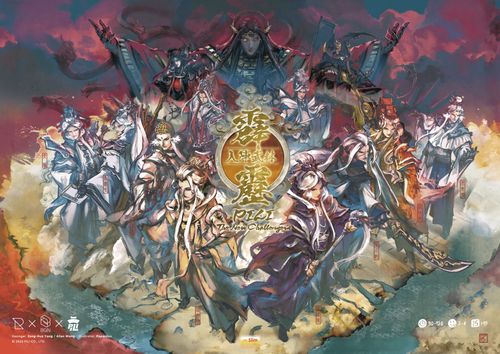
Pili: The New Challengers
Pili: The New Challengers Rulebook
Table of Contents
Table of Contents
- Ultimate Mode
- Story Phase Setup
- Starting Resources
- Story Phase Game Flow
- Forge Fate
- Recruit Heroes
- Gain Skills
- A Quick Note on Sacred Stone Tokens
- Upgrading Skill Cards
- Harness Qi
- Upgrading Skill Cards Reminder
- A Quick Note on Skill Cards
- Buy Equipment
- Challenge Foes
- A Quick Note on Hero Cards
- Qitiandi - The Strongest Foe
- Story Phase Scoring
- Battle Phase Setup
- Battle Phase Game Flow
- Special Effects
- Two-Player Rules for Ultimate Mode
- Other Modes of Play
- Advanced Rules - Factions
Ultimate Mode
Pili Legends has three modes of play: Story Mode, Battle Mode, and Ultimate Mode. Ultimate Mode combines elements from both Story Mode and Battle Mode, giving players the ultimate way to experience the game. Ultimate Mode is divided into two parts: the Story Phase and the Battle Phase. In the Story Phase, players start from nothing and build up their character's skills and abilities. In the Battle Phase, players will use everything they've gained in the Story Phase to fight in an epic battle to the death. The following game rules will explain Ultimate Mode for 3 to 4 players.
For a two-player game, refer to Two-Player Rules for Ultimate Mode on page 17.
Story Phase Setup
The following diagram is an example setup for a 4-player game.
Player Board Explanation (diagram labels: skill cards in training, mercenary hero cards, qi level section, fate tokens section, weapons section, story phase scoring, mastered skill cards, defeated foe cards, allied hero cards)
- Each player takes 1 player board and places it in front of them (story mode side up).
- Each player takes the 16 qi tokens in their player color and 1 sacred stone token, and then places all 17 tokens next to their player board.
- Randomly deal each player a starting skill card. Place this near the Training section of your player board. *Refer to Player Board Explanation on page 5.
- Place the equipment board in the center of the table.
- Place the 6 action cards face up in the center of the table.
- Find and remove the following heroes from the hero card deck: Shulou Longxiu, Jianzi Xianji, Fojian Fenshuo, and Wind's Scar. Find and remove the following skills from the skill card deck: River of the Red Dynasty, Heaven Splitting Sword Congregation, Punishment of the Buddha, and Demon Sword - Wind Scar. Return these 8 cards to the box.
- Find the Qitiandi card from the foe deck, the Light of God card from the skill card deck, and the four equipment tokens: Invincible War Dragon's Fist, Light of Hope, Deathkiller, and Godslayer Wheel. Place them together in the center of the table. (Refer to the diagram above.) *These cards will only be used in the Faction Advanced Rules. (Refer to page 22.)
Starting Resources
4-Player Game: Give 4 silver each to the first and second players, 5 silver and 1 fate token (roll one die to decide the color) to the third player, and 5 silver and 2 fate tokens (roll the dice to decide the colors) to the fourth player.
3-Player Game: Give 4 silver each to the first and second players. Give 5 silver and 1 fate token (roll one die to decide the color) to the third player.
Example (4-player game): the first player (Player A) receives 4 silver. The second player (Player B) receives 4 silver. The third player (Player C) rolls one die and receives 5 silver and one fate token in the color shown by the die. The fourth player (Player D) rolls two dice and then receives 5 silver and two fate tokens in the colors shown by the dice.
Story Phase Game Flow
Each round begins with the starting player; gameplay proceeds clockwise. For a 4-player game, the game will consist of 6 rounds. For a 3-player game, the game will consist of 7 rounds.
Round Flow:
- The starting player becomes the active player and chooses 1 action card. Beginning from the active player and going clockwise around the table, each player will execute the effect of the chosen action card. After all players have executed this action, flip the action card face down. Some action cards require spending resources to carry out. Players may choose to pass if they are unable or are unwilling to do so.
- The next player in clockwise order becomes the active player and chooses 1 face-up action card. All players, in clockwise order from the active player, execute the effect of the chosen action card.
- Repeat Step 2 until all players have been the active player and have chosen an action card.
- Place 1 silver on each face-up action card. Then, flip all action cards face up. Pass the starting player token clockwise; this new player will be the starting player of the next round. When the player chooses an action card with silver on it, they take all the silver on the card. There can be multiple silver banknotes on one action card.
There are 6 action cards to choose from, and when a player chooses one action, all the other players will either perform the action or choose to pass. The player who chooses the card performs the stronger effect, and all other players perform the weaker effect.
The following section of the rulebook explains the 6 different action cards: Forge Fate, Recruit Heroes, Gain Skills, Harness Qi, Buy Equipment, Challenge Foes.
Example (4-player game; Player A is the starting player): Player A chooses 1 face-up action card, then Player B, Player C, and Player D each choose 1 face-up action card in clockwise order. For each chosen action card, the effect is executed clockwise starting from the active player.
Forge Fate
In the world of martial arts, the fated protagonist always encounters various adventures to learn powerful skills. Forging fate is an indispensable part of becoming a legendary master. Players choose this action to gain more fate tokens, which are needed to gain skill cards. There are 6 different colors of fate.
The active player rolls all 5 Fate dice.
- Action player: Take all 5 fate tokens corresponding to the dice results.
- Other players: Take 2 of the 5 fate tokens corresponding to the dice results.
Gained fate tokens are taken from the general supply.
Fate tokens are unlimited. In the rare event that fate tokens run out, use any suitable substitute.
Example: Player A chooses the Forge Fate action and rolls the five Fate dice, then takes the five fate tokens matching the dice results from the supply. Player B then takes two of the fate tokens matching the dice results shown on the example. Player C and Player D each take two fate tokens matching their dice results.
Recruit Heroes
Players choose this action to recruit (gain) heroes; heroes are useful during the challenge foes action. (See page 11.) Heroes can be hired as mercenaries and be used only once (and then be permanently removed from the game).
However, Mercenary heroes can also ally with you if they're given specific gifts. Once Allied, the hero card moves from the Mercenary section of your player board to the Allied section. Allied heroes will not only stay with you for the rest of the story phase but will also aid you in the upcoming battle phase. Allied heroes will also award players victory points at the end of the Story Phase.
When taking the recruit heroes action, starting from the active player and going clockwise, each player chooses a face-up hero card from the center of the table and, at no cost, places it into the Mercenary section of their player board.
- Action player: Recruit 1 hero card, and after all other players have gained one, gain the last remaining hero card.
- Other players: Recruit 1 hero card.
* The hero combo effect is only used in the hero combo effect advanced rules. (See page 20). Ignore the hero combo effect in the story phase.
Hero card layout: hero name; ally requirements; technique; combat power; hero combo effect.
Example: Player B chooses the recruit heroes action. In the display are Yiyeshu, Qingyang Zi, King Jiwu, Diming, and Qi Luosheng. Player B chooses Yiyeshu. Players C, D, and A take Diming, Qi Luosheng, and Qingyang Zi respectively. After all other players have chosen, Player B takes King Jiwu, who is the last hero remaining in the display.
Do not replenish hero cards immediately after they are chosen by players. After all the hero cards in the display have been taken, replenish the display by drawing (player count + 1) cards face-up to form a new display.
Gain Skills
Players choose this action to use their fate tokens to gain skill cards. More powerful skill cards require more fate tokens. Skill cards are useful during the challenge foes action as well as the battle phase.
Starting from the active player and going clockwise, each player selects a skill card from the display and then must immediately pay the required fate tokens listed on the selected skill card to the supply; the skill card is then placed in the Training section of their player board. If a player does not have the required fate tokens, they cannot select that particular skill card. Players unwilling or unable to pay for any skill card may pass and have their turn skipped.
- Action player: Gain 1 skill card from the display or from the bottom 2 cards from the skill deck. Pay the fate cost. You may use any 2 fate tokens as 1 of your choice.
- Other players: Gain 1 skill card from the display. Pay the fate cost. You may use any 3 fate tokens as 1 of your choice.
* Players can trade in as many fate tokens as they like so long as they have enough fate tokens to trade in. * The active player should draw the bottom 2 cards from the skill deck first. Then, compare them with the cards in the display. Although 2 cards were drawn, those cards are not in the active player's hand. The active player only adds 1 skill card to the hand. * The 2 skill cards drawn by the active player are kept secret from other players.
When paying the fate cost of a skill card, you may use your sacred stone token as 2 fate tokens of any color.
Skill card layout: skill name; technique; combat power; victory points (VP); qi level requirement; fate cost. The [/] in the fate cost represents "or", so the player may pay either cost. The [+] represents "and", so both costs must be paid by the player. In the example, the player pays either 4 of one color, 4 of another color, or 4 of a third color.
Do not replenish skill cards immediately after they are chosen by players. After each player has gained a skill card or passed, remove all remaining skill cards (if any) from the game. Replenish the display by drawing (player count + 1) cards skill side face-up to form a new display.
Skills are divided into four techniques: palm, sword, knife, and mystical. They can be enhanced by weapons of the same type to strengthen combat power and defeat foes.
A Quick Note on Sacred Stone Tokens
Sacred stone tokens have 2 uses in the game. Once a sacred stone token has been used, it is immediately removed from the game.
- Used as any 2 fate tokens of any color during a gain skills action.
- Used as any 2 ally requirements when allying with a hero.
* There are 4 different kinds of ally requirements for heroes: wine, antiques, paintings, and musical instruments. Five heroes (specifically Ye Xiaochai, Shulou Longxiu, Jianzi Xianji, Fojian Fenshuo, and Wind's Scar) have a unique symbol meaning that any of the 4 requirements will satisfy.
Upgrading Skill Cards
At any point in the game, skill cards can immediately move from the Training section of the player board to the Mastered section if and only if the player has satisfied the qi level requirements depicted on the skill card. A player has satisfied the qi level requirements if their corresponding acupoints are equal to or higher than those depicted on the skill card. If a player gains a skill card they already have the qi level requirements for, the skill card is immediately moved from the Training section of the player board to the Mastered section. Players do not lose or consume any qi when moving a skill card from Training to Mastered.
In addition, at the end of the story phase, Mastered skill cards score 2.5 times more than skill cards in the Training section of the player boards.
Example: Player C chooses the gain skills action. There are a total of 5 skill cards in the display, including Heavenly Butterfly Slash, Roots of Heaven and Earth, Conflagration of Ninth Heaven, Qi Rally, and March of the Reaper. Player C is the active player and draws another 2 cards from the bottom of the deck: Sword of the Heart and Mourning Dragon Slash. Player C pays two fate tokens plus their sacred stone to obtain Mourning Dragon Slash. Player D then pays 1 fate token and their sacred stone, and trades 3 fate tokens for 1 fate token, to pay the cost for Qi Rally. Player A pays three fate tokens to gain Heavenly Butterfly Slash. Finally, Player B pays two fate tokens to gain Roots of Heaven and Earth. The remaining 3 skill cards are removed from the game and will not be seen again. Flip over a new 5 cards to form the new display.
Harness Qi
Players use this action to increase their qi levels in order to move skill cards from the Training section of their player boards to the Mastered section. Each player has 8 acupoints; each acupoint has a qi level. The higher your qi levels, the more skill cards you can master.
There are 8 acupoints: baihui (brain), yintang (forehead), danzhong (chest), dantian (abdomen), quchi (arm), shenmen (wrist), fengshi (thigh), and yongquan (foot). At the beginning of the game, all qi level values start from 0.
The active player who chooses this action draws 5 acupoint tokens from the draw bag.
- Action player: Increase the qi levels of all 5 corresponding acupoints by 1.
- Other players: Increase the qi levels of 2 out of the 5 corresponding acupoints by 1.
Return all acupoint tokens back to the bag after everyone has completed this action.
Each player should use the qi tokens on the acupoint locations of their player boards to keep track of their qi levels. The highest possible qi level is 4.
* Each player has 16 qi tokens. 8 tokens have qi levels 1 and 2; the other 8 tokens have qi levels 3 and 4.
The 10 acupoint tokens in the draw bag include 1 baihui, 1 yintang, 1 danzhong, 1 dantian, 1 quchi, 1 shenmen, 1 fengshi, 1 yongquan, and 2 tokens that increase the qi level of any of the 8 acupoint locations by 1 point.
* At the end of the story phase, players score VP if all 8 acupoints are of the same level or higher; the higher the collective level, the more VP scored.
Example: Player D chooses the harness qi action and draws the following tokens from the draw bag: baihui, dantian, quchi, yongquan, and a wild token. Player D uses the wild token as fengshi and increases their qi levels by 1 in the following acupoint locations: baihui, dantian, quchi, yongquan, and fengshi. At this point, the player's qi level match and exceed both their starting skill Aimless Punch as well as the previously acquired skill card Six Winged Slash. Player D moves both skill cards to the Mastered section. It is now the turn of players A, B, and C to choose 2 acupoints from the 5 drawn tokens and increase their qi.
Upgrading Skill Cards Reminder
At any point in the game, skill cards can immediately move from the Training section of the player board to the Mastered section if and only if the player has satisfied the qi level requirements depicted on the skill card. A player has satisfied the qi level requirements if their corresponding acupoints are equal to or higher than those depicted on the skill card. If a player gains a skill card they already have the qi level requirements for, the skill card is immediately moved from the Training section of the player board to the Mastered section.
Players do not lose or consume any qi when moving a skill card from Training to Mastered.
A Quick Note on Skill Cards
When taking the challenge foes action, players may use Mastered skill cards but cannot use skill cards in Training. Mastering skill cards is important. Not only are mastered skill cards worth higher victory points at the end of the story phase but mastered skill cards provide players with more flexibility during the upcoming battle phase.
Buy Equipment
Players choose this action to use their silver banknotes to buy equipment: weapons, relics, or gifts. Weapons increase combat power. Relics give you more fate tokens or raise your qi levels. Gifts help move hero cards from your Mercenary section (remove from the game after one fight) to your Allied section (permanently joining your party).
Starting from the active player and going clockwise, each player pays the silver cost stated on the equipment board and gains 1 equipment token. If a player is unable or unwilling to pay the required silver, they may choose to pass and have their turn skipped.
- Action player: Buy 1 equipment token. After all other players have taken their turn, you may buy 1 more equipment token.
- Other players: Buy 1 equipment token.
* Equipment in the left column costs 1 silver. Equipment in the middle column costs 3 silver. Equipment in the right column costs 6 silver.
Equipment tokens are limited and will never be refreshed during the game. Equipment is divided into 3 categories: weapons, relics, and gifts.
-
Weapons
Weapons tokens are divided into 4 techniques: palm, sword, knife, and mystical. Each icon on a weapon token equals 1 combat power. These correspond to and improve the same techniques as the player's skill cards. After the weapon is purchased, it will belong to the player for the rest of the game and will never be consumed or discarded. Weapons of the exact same type cannot be combined. For example, possessing 2 knives (with combat power 3) cannot be combined for a combat power of 6 but will remain as a combat power of 3. During a challenge foes action, if the player does not have a matching technique when fighting a foe, they may use a weapon on its own as though it were a skill card. (See Challenge Foes on page 11.)
At the end of the story phase, each icon on a weapon token is worth 4 victory points.
* In addition, weapons can also be used in the upcoming battle phase.
Example: The knife All Bark No Bite with the skill card Six Winged Slash can combine to a combat power of 6. However, the mystical weapon Storm Fan cannot be combined with the skill card Six Winged Slash because they are of different techniques. When taking a challenge foes action, the player may choose to use the knife for a combat power of 6 or use the mystical weapon for a combat power of 4.
Example: If a player has the two swords Prajna and Dragonspring Sword as well as the skill card Samsara of the Dust, the maximum combat power is 11 and not 13.
-
Relics
Relic tokens are divided into two types: qi and fate. After purchasing relic equipment tokens, they are immediately used and removed from the game.
Fate relics: Eight Trigram Mirror, Ancient Burning Furnace, Buddhist relics. Each fate icon on these tokens immediately gives the player 1 fate token in the color of their choice without the need to roll the fate dice.
Qi relics: Strength Potion, Elixir of Life, Pill of the Gods. Each qi icon on these tokens immediately increases the qi level by 1 point; the player may choose any acupoint location.
Example: Yuan Wuxiang's ally requirement is 3 wine icons. To ally with him, you may give him a Moutai Liquor (3 wine icons), or give him both a West Phoenix Wine (2 wine icons) and a Nuerhong Wine (1 wine icon) together.
Example: Ye Xiaochai's requirement is 5 mixed gifts. You may combine Han Guqin (3 gifts) with One Hundred Horses (1 gift) and Nuerhong Wine (1 gift) to fulfill his ally requirement.
Challenge Foes
On the path to becoming a legendary master, you will encounter enemies obstructing your way. Defeat them and transform them into nourishment for your growth. Players choose this action to challenge (fight) face-up foes in the display (located at the center of the table).
Starting from the active player and going clockwise, each player chooses a foe card in the display to challenge. Players may choose exactly 1 mastered skill, 1 weapon (that matches the technique), and any number of hero cards to add to their combat power.
* If a player cannot match a weapon in their possession with any mastered skill, they may use a weapon token on its own as though it were a skill card.
The total combat power needs to be equal to or higher than the chosen foe card to defeat it and gain the rewards. After challenging a foe, the player's skill cards and weapon tokens will not be removed from the game. Players cannot select a foe they cannot defeat. If a player is unable or unwilling to defeat a foe card, they may choose to pass and have their turn skipped.
- Action player: Challenge 1 foe card; gain temporary +3 combat power.
- Other players: Challenge 1 foe card.
Each foe has different weaknesses and immunities. If a player uses a technique that the foe is weak towards, the value of the player's combat power doubles (x2). If a player uses a technique that the foe is immune against, skills, weapons and heroes matching the technique have a combat power of zero.
* The hero Ye Xiaochai can choose either sword or knife technique when fighting foes but may not choose both. Because of this, Ye Xiaochai should always be able to evade a foe card's immunity.
After a foe card is successfully defeated, the player receives the rewards corresponding to the icons shown on the bottom of the foe card:
- Silver icon: gain the corresponding amount of silver.
- Qi icon: increase the corresponding qi levels equal to the number shown. You may choose any acupoint location.
- Fate icon: roll the corresponding number of fate dice and receive the corresponding fate tokens from the supply.
After receiving your rewards, place the foe card in the Fallen Foes section at the bottom of your player board. The card will be scored at the end of the story phase.
Do not replenish foe cards immediately after they are defeated. When all players have fought a foe card or passed, all remaining foe cards in the display are removed from the game. Flip (player count + 1) foe cards face up to replenish and form the new display.
A Quick Note on Hero Cards
During a challenge foes action, players may use any of their hero cards to fight a foe from the display. Mercenary heroes can be used but then are immediately removed from the game. However, Allied heroes are never removed from the game and will even be used in the upcoming battle phase.
Example: After a few rounds, Player A has learned the sword technique Samsara of the Dust (combat power 7), the knife technique Heavenly Butterfly Slash (combat power 5), and the starting skill Pointless Split (qi icon x1). Player A also possesses 2 weapons: Dragonspring Sword (combat power 2) and Silver Transformer (combat power 4). Player A also has 2 Mercenary heroes: Rahu (combat power 8) and Qingyang Zi (combat power 6). When it reaches Player A's turn, there are 3 foe cards left in the display: Twin Kayas (combat power 26; weakness: palm; immunity: knife), Grand Chancellor (combat power 22; weakness: sword; immunity: knife), and Baoyu Xinnu (combat power 9; weakness: knife; immunity: mystical).
First, Player A looks at Twin Kayas. Player A is unable to use Heavenly Butterfly Slash or Rahu because Twin Kayas is immune to knife techniques. Player A could use their Silver Transformer for 8 combat power (weak to palm) or combine their skill Samsara of the Dust with their weapon Dragonspring Sword for 9 combat power. However, no matter the combination, even with the addition of the hero Qingyang Zi, Twin Kayas cannot be defeated.
Next, Player A looks at the Grand Chancellor. Grand Chancellor is also immune to the knife technique, so Heavenly Butterfly Slash and Rahu cannot be used. However, because Grand Chancellor is weak towards sword techniques, Player A's sword skill Samsara of the Dust and weapon Dragonspring Sword could be combined for 18 combat power (9 x 2). In addition, the hero Qingyang Zi has 6 combat power and the combined total (24) is sufficient to defeat Grand Chancellor. However, because Qingyang Zi is currently a Mercenary, the hero card will be removed from the game after fighting Grand Chancellor.
Baoyu Xinnu can also be defeated by Player A using the knife skill Heavenly Butterfly Slash and without losing any hero cards (5 x 2 = 10). However, after comparing the rewards (2 silver, 1 qi, 1 fate versus 4 silver, 2 qi, 2 fate), Player A decides to defeat Grand Chancellor and remove Qingyang Zi from the game.
Qitiandi - The Strongest Foe
Combat Power: 40. Weakness: None. Immunity: None.
Qitiandi is the strongest foe in the Pili universe. He is available for players to fight from the beginning of the game. When taking a challenge foes action, any player may also choose to fight against Qitiandi instead of one of the foes in the display. The combat rules are the same as fighting any other foe.
After defeating Qitiandi, the player receives the following rewards:
Choose 1 of the 4 legendary (level IV) weapons Invincible War Dragon's Fist, Light of Hope, Deathkiller, or Godslayer Wheel, or choose the Light of God skill card.
- Qi icon x4: gain 4 qi levels to any acupoint locations.
- Fate icon x4: roll 4 fate dice and receive the 4 corresponding fate tokens.
* If "Qitiandi" is defeated successfully, it is placed in the Fallen Foes section together with the other foes and scored at the end of the story phase.
* The skill Light of God is classified as a God Technique. As it does not belong to the other 4 techniques, it avoids any immunity and also cannot be doubled when attacking foes. It can also be paired with any one weapon to increase its combat power.
Story Phase Scoring
For a 4-player game, the game ends after 6 rounds. For a 3-player game, the game ends after 7 rounds. At this point, use the following categories to score victory points (VP):
- Skill Cards: For each skill card obtained by the player, score the higher VP if the skill was Mastered, and score the lower VP if it was not.
- Foe Cards: Sum the total combat power of the defeated (fallen) foes by the player. Each point of combat power is worth 1VP.
- Hero Cards: Only score heroes in the Allied section. Each point of combat power is worth 3VP.
- Equipment Tokens: Every icon on a weapon token is worth 4VP.
- Qi Level: If all 8 acupoints are above level 1/2/3, the player gains 5/15/35VP respectively.
- Silver and Fate Tokens: Each silver and each fate token is worth 1VP.
* Leftover sacred stone tokens are worth zero victory points.
After calculating each player's total VP, note down each player's total score and rank them in order from highest to lowest.
If the story phase ends in a tie, the player with the most VP from skill cards is ranked higher. If it is still tied, the player with the most VP from foe cards is ranked higher. If it is still tied, the player with the most VP from silver and fate tokens is ranked higher. If it is still tied, the players toss a coin to decide who is ranked higher.
After a long arduous journey, the story phase concludes, and the battle phase begins! Players will form teams according to their rank and fight to the death!
Battle Phase Setup
Starting HP
Each player's starting HP is equal to half of their total VP from the story phase (rounded up). Then, add their ranking bonus as the table on the right.
* We suggest every player writes down their own starting HP on a piece of scrap paper or use the calculator application on their mobile devices.
| Ranking | 4-player game | 3-player game |
|---|---|---|
| 1st | +50 HP | +80 HP & choose 1 of the remaining legendary weapons |
| 2nd | +40 HP | no bonus |
| 3rd | +30 HP | no bonus |
| 4th | +20 HP | — |
Example: In a 4-player game, Player A scored 167VP in the story phase, ranking second. Their starting HP in the battle phase is 84 + 40 = 124 health points.
The following diagram is an example of a 4-player game.
(Use the diagram on page 13 to aid you in the following preparation steps.)
- Players keep all Mastered skill cards, all weapons, and all Allied hero cards. Players then flip their starting skill card to the rest side. All of these components are placed in front of them and all other non-kept components are returned to the box.
- Take out the battle map and place it in the center of the table.
- Each player flips their player board to the battle mode side. If necessary, rotate all player boards such that they face the same direction as the battle map.
- Give each player the player screen of their color and stand it up in front of their player board, covering it from the view of the other players.
- Each player takes the 2 player pawns in their color. They place 1 player pawn of their color on the hexagon closest to them on the battle map. The other player pawn is placed on their own player board in the corresponding position, as shown in the figure below.
- Flip all skill cards to the attack side (hereafter referred to as attack cards), and place these attack cards behind the player's screen. Place the hero cards and weapon tokens in front of the player screen as public information.
- Each player finds the corresponding hero tokens to their hero cards and places them in the same hexagon as their player pawn on the battle map.
* Ignore the Combo Effects on Hero cards, as they are only used for the Battle Mode Advanced Rules (see page 20).
The diagrams on page 14 show the battle map and player boards set up for a 4-player game (left) and a 3-player game (right).
Battle Phase Game Flow
Before the battle phase starts, recall the ranking from the story phase to form teams.
- In a 4-player game, the 1st and 4th players form one team, and the 2nd and 3rd players form the opposing team.
- In a 3-player game, the 2nd and 3rd players team up to fight against the 1st player.
All players in the Battle Phase will plan their actions at the same time. The action sequence of the Battle Phase is as follows:
-
Each player secretly chooses one attack card (or rest card) from their hand and plays it behind their screen. Some attacks have different special effects, which include: accelerate, shield, stun, slow, pierce, debilitate, bleed, reflect, teleport, precision, and backlash. For specifics, refer to Special Effects on page 17.
* The negative special effects slow, debilitate, bleed, and backlash will last until the end of the next round. Check if you were influenced by these negative special effects in the previous round.
-
Each player secretly moves their player pawn located behind their screen 0 to 2 spaces, then decides the direction their pawn is facing. (see the example on page 15.)
Example: Player A moves their pawn to the left 2 spaces and then changes the direction of their pawn.
* Special effects such as teleport, accelerate, or slow will modify the number of spaces a player can move. For example, if a player plays a skill with:
- teleport: the player can move to any space this round.
- accelerate: the player can move +1 space this round.
- slow: the opponent(s) hit by this attack move -1 space in the next round.
Player pawns have an attack direction, marked by the direction of the token's outstretched hand. The position of the hand needs to face one of the six sides of the hexagon and cannot face a corner.
-
Once all the players have decided their attack, count to 3, and remove all the player screens simultaneously. First, each player simultaneously moves their player pawn on the battle map to the space matching their player pawn on their player board. The attack direction of the player pawn on the battle map must also be the same as the one on their player board. After all pawns have been moved, each player checks to see if their opponents have been hit by the attack card they had just played and whether they have been hit by the opponents' attack cards as well. Hit players will lose HP equal to the damage value of the attack card. (Refer to Range and Damage Calculation below for more details.)
* After playing an attack card, no matter if it hits your opponent(s) or not, it cannot be reclaimed and must stay outside your screen until you play your rest card. When the Rest card is played, the player moves 0 to 2 spaces and takes back all played attack cards in front of their screen (including the rest card itself).
* Players on the same team cannot cause damage to each other. Hero tokens cannot take any damage by any player's attacks. Heroes cannot damage other heroes regardless of whom they're allied with.
* If a player makes an illegal move (for example, they can only move 2 spaces, but they moved their player pawn 3 spaces), the player's movement in this round is invalid and the player pawn remains in the same position from the previous round. If a player's pawn faces a corner of the hexagon, the damage from the player's attack will not be counted.
-
Check if a player's HP has been reduced to zero or lower. If so, that player will immediately remove their player pawn from the battle map as well as all hero tokens Allied to them.
-
All players may now openly move their hero tokens on the battle map 0 to 1 space. If after their movement, the hero tokens are in the same space as any enemy player pawn, the enemy player will receive damage equal to the combat number on the hero tokens.
* If the player is hit by an attack with a stun effect in this round, their heroes will be stunned and cannot move this turn.
* There is no fixed turn order for the movement of heroes; the sequence is to be decided by the players. However, players who prefer a stricter game may use the starting player token and rotate it every round to determine who can move their heroes first.
Range and Damage Calculation
All attack cards have different damage values and ranges. The direction of the player pawn maps onto the black arrow on the attack card. The yellow hexagons on the attack card are the range of the attack.
* In some cases, the attack range may go beyond the range of the Battle Map. This is permitted, and will not change the damage calculation in any way.
Each attack card has 5 damage values, presented in the sequence - / I / II / III / IV. This represents the damage values with different levels of matching weapons. Each point of damage reduces the opponent's HP by 1 point.
- No matching weapon: the damage value shown at "–".
- A matching level I weapon (2 icons): the damage value shown at "I".
- A matching level II weapon (3 icons): the damage value shown at "II".
- A matching level III weapon (4 icons): the damage value shown at "III".
- A matching legendary weapon (5 icons): the damage value shown at "IV".
If a player's weapon does not match any attack cards, that weapon is effectively useless in the battle phase.
* If a player has more than one of the same weapon type, they may only use the highest-leveled weapon for the attack.
Example: Player A has 2 weapons: Dragonspring Sword (sword) and Silver Transformer (palm). The damage calculation is as follows. For the attack card Heavenly Butterfly Slash (knife power 5), the player does not have a matching weapon, so the damage is 16. For the attack card Supreme Tao Technique (palm power 5), the damage is 27 as Silver Transformer is a Level III weapon. For the attack card Samsara of the Dust (sword power 7), the damage is 24 as Dragonspring Sword is a Level I weapon.
Special Effects
Some attacks have special effects.
- Accelerate: Move +1 space this round.
- Stun: Opponents hit by stun cannot move their hero tokens this round.
- Slow: Opponents hit by slow move -1 space in the next round.
- Shield: Reduce total damage taken this round by a set number. * Damage is reduced from the total damage taken this round, and not from each individual hit by player attacks and hero tokens.
- Pierce: Ignore all shield effects played by opponents this round.
- Reflect: Opponents who hit you this round lose 5 HP.
- Teleport: Move to any space this round.
- Debilitate: Opponents hit by debilitate cannot activate special effects in the next round. * The damage and the range of the attack card are not affected for the next round. In addition, debilitated cannot play "Light of God" in the next round.
- Bleed: Opponents hit by bleed lose 5 HP at the end of each round, starting from the next round. This effect will not trigger again (or stack) if the hit opponent already has this effect. * This effect only ends when the player with the bleed attack card leaves the battle map.
- Precision: This attack hits all hexagons and cannot be avoided.
- Backlash: The player who played backlash must play their rest card next round. In addition, they move -1 space in the next round. This card cannot be played in the first round.
Two-Player Rules for Ultimate Mode
To play Ultimate Mode for two players make the following changes to the 3-4 player game:
Story Phase Setup
Remove foe card Qitiandi, skill card Light of God, and weapon tokens Invincible War Dragon's Fist, Light of Hope, Deathkiller, and Godslayer Wheel from the game. The 1st player receives 4 silver, and the 2nd player receives 5 silver.
Story Phase Game Flow
In each round, players will alternate taking actions, taking a total of 2 actions each. There will be a total of 5 rounds. (see the example on the right)
Example: Players A and B are playing a 2-player game. In odd-numbered rounds, the active player turn sequence goes A → B → A → B. In even-numbered rounds, the active player turn sequence goes B → A → B → A.
Story Phase Scoring
No changes.
Battle Phase Setup
Each player's HP is half of the total VP from the story phase (rounded up). There are no ranking bonuses. The starting positions for the player pawns are opposite corners of the map, as shown in the diagram on the right.
Battle Phase Game Flow
No changes.
Other Modes of Play
In addition to Ultimate Mode, there are two other ways to play Pili Legends: Story Mode and Battle Mode. Story Mode focuses on the building up of a character's journey through the world of martial arts. This mode takes about 60-90 minutes depending on the number of players. Battle Mode speeds up the character-building portion of the game and jumps straight into the battle aspect of the game. This mode takes about 30-45 minutes depending on the number of players.
[Source gap: printed page 18 is absent from the source file. The "Other Modes of Play" text continues there and is not transcribed.]
Advanced Rules - Factions
For Ultimate Mode / Story Mode.
Faction cards can be used for both Ultimate Mode and Story Mode. In this ruleset, players aren't just starting from scratch but are disciples of one of the four different powerful factions: Ruist, Taoist, Buddhist, and Demon. Players will start with a starting skill, hero, and special power of their aligned faction, which turbocharges their journey through the Story Phase.
Story Phase Setup
Modify the Story Phase setup in the following ways, using the diagram:
- Randomly deal 1 of the following faction heroes to each player: Shulou Longxiu, Jianzi Xianji, Fojian Fenshuo, Wind's Scar. * In a 2- or 3-player game, return unused cards to the box.
- According to the faction dealt, players gain the corresponding faction power card and skill card:
- Wind's Scar: Demon + Demon Sword - Wind Scar
- Shulou Longxiu: Ruist + River of the Red Dynasty
- Fojian Fenshuo: Buddhist + Punishment of the Buddha
- Jianzi Xianji: Taoist + Heaven Splitting Sword Congregation
- Players can choose to play either side of their faction power card. Place both their faction power card (on the side that they choose) and their corresponding faction skill card face up next to their player board. They may only use this power for the rest of the game and may not flip it over.
- Place their starting skill card on the Mastered skill section, and gain 1 qi level from the corresponding acupoint location on the starting skill card.
Heroes and Their Corresponding Faction Skills
- Shulou Longxiu: Ruist faction, with the skill River of the Red Dynasty.
- Jianzi Xianji: Taoist faction, with the skill Heaven Splitting Sword Congregation.
- Fojian Fenshuo: Buddhist faction, with the skill Punishment of the Buddha.
- Wind's Scar: Demon faction, with the skill Demon Sword - Wind Scar.
The faction skill cards are labeled "Master 3 Skills" on the card face (see the diagram on page 22).
Story Phase Game Flow
Follow the base Ultimate/Story Mode rules with the following modifications:
- Use the faction power card whenever applicable to gain its benefits.
- The faction skill works differently than other skill cards. Upon Mastering (not acquiring) 3 skills (not counting the starting skill), move the faction skill card to either the Training or Mastered section according to their current qi levels.
- Similar to the super skill card Light of God, the 4 faction skills are considered to be neutral and do not belong to any of the 4 techniques. Therefore, when fighting foes (challenge foes action), the faction skill ignores immunities but also will not double against any weakness. It can be paired with any one weapon to increase its combat power.
- The faction heroes (Shulou Longxiu, Jianzi Xianji, Fojian Fenshuo, Wind's Scar) have a combat power of 8. Their combat power is also neutral and thus ignores immunities and weaknesses.
Faction Special Powers
Each faction has two special powers; players must choose one of the two sides to play. The side with the white font (with a dark background) is simpler to use, while the side with black font (with a bright background) is for more advanced players. Players can all choose different sides. After selecting a side, players may not flip the card for the rest of the game.
* We recommend that beginner players use the white font side, while veteran players use the black font side.
Ruist
- White font side: Starting from Round 2, gain 1 silver at the start of every round.
- Black font side: During the Buy Equipment action, get 1 silver back for each 3 silver that you spend. * This effect applies whether you are the active player or not.
Taoist
- White font side: Starting from Round 2, at the beginning of the round, draw 1 acupoint token from the draw bag and increase the corresponding acupoint by 1 qi level. Redraw if you draw the wild acupoint token (shown with the coin icon on the card).
- Black font side: During the Harness Qi action, you may decrease an acupoint's qi by 1 level to increase another acupoint's qi by 1 level. * This effect applies whether you are the active player or not.
Buddhist
- White font side: Starting from Round 2, roll 1 fate die and gain the corresponding fate token at the beginning of every round.
- Black font side: During the Forge Fate action, you may choose 1 side of the fate dice after the dice have been rolled. For each time this side appears as a result, you may take any fate token instead of the actual die result. * This effect applies whether you are the active player or not.
Demon
- White font side: Starting from Round 2, during the Challenge Foes action, you may choose one skill or one hero to ignore the foe's immunity.
- Black font side: During the Challenge Foes action, after all players have chosen a foe to fight, you may choose to additionally fight one of the remaining foes. However, you may only choose one of the three rewards, and the extra foe card will be removed from the game and not be scored. * Both effects apply whether you are the active player or not.